
No products in the cart.
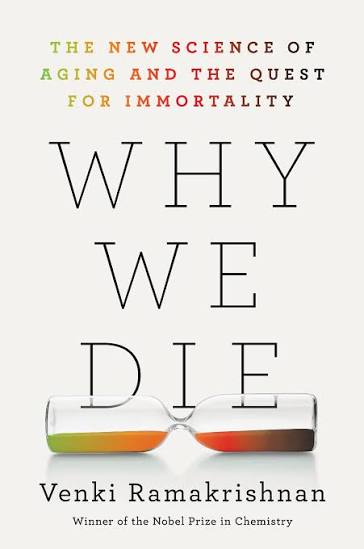


Why We Die by Venki Ramakrishnan

රු1,800.00
3 X Rs. 600.00 or 8% Cashback with


or 3 X රු600.00 with


or up to 4 X රු450.00 with


Why do we age—and could science help us live healthier for longer?
In Why We Die, Nobel Prize-winning biologist Venki Ramakrishnan explores the biology of ageing, genetics, cellular damage, longevity research and humanity’s search for longer life.
A fascinating and evidence-focused guide for readers interested in biology, ageing, biotechnology, longevity and popular science.
Author: Venki Ramakrishnan
Format: Paperback
Pages: 320
Genre: Popular Science / Biology / Longevity
3 in stock
Why We Die by Venki Ramakrishnan
Why Do We Age — And Can Science Help Us Live Longer?
Why We Die by Venki Ramakrishnan is an accessible exploration of one of humanity’s oldest questions:
Why do living things grow old and die?
Modern biology has made enormous progress in understanding ageing.
Scientists can now investigate what happens inside cells as organisms grow older, why some species live much longer than others, and whether biological processes associated with ageing can be slowed or altered.
But the science of longevity is also surrounded by enormous hype.
Claims about anti-ageing drugs, supplements, genetic engineering and radically extended human lifespans often move faster than the evidence.
Ramakrishnan approaches the subject as a working molecular biologist and Nobel Prize-winning scientist.
Rather than promising immortality, he examines what research can currently tell us, what remains uncertain, and what the consequences might be if humans eventually learn to substantially extend healthy life.
Hachette describes the book as an exploration of the science of ageing, the possibility of extending lifespan and the social questions that would follow if people began living much longer.
What Causes Ageing?
Ageing is not caused by one single biological mechanism.
Instead, scientists study several interconnected processes that gradually affect cells, tissues and organs.
The book explores areas such as:
- DNA damage
- Cellular repair
- Mitochondria
- Protein quality control
- Metabolism
- Stem cells
- Cellular senescence
- Inflammation
- Genetic regulation
- Evolution
Ramakrishnan explains how these systems interact and why ageing is much more complicated than simply finding one biological switch that can be turned off.
This makes Why We Die especially useful for readers who want to understand the science behind longevity research without relying on exaggerated promises.
Why Do Different Species Live for Different Lengths of Time?
One fascinating question in ageing research is why lifespans vary so dramatically across species.
Some animals live only briefly.
Others survive for decades or even centuries.
Scientists study these differences to understand whether long-lived organisms possess biological mechanisms that protect them from cellular damage, cancer or other age-related problems.
Ramakrishnan uses comparative biology to show how evolution can offer clues about ageing.
The goal is not simply to ask:
How can humans live longer?
It is also to understand:
Why did ageing evolve the way it did?
Evolution and Death
From an evolutionary perspective, living forever is not necessarily the goal of an organism.
Natural selection favours traits that help organisms survive and reproduce successfully.
Once reproduction has occurred, the evolutionary pressure to maintain perfect cellular repair may become weaker.
This creates an important distinction between:
what is good for an individual
and
what evolutionary processes select for across generations.
Ramakrishnan uses evolution to place ageing within a much larger biological framework.
Cellular Senescence
One important area of longevity research involves senescent cells.
These are cells that have stopped dividing but remain biologically active.
Senescence can sometimes protect the body—for example, by preventing damaged cells from multiplying uncontrollably.
But the accumulation of senescent cells with age may also contribute to inflammation and declining tissue function.
Scientists are therefore investigating whether removing or modifying some senescent cells could improve health during ageing.
However, this remains an active research area rather than a proven route to human immortality.
Can We Slow Ageing?
Scientists are investigating many possible approaches to extending healthy lifespan.
These include research into:
- Calorie restriction
- Metabolic pathways
- Senolytic drugs
- Genetic interventions
- Stem-cell biology
- Rapamycin
- Metformin
- Cellular reprogramming
But Ramakrishnan approaches these areas critically.
Results seen in yeast, worms, flies or mice cannot automatically be assumed to work in humans.
A treatment that affects lifespan in one organism may have very different consequences in another.
This cautious approach is one of the book’s strengths.
Lifespan vs Healthspan
Living longer is not necessarily valuable if those additional years are dominated by serious illness.
That is why scientists increasingly distinguish between:
Lifespan — how long a person lives.
and
Healthspan — how long a person remains relatively healthy and functional.
Why We Die examines the possibility that improving healthspan may be a more realistic and useful goal than pursuing extreme lifespan extension.
For most people, the important question may not be:
How can I live forever?
but:
How can humans remain healthier for a greater proportion of their lives?
The Longevity Industry
Ageing research has attracted enormous commercial interest.
Companies and investors are funding projects related to:
- Anti-ageing treatments
- Biotechnology
- Genetic engineering
- Cellular rejuvenation
- Longevity medicine
But commercial enthusiasm can sometimes create claims that move beyond established evidence.
Ramakrishnan examines longevity research with what Hachette describes as a critical, scientifically grounded perspective rather than treating every proposed intervention as a breakthrough.
Can Humans Become Immortal?
The possibility of immortality has fascinated people for thousands of years.
Modern biotechnology makes the question feel less purely philosophical than it once did.
But there is a huge difference between:
slowing certain mechanisms associated with ageing
and
making humans biologically immortal.
The book explores what science currently understands while remaining cautious about predictions of dramatic life extension.
What Happens If Humans Live Much Longer?
Longevity is not only a biological question.
It is also a social one.
If some people began living significantly longer, societies could face major questions involving:
- Population growth
- Retirement
- Employment
- Healthcare
- Wealth inequality
- Access to expensive treatments
- Generational change
- Political power
- Family structures
- Resource use
A longevity treatment available only to wealthy people could potentially increase existing inequality.
Ramakrishnan therefore examines not only whether life extension is scientifically possible, but also what its social consequences might be.
Major Topics
Biology of Ageing
Understand the biological processes associated with growing older.
Genetics
Explore how genes influence lifespan and cellular maintenance.
Evolution
Learn why ageing exists from an evolutionary perspective.
Longevity
Examine current research designed to extend healthy life.
Cellular Biology
Discover what happens inside cells as organisms age.
Biotechnology
Explore emerging scientific attempts to influence ageing.
Healthspan
Understand the difference between simply living longer and remaining healthy longer.
Ethics
Consider what extended human lifespans could mean for society.
Who Will Enjoy Why We Die?
This book may especially appeal to readers interested in:
- Biology
- Ageing
- Longevity
- Genetics
- Medicine
- Biotechnology
- Popular science
- Human lifespan
- Evolution
- Health science
- Scientific research
- Philosophy of life and death
Readers do not need to be professional scientists to appreciate the book.
It is written as popular science and aims to explain complex research to a general audience.
Awards & Recognition
Why We Die was shortlisted for the Royal Society Trivedi Science Book Prize 2024 and was highlighted by publications including The Sunday Times, New Scientist and the Financial Times.
About Venki Ramakrishnan
Venki Ramakrishnan is a molecular biologist known for his research into the structure and function of the ribosome.
He shared the 2009 Nobel Prize in Chemistry with Thomas A. Steitz and Ada E. Yonath for studies of the structure and function of the ribosome.
Ramakrishnan works at the MRC Laboratory of Molecular Biology in Cambridge and served as President of the Royal Society from 2015 to 2020.
His books include:
- Gene Machine
- Why We Die
For Sri Lankan readers interested in biology, ageing, longevity and the future of human health, Why We Die provides a scientifically grounded introduction to one of the most important areas of modern biological research.
Important Health & Science Note
Why We Die discusses experimental research into ageing and longevity.
The book should not be interpreted as medical advice or as evidence that any particular anti-ageing treatment, supplement or drug has been proven to extend human lifespan.
Research into many proposed longevity interventions remains ongoing.
Be the first to review “Why We Die by Venki Ramakrishnan”
Related products

Non-Fiction & Knowledge
රු2,300.00
3 X Rs. 766.67 or 8% Cashback with
or 3 X රු766.67 with
or up to 4 X රු575.00 with
-24%
Out of stock
Non-Fiction & Knowledge
Original price was: රු2,100.00.රු1,600.00Current price is: රු1,600.00.
3 X Rs. 533.33 or 8% Cashback with
or 3 X රු533.33 with
or up to 4 X රු400.00 with
Biography
රු2,100.00
3 X Rs. 700.00 or 8% Cashback with
or 3 X රු700.00 with
or up to 4 X රු525.00 with
Non-Fiction & Knowledge
රු1,400.00
3 X Rs. 466.67 or 8% Cashback with
or 3 X රු466.67 with
or up to 4 X රු350.00 with
-24%
Non-Fiction & Knowledge
Original price was: රු2,300.00.රු1,750.00Current price is: රු1,750.00.
3 X Rs. 583.33 or 8% Cashback with
or 3 X රු583.33 with
or up to 4 X රු437.50 with
රු2,100.00
3 X Rs. 700.00 or 8% Cashback with
or 3 X රු700.00 with
or up to 4 X රු525.00 with
-14%
Out of stock
Non-Fiction & Knowledge
Original price was: රු3,500.00.රු3,000.00Current price is: රු3,000.00.
3 X Rs. 1,000.00 or 8% Cashback with
or 3 X රු1,000.00 with
or up to 4 X රු750.00 with

Non-Fiction & Knowledge
රු1,950.00
3 X Rs. 650.00 or 8% Cashback with
or 3 X රු650.00 with
or up to 4 X රු487.50 with
Reviews
There are no reviews yet.