
No products in the cart.
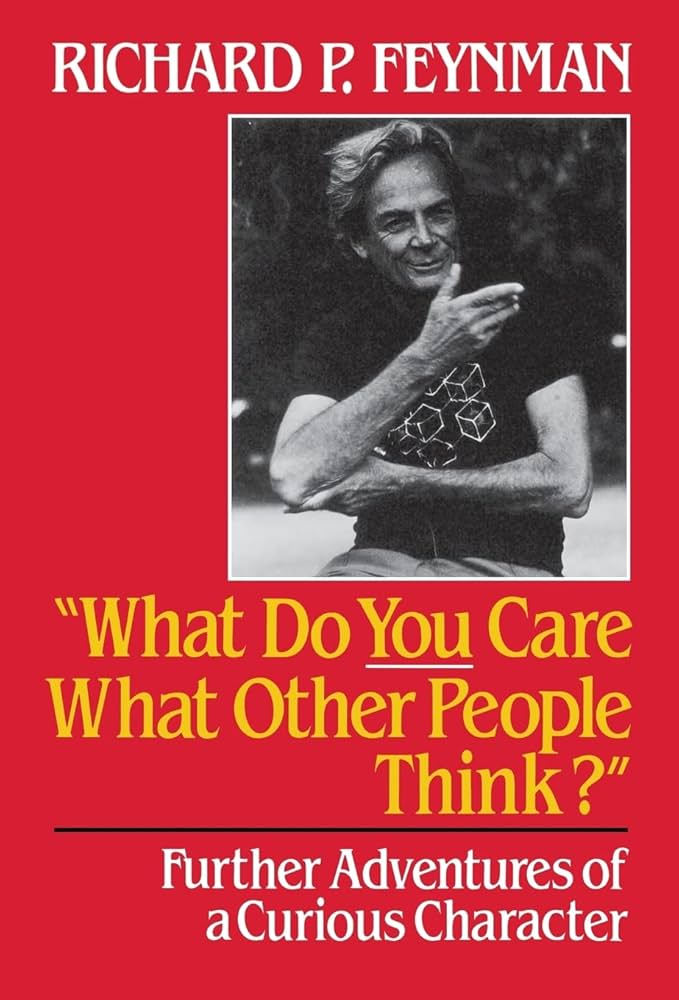
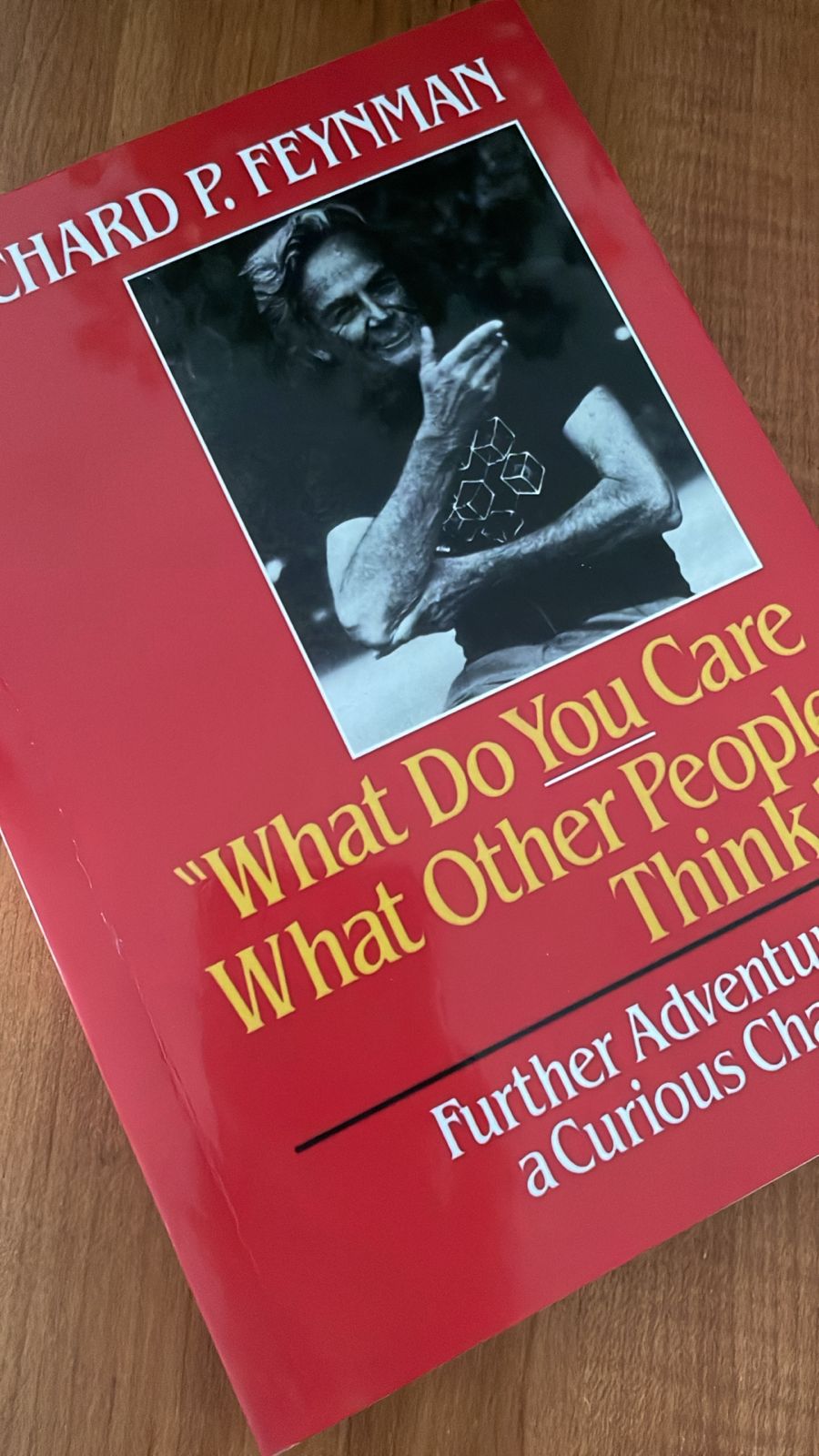







What Do You Care What Other People Think by Richard P. Feynman

රු1,950.00
3 X Rs. 650.00 or 8% Cashback with


or 3 X රු650.00 with


or up to 4 X රු487.50 with


Book Description
What Do You Care What Other People Think? is a collection of autobiographical stories that reveal Richard Feynman’s unique approach to science and life. The book includes personal experiences, humorous anecdotes, and his involvement in the Challenger disaster investigation, highlighting his curiosity, honesty, and independent thinking.
2 in stock
What Do You Care What Other People Think? by Richard P. Feynman
What Do You Care What Other People Think by Richard P. Feynman is a witty, moving, and thought-provoking collection of stories from the life of one of the twentieth century’s most famous physicists.
The book combines science, curiosity, love, humor, independent thinking, and personal reflection.
Feynman does not simply talk about physics.
He talks about how to think.
How to question assumptions.
And how to care less about unnecessary judgment from other people.
About What Do You Care What Other People Think?
What Do You Care What Other People Think is a collection of autobiographical stories and reflections by Richard P. Feynman.
The material was prepared with Ralph Leighton.
Some stories are funny.
Others are deeply personal.
The book covers Feynman’s childhood, education, marriage, scientific work, and his involvement in the investigation of the Space Shuttle Challenger disaster.
7 Brilliant Lessons from What Do You Care What Other People Think
1. Think for Yourself
One of the strongest ideas in What Do You Care What Other People Think is independent thinking.
Feynman dislikes accepting things simply because someone important says they are true.
He wants evidence.
He wants understanding.
He wants to see how something actually works.
This attitude shaped both his scientific career and his everyday life.
2. Curiosity Is Powerful
Feynman is curious about almost everything.
Science.
Art.
Machines.
People.
Language.
He constantly asks questions.
The book shows that curiosity is not limited to school or formal education.
It can become a way of living.
3. Do Not Be Afraid to Question Experts
Experts can be wrong.
Institutions can be wrong.
Official explanations can be incomplete.
Feynman repeatedly tests ideas for himself.
This becomes especially important during the Challenger investigation.
He looks for practical evidence instead of relying only on formal presentations.
4. Love Can Change a Person
One of the most emotional parts of the book is Feynman’s relationship with his first wife, Arlene.
Their story shows a different side of him.
It is tender.
Sad.
And deeply personal.
Their relationship becomes one of the most memorable parts of the book.
5. Simplicity Can Reveal the Truth
Feynman was famous for explaining difficult ideas clearly.
That same skill appears in the Challenger investigation.
Instead of making the problem unnecessarily complicated, he looks for a simple demonstration.
This becomes one of the book’s strongest examples of practical reasoning.
6. Reputation Is Not the Same as Truth
People often care about appearances.
Organizations care about reputation.
Individuals care about what others think.
Feynman repeatedly argues that truth matters more.
A respected institution can still make mistakes.
A confident person can still be wrong.
7. Life Should Be Explored
Feynman’s approach to life is playful.
He experiments.
He investigates.
He learns.
He refuses to limit himself to one identity.
That sense of exploration makes the memoir enjoyable even for readers who are not interested in physics.
The Meaning Behind the Title
The title What Do You Care What Other People Think? reflects one of Feynman’s central attitudes.
He believes people often waste energy worrying about judgment.
What will others think?
Will I look foolish?
Will people approve?
Feynman encourages a different approach.
Ask whether something is true.
Ask whether it matters.
Then make your own decision.
Richard Feynman and His Father
Feynman often credits his father with teaching him how to think.
His father encouraged questions.
He did not want Richard to memorize labels without understanding meaning.
This becomes an important lesson.
Knowing the name of something is not the same as understanding it.
That distinction shaped Feynman’s scientific thinking.
Feynman and Arlene
The story of Feynman’s first wife, Arlene, gives the book much of its emotional depth.
They fell in love when they were young.
Arlene later became seriously ill.
Feynman remained devoted to her.
Their relationship shows a deeply human side of a man usually remembered for science and humor.
Penguin highlights their relationship as one of the major stories in the collection.
The Challenger Disaster
One of the most important sections focuses on the 1986 Space Shuttle Challenger disaster.
Feynman served on the Rogers Commission investigating the accident.
He became frustrated with some of the formal procedures surrounding the investigation.
He wanted direct answers.
He wanted evidence.
He wanted to know what had physically failed.
The O-Ring Demonstration
Feynman’s most famous contribution to the Challenger investigation involved the shuttle’s rubber O-rings.
He demonstrated how cold temperatures affected the material.
The experiment was simple.
But it communicated the problem clearly.
This moment became one of the most famous examples of Feynman’s practical scientific style.
Science and Honesty
Feynman believed scientists must be extremely honest.
Not just with other people.
With themselves.
It is easy to look for evidence that supports what you already believe.
Good science requires the opposite.
You must actively search for ways your idea could be wrong.
This lesson applies far beyond laboratories.
Curiosity Over Status
Feynman never seems especially impressed by titles.
He is more interested in whether someone understands what they are talking about.
This makes his stories funny.
But it also reveals something important.
Status should not replace evidence.
Authority should not replace reasoning.
Learning by Understanding
The book repeatedly shows the difference between memorization and real understanding.
Feynman wants to know why something happens.
Not just what it is called.
This makes the book valuable for students.
Teachers.
Scientists.
And anyone who wants to become a better thinker.
Humor and Personality
Feynman was known for his playful personality.
That humor appears throughout the book.
He enjoys unusual problems.
He enjoys surprising people.
He enjoys finding simple explanations.
This keeps the memoir accessible.
You do not need a physics background to enjoy it.
Science Without Complicated Mathematics
Although Feynman was a brilliant physicist, this book is not a technical physics textbook.
Readers do not need advanced mathematics.
The emphasis is on stories.
Ideas.
Reasoning.
And personal experiences.
This makes it suitable for a much wider audience.
Who Should Read This Book?
What Do You Care What Other People Think is ideal for readers interested in science, biography, psychology, independent thinking, curiosity, and personal development.
It may especially appeal to students.
Teachers.
Engineers.
Scientists.
Entrepreneurs.
And anyone who enjoys unusual memoirs.
Readers who enjoyed Surely You’re Joking, Mr. Feynman! will likely appreciate this collection too.
About Richard P. Feynman
Richard P. Feynman was an American theoretical physicist.
He taught at Cornell University and later at Caltech.
He received the Nobel Prize in Physics in 1965.
He also served on the Rogers Commission investigating the Challenger disaster.
Readers can learn more through the official Penguin page for What Do You Care What Other People Think?.
Product Details
Title: What Do You Care What Other People Think?
Subtitle: Further Adventures of a Curious Character
Author: Richard P. Feynman
Contributor: Ralph Leighton
Genre: Memoir / Science / Biography / Personal Development
Language: English
Common Penguin Paperback Edition
Publisher: Penguin
ISBN-13: 9780141030883
Format: Paperback
Pages: 256
Publication Date: September 6, 2007
Dimensions: 198 × 128 × 17 mm
Weight: 198 g
Penguin confirms these specifications for the 2007 paperback edition.
Important Edition Note
The ebook carries a different ISBN.
Ebook ISBN: 9780141937588
Do not use that ISBN for the physical paperback.
The original U.S. edition was first published in 1988 by W. W. Norton.
Always check the barcode on your physical copy before entering the final WooCommerce details.
Explore More Biography and Science Books
What Do You Care What Other People Think is much more than a book about a famous scientist.
It is a book about curiosity.
Love.
Truth.
Independent thinking.
And the courage to question accepted ideas.
Feynman’s stories show that intelligence is not just knowing more facts.
It is being willing to ask better questions.
Readers can explore more Biography Books at Bargain Books.
You can also explore Non-Fiction & Knowledge Books at Bargain Books.
For readers who enjoy science, memoirs, curiosity, and unconventional thinking, What Do You Care What Other People Think is a brilliant and memorable read.
Be the first to review “What Do You Care What Other People Think by Richard P. Feynman”
Related products
-24%
Out of stock
Non-Fiction & Knowledge
Original price was: රු2,100.00.රු1,600.00Current price is: රු1,600.00.
3 X Rs. 533.33 or 8% Cashback with
or 3 X රු533.33 with
or up to 4 X රු400.00 with

Non-Fiction & Knowledge
රු1,550.00
3 X Rs. 516.67 or 8% Cashback with
or 3 X රු516.67 with
or up to 4 X රු387.50 with
-33%

Self-Help & Psychology
Original price was: රු2,300.00.රු1,550.00Current price is: රු1,550.00.
3 X Rs. 516.67 or 8% Cashback with
or 3 X රු516.67 with
or up to 4 X රු387.50 with
-23%

Non-Fiction & Knowledge
Original price was: රු2,200.00.රු1,700.00Current price is: රු1,700.00.
3 X Rs. 566.67 or 8% Cashback with
or 3 X රු566.67 with
or up to 4 X රු425.00 with
Out of stock
Non-Fiction & Knowledge
රු1,600.00
3 X Rs. 533.33 or 8% Cashback with
or 3 X රු533.33 with
or up to 4 X රු400.00 with

Out of stock
Autobiography
රු2,750.00
3 X Rs. 916.67 or 8% Cashback with
or 3 X රු916.67 with
or up to 4 X රු687.50 with
Non-Fiction & Knowledge
රු2,250.00
3 X Rs. 750.00 or 8% Cashback with
or 3 X රු750.00 with
or up to 4 X රු562.50 with
Non-Fiction & Knowledge
රු2,450.00
3 X Rs. 816.67 or 8% Cashback with
or 3 X රු816.67 with
or up to 4 X රු612.50 with
Reviews
There are no reviews yet.