
No products in the cart.
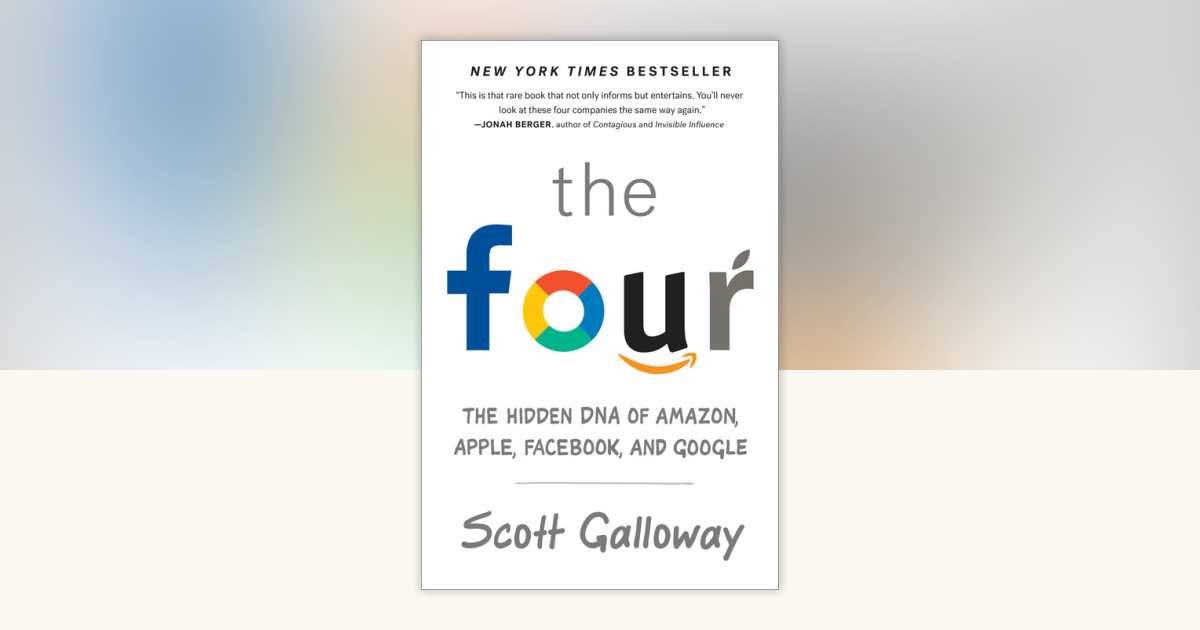
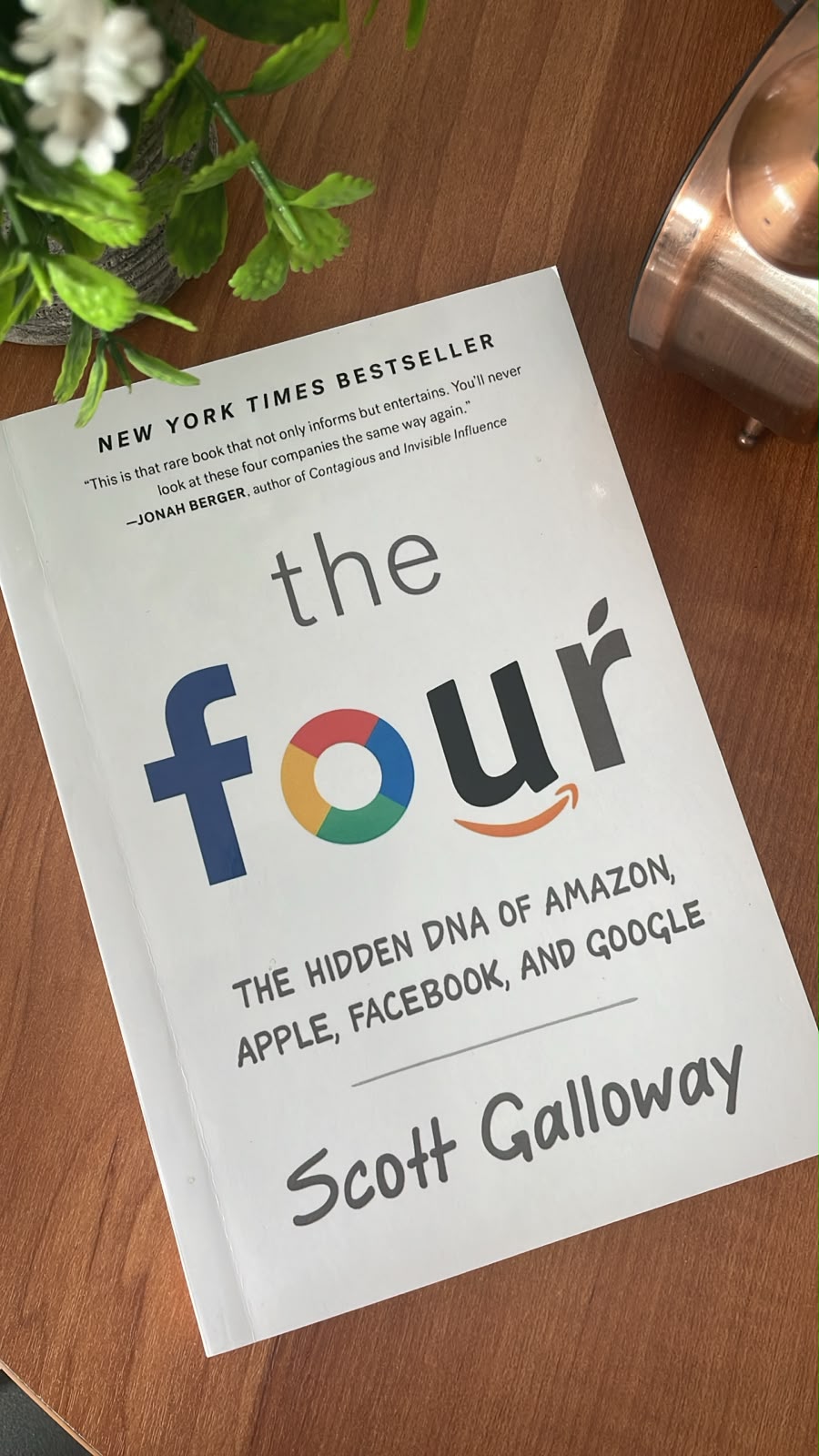

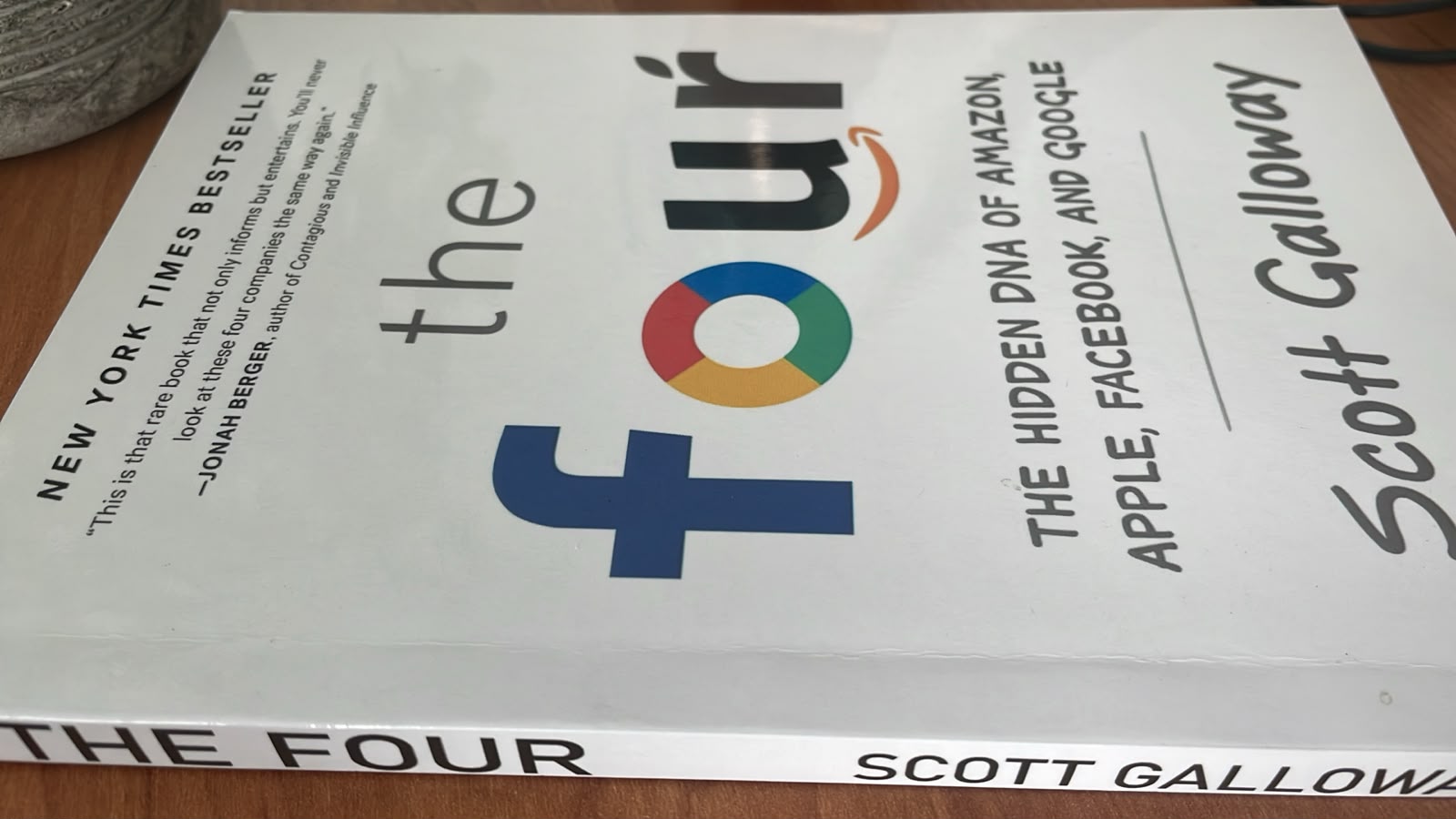





Four by Scott Galloway, Jonathan Todd Ross


රු1,700.00
3 X Rs. 566.67 or 8% Cashback with


or 3 X රු566.67 with


or up to 4 X රු425.00 with


Four reveals how Amazon, Apple, Facebook, and Google became the most influential companies in the world by understanding human behavior, leveraging technology, and building powerful ecosystems that shape modern life.
4 in stock
The Four by Scott Galloway is a provocative business and technology book that examines four companies that transformed modern life:
Amazon.
Apple.
Facebook.
Google.
Millions of people use their products every day.
We shop through Amazon.
Carry Apple devices.
Connect through Facebook.
Search through Google.
These companies have become so deeply integrated into everyday life that imagining the modern digital world without them is difficult.
But how did they become so powerful?
Was it simply better technology?
Better leadership?
Better marketing?
Or did these companies understand something deeper about human behaviour?
In The Four by Scott Galloway, NYU professor and entrepreneur Scott Galloway examines the strategies, competitive advantages, branding, psychology, and business models behind four of the most influential technology companies of the modern era.
Why Read The Four by Scott Galloway?
The Four by Scott Galloway is ideal for readers interested in business, technology, entrepreneurship, marketing, digital strategy, and the companies shaping modern society.
The book explores:
- Amazon
- Apple
- Technology
- Business strategy
- Branding
- Consumer psychology
- Digital marketing
- Competitive advantage
- Entrepreneurship
- Career strategy
- Innovation
- Corporate power
- Modern capitalism
Galloway does not simply repeat the success stories these companies tell about themselves.
He questions them.
How did they become so difficult to avoid?
Why can they take risks that would damage smaller companies?
What emotional needs do their products satisfy?
And can competitors realistically challenge them?
The Four by Scott Galloway and Amazon
Amazon began as an online bookstore.
It eventually became something much larger.
Retail.
Logistics.
Cloud computing.
Digital entertainment.
Advertising.
Devices.
Subscriptions.
Marketplace services.
Galloway examines how Amazon built enormous power by focusing relentlessly on convenience, selection, price, and infrastructure.
Customers want things.
Amazon makes obtaining those things easier.
That sounds simple.
But executing it at enormous scale created one of the most influential companies in modern business.
Amazon and Our Desire to Consume
One of Galloway’s central ideas is that the Four succeed partly because they connect with fundamental human desires.
Amazon connects strongly with consumption.
We want:
More choice.
Lower prices.
Faster delivery.
Greater convenience.
Less friction.
Every improvement makes purchasing easier.
That convenience strengthens customer behaviour.
The easier shopping becomes, the more naturally consumers return.
The Four by Scott Galloway and Apple
Apple operates differently.
Amazon often competes through convenience and scale.
Apple builds desire through premium branding.
Its products are not always the cheapest.
Yet millions of consumers willingly pay more for them.
Why?
Design.
Status.
Trust.
Integration.
Brand identity.
Customer experience.
Apple transformed technology products into lifestyle objects.
That is one reason Galloway considers it such an extraordinary business.
Apple and Luxury Branding
Apple does something unusual.
It sells mass-market technology using many techniques associated with luxury brands.
Beautiful stores.
Minimalist design.
Premium pricing.
Strong visual identity.
Carefully controlled product presentation.
Owning an Apple product can therefore communicate more than functionality.
It can communicate taste.
Identity.
Status.
And belonging.
This allows Apple to maintain a powerful relationship with consumers.
The Four by Scott Galloway and Facebook
Facebook built its power around human connection.
People naturally want relationships.
Friendship.
Recognition.
Community.
Communication.
And information about other people.
Facebook transformed these social behaviours into a global digital network.
The platform made it easier to:
Find people.
Share updates.
Post photographs.
Join communities.
Communicate.
Follow events.
And build digital identities.
Galloway examines how powerful that network effect became as more people joined.
Facebook and Network Effects
A social network becomes more useful when more people use it.
One telephone is useless.
Two telephones create a connection.
Millions create a network.
Facebook benefited from this dynamic at enormous scale.
Your friends were there.
Your family was there.
Businesses were there.
Groups were there.
Leaving became harder because the value came partly from everyone else being present.
That network effect helped strengthen Facebook’s position.
The Four by Scott Galloway and Google
Google became powerful by organizing information.
Before modern search engines, finding information online could be slow and frustrating.
Google made the process easier.
Type a question.
Receive answers.
Search became so normal that many people stopped thinking about the enormous infrastructure behind it.
Google became the gateway between human curiosity and the internet.
That position created extraordinary influence.
Google and Human Curiosity
People constantly ask questions.
Where is the nearest restaurant?
What does this word mean?
Who wrote this book?
How do I repair something?
What should I buy?
What happened today?
Google sits between the question and the answer.
That gives it enormous economic power.
Search intent can reveal what people want.
Advertisers are willing to pay to appear at exactly that moment.
This created one of the most powerful advertising businesses in history.
The Four by Scott Galloway and Human Psychology
One of the book’s most interesting arguments is that the Four became powerful partly because they appeal to deep human needs rather than merely offering useful technology.
Publishers and reviewers summarize Galloway’s framework as connecting the companies with instinctive human drives—for example, acquisition, creativity/status, social connection, and the search for information or answers.
This gives the book a different perspective from a conventional corporate history.
Technology matters.
But psychology matters too.
The Four Are More Than Technology Companies
Amazon sells products.
Apple sells devices.
Facebook connects people.
Google organizes information.
But each company expanded far beyond its original category.
That is important.
Great businesses do not always remain inside the boundaries people initially assign to them.
Amazon was not destined to remain a bookstore.
Google was not destined to remain only a search engine.
Apple became much more than a computer company.
Facebook became more than a university social network.
Their expansion shows how technology companies can use one successful platform to enter multiple industries.
The Four by Scott Galloway and Competitive Advantage
Why are these companies so difficult to challenge?
Because scale creates advantages.
More customers create more data.
More data can improve products.
Better products attract more customers.
More customers attract developers, sellers, advertisers, or creators.
That ecosystem becomes increasingly difficult for new competitors to reproduce.
The result can become a powerful feedback loop.
Scale Changes the Rules
Large companies can often do things smaller competitors cannot.
Spend billions on infrastructure.
Experiment with new products.
Acquire competitors.
Hire expensive talent.
Wait years for new businesses to become profitable.
Negotiate from positions of enormous strength.
That scale can create protection around the business.
The Four by Scott Galloway encourages readers to understand these structural advantages rather than assuming success comes simply from having a better idea.
The Four by Scott Galloway and Branding
Branding is especially important in Galloway’s analysis.
A strong brand changes customer behaviour.
People may:
Trust the company more.
Pay premium prices.
Recommend products.
Stay loyal.
Forgive mistakes.
Or identify personally with the brand.
Apple is perhaps the clearest example.
Its brand allows products to compete on more than technical specifications.
That is an extremely valuable business advantage.
Innovation Is Not Enough
Businesses often talk about innovation as if it automatically guarantees success.
It does not.
A company may invent something excellent and still fail.
Distribution matters.
Capital matters.
Brand matters.
Timing matters.
Management matters.
Customer acquisition matters.
Scale matters.
The Four by Scott Galloway demonstrates that technology leadership is built from many advantages working together.
The Four by Scott Galloway and Career Lessons
The book also moves beyond company analysis.
Galloway discusses what individuals can learn from the rise of these companies.
Modern careers increasingly reward:
Technical literacy.
Adaptability.
Strong communication.
Ownership.
International awareness.
Emotional intelligence.
The ability to work with talented people.
And willingness to develop valuable skills.
The book therefore becomes partly about surviving and succeeding in an economy increasingly shaped by powerful technology companies.
Entrepreneurship Lessons From The Four
Entrepreneurs may find several useful questions in the book.
Does your company solve an important problem?
Can it scale?
Does your brand mean something?
Is your product difficult to replace?
Can you create recurring relationships with customers?
Does your business become stronger as more people use it?
What emotional need does it satisfy?
These questions can help founders think beyond the immediate product.
The Four by Scott Galloway and Digital Marketing
Scott Galloway taught brand strategy and digital marketing at NYU Stern, and that background is clearly reflected in the book.
He examines companies not only as technology businesses but as brands competing for consumer attention.
Modern marketing is closely connected with:
Search.
Social media.
E-commerce.
Mobile devices.
Data.
Advertising platforms.
And digital ecosystems.
The Four dominate many of these areas.
Understanding them therefore helps readers understand modern marketing itself.
The Book Was Written in 2017
One important note for modern readers:
The Four by Scott Galloway was originally published in 2017.
Technology has changed considerably since then.
Facebook’s parent company is now Meta.
Amazon expanded further.
Apple became even larger.
Google reorganized under Alphabet before the book and has continued evolving.
Artificial intelligence has transformed the technology landscape.
Therefore, some individual statistics and competitive assumptions in the book reflect the era in which it was written.
However, the strategic ideas about scale, brand, data, consumer psychology, platforms, and competitive advantage remain useful.
Why The Four Still Matters
Technology changes quickly.
Business principles often change more slowly.
Amazon’s products may evolve.
Apple’s devices may change.
Facebook’s platforms may shift.
Google may become increasingly AI-driven.
But questions around:
Scale.
Network effects.
Brand.
Consumer behaviour.
Distribution.
Data.
Capital.
And corporate influence
remain highly relevant.
That gives The Four by Scott Galloway continued value as a business strategy book.
A Critical View of Big Tech
The book is not simply a celebration of these companies.
Galloway also examines the consequences of their enormous power.
Successful technology businesses can create convenience and innovation.
But dominance can also raise questions involving:
Competition.
Jobs.
Privacy.
Taxation.
Market power.
Social influence.
Media.
Economic inequality.
The book therefore encourages readers to admire the Four’s strategic brilliance while remaining critical of the power they accumulate.
7 Powerful Lessons From The Four by Scott Galloway
- Successful businesses often satisfy deep human needs. The strongest products connect with motivations larger than their technical features.
- Scale creates enormous competitive advantages. Infrastructure, data, capital, and user networks can make dominant platforms increasingly difficult to challenge.
- Brand can be as powerful as technology. Apple demonstrates how design, identity, and premium positioning can create exceptional loyalty.
- Network effects strengthen platforms. Services such as social networks become more useful as more people join.
- Convenience is a powerful competitive weapon. Amazon reduced friction between wanting something and obtaining it.
- Control of information creates influence. Google became enormously powerful by becoming a gateway to online knowledge.
- Technology success brings social consequences. The Four by Scott Galloway asks readers to consider not only how these companies became dominant but what that dominance means for society.
What You Can Expect From The Four by Scott Galloway
Readers can expect:
- Amazon
- Apple
- Business strategy
- Digital marketing
- Technology
- Entrepreneurship
- Branding
- Consumer psychology
- Network effects
- Competitive advantage
- E-commerce
- Social media
- Search engines
- Career advice
- Corporate power
- Big Tech analysis
Who Should Read The Four by Scott Galloway?
The Four by Scott Galloway is ideal for:
Business students.
Entrepreneurs.
Marketing professionals.
Managers.
Technology professionals.
Investors interested in business strategy.
Digital marketers.
Startup founders.
MBA students.
Young professionals.
Readers interested in Big Tech.
Anyone curious about how Amazon, Apple, Facebook, and Google became dominant global businesses.
A Powerful Look Inside Four Technology Giants
The Four by Scott Galloway asks readers to look beyond the polished stories technology companies tell about themselves.
Amazon did not become powerful simply because it sold books online.
Apple did not become extraordinary simply because it made attractive computers.
Facebook did not become enormous simply because people wanted online profiles.
Google did not dominate simply because its search engine was faster.
Each company built powerful advantages involving human behaviour, branding, technology, distribution, data, networks, and scale.
Galloway examines those advantages while also questioning what happens when a small number of technology companies become deeply embedded in modern economic and social life.
For readers interested in business strategy, marketing, entrepreneurship, technology, corporate power, and the rise of Big Tech, The Four by Scott Galloway remains a provocative and accessible business read.
Book Details
Title: The Four
Full Title: The Four: The Hidden DNA of Amazon, Apple, Facebook, and Google
Author: Scott Galloway
Genre: Business / Technology / Entrepreneurship / Marketing
Companies Covered: Amazon, Apple, Facebook & Google
Original Publication: October 3, 2017
Publisher: Portfolio / Penguin
Original Edition Length: 320 pages.
Hardcover Edition
A widely listed U.S. hardcover edition has:
ISBN-13: 9780735213654
Format: Hardcover
Publisher: Portfolio / Penguin
Publication Date: October 3, 2017
Pages: 320.
Paperback Edition
A U.S. Penguin paperback edition is listed as:
ISBN-13: 9780735213678
Format: Paperback
Publication: 2018
Pages: 336.
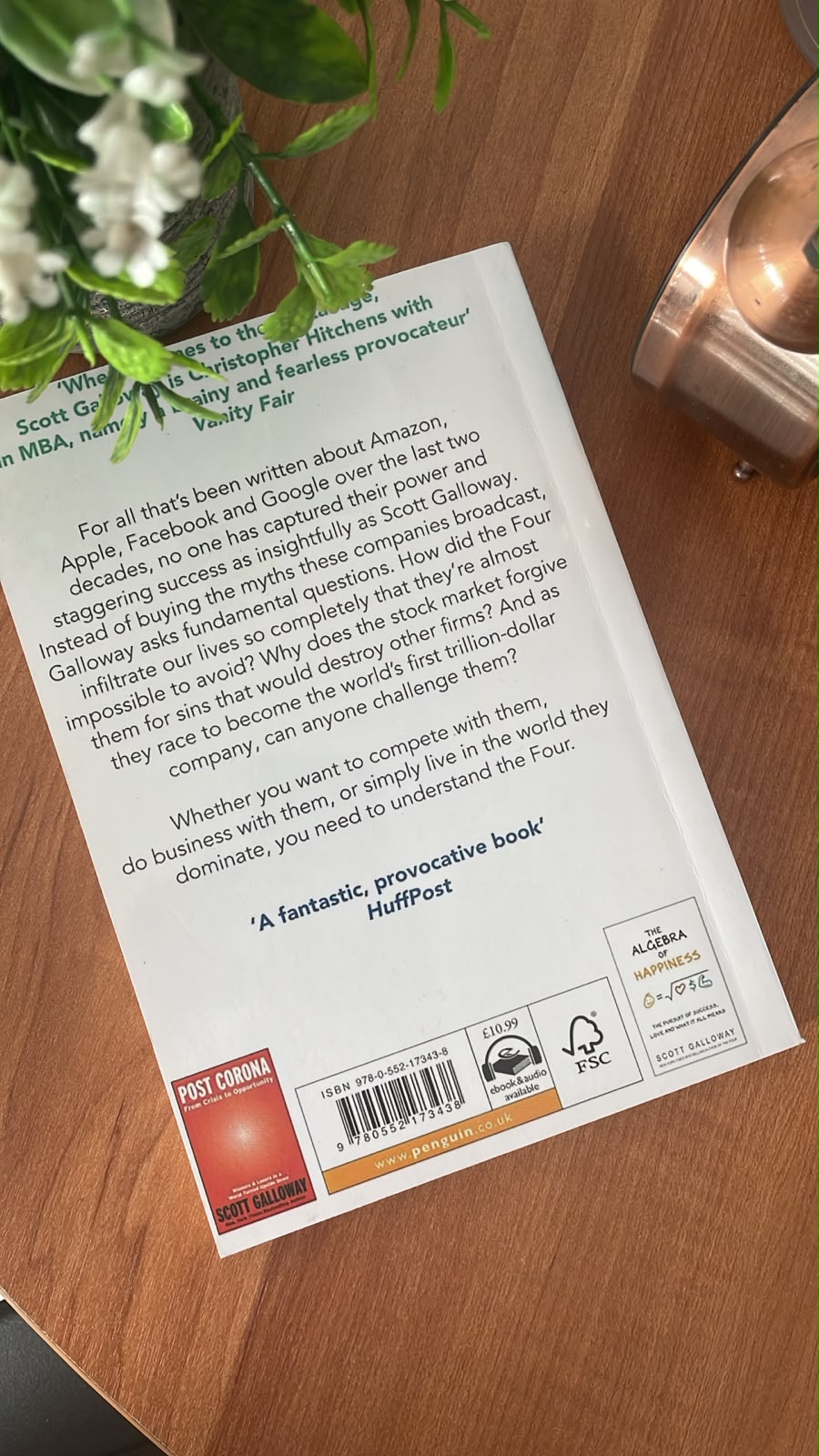
A Corgi/UK edition is also listed with ISBN 9780552173438 and approximately 323 pages, so check your physical copy before entering edition-specific information.
Audiobook Details
If your product is the audiobook:
Author: Scott Galloway
Narrator: Jonathan Todd Ross
Length: approximately 8 hours 32 minutes
Audio Publication: October 5, 2017 for the listed Penguin/Transworld edition.
Important Author Note
For the printed book, enter:
Scott Galloway
as the author.
Do not enter Jonathan Todd Ross as a co-author. He is the audiobook narrator.
Learn more about The Four by Scott Galloway on the official Penguin Random House website.
Explore more business and entrepreneurship books at Bargain Books.
Be the first to review “Four by Scott Galloway, Jonathan Todd Ross”
Related products

Out of stock
Non-Fiction & Knowledge
රු1,900.00
3 X Rs. 633.33 or 8% Cashback with
or 3 X රු633.33 with
or up to 4 X රු475.00 with
Out of stock
Non-Fiction & Knowledge
රු1,600.00
3 X Rs. 533.33 or 8% Cashback with
or 3 X රු533.33 with
or up to 4 X රු400.00 with
-19%

Out of stock
Non-Fiction & Knowledge
Original price was: රු2,650.00.රු2,150.00Current price is: රු2,150.00.
3 X Rs. 716.67 or 8% Cashback with
or 3 X රු716.67 with
or up to 4 X රු537.50 with
-34%

Non-Fiction & Knowledge
Original price was: රු2,250.00.රු1,490.00Current price is: රු1,490.00.
3 X Rs. 496.67 or 8% Cashback with
or 3 X රු496.67 with
or up to 4 X රු372.50 with
-14%

Out of stock
Self-Help & Psychology
Original price was: රු2,900.00.රු2,500.00Current price is: රු2,500.00.
3 X Rs. 833.33 or 8% Cashback with
or 3 X රු833.33 with
or up to 4 X රු625.00 with
-26%

Non-Fiction & Knowledge
The 7 Habits of Highly Effective People by Stephen R. Covey – Blue Cover
Original price was: රු2,300.00.රු1,700.00Current price is: රු1,700.00.
3 X Rs. 566.67 or 8% Cashback with
or 3 X රු566.67 with
or up to 4 X රු425.00 with

රු2,000.00
3 X Rs. 666.67 or 8% Cashback with
or 3 X රු666.67 with
or up to 4 X රු500.00 with
-24%

Out of stock
Non-Fiction & Knowledge
Original price was: රු2,100.00.රු1,600.00Current price is: රු1,600.00.
3 X Rs. 533.33 or 8% Cashback with
or 3 X රු533.33 with
or up to 4 X රු400.00 with
Reviews
There are no reviews yet.