
No products in the cart.
-16%
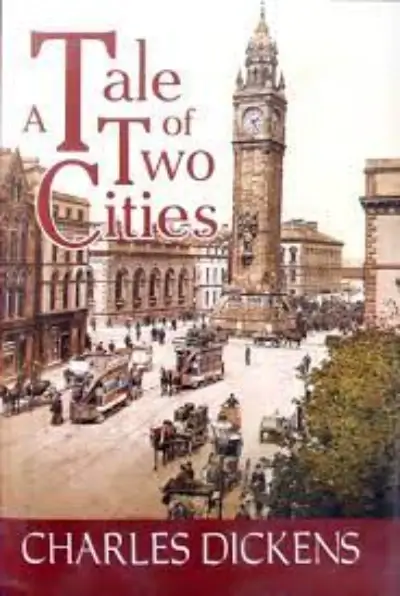
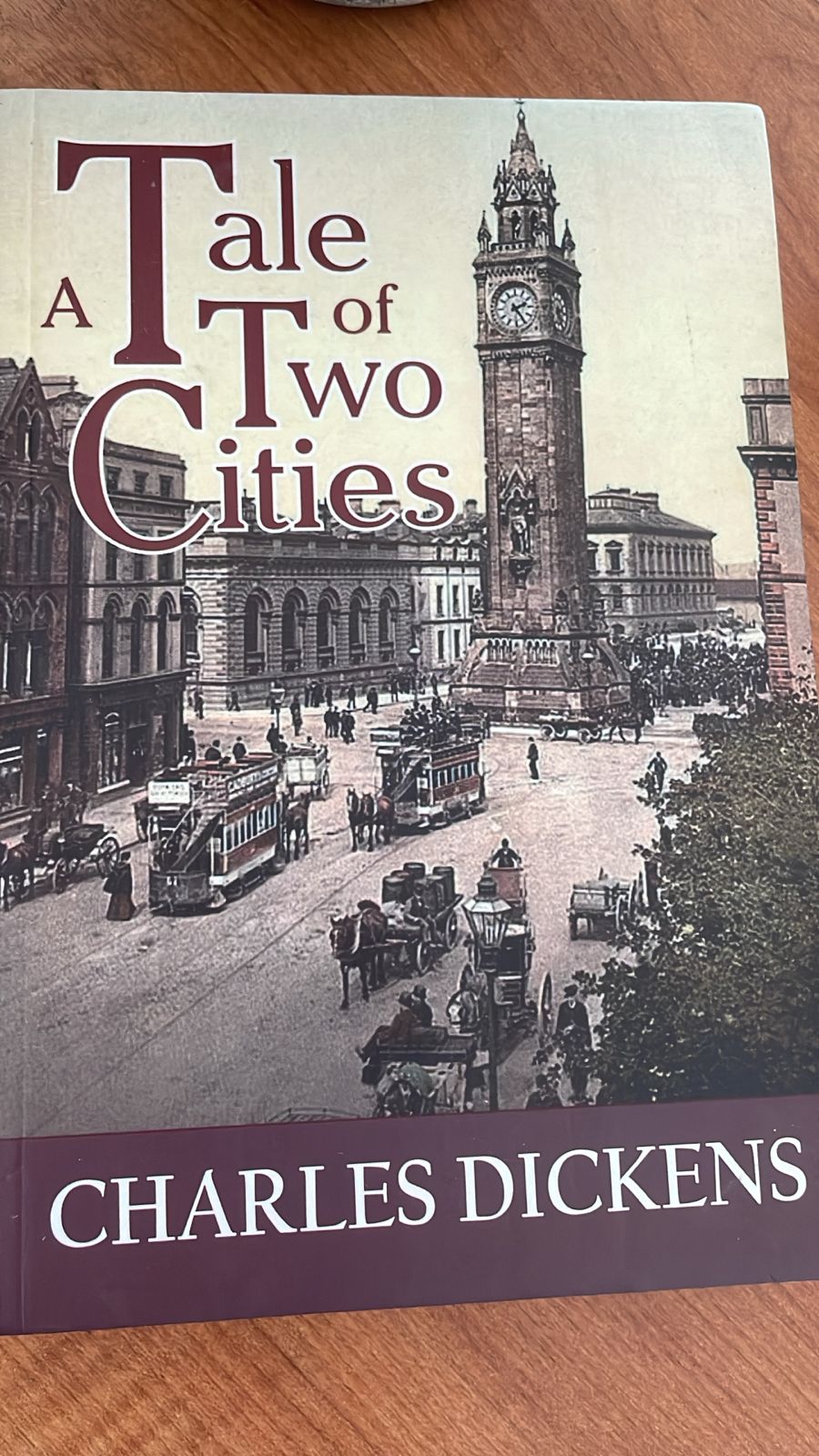

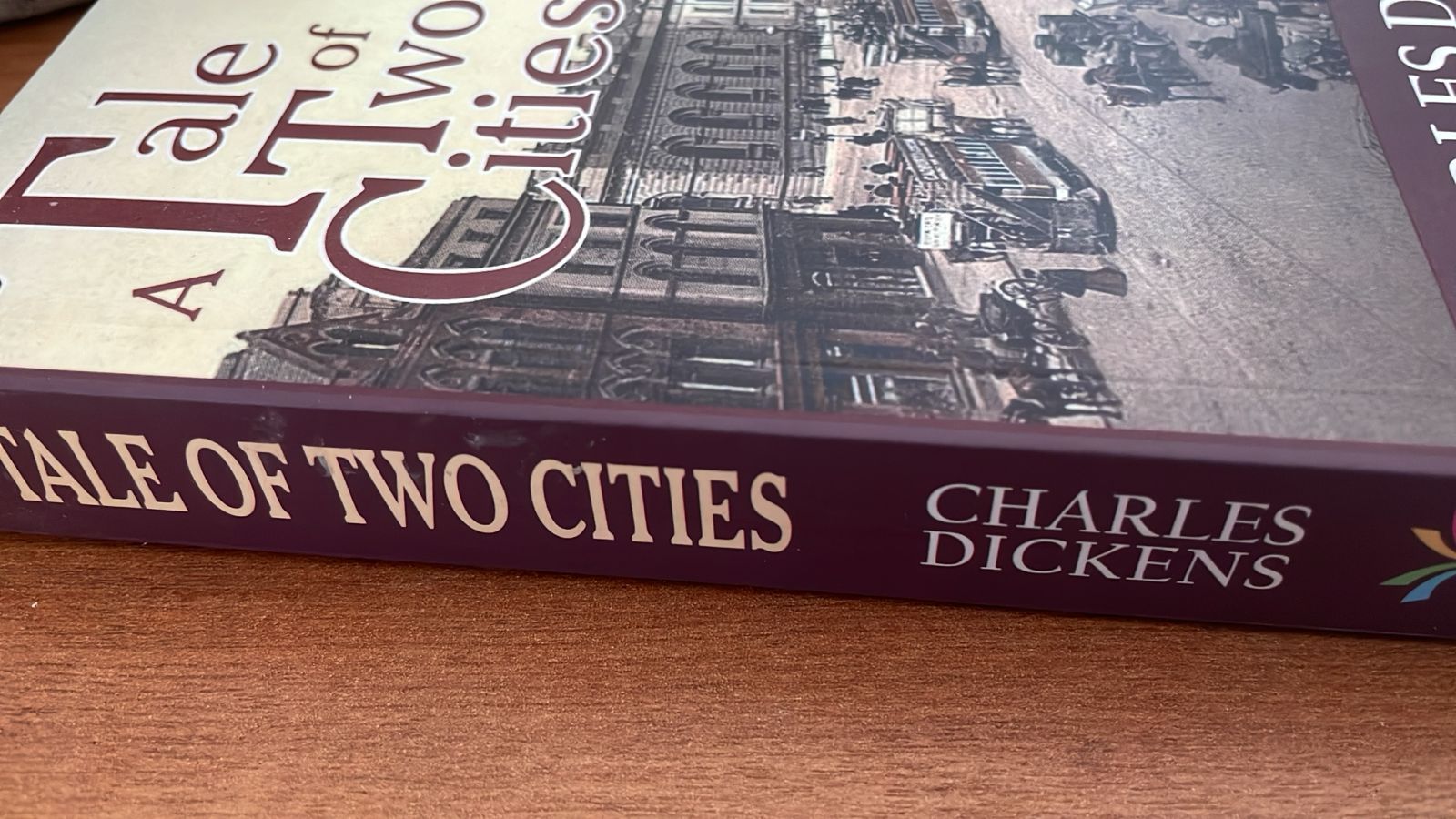
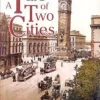

Tale Of Two Cities by Charles Dickens


Original price was: රු3,200.00.රු2,700.00Current price is: රු2,700.00.
3 X Rs. 900.00 or 8% Cashback with


or 3 X රු900.00 with


or up to 4 X රු675.00 with


Immerse yourself in the gripping narrative of ‘A Tale of Two Cities’ by Charles Dickens. Set against the tumultuous backdrop of the French Revolution, this timeless classic weaves a tale of love, sacrifice, and redemption. Dickens’s masterful storytelling and vivid characters transport readers to a world of historical drama and enduring themes.
6 in stock
A Tale of Two Cities by Charles Dickens
A Tale of Two Cities by Charles Dickens is a powerful historical novel about love, sacrifice, revolution, injustice, loyalty, and redemption.
Set in London and Paris during the years surrounding the French Revolution, the story follows several characters whose lives become connected by family, politics, imprisonment, and danger.
At the center are Charles Darnay and Sydney Carton.
The two men look remarkably similar.
But their personalities and life paths are very different.
Their connection eventually leads to one of the most memorable acts of sacrifice in classic literature.
About A Tale of Two Cities
A Tale of Two Cities begins during a period of political tension and social inequality.
France is approaching revolution.
The aristocracy enjoys privilege while ordinary people suffer under poverty and oppression.
Charles Dickens uses personal stories to show how these conditions create anger and violence.
The novel moves between London and Paris.
As political events intensify, the lives of the main characters become increasingly dangerous.
Meet Charles Darnay
Charles Darnay is a French aristocrat by birth.
However, he rejects the cruelty and injustice connected to his family name.
He leaves France and attempts to build a new life in England.
Darnay wants to live according to his own values.
But escaping his family history is not easy.
When events in France force him to return, he becomes caught in the violence of the Revolution.
Meet Sydney Carton
Sydney Carton is one of the most memorable characters in A Tale of Two Cities.
He is intelligent and capable.
But he feels that he has wasted much of his life.
Carton is cynical and unhappy.
He sees very little value in himself.
His feelings for Lucie Manette gradually reveal another side of his character.
Through Carton, Dickens explores whether a person can still find meaning after years of disappointment.
Lucie Manette
Lucie Manette is an important emotional center of the story.
She is compassionate, loyal, and devoted to her family.
Her relationship with her father, Dr. Manette, becomes especially important.
Lucie also becomes connected to both Darnay and Carton.
Her kindness influences many of the people around her.
She represents stability in a world becoming increasingly violent.
Dr. Manette
Dr. Alexandre Manette has spent eighteen years imprisoned in the Bastille.
His imprisonment has deeply affected him.
When he is finally released, he must learn how to live again.
His story introduces one of the novel’s central themes: resurrection.
Can someone recover after losing years of their life?
Can trauma ever truly disappear?
Dickens explores these questions through Dr. Manette’s experiences.
7 Powerful Reasons to Read A Tale of Two Cities
1. A Powerful Story of Sacrifice
Sacrifice is one of the strongest themes in A Tale of Two Cities.
Characters repeatedly face choices between personal safety and helping others.
Sydney Carton’s journey gives this theme its greatest emotional impact.
The novel asks what gives a life meaning.
Its answer is closely connected to love and selflessness.
2. A Dramatic Historical Setting
The French Revolution provides an intense backdrop.
Crowds become powerful.
Prisons fill.
The guillotine becomes a symbol of revolutionary justice and terror.
Dickens creates a world where political change affects ordinary lives directly.
The historical setting gives the novel urgency.
3. Memorable Characters
The book contains several distinctive characters.
Charles Darnay represents someone trying to escape an inherited legacy.
Sydney Carton represents wasted potential and redemption.
Dr. Manette represents survival.
Lucie represents love and loyalty.
Madame Defarge represents anger shaped by injustice and revenge.
Together, they give the story emotional depth.
4. Justice and Revenge
The novel asks whether justice can become revenge.
The French aristocracy has committed serious injustices.
The revolution begins as a response to oppression.
But violence can become uncontrollable.
Dickens shows how suffering can create anger.
He also shows how anger can create new suffering.
5. Redemption Is Possible
Sydney Carton believes his life has little value.
But the novel challenges that belief.
A person’s past does not necessarily determine their final meaning.
This gives the book a strong theme of redemption.
Someone who has made mistakes can still make an important choice.
6. Love Has Different Forms
Love in the novel is not limited to romance.
There is family love.
There is loyalty.
There is friendship.
There is self-sacrifice.
Each form of love influences the characters differently.
This helps make the story emotionally powerful.
7. It Is One of Dickens’s Most Famous Novels
A Tale of Two Cities remains one of Charles Dickens’s best-known works.
Its opening and closing passages are among the most recognizable in English literature.
The novel continues to be widely read because its themes remain relevant.
Power, inequality, anger, sacrifice, and justice are still important subjects today.
The French Revolution
The Revolution is more than a historical background.
It shapes the entire story.
Dickens shows how extreme inequality can create dangerous resentment.
The aristocracy has ignored suffering for too long.
When revolution begins, that resentment explodes.
But the novel also warns about uncontrolled violence.
Revolutionary justice can become revenge.
Innocent people can become victims.
This complexity gives the story much of its power.
Resurrection and Rebirth
Resurrection is a repeated theme throughout A Tale of Two Cities.
Dr. Manette returns to life after years of imprisonment.
Charles Darnay tries to create a new identity.
Sydney Carton searches for a way to give meaning to his life.
Even society itself is going through a kind of violent rebirth.
Dickens repeatedly asks whether people can begin again.
The Meaning of Sacrifice
Sacrifice becomes especially important near the end of the novel.
Characters must decide what they are willing to give up for others.
Dickens presents sacrifice as something that can transform a person.
It can turn regret into purpose.
It can turn a wasted life into a meaningful one.
This theme gives the ending its lasting emotional impact.
Social Inequality
The novel strongly criticizes social injustice.
The French aristocracy has enormous privilege.
Ordinary people struggle with hunger and poverty.
The ruling class often shows little concern.
Dickens makes it clear that such inequality has consequences.
Ignoring suffering can create anger that eventually becomes impossible to control.
Madame Defarge
Madame Defarge is one of the novel’s most striking characters.
She has suffered because of aristocratic cruelty.
Her anger has understandable origins.
But that anger becomes increasingly destructive.
Through her, Dickens explores what happens when the desire for justice becomes consumed by revenge.
She is frightening because her motivations are not completely simple.
London and Paris
The title refers to two cities.
London represents relative safety for many characters.
Paris becomes the center of revolution.
Moving between the two locations creates contrast.
One city offers escape.
The other becomes increasingly dangerous.
Yet the characters remain connected to both worlds.
Who Should Read This Book?
A Tale of Two Cities is ideal for readers who enjoy classic literature, historical fiction, political drama, and emotionally powerful stories.
It is also a strong choice for readers interested in the French Revolution.
Students may find it useful for studying themes such as sacrifice, resurrection, social inequality, and justice.
Readers who enjoy character-driven stories will especially appreciate Sydney Carton’s development.
About Charles Dickens
Charles Dickens was one of the most important writers of the Victorian era.
His novels often explored poverty, social inequality, childhood, crime, justice, and the conditions of ordinary people.
His best-known works include Oliver Twist, Great Expectations, David Copperfield, Bleak House, A Christmas Carol, and A Tale of Two Cities.
The novel was originally published in 1859.
Readers can learn more through the official Penguin Classics page for A Tale of Two Cities.
Product Details
Title: A Tale of Two Cities
Author: Charles Dickens
Genre: Classic Literature / Historical Fiction
Language: English
Original Publication: 1859
Setting: London and Paris
Themes: Sacrifice, Revolution, Justice, Redemption, Love, Social Inequality
A common Penguin Classics paperback edition carries ISBN 9780141439600 and contains 544 pages.
A Puffin Classics edition carries ISBN 9780141325545 and contains 384 pages.
Other editions have different ISBNs and page counts.
Always check the ISBN printed on your physical copy before entering final WooCommerce specifications.
Explore More Classic Fiction
A Tale of Two Cities combines history, romance, political conflict, and personal sacrifice.
Its characters live in a world where society is changing rapidly.
Some try to escape the past.
Others seek revenge.
And one man discovers that a single courageous decision can transform the meaning of his entire life.
Readers interested in more classics can explore Fiction & Literature Books at Bargain Books.
For readers who enjoy dramatic historical fiction, unforgettable characters, and stories about sacrifice and redemption, A Tale of Two Cities remains a powerful classic.
| Author | Charles Dickens |
|---|---|
| Type | Paperback Printed Book |
| ISBN/ISSN | 978-8171674077, 9788171674077 |
| Language | English |
| Pages | 416 |
Be the first to review “Tale Of Two Cities by Charles Dickens”
Related products
-20%
Classics & Literary Fiction
Original price was: රු2,450.00.රු1,950.00Current price is: රු1,950.00.
3 X Rs. 650.00 or 8% Cashback with
or 3 X රු650.00 with
or up to 4 X රු487.50 with

Out of stock
Fiction & Literature
රු1,750.00
3 X Rs. 583.33 or 8% Cashback with
or 3 X රු583.33 with
or up to 4 X රු437.50 with
-22%
Out of stock
Fiction & Literature
Original price was: රු2,300.00.රු1,800.00Current price is: රු1,800.00.
3 X Rs. 600.00 or 8% Cashback with
or 3 X රු600.00 with
or up to 4 X රු450.00 with
Out of stock
රු2,000.00
3 X Rs. 666.67 or 8% Cashback with
or 3 X රු666.67 with
or up to 4 X රු500.00 with

Classics & Literary Fiction
රු950.00
3 X Rs. 316.67 or 8% Cashback with
or 3 X රු316.67 with
or up to 4 X රු237.50 with
Classics & Literary Fiction
රු950.00
3 X Rs. 316.67 or 8% Cashback with
or 3 X රු316.67 with
or up to 4 X රු237.50 with

Out of stock
Classics & Literary Fiction
රු1,750.00
3 X Rs. 583.33 or 8% Cashback with
or 3 X රු583.33 with
or up to 4 X රු437.50 with
-28%

Out of stock
Classics & Literary Fiction
Original price was: රු1,800.00.රු1,300.00Current price is: රු1,300.00.
3 X Rs. 433.33 or 8% Cashback with
or 3 X රු433.33 with
or up to 4 X රු325.00 with
Reviews
There are no reviews yet.