No products in the cart.
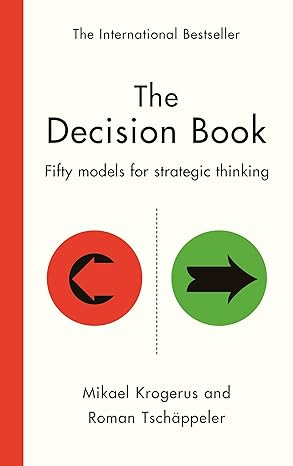
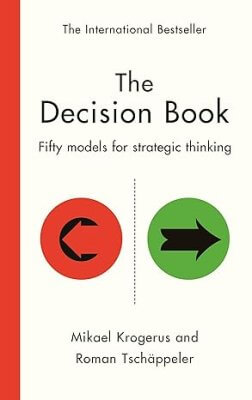
The Decision Book : 50 Models for Strategic Thinking by Mikael Krogerus

රු1,550.00
3 X Rs. 516.67 or 8% Cashback with


or 3 X රු516.67 with


or up to 4 X රු387.50 with


The Decision Book provides 50 powerful models to improve your decision-making skills—fast. From everyday choices to high-stakes dilemmas, this practical guide offers clear, actionable frameworks to enhance judgment, reduce decision fatigue, and boost clarity. Perfect for personal and professional use, it’s your go-to resource for smarter, more strategic decisions.
Out of stock
Email when stock available
The Decision Book by Mikael Krogerus and Roman Tschäppeler is a practical guide to making better decisions, solving problems and thinking more strategically.
The book brings together 50 useful decision-making models that can be applied to work, business and everyday life.
Instead of giving readers long theoretical explanations, the authors present ideas in a concise and visual format.
Each model is designed to help readers examine a situation from a different perspective.
The Decision Book is especially useful for managers, entrepreneurs, students, professionals and anyone who regularly faces difficult choices.
Why Read The Decision Book?
The Decision Book helps turn complicated decisions into clearer questions.
People make decisions every day.
Some are small.
Others can affect careers, businesses, relationships or long-term goals.
The difficulty is that people do not always know how to evaluate their options objectively.
This book provides frameworks that can help organise thoughts before taking action.
Instead of relying entirely on instinct, readers can use structured models to examine a problem.
50 Models for Strategic Thinking
One of the strongest features of The Decision Book is its collection of 50 models.
The updated edition brings together decision-making frameworks used in business education and wider strategic thinking.
Some models help with productivity.
Others help evaluate choices.
Some examine risk.
Others help readers understand themselves or the people around them.
The variety makes the book useful in many different situations.
The Decision Book and Better Decision-Making
Good decisions usually require more than simply choosing the first available option.
You need to understand the problem.
You need to consider alternatives.
You may also need to think about consequences.
The Decision Book provides models that encourage this structured approach.
A framework does not automatically make the decision for you.
Instead, it gives you another way to examine the situation.
That can make complicated choices easier to understand.
The Eisenhower Matrix
One of the well-known models included in The Decision Book is the Eisenhower Matrix.
This framework helps people think about tasks according to urgency and importance.
Some tasks may be both urgent and important.
Others may be important but not urgent.
Some may feel urgent without actually contributing much value.
Understanding these differences can improve productivity.
It can also help people decide where their attention should go first.
Improve Time Management
Time is limited.
People frequently attempt to complete too many tasks at once.
The result can be constant activity without meaningful progress.
The Decision Book includes models that can help readers prioritise more effectively.
The goal is not simply to become busier.
It is to become clearer about which activities deserve attention.
This can be especially useful for managers and professionals who constantly face competing priorities.
The Decision Book for Problem-Solving
Problems often feel complicated because several factors are mixed together.
A useful model can separate those factors.
This makes the situation easier to examine.
The Decision Book encourages readers to turn vague concerns into clearer questions.
What is the real problem?
What options are available?
What are the risks?
What outcome do you want?
These questions can improve the quality of decision-making.
Strategic Thinking Made Simple
Strategy can sound complicated.
But strategic thinking often begins with understanding where you are, where you want to go and what obstacles stand between those two points.
The Decision Book presents models designed to help readers think about these questions.
The models are concise.
That makes them useful when someone needs a quick framework rather than a long academic explanation.
Visual Models Make Ideas Easier
A distinctive feature of the book is its visual approach.
The authors use diagrams and simple graphical models to communicate complex ideas. WIRED noted that the book was designed around simple visual frameworks for strategic thinking.
Visual explanations can make ideas easier to remember.
A diagram may sometimes communicate a relationship faster than several pages of text.
This makes The Decision Book especially useful as a reference book.
Readers can return to a specific model whenever they need it.
The Decision Book for Business
Business leaders regularly make difficult choices.
Should the company launch a new product?
Should resources be invested in one project or another?
Which tasks deserve immediate attention?
What risks should be considered?
The Decision Book provides frameworks that can help organise these conversations.
It can be useful during meetings.
It can also help individuals prepare before important discussions.
Useful for Managers
Managers constantly balance people, deadlines and priorities.
They may need to evaluate performance.
They may need to allocate resources.
They may also need to resolve disagreements.
The Decision Book can help managers approach these situations more systematically.
A model can provide a neutral structure for discussing a complicated issue.
That can make decision-making more transparent.
Useful for Entrepreneurs
Entrepreneurs face uncertainty almost every day.
A business owner may need to choose between several ideas.
They may need to decide when to expand.
They may need to evaluate risk.
They may also need to determine what deserves their limited time.
The Decision Book can provide useful frameworks for examining these problems before making a commitment.
It cannot remove uncertainty.
But it can help structure the thinking process.
The Decision Book for Personal Decisions
The models are not limited to corporate situations.
Many can also be applied to personal choices.
Should you change careers?
Should you accept a new opportunity?
What should you prioritise?
Which option fits your goals?
The Decision Book encourages readers to examine choices more consciously instead of reacting automatically.
This makes the book relevant outside traditional business environments.
Understand Yourself Better
Some decisions become difficult because people do not clearly understand what they want.
They may compare themselves with others.
They may follow expectations rather than their own priorities.
Several models in The Decision Book focus on personal effectiveness and self-understanding.
Clarifying your priorities can make future decisions easier.
If you know what matters most, you have a stronger basis for comparing alternatives.
Think Before Acting
Fast decisions are sometimes necessary.
But not every decision needs an immediate reaction.
The Decision Book encourages a more deliberate approach.
Pause.
Look at the situation.
Choose an appropriate framework.
Consider the available options.
Then decide.
This small change can prevent emotional or poorly considered decisions.
Learn to Compare Alternatives
One reason choices become difficult is that several options may appear attractive.
A structured model can help compare them.
What are the advantages?
What are the disadvantages?
What could go wrong?
Which option best supports the desired outcome?
The Decision Book gives readers tools that can help transform unclear choices into more manageable comparisons.
Risk and Uncertainty
No decision-making system can completely remove risk.
The future remains uncertain.
However, understanding possible risks can improve preparation.
The updated edition includes models dealing with uncertainty and complex systems, including the Swiss Cheese Model.
Thinking about risk in advance can help people identify weaknesses before they become larger problems.
Make Meetings More Productive
Teams can spend a long time discussing problems without reaching a conclusion.
A framework can improve these conversations.
Instead of everyone approaching the issue differently, the group can use the same model.
This provides a common structure.
The Decision Book can therefore be useful during planning sessions, workshops and strategy meetings.
A Book You Can Return To
The Decision Book does not necessarily need to be read once and then placed on a shelf.
It works well as a reference guide.
When you face a specific problem, you can return to a relevant model.
A model that seems unimportant today may become extremely useful later.
That gives the book long-term practical value.
7 Powerful Lessons From The Decision Book
- Structure Difficult Choices – Breaking a problem into smaller parts can make decisions clearer.
- Prioritise What Matters – Not every urgent task is equally important.
- Use Models as Tools – Frameworks can provide new perspectives without replacing personal judgement.
- Think Strategically – Consider consequences rather than focusing only on immediate results.
- Understand Yourself – Better self-awareness can improve important personal decisions.
- Evaluate Risk – Consider what could go wrong before committing to an option.
- Keep Decisions Simple – A clear visual framework can sometimes explain a complicated situation better than pages of theory.
What You Can Learn From The Decision Book
Readers can explore:
- Decision-making
- Strategic thinking
- Problem-solving
- Time management
- Productivity
- Prioritisation
- Business strategy
- Risk analysis
- Leadership
- Self-awareness
- Career decisions
- Planning
- Management
- Personal effectiveness
- Visual thinking
- Decision frameworks
Who Should Read The Decision Book?
The Decision Book is ideal for managers and business leaders.
Entrepreneurs can use its frameworks when evaluating opportunities.
Students can learn structured approaches to problem-solving.
Professionals can apply the models to productivity and career decisions.
Consultants and strategists may also find the visual frameworks useful during discussions with teams or clients.
It is particularly suitable for readers who prefer concise, practical books instead of long theoretical explanations.
A Powerful Guide to Smarter Decisions
The Decision Book provides a collection of practical tools for people who want to think more clearly.
Mikael Krogerus and Roman Tschäppeler bring together 50 models designed to help readers evaluate choices, organise priorities and approach problems strategically.
The visual format makes the frameworks easy to revisit.
Some models may help with business.
Others may help with personal decisions.
Together, they provide a useful toolbox for navigating uncertainty.
For readers interested in decision-making, management, productivity and strategic thinking, The Decision Book is a valuable addition to any business or personal-development bookshelf.
Book Details
Title: The Decision Book: Fifty Models for Strategic Thinking
Authors: Mikael Krogerus & Roman Tschäppeler
Category: Business / Decision-Making / Strategic Thinking
Publisher: Profile Books
Updated Edition: 2023
Updated Edition Length: approximately 174–176 pages, depending on listing/format. https://yourwebsite.com/the-decision-book/


Be the first to review “The Decision Book : 50 Models for Strategic Thinking by Mikael Krogerus”
Related products
-24%
Out of stock
Non-Fiction & Knowledge
Original price was: රු2,100.00.රු1,600.00Current price is: රු1,600.00.
3 X Rs. 533.33 or 8% Cashback with
or 3 X රු533.33 with
or up to 4 X රු400.00 with
-19%
Out of stock
Non-Fiction & Knowledge
Original price was: රු2,650.00.රු2,150.00Current price is: රු2,150.00.
3 X Rs. 716.67 or 8% Cashback with
or 3 X රු716.67 with
or up to 4 X රු537.50 with
-34%

Self-Help & Psychology
Original price was: රු2,350.00.රු1,550.00Current price is: රු1,550.00.
3 X Rs. 516.67 or 8% Cashback with
or 3 X රු516.67 with
or up to 4 X රු387.50 with
-29%
Self-Help & Psychology
Original price was: රු1,750.00.රු1,250.00Current price is: රු1,250.00.
3 X Rs. 416.67 or 8% Cashback with
or 3 X රු416.67 with
or up to 4 X රු312.50 with
Out of stock
රු1,900.00
3 X Rs. 633.33 or 8% Cashback with
or 3 X රු633.33 with
or up to 4 X රු475.00 with
Out of stock
Non-Fiction & Knowledge
රු1,600.00
3 X Rs. 533.33 or 8% Cashback with
or 3 X රු533.33 with
or up to 4 X රු400.00 with
-33%

Self-Help & Psychology
Original price was: රු2,300.00.රු1,550.00Current price is: රු1,550.00.
3 X Rs. 516.67 or 8% Cashback with
or 3 X රු516.67 with
or up to 4 X රු387.50 with
Out of stock
Non-Fiction & Knowledge
රු1,500.00
3 X Rs. 500.00 or 8% Cashback with
or 3 X රු500.00 with
or up to 4 X රු375.00 with
Reviews
There are no reviews yet.