
No products in the cart.
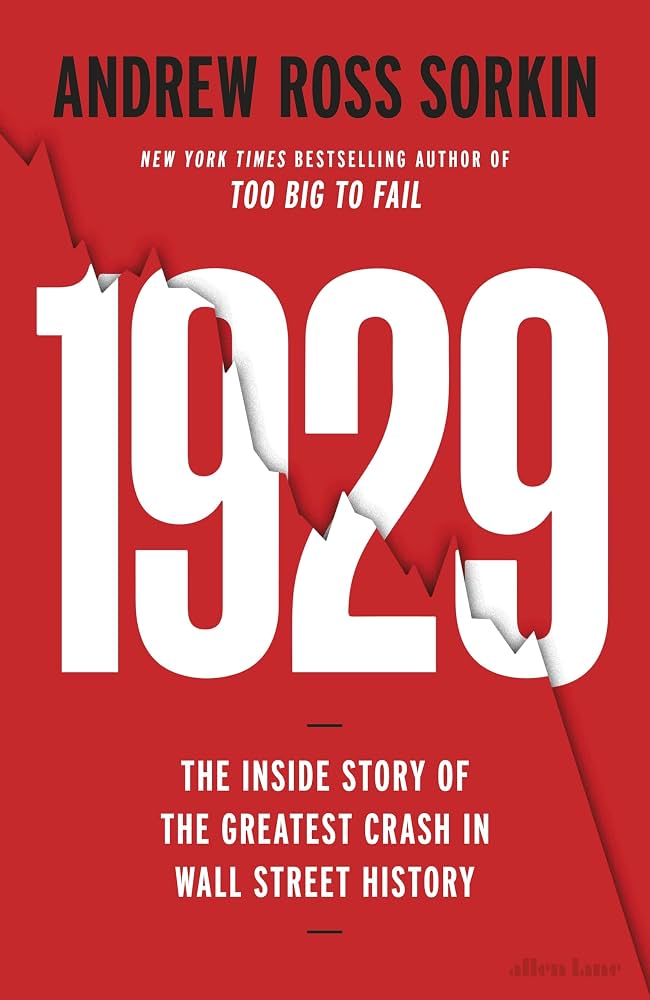
1929: The Inside Story of the Greatest Crash in Wall Street History by Andrew Ross Sorkin

රු3,200.00
3 X Rs. 1,066.67 or 8% Cashback with


or 3 X රු1,066.67 with


or up to 4 X රු800.00 with


From the bestselling author of Too Big to Fail comes a gripping account of the 1929 Wall Street Crash and the people, institutions and decisions behind one of history’s most consequential financial collapses.
Andrew Ross Sorkin takes readers inside the speculative boom, the battle between Wall Street and Washington, the psychology of investors and the dramatic collapse that helped reshape a generation.
A compelling read for fans of economic history, finance, business, Wall Street and narrative non-fiction.
Trade Paperback | 592 pages | Allen Lane / Penguin | ISBN 9780241798003
13 in stock
1929 by Andrew Ross Sorkin
1929: The Inside Story of the Greatest Crash in Wall Street History is an expansive work of financial and economic history by Andrew Ross Sorkin, bestselling author of Too Big to Fail.
Published in 2025, the book returns to one of the most consequential financial collapses in modern history: the Wall Street crash of 1929 and the extraordinary period of speculation, optimism, political conflict and financial ambition that surrounded it.
Rather than presenting the crash as a collection of stock-market statistics, Sorkin reconstructs the period as a human drama involving bankers, investors, politicians, regulators, entrepreneurs, sceptics and ordinary people who believed the extraordinary economic boom might continue indefinitely.
Penguin describes the book as an account of how the seemingly unstoppable Wall Street bull market entered a devastating freefall, destroying fortunes and contributing to an economic crisis that reshaped a generation.
Before the Crash
One of the central strengths of 1929 is its focus on the period before the collapse.
The crash did not appear from nowhere.
The United States had experienced extraordinary economic growth and technological change. Markets were rising, wealth appeared to be expanding and confidence in the future encouraged increasing levels of speculation.
For many investors, the belief that prosperity would continue seemed perfectly rational.
Sorkin explores how this atmosphere of confidence developed and how influential financial and political figures interpreted the warning signs appearing around them.
The book examines not only what happened when prices fell but also why intelligent, experienced people could convince themselves that the boom was sustainable.
That question gives the history clear relevance beyond the 1920s.
Wall Street, Washington and Financial Power
The story also moves beyond stock exchanges and trading floors.
Sorkin examines the relationship between Wall Street and Washington, showing how financial decisions, government policy and political pressures influenced one another before and during the crisis.
The official Penguin description emphasises the battle between Wall Street and Washington as one of the major strands of the narrative.
Readers encounter a financial system shaped by ambitious bankers, powerful institutions, political calculations and debates over how much governments should intervene when markets become unstable.
The result is both economic history and a broader story about institutions, incentives and power.
The People Behind the Numbers
Financial crashes are often explained using charts, percentages and market indexes.
1929 instead places people at the centre.
Sorkin follows what Penguin describes as a cast of visionaries, fraudsters, titans and dreamers, exploring the ambitions and assumptions that shaped their decisions.
Some believed deeply in the continued expansion of the American economy.
Others recognised danger but struggled to convince investors and decision-makers that the situation could not continue.
This narrative approach allows readers to understand the crash not merely as an abstract economic event but as the result of millions of decisions made under conditions of optimism, fear, uncertainty and financial pressure.
Speculation and the Belief That “This Time Is Different”
One of the book’s recurring ideas is the seductive belief that old financial rules no longer apply.
During powerful market booms, rising prices can reinforce the assumption that further increases are inevitable.
When enough people share that expectation, speculation can intensify.
Sorkin uses the history of 1929 to explore how optimism can become self-reinforcing, how warning signs can be ignored and how influential people can underestimate the possibility of a severe reversal.
Penguin describes the book as a study of power, psychology and the illusion that “this time is different.”
That psychological dimension is important because financial markets are not driven solely by mathematical models. They are also influenced by confidence, fear, competition, herd behaviour and expectations about what other investors will do.
The Crash and Its Consequences
When the boom finally collapsed, the effects spread far beyond investors who owned shares.
Fortunes disappeared, businesses struggled and the financial crisis became part of a much broader economic downturn.
The crash is closely associated with the beginning of the Great Depression, although historians generally distinguish the stock-market collapse itself from the multiple banking, monetary, policy and international factors that deepened the Depression.
Sorkin’s account focuses on the people, institutions and decisions surrounding the market collapse while tracing the broader consequences that followed.
This distinction is useful for readers because it avoids reducing the Great Depression to a single day or single financial event.
Is 1929 a Finance Guide?
No.
1929 is primarily narrative history and economic history, not a book offering personal investment recommendations.
Readers may draw lessons from the historical patterns Sorkin describes, but the book should not be presented as financial advice or as a formula for predicting future crashes.
Financial markets operate under different regulations, technologies, institutions and economic conditions today.
The value of the book lies in understanding historical behaviour, institutional decisions and recurring patterns of speculation rather than assuming history will repeat in an identical way.
Themes in 1929
Major themes include:
- The Wall Street Crash of 1929
- Financial speculation
- Market psychology
- Economic bubbles
- Banking and finance
- Wall Street and government
- Wealth and power
- Political decision-making
- Investor confidence
- Financial regulation
- The Great Depression
- Economic history
- Financial crises
- Human behaviour during booms and crashes
About Andrew Ross Sorkin
Andrew Ross Sorkin is an award-winning financial journalist, author and television presenter.
Penguin Random House identifies him as a journalist for The New York Times, co-anchor of CNBC’s Squawk Box, and founder and editor at large of DealBook, the financial-news platform he created in 2001. He is also the bestselling author of Too Big to Fail and co-creator of the television drama Billions.
His previous book, Too Big to Fail, examined the 2008 financial crisis. With 1929, Sorkin turns to an earlier market collapse and again uses detailed reporting and narrative storytelling to explain how a financial system moved from confidence to crisis.
Recognition
The US edition became a #1 New York Times bestseller and was selected as a notable or best book of 2025 by several major publications. Penguin Random House also notes recognition from outlets including The Washington Post, TIME, The Economist and Bloomberg.
The work therefore appeals not only to specialist finance readers but also to general readers interested in history and narrative non-fiction.
Who Will Enjoy 1929?
This book is particularly suitable for readers interested in:
- Economic history
- Wall Street history
- The Great Depression
- Stock-market crashes
- Financial crises
- Banking history
- Business and economics
- Narrative non-fiction
- Market psychology
- Andrew Ross Sorkin’s Too Big to Fail
At 592 pages, it is a substantial work, making it especially suitable for readers who want an in-depth narrative rather than a brief introduction to the crash.
Buy 1929 in Sri Lanka
For customers looking to buy 1929 by Andrew Ross Sorkin in Sri Lanka, ISBN 9780241798003 is the large-format Allen Lane trade paperback edition.
Its combination of financial history, political conflict and character-driven storytelling makes it a strong choice for readers interested in understanding how periods of apparently unstoppable prosperity can give way to financial crisis—and why warning signs can be surprisingly easy to ignore.
Be the first to review “1929: The Inside Story of the Greatest Crash in Wall Street History by Andrew Ross Sorkin”
Related products
Business, Finance & Economics
රු2,500.00
3 X Rs. 833.33 or 8% Cashback with
or 3 X රු833.33 with
or up to 4 X රු625.00 with
Out of stock
Business, Finance & Economics
රු2,750.00
3 X Rs. 916.67 or 8% Cashback with
or 3 X රු916.67 with
or up to 4 X රු687.50 with
-31%
Business, Finance & Economics
Original price was: රු1,600.00.රු1,100.00Current price is: රු1,100.00.
3 X Rs. 366.67 or 8% Cashback with
or 3 X රු366.67 with
or up to 4 X රු275.00 with

Business
රු2,700.00
3 X Rs. 900.00 or 8% Cashback with
or 3 X රු900.00 with
or up to 4 X රු675.00 with

3 X Rs. 0.00 or 8% Cashback with
or 3 X රු0.00 with
or up to 4 X රු0.00 with
-16%
Business, Finance & Economics
Original price was: රු3,150.00.රු2,650.00Current price is: රු2,650.00.
3 X Rs. 883.33 or 8% Cashback with
or 3 X රු883.33 with
or up to 4 X රු662.50 with
Out of stock
රු1,750.00
3 X Rs. 583.33 or 8% Cashback with
or 3 X රු583.33 with
or up to 4 X රු437.50 with
Out of stock
රු2,500.00
3 X Rs. 833.33 or 8% Cashback with
or 3 X රු833.33 with
or up to 4 X රු625.00 with
Reviews
There are no reviews yet.