
No products in the cart.
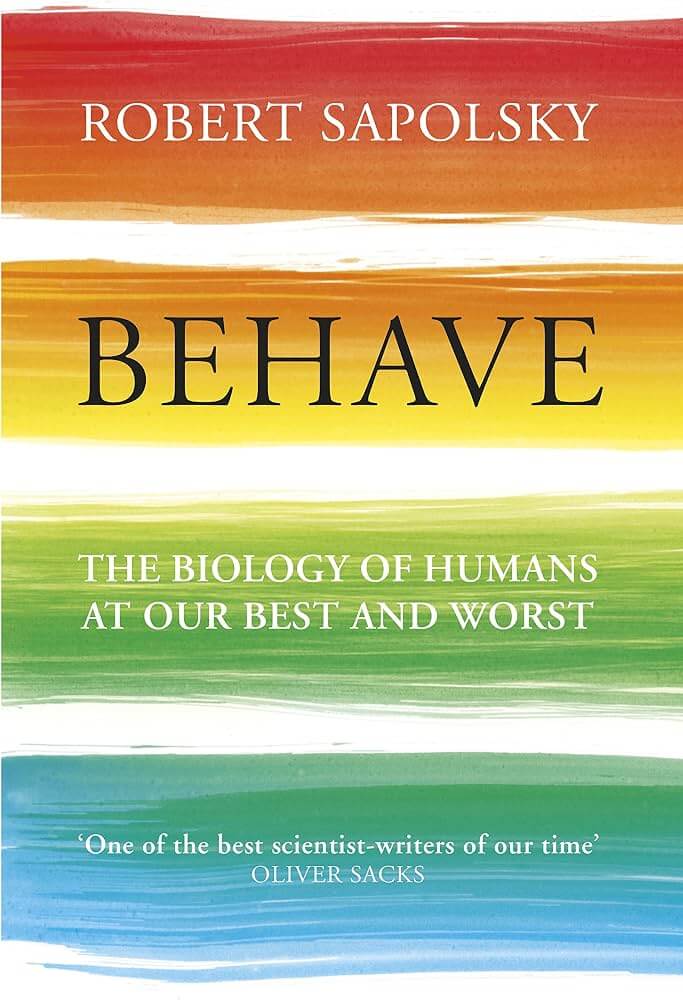
Behave: The Biology of Humans at Our Best and Worst by Robert M. Sapolsky
රු2,950.00
3 X Rs. 983.33 or 8% Cashback with


or 3 X රු983.33 with


or up to 4 X රු737.50 with


Why do humans behave as they do?
In Behave, neuroscientist and biologist Robert M. Sapolsky explores human behaviour across an extraordinary range of causes—from what happens in the brain seconds before an action to hormones, childhood, genetics, culture and evolutionary history.
The book examines:
- Neuroscience and the brain
- Hormones and behaviour
- Genetics and environment
- Childhood and adolescence
- Aggression and compassion
- Tribalism and prejudice
- Morality
- Culture and evolution
- Cooperation and competition
- Free will and responsibility
A major work of popular science for readers interested in psychology, neuroscience, biology and human nature.
Paperback | 800 pages | Vintage | ISBN 9780099575061
10 in stock
Behave by Robert M. Sapolsky
Behave: The Biology of Humans at Our Best and Worst by Robert M. Sapolsky is an ambitious exploration of one of the most difficult questions in science:
Why do human beings behave the way they do?
Rather than offering a single explanation for aggression, compassion, morality, prejudice or cooperation, Sapolsky examines behaviour across multiple levels of cause—from what happens in the brain a fraction of a second before an action to the effects of hormones, childhood, culture, genetics and evolutionary history.
Penguin describes the book as a synthesis of the science of human behaviour and highlights Sapolsky’s central method: tracing behaviour backwards through layers of causation spanning seconds, days, years, generations and eventually evolutionary time.
Understanding Behaviour Across Time
One of the most distinctive aspects of Behave is its structure.
Sapolsky begins with a behaviour that has already occurred.
Then he works backwards.
He asks:
- What happened in the brain immediately before the behaviour?
- What sensory information arrived seconds earlier?
- What hormonal conditions influenced the person?
- What experiences shaped the brain during adolescence?
- What happened during childhood?
- How might prenatal development have influenced later behaviour?
- What genetic variations matter?
- What cultural forces shaped the individual?
- What evolutionary pressures influenced the species?
This layered approach is one of the reasons the book is much broader than a conventional neuroscience or psychology title.
It combines material from:
- Neuroscience
- Biology
- Endocrinology
- Genetics
- Psychology
- Primatology
- Anthropology
- Sociology
- Evolution
- History
- Moral philosophy
Google Books similarly classifies the work across evolutionary psychology, physiological psychology, biology, evolution, genetics and philosophy.
The Brain and Immediate Behaviour
Sapolsky begins close to the moment of action.
The brain and nervous system can rapidly influence whether someone responds with fear, aggression, empathy, restraint or cooperation.
But Sapolsky repeatedly warns against simplistic explanations such as saying that one brain region “causes” violence or another “creates” morality.
Human behaviour emerges from interactions among many systems.
Context matters.
A biological mechanism that contributes to one behaviour in one setting may contribute to something entirely different in another.
That complexity is central to the book’s approach.
Hormones and Behaviour
Hormones are another major subject.
Popular culture often treats hormones such as testosterone or cortisol as simple switches that directly cause aggression, stress or particular personality traits.
Sapolsky presents a more complicated picture.
Hormones can influence behaviour, but their effects depend heavily on context, prior experience, social environment and the brain systems already active.
This prevents the discussion from becoming biologically deterministic.
The book repeatedly shows that biological factors matter enormously while still interacting with learning, culture and environment.
Childhood and Adolescence
Sapolsky then moves further back in time.
Childhood experiences affect brain development, emotional regulation, stress responses and social behaviour.
Adolescence receives particular attention because the teenage brain undergoes major developmental changes involving reward, risk-taking, impulse control and social sensitivity.
Sapolsky discusses how the biological changes of adolescence interact with family, culture, peers and social expectations.
The book’s strength lies in repeatedly connecting different levels of explanation rather than treating biology and environment as competing explanations.
Genetics Without Genetic Determinism
Genetics plays a substantial role in the book, but Behave does not argue that behaviour is simply “written in our genes.”
Instead, Sapolsky explains how genes interact with environment.
A particular genetic variant may have different effects depending on childhood conditions, stress, social experience or other biological factors.
This gene-environment interaction helps explain why the same biological predisposition does not produce identical outcomes in every person.
The book therefore challenges simplistic claims that a single gene explains complex behaviours such as violence, generosity or intelligence.
Culture and Human Behaviour
Human beings are deeply cultural animals.
Sapolsky examines how social norms, traditions, institutions and historical conditions influence behaviour.
Questions considered throughout the book include:
- Why do people divide themselves into groups?
- How does tribalism develop?
- Why do humans create hierarchies?
- What encourages cooperation?
- What produces prejudice?
- How do moral systems develop?
- Why can ordinary people participate in cruelty?
- Why can others perform extraordinary acts of compassion?
Penguin specifically highlights the book’s exploration of morality, war, peace, justice, persecution and the relationship between biological evolution and culture.
Aggression and Compassion
One of Sapolsky’s recurring themes is the contrast between humanity’s capacity for brutality and its capacity for kindness.
Human beings can commit violence, discriminate against outsiders and create oppressive systems.
But the same species can also cooperate, forgive, rescue strangers and make enormous sacrifices for others.
Behave does not reduce these behaviours to a simple battle between “good” and “bad” instincts.
Instead, Sapolsky explores the biological and social mechanisms that make both possible.
This makes the book particularly valuable for readers interested in the science behind:
- Aggression
- Empathy
- Altruism
- Cooperation
- Competition
- Prejudice
- Morality
- Group identity
- Punishment
- Forgiveness
Us Versus Them
Sapolsky devotes considerable attention to how humans categorise people into groups.
These divisions can form rapidly and around surprisingly arbitrary distinctions.
Once an “us” and “them” divide develops, perception, empathy and moral judgement can shift.
The book examines how biology interacts with social learning and cultural narratives to reinforce group identity.
This discussion connects neuroscience with politics, history, religion, nationalism and social conflict without suggesting that any single factor explains them all.
Free Will and Responsibility
Behave also addresses questions surrounding free will.
If behaviour is influenced by brain chemistry, hormones, genes, childhood experiences and culture, what does that mean for moral responsibility?
Sapolsky explores this question through neuroscience and biology.
Readers should note that debates about free will extend beyond empirical science into philosophy, ethics and law, and Sapolsky’s conclusions represent his interpretation of the evidence rather than an uncontested scientific settlement.
His later book Determined develops these ideas about free will in greater depth.
Science for General Readers
Despite its size—800 pages in this edition—Behave is written for a broad audience.
Sapolsky combines scientific research with anecdotes, humour and real-world examples.
Penguin quotes reviewers praising the book’s combination of scholarly depth and accessibility, while Foyles describes it as a multidisciplinary journey through the immediate and long-term causes of behaviour.
Readers do not need professional training in neuroscience or biology to begin the book, although its level of detail is much deeper than a light popular-psychology title.
About Robert M. Sapolsky
Robert M. Sapolsky is a professor of biology and neurology at Stanford University and a researcher known for work on stress, neuroscience, primates and human behaviour.
Penguin notes that he has degrees from Harvard and Rockefeller Universities and has also worked with the Institute of Primate Research at the National Museums of Kenya.
His other major books include:
- Why Zebras Don’t Get Ulcers
- A Primate’s Memoir
- The Trouble with Testosterone
- Determined
His ability to combine neuroscience, biology and social analysis has made him one of the better-known science writers working on human behaviour.
Who Will Enjoy Behave?
This book may particularly appeal to readers interested in:
- Neuroscience
- Psychology
- Human behaviour
- Biology
- Evolution
- Genetics
- Anthropology
- Sociology
- Morality
- Aggression and cooperation
- Human nature
- Popular science
It is especially suitable for readers who want a deep, multidisciplinary explanation rather than a simplified behavioural guide.
Buy Behave in Sri Lanka
For readers looking to buy Behave by Robert M. Sapolsky in Sri Lanka, ISBN 9780099575061 is the Vintage paperback edition with 800 pages.
Sri Lankan booksellers also currently catalogue this exact ISBN as a Vintage paperback, confirming that this edition circulates in the local market.
It is a substantial but accessible work for anyone interested in understanding how brains, hormones, genes, development, society, culture and evolution combine to shape human behaviour.
Be the first to review “Behave: The Biology of Humans at Our Best and Worst by Robert M. Sapolsky”
Related products
-24%

Non-Fiction & Knowledge
Original price was: රු2,300.00.රු1,750.00Current price is: රු1,750.00.
3 X Rs. 583.33 or 8% Cashback with
or 3 X රු583.33 with
or up to 4 X රු437.50 with
Out of stock
Non-Fiction & Knowledge
රු1,500.00
3 X Rs. 500.00 or 8% Cashback with
or 3 X රු500.00 with
or up to 4 X රු375.00 with

Non-Fiction & Knowledge
රු2,800.00
3 X Rs. 933.33 or 8% Cashback with
or 3 X රු933.33 with
or up to 4 X රු700.00 with

රු1,950.00
3 X Rs. 650.00 or 8% Cashback with
or 3 X රු650.00 with
or up to 4 X රු487.50 with
-24%

Out of stock
Non-Fiction & Knowledge
Original price was: රු2,500.00.රු1,900.00Current price is: රු1,900.00.
3 X Rs. 633.33 or 8% Cashback with
or 3 X රු633.33 with
or up to 4 X රු475.00 with

Psychology
රු2,950.00
3 X Rs. 983.33 or 8% Cashback with
or 3 X රු983.33 with
or up to 4 X රු737.50 with

Out of stock
Non-Fiction & Knowledge
The Decision Book : 50 Models for Strategic Thinking by Mikael Krogerus
රු1,550.00
3 X Rs. 516.67 or 8% Cashback with
or 3 X රු516.67 with
or up to 4 X රු387.50 with

රු2,200.00
3 X Rs. 733.33 or 8% Cashback with
or 3 X රු733.33 with
or up to 4 X රු550.00 with
Reviews
There are no reviews yet.