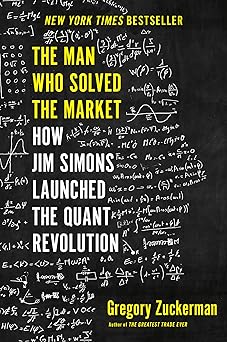
The Man Who Solved the Market by Gregory Zuckerman is a fascinating business and investing biography about mathematician Jim Simons, Renaissance Technologies and the revolutionary use of mathematics, data and algorithms in financial markets.
For generations, investors tried to beat markets by studying:
Companies.
Management teams.
Economic conditions.
Industries.
Financial statements.
News.
Jim Simons approached the problem differently.
He believed markets contained patterns.
And if those patterns could be discovered through:
Mathematics.
Statistics.
Computer models.
Large amounts of data.
Scientific testing.
they might create profitable trading opportunities.
Simons was not originally a traditional Wall Street investor.
He was a mathematician.
He recruited mathematicians, physicists, computer scientists and researchers—many with little conventional investing experience—and built a firm that treated financial markets almost like a scientific laboratory.
That firm became Renaissance Technologies.
At its center was the legendary Medallion Fund, which became famous for extraordinary long-term investment performance.
But The Man Who Solved the Market by Gregory Zuckerman is not simply a story about making money.
It is also about:
Mathematics.
Technology.
Artificial intelligence.
Data.
Leadership.
Competition.
Secrecy.
Research culture.
Failure.
Risk.
Human behavior.
Politics.
Wealth.
And the enormous consequences of building a financial machine that appears capable of discovering patterns ordinary investors cannot see.
For readers interested in investing, hedge funds, quantitative finance, mathematics, technology and remarkable business stories, this is one of the most compelling accounts of modern financial innovation.
The Man Who Solved the Market by Gregory Zuckerman – Book Overview
The Man Who Solved the Market by Gregory Zuckerman follows the life and career of Jim Simons, one of the most successful quantitative investors in modern finance.
Simons began as a gifted mathematician.
His academic work involved advanced mathematics.
He also worked in government code-breaking before eventually becoming more interested in financial markets.
Instead of trying to become a traditional stock picker, Simons developed another idea.
Markets generate enormous amounts of information.
Prices move.
Volumes change.
Relationships appear and disappear.
Could computers identify patterns hidden inside that data?
That question became the foundation of Renaissance Technologies.
Who Was Jim Simons?
Jim Simons was an American mathematician, investor and philanthropist.
Before becoming famous in finance, he built a respected career in mathematics.
His unusual background helped shape his approach to investing.
He did not begin by asking:
Which company has the best CEO?
He asked questions closer to:
What does the data show?
Is there a repeatable statistical relationship?
Can the pattern be tested?
Does it remain profitable after costs?
That scientific mindset became central to Renaissance.
Mathematics Meets Wall Street
Traditional investing often involves stories.
This company will grow.
This industry will improve.
This economy will recover.
Quantitative investing tries to reduce dependence on stories.
Instead, models examine numerical relationships.
The goal is to find measurable patterns.
Quantitative Investing
Quantitative investing uses:
Mathematics.
Statistics.
Computer programming.
Historical data.
Algorithms.
Models.
to make investment decisions.
The approach can involve thousands or millions of calculations that would be impossible for humans to perform manually.
Data Before Opinions
One of the strongest themes in The Man Who Solved the Market by Gregory Zuckerman is the importance of trusting evidence.
Humans naturally create explanations.
A stock rises.
We invent a reason.
A market falls.
We create another story.
But stories can be wrong.
Data provides another perspective.
Renaissance Technologies
Renaissance Technologies became one of the world’s most famous quantitative investment firms.
What made the company unusual was not only its trading methods.
It was its people.
Simons recruited researchers from disciplines such as:
Mathematics.
Physics.
Statistics.
Computer science.
Signal processing.
Many were not traditional Wall Street professionals.
That was intentional.
Hire Brilliant Problem Solvers
Simons often preferred people who knew how to solve difficult problems rather than people who simply understood conventional finance.
Why?
Because conventional thinking can sometimes create conventional results.
A mathematician may see the market differently from a banker.
A physicist may notice patterns others ignore.
The Medallion Fund
The most famous product associated with Renaissance is the Medallion Fund.
Medallion became legendary because of its investment performance.
Over time, access became largely restricted to Renaissance employees and insiders.
Its results made Simons and his colleagues enormously wealthy.
Why Medallion Became So Famous
Many professional investors struggle to outperform markets consistently.
Medallion managed to produce remarkable results over long periods.
That attracted enormous curiosity.
What exactly was Renaissance doing?
Which signals worked?
Which markets?
Which algorithms?
The answers remained highly secret.
Secrecy
Secrecy became part of Renaissance’s culture.
A successful trading strategy can become less valuable if everyone begins using it.
If competitors discover the same pattern, they may trade before you.
Eventually the opportunity can disappear.
Knowledge therefore became an asset.
Competitive Advantage
Every business needs some form of competitive advantage.
For Renaissance, advantages included:
Research.
Talent.
Data.
Technology.
Models.
Execution.
Secrecy.
The combination mattered more than any single formula.
There Was No One Magic Formula
One misunderstanding would be imagining Simons discovered one perfect mathematical equation that solved financial markets forever.
The reality was much more complicated.
Markets change.
Patterns weaken.
Competitors adapt.
Strategies require constant improvement.
Success came from a research process.
Research Culture
Renaissance operated more like a scientific organization than a traditional investment firm.
Researchers could:
Propose ideas.
Test them.
Challenge them.
Analyze results.
Reject weak theories.
Improve promising signals.
This culture helped transform investing into an ongoing research problem.
Test Everything
An attractive theory is not enough.
Does it work in the data?
That question is fundamental.
A strategy may sound intelligent but fail when tested historically.
Conversely, a strange pattern may look meaningless yet produce useful predictive information.
Backtesting
Quantitative researchers often test strategies against historical data.
This process is known as backtesting.
The goal is to ask:
If we had used this strategy in the past, what might have happened?
But backtesting contains dangers.
Overfitting
One major danger is creating a model that perfectly explains historical data but fails in the future.
This is called overfitting.
A model may accidentally learn noise rather than a genuine repeatable pattern.
Good quantitative research therefore requires skepticism.
Correlation Does Not Always Mean Prediction
Data can produce countless relationships.
But not every relationship matters.
Two variables may move together by coincidence.
Researchers must determine whether a pattern is:
Real.
Repeatable.
Economically useful.
Stable enough to trade.
Small Edges
A trading strategy does not necessarily need to predict markets perfectly.
It may only need a small statistical advantage.
If a model is slightly more likely to be correct than incorrect, and that edge can be repeated many times while controlling risk, the results can become powerful.
Repeatability
This is one reason computer-driven trading can be effective.
Humans become:
Tired.
Emotional.
Distracted.
Overconfident.
A computer can follow the same rules repeatedly.
Human Emotion
Fear and greed influence financial markets.
Humans chase trends.
Panic.
Become overly optimistic.
Respond emotionally to news.
Quantitative models sometimes try to exploit predictable patterns created by these behaviors.
Remove Emotion From Decisions
A systematic strategy can reduce emotional decision-making.
Instead of asking:
“Do I feel confident?”
the system asks:
“Does the signal meet the rules?”
That difference can create discipline.
Discipline
One important lesson from The Man Who Solved the Market by Gregory Zuckerman is that success depends on disciplined execution.
A model is useless if the investor constantly ignores it because of emotion.
Systems only work when they are followed appropriately.
Technology
Renaissance’s story is also a technology story.
Financial markets generate enormous data streams.
Computers allow researchers to:
Store data.
Clean data.
Analyze patterns.
Run models.
Execute trades.
Monitor risk.
As computing power improved, quantitative investing became increasingly sophisticated.
Better Data Can Create Better Decisions
Data quality matters.
If the data is incorrect, the model may produce incorrect conclusions.
Researchers need to understand:
Missing information.
Errors.
Changing market structures.
Historical inconsistencies.
Data cleaning can be as important as model building.
Garbage In, Garbage Out
A brilliant algorithm using bad data can still fail.
This principle applies far beyond investing.
Businesses should ask:
Is our information reliable?
Before trusting:
Reports.
Forecasts.
AI systems.
Dashboards.
Analytics.
Algorithms
Algorithms are sets of rules used to solve problems or make decisions.
In trading, algorithms can determine:
When to buy.
When to sell.
How much to trade.
How to manage risk.
How to respond to changing conditions.
Speed
As markets became more computerized, speed became increasingly important.
A profitable signal may disappear quickly.
Fast:
Analysis.
Execution.
Technology.
can therefore become competitive advantages.
Markets Are Dynamic
A strategy that worked yesterday may not work forever.
Other investors learn.
Regulations change.
Technology evolves.
Market participants adapt.
This means constant research is required.
Adaptation
Renaissance’s success depended not only on finding patterns.
It also depended on continuously finding new ones.
This is a lesson relevant to every business.
Competitive advantages decay.
Companies must keep improving.
Failure
Jim Simons did not achieve perfect success immediately.
The journey involved:
Bad periods.
Wrong approaches.
Disagreements.
Research failures.
Personnel problems.
Trading losses.
The final success can make the earlier uncertainty easy to forget.
Persistence
Building Renaissance took years.
The company had to experiment repeatedly.
This reinforces an important business lesson:
Successful systems often emerge from many failed attempts.
Learn From Mistakes
A research culture treats mistakes differently.
Instead of asking:
Who should we blame?
ask:
Why did this happen?
What did the model miss?
What assumption failed?
What can we improve?
Scientific Thinking
Scientific thinking involves:
Hypothesis.
Testing.
Evidence.
Revision.
A scientist should be willing to abandon a favorite idea if evidence contradicts it.
That intellectual flexibility became important at Renaissance.
Ego Versus Evidence
Highly intelligent people can still become emotionally attached to ideas.
The challenge is allowing data to prove you wrong.
A good researcher should be able to say:
“My theory was wrong.”
That is progress.
Collaboration
Renaissance also benefited from collaboration.
Complex problems often require many specialists.
One researcher may understand:
Statistics.
Another:
Programming.
Another:
Market structure.
Another:
Data.
Together they create something stronger.
Sharing Knowledge Internally
Some investment firms encourage individuals to compete against each other.
Renaissance developed a culture where researchers could benefit from shared knowledge.
That allowed discoveries to compound.
Teams Beat Lone Geniuses
Jim Simons was extraordinarily talented.
But Renaissance was not built by Simons alone.
Its success depended on teams of:
Scientists.
Mathematicians.
Programmers.
Researchers.
Managers.
Execution specialists.
This is an important leadership lesson.
Leadership
Simons’ leadership strength was not simply solving every problem himself.
It involved identifying extraordinary people and creating an environment where they could solve problems together.
Hire People Smarter Than You
Great leaders do not need to be the smartest person in every room.
They need to build rooms filled with excellent people.
This is one of the most valuable lessons from The Man Who Solved the Market by Gregory Zuckerman.
Intellectual Diversity
Different academic backgrounds create different mental models.
A statistician.
A physicist.
A computer scientist.
may approach the same problem differently.
That diversity can create innovation.
Conventional Expertise Can Become a Limitation
Expertise is valuable.
But experts can also become attached to existing methods.
Outsiders sometimes ask questions insiders no longer ask.
Why must it work this way?
Can data reveal something different?
Wall Street Versus Science
Traditional Wall Street culture historically emphasized:
Traders.
Analysts.
Economic opinions.
Company research.
Relationships.
Renaissance introduced a culture that looked more like:
A university.
A laboratory.
A technology company.
That cultural difference became powerful.
Patterns
Financial markets contain enormous complexity.
Millions of people make decisions.
Companies release information.
Governments change policy.
Investors react.
Prices move.
Simons believed this complexity could still contain patterns.
Signal Versus Noise
One of the central problems in quantitative finance is separating signal from noise.
Noise is random movement.
Signal contains useful information.
Finding a true signal inside massive amounts of noise is difficult.
That is where mathematics becomes valuable.
Probability
Quantitative investing is rarely about certainty.
It is about probability.
The model may say:
This outcome is slightly more likely than another.
That is very different from claiming:
This will definitely happen.
Think Probabilistically
Probability is useful far beyond investing.
Business decisions rarely have guaranteed outcomes.
Instead, managers estimate:
Likelihood.
Risk.
Potential reward.
Possible downside.
Thinking probabilistically can improve decision-making.
Risk Management
Investment success is not simply about generating profits.
It is also about controlling losses.
A strategy that earns enormous profits but occasionally risks complete destruction is dangerous.
Risk management is essential.
Diversification
One way quantitative systems manage uncertainty is by spreading trades across many:
Markets.
Instruments.
Signals.
Time periods.
No single prediction must be perfect.
Position Sizing
How much money is placed behind an idea can matter as much as the idea itself.
A good prediction with reckless sizing can still create disaster.
This is another universal financial lesson.
Survival First
In markets, surviving bad periods is crucial.
If you lose all your capital, you cannot benefit when conditions improve.
Risk management preserves the ability to continue.
Long-Term Thinking
Renaissance’s success accumulated over years.
Compounding transforms small advantages into enormous outcomes.
This is one of the most powerful forces in finance.
Compounding
If capital grows and returns are reinvested, future gains can build upon previous gains.
Over long periods, compounding can create dramatic differences.
But losses also compound negatively.
Risk still matters.
Wealth
Renaissance’s success created extraordinary personal wealth for Simons and others.
The book therefore also explores what happens when intellectual achievement produces enormous financial power.
Philanthropy
Jim Simons became known not only for investing but also for philanthropy, particularly support for:
Science.
Mathematics.
Education.
Research.
His later life shows another way financial success can influence society.
Money and Purpose
The ability to generate wealth creates another question:
What should wealth be used for?
Personal consumption?
Investment?
Scientific research?
Charity?
Political influence?
Different individuals answer differently.
Politics
The book also explores the political activities and beliefs of people associated with Renaissance.
Employees and former leaders used wealth to support political causes across different parts of the political spectrum.
This adds another dimension to the story.
Robert Mercer
One notable Renaissance figure discussed in the book is Robert Mercer, a computer scientist who became highly influential inside the firm.
He later became known publicly for political involvement.
His story demonstrates how wealth created through finance can eventually influence areas far beyond markets.
Peter Brown
Another major Renaissance figure is Peter Brown, who became deeply involved in the firm’s research and leadership.
Like several important Renaissance employees, he came from a scientific and computational background rather than traditional Wall Street investing.
Extraordinary People
One reason The Man Who Solved the Market by Gregory Zuckerman is so engaging is the cast of unusual characters.
These are not typical investment bankers.
They are:
Mathematicians.
Code breakers.
Scientists.
Computer researchers.
They approach money as a difficult intellectual puzzle.
The Power of Curiosity
Many of Renaissance’s breakthroughs began with curiosity.
Why does this pattern occur?
Could this relationship predict something?
What happens if we combine these signals?
Curiosity drives research.
Ask Better Questions
The quality of answers often depends on the quality of questions.
Instead of:
Which stock should I buy?
a quantitative researcher might ask:
What measurable relationships have predictive value across thousands of observations?
That is a completely different problem.
Systems Thinking
Renaissance did not depend entirely on individual intuition.
It built systems.
Systems allow:
Consistency.
Measurement.
Testing.
Improvement.
Scale.
This principle applies directly to business.
Build Processes That Can Improve
A strong business process should generate information.
That information should reveal:
What works.
What fails.
What needs improvement.
Then the system becomes better over time.
Lessons for Entrepreneurs
Entrepreneurs can learn from Renaissance even if they never invest in markets.
Use data.
Test ideas.
Hire excellent people.
Create systems.
Measure results.
Challenge assumptions.
Learn from failure.
Protect genuine competitive advantages.
Lessons for Managers
Managers can also apply these ideas.
Do not make every decision from intuition.
Ask:
What does our data show?
What assumptions are we making?
Can we run an experiment?
What result would prove us wrong?
Lessons for Technology Teams
Renaissance demonstrates the enormous value of combining:
Domain problems.
Software.
Statistics.
Automation.
A strong technology system can transform an entire industry’s economics.
Lessons for Investors
Investors may learn something surprising from The Man Who Solved the Market by Gregory Zuckerman.
The lesson is not:
“Copy Jim Simons’ trades.”
The book does not provide the secret Renaissance algorithms.
Instead, it demonstrates how difficult consistent market-beating performance actually is.
This Is Not a Trading Manual
Readers should understand that The Man Who Solved the Market by Gregory Zuckerman is primarily:
A biography.
A business story.
A history of quantitative investing.
It is not a step-by-step strategy for reproducing Medallion’s returns.
The proprietary Renaissance models remain secret.
No Guaranteed Investment Strategy
No book can guarantee profits in financial markets.
Historical success does not ensure future returns.
Readers should not interpret descriptions of Renaissance’s results as evidence that any particular quantitative strategy will automatically work.
Investing Involves Risk
Financial markets can produce substantial losses.
Anyone making investment decisions should consider:
Personal financial circumstances.
Risk tolerance.
Time horizon.
Diversification.
Professional financial advice where appropriate.
Why Ordinary Investors Cannot Simply Copy Renaissance
Renaissance possessed resources that ordinary investors generally do not have.
These include:
Elite researchers.
Large datasets.
Advanced technology.
Sophisticated execution.
Years of proprietary research.
Specialized infrastructure.
The lesson is therefore about process and thinking rather than copying specific trades.
Is The Man Who Solved the Market About Jim Simons?
Yes.
Jim Simons is the central figure.
But the book also tells the story of the people and culture behind Renaissance Technologies.
It therefore functions as both:
A biography.
And an organizational history.
Is It a Finance Book?
Yes.
It is especially relevant to readers interested in:
Investing.
Hedge funds.
Quantitative finance.
Trading.
Financial markets.
But readers do not need an advanced finance background to understand the main story.
Is It a Mathematics Book?
Mathematics plays a major role, but the book is not a textbook.
Readers are not expected to solve complex equations.
The focus is on how mathematicians used scientific thinking to approach markets.
Is It Good for Beginners?
Yes, particularly beginners curious about hedge funds and quantitative investing.
The narrative format makes complex ideas easier to understand.
However, it should not be viewed as an introductory course in personal investing.
Who Is Gregory Zuckerman?
Gregory Zuckerman is a financial journalist and author known for writing about:
Wall Street.
Investing.
Business.
Financial markets.
His journalistic approach allows the book to combine technical financial history with personal stories.
Why the Story Matters
The story matters because Renaissance helped demonstrate that financial markets could be approached in a radically different way.
Today, algorithmic and quantitative investing are major parts of finance.
But when Simons began, the idea of letting mathematical models drive investment decisions was much more unusual.
Data-Driven Finance
Modern finance increasingly relies on:
Machine learning.
Alternative data.
Algorithms.
High-speed computing.
Automation.
Statistical models.
Renaissance’s history helps readers understand part of the evolution toward this world.
Artificial Intelligence Connection
Modern readers interested in AI may find the book especially relevant.
The core mindset—using massive datasets and mathematical models to detect subtle patterns—is closely related to ideas that appear throughout modern machine learning.
However, quantitative trading and AI are not exactly the same thing.
Humans Still Matter
Even highly automated systems are created by people.
Humans decide:
What data to use.
How to test models.
How much risk to accept.
When systems need adjustment.
Technology does not eliminate human responsibility.
The Danger of Blindly Trusting Models
Models are representations of reality.
They are not reality itself.
Unexpected events can occur.
Relationships can break.
Markets can behave differently.
Good quantitative investors therefore need both:
Confidence in systems.
And humility about uncertainty.
7 Powerful Investing Lessons From The Man Who Solved the Market by Gregory Zuckerman
There are many lessons in The Man Who Solved the Market by Gregory Zuckerman, but seven stand out:
- Data can reveal opportunities that intuition misses – Renaissance built its advantage by searching massive datasets for repeatable patterns rather than relying only on traditional investment stories.
- Small statistical edges can become powerful when repeated – A strategy does not need perfect predictions if it has a genuine advantage, disciplined execution and effective risk management.
- Hire exceptional problem solvers – Jim Simons built Renaissance by recruiting mathematicians, physicists and computer scientists capable of approaching markets from unconventional perspectives.
- Test ideas instead of falling in love with them – Scientific thinking requires evidence. A beautiful theory must be abandoned when the data shows it does not work.
- Systems can outperform inconsistent human behavior – Automated rules can reduce the influence of fear, greed, fatigue and other emotions that damage investment decisions.
- Competitive advantages require constant improvement – Market patterns disappear, competitors adapt and technology changes. Successful organizations must continue researching and evolving.
- Risk management matters as much as finding opportunities – A profitable strategy is useless if one uncontrolled loss destroys the entire operation.
Why Read The Man Who Solved the Market by Gregory Zuckerman?
The Man Who Solved the Market by Gregory Zuckerman is an excellent choice for readers interested in:
- Jim Simons
- Renaissance Technologies
- Medallion Fund
- Quantitative investing
- Hedge funds
- Financial markets
- Algorithmic trading
- Mathematics
- Statistics
- Data science
- Artificial intelligence
- Machine learning
- Investing
- Business biographies
- Wall Street
- Technology
- Risk management
- Scientific thinking
- Business strategy
- Wealth creation
It is particularly valuable for readers fascinated by the intersection of mathematics, technology and money.
Who Should Read This Book?
The Man Who Solved the Market by Gregory Zuckerman may especially appeal to:
- Investors
- Finance students
- Business students
- Entrepreneurs
- Data scientists
- Software engineers
- Mathematicians
- Traders
- Technology professionals
- Hedge-fund enthusiasts
- Readers interested in Wall Street
- Readers who enjoy business biographies
- AI and machine-learning enthusiasts
- Managers interested in data-driven decision-making
- Anyone curious about how quantitative finance changed investing
The Man Who Solved the Market by Gregory Zuckerman – When Mathematics Became an Investing Superpower
The Man Who Solved the Market by Gregory Zuckerman tells the story of a man who looked at Wall Street and saw something very different from what traditional investors saw.
Others saw companies.
News.
Management teams.
Economic stories.
Jim Simons saw data.
Patterns.
Probability.
Signals.
Noise.
He believed markets might contain tiny relationships that could be discovered with enough mathematics, computing power and research.
But the real achievement was not one formula.
It was building an organization capable of discovering, testing and improving ideas continuously.
Renaissance Technologies combined:
Exceptional people.
Powerful computers.
Massive datasets.
Statistical research.
Disciplined execution.
Secrecy.
Risk management.
And years of experimentation.
That combination created one of the most extraordinary investment stories in financial history.
The broader lesson goes far beyond Wall Street.
Whether you run:
A bookstore.
A technology company.
A financial firm.
A retail business.
A startup.
the same questions are useful.
What does the data reveal?
Which assumptions are unsupported?
How can we test this idea?
What would prove us wrong?
Are we learning faster than competitors?
Have we built systems that improve over time?
Those questions helped create Renaissance.
And they represent one of the most valuable ideas in The Man Who Solved the Market by Gregory Zuckerman:
Great results often come not from predicting the future perfectly, but from building a disciplined system that learns from evidence faster than everyone else.
Learn more about The Man Who Solved the Market by Gregory Zuckerman on the official Penguin Random House website.
Explore more investing and finance books at Bargain Books.


Reviews
There are no reviews yet.