
No products in the cart.

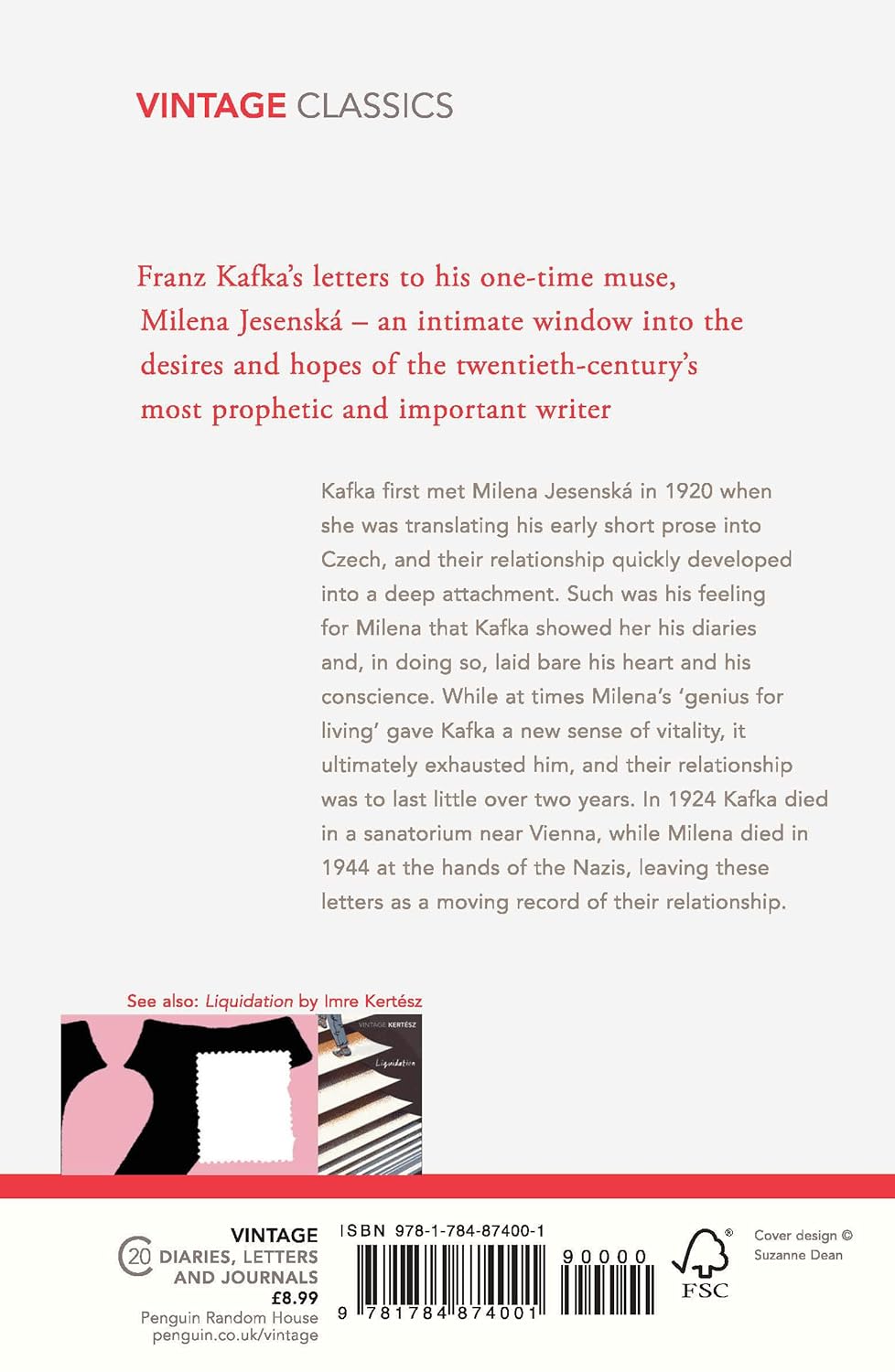


letters to milena by Franz Kafka


රු2,100.00
3 X Rs. 700.00 or 8% Cashback with


or 3 X රු700.00 with


or up to 4 X රු525.00 with


Letters to Milena by Franz Kafka is an intimate collection of letters written by Kafka to Czech journalist and translator Milena Jesenská. Beginning through their shared connection to literature and translation, their correspondence develops into a deeply emotional relationship filled with love, longing, anxiety, vulnerability, distance and self-doubt. Revealing a remarkably personal side of the author of The Metamorphosis and The Trial, this collection is an essential read for Kafka fans, classic-literature readers and anyone fascinated by powerful literary correspondence.
Out of stock
Email when stock available
Letters to Milena by Franz Kafka is an intimate and emotionally powerful collection of correspondence revealing the private thoughts, fears, desires and vulnerabilities of one of the most influential writers of modern literature.
Franz Kafka is often remembered through strange and unsettling works such as:
The Metamorphosis
The Trial
The Castle
But his letters reveal another side of him.
A man capable of extraordinary tenderness.
Fear.
Longing.
Self-doubt.
Humour.
Emotional intensity.
And an almost painful awareness of the distance between himself and the woman he loved.
That woman was Milena Jesenská.
She was a Czech journalist, writer and translator who became deeply connected with Kafka through literature.
Their correspondence gradually grew into something much more personal.
What began with translation and discussion of writing developed into an emotionally intense relationship largely sustained through letters.
Letters to Milena by Franz Kafka allows readers to witness that relationship through Kafka’s own words.
Letters to Milena by Franz Kafka – Book Overview
Letters to Milena by Franz Kafka brings together letters written during one of the most emotionally significant relationships in Kafka’s life.
Milena Jesenská first entered Kafka’s world through literature.
She was interested in translating his writing into Czech.
That professional connection opened a conversation.
The conversation became correspondence.
The correspondence became increasingly intimate.
Kafka wrote to Milena about:
Love.
Fear.
Health.
Writing.
Loneliness.
Marriage.
Distance.
Anxiety.
Daily life.
The emotional barriers between them.
The letters reveal a relationship filled with enormous affection but also difficulty.
Franz Kafka
Franz Kafka was born in Prague in 1883.
Today, he is recognized as one of the most important writers of twentieth-century literature.
His fiction often explores:
Alienation.
Bureaucracy.
Fear.
Powerlessness.
Identity.
Isolation.
Absurdity.
The word Kafkaesque eventually emerged from the atmosphere of his work.
Yet Letters to Milena by Franz Kafka shows that many of the emotional tensions readers recognize in his fiction also appeared in his personal life.
Milena Jesenská
Milena Jesenská was far more than simply the recipient of Kafka’s letters.
She was:
A journalist.
Writer.
Translator.
Independent intellectual.
A significant cultural figure in her own right.
Her intelligence appears to have attracted Kafka strongly.
He could discuss literature with her.
But their connection quickly moved beyond literature.
Translator and Writer
Translation became the bridge between Kafka and Milena.
Milena’s interest in translating Kafka’s work created the opportunity for their correspondence.
That beginning is especially meaningful.
Language connected them.
Then letters carried that connection across distance.
A Relationship Built Through Letters
Many relationships develop through physical presence.
Kafka and Milena’s developed largely through words.
Letters allowed Kafka to express things that may have been difficult for him to communicate face-to-face.
Writing gave him:
Distance.
Control.
Time.
Privacy.
But it also intensified longing.
He could feel emotionally close to Milena while remaining physically separated from her.
Love
Love is one of the strongest themes in Letters to Milena by Franz Kafka.
But this is not an easy romantic story.
Kafka’s love is complicated by:
Fear.
Circumstances.
Distance.
Health.
Other relationships.
His own psychological struggles.
His letters often show someone who desperately wants closeness while simultaneously being frightened by what closeness demands.
Longing
Longing fills the correspondence.
Kafka waits for letters.
Thinks about Milena.
Imagines conversations.
Questions silences.
Words become emotionally significant.
A letter arriving could change the emotional tone of an entire day.
This makes the collection especially powerful for readers who understand how distance can intensify attachment.
Distance
Physical distance becomes almost another character in the relationship.
Kafka and Milena are often separated.
The distance creates:
Anticipation.
Idealization.
Fear.
Misunderstanding.
Desire.
Letters attempt to bridge that separation.
But letters can never fully replace presence.
Vulnerability
Perhaps the most remarkable quality of Letters to Milena by Franz Kafka is Kafka’s vulnerability.
The famous literary figure becomes deeply human.
He admits:
Fear.
Weakness.
Confusion.
Emotional dependence.
He does not present himself as heroic.
He often analyzes his own limitations with brutal honesty.
Anxiety
Kafka frequently struggled with anxiety.
His letters reveal a mind constantly examining:
Possibilities.
Problems.
Relationships.
Consequences.
He can turn one feeling into many layers of reflection.
That psychological intensity makes the letters fascinating.
Overthinking
Modern readers may recognize something familiar in Kafka’s tendency to overthink.
A message.
A silence.
A decision.
A future meeting.
An emotional change.
Everything can become the subject of intense analysis.
This makes the correspondence surprisingly relatable despite being written more than a century ago.
Fear of Intimacy
Kafka often appears caught between two opposing desires.
He wants closeness.
But closeness frightens him.
This conflict appears repeatedly throughout his personal writing.
He longs for deep connection.
Yet he also worries about the consequences of relationships.
Emotional Contradictions
Human beings can want two opposite things at the same time.
Stay.
Leave.
Come closer.
Give me space.
Love me.
Do not depend on me.
Kafka’s letters capture these contradictions with extraordinary honesty.
Loneliness
Loneliness is another major theme.
Kafka often seems separated from others even when surrounded by people.
His connection with Milena gives him someone he believes may understand him differently.
That possibility makes the relationship especially important.
Being Understood
One of Kafka’s deepest needs appears to be understanding.
Not merely being liked.
Being understood.
Milena’s intelligence and sensitivity gave Kafka a person with whom he could discuss parts of himself that were difficult to communicate elsewhere.
Literature
Literature remains present throughout Letters to Milena by Franz Kafka.
The relationship itself begins through writing.
Kafka discusses:
Books.
Translation.
Language.
His own work.
Thoughts about expression.
Readers interested in Kafka as a writer can gain valuable insight into the mind behind his fiction.
Writing as Communication
For Kafka, writing was more than professional work.
It was a way of existing.
Letters allowed him to communicate with extraordinary precision.
A feeling could be examined.
Rewritten.
Expanded.
Qualified.
This makes the correspondence almost literary in itself.
The Power of Letters
Letters occupy an unusual space between conversation and literature.
They are personal.
But carefully written.
Immediate.
But preserved.
Kafka’s letters were meant for one person.
Yet today they allow generations of readers to experience his private voice.
Waiting for a Letter
Modern communication is immediate.
Messages arrive within seconds.
Kafka and Milena lived in a world where correspondence required waiting.
That delay intensified emotion.
Did the letter arrive?
Will there be a reply?
What does the silence mean?
The waiting becomes part of the relationship.
Love Before Instant Messaging
For modern readers, Letters to Milena by Franz Kafka offers a fascinating glimpse into intimacy before instant communication.
There are no:
Typing indicators.
Read receipts.
Voice notes.
Video calls.
Instead, emotional connection depends on written pages traveling between cities.
This changes the rhythm of the relationship.
Kafka’s Voice
Kafka’s personal voice can surprise readers.
He can be:
Serious.
Tender.
Playful.
Desperate.
Self-critical.
Philosophical.
His letters demonstrate that the man behind dark and difficult fiction possessed enormous emotional sensitivity.
Self-Doubt
Kafka frequently questions himself.
Am I capable of this relationship?
Am I harming her?
Can I give her what she needs?
These questions show someone who is intensely aware of his own perceived limitations.
Health
Kafka’s health also shapes the correspondence.
He suffered from tuberculosis.
Illness affected his:
Energy.
Travel.
Future.
Relationships.
Awareness of physical vulnerability adds another emotional layer to the letters.
Illness and Love
Serious illness can change the way someone thinks about love.
Time becomes uncertain.
Plans become difficult.
Dependence becomes frightening.
Kafka’s physical condition influences how he imagines his future with other people.
Mortality
Knowing that life may be shorter than expected can make relationships feel more urgent.
At the same time, it can make commitment frightening.
This tension appears throughout Kafka’s personal life.
Milena’s Marriage
Another complication was that Milena was married during much of their correspondence.
This made the relationship emotionally and practically difficult.
Their connection existed inside complicated circumstances rather than a simple romantic situation.
Impossible Love
For many readers, Letters to Milena by Franz Kafka can feel like a record of impossible love.
The feelings are real.
But circumstances make a conventional relationship difficult.
That can make the correspondence even more emotionally intense.
Idealization
Distance can make people idealize each other.
Without everyday reality, imagination fills the gaps.
Kafka sometimes appears to construct an enormous emotional world around Milena.
That makes the letters beautiful but also psychologically fascinating.
Attachment
The correspondence shows how strongly people can become attached through communication.
Physical proximity is not always necessary for emotional intensity.
Repeated letters create:
Expectation.
Routine.
Connection.
Dependence.
Silence
Silence becomes meaningful.
When letters do not arrive, Kafka notices.
Absence becomes something to interpret.
This demonstrates how communication can shape emotional security.
Communication
Letters to Milena by Franz Kafka is ultimately also a book about communication.
How much can words accomplish?
Can language overcome distance?
Can writing communicate something that speech cannot?
Can a letter create intimacy?
Kafka’s correspondence suggests both the power and limitations of language.
Language
Kafka wrote within a multilingual Central European environment.
Language was deeply connected with identity, literature and culture.
Milena’s work as a translator made language especially important to their relationship.
Translation
Translation is more than replacing one word with another.
A translator must understand:
Meaning.
Tone.
Context.
Emotion.
Rhythm.
Milena’s ability to engage with Kafka’s writing created intellectual intimacy before romantic intimacy.
Intellectual Connection
Attraction is not always only physical.
Kafka and Milena connect through ideas.
Literature.
Language.
Thought.
This intellectual dimension strengthens their correspondence.
Emotional Intelligence
Milena appears to understand aspects of Kafka that others may have struggled to reach.
Kafka’s letters suggest that he recognized this understanding and valued it enormously.
Kafka Beyond The Metamorphosis
Many readers know Kafka only through The Metamorphosis.
Gregor Samsa.
Alienation.
Transformation.
Absurdity.
But Letters to Milena by Franz Kafka reveals a different dimension.
The author becomes a person.
Not simply a literary symbol.
Kafka Beyond The Trial
Readers of The Trial may expect Kafka’s personal writing to be equally cold or abstract.
Instead, these letters can be warm and intensely emotional.
That contrast makes them especially interesting.
The Man Behind Kafkaesque
Kafka’s name became associated with:
Nightmare bureaucracy.
Absurd systems.
Powerlessness.
But the man himself was not simply gloomy.
His correspondence contains affection, humour and emotional nuance.
Love and Fear
Love and fear exist together throughout the letters.
Kafka can desire closeness intensely while fearing what it might require.
That tension makes the correspondence psychologically rich.
Emotional Dependence
When one person becomes central to emotional wellbeing, communication can become extremely important.
Kafka’s reaction to Milena’s letters sometimes shows how much emotional weight he placed on their connection.
Independence
At the same time, Milena was an independent person with her own life, career, marriage and responsibilities.
This means their relationship could never exist only according to Kafka’s emotional needs.
Relationships Are Complicated
One strength of Letters to Milena by Franz Kafka is that it does not resemble a perfect romance.
There are no simple solutions.
People can love each other and still face circumstances that make being together extremely difficult.
Honesty
Kafka often writes with extraordinary honesty.
Sometimes painfully so.
He examines:
His fears.
His needs.
His limitations.
His uncertainty.
That honesty makes the letters feel immediate even today.
Intimacy Through Writing
Writing can create a form of intimacy different from conversation.
A person can reveal thoughts they might never speak aloud.
Kafka’s letters demonstrate this beautifully.
Psychological Depth
Readers interested in psychology may find the collection especially compelling.
Kafka’s letters offer insight into:
Anxiety.
Attachment.
Avoidance.
Self-esteem.
Fear of intimacy.
Emotional dependence.
Overthinking.
Introversion
Kafka is often associated with introspection.
He spends enormous energy examining his inner world.
Readers who are naturally introspective may recognize aspects of this personality.
Sensitivity
Kafka appears extremely sensitive to:
Tone.
Words.
Silence.
Emotion.
Physical condition.
Relationships.
This sensitivity contributed both to his literary brilliance and to personal difficulty.
Love Without Simplicity
Modern romance often emphasizes certainty.
Kafka’s correspondence is almost the opposite.
Love can be real without being easy.
Affection can exist alongside doubt.
Desire alongside fear.
Connection alongside separation.
Heartbreak
Because the relationship faces serious obstacles, readers may experience the collection as deeply melancholic.
These are not letters from a simple happily-ever-after romance.
They document something more complicated.
Melancholy
There is beauty in the sadness of the correspondence.
Kafka often understands that what he wants may not become possible.
That awareness gives many passages their emotional intensity.
Hope
Yet he continues writing.
That itself contains hope.
Every letter is another attempt at connection.
Another attempt to make distance smaller.
The Human Need for Connection
Whatever century people live in, they want to be:
Seen.
Heard.
Understood.
Loved.
Kafka’s letters make this universal need visible.
Biography Through Letters
Traditional biography tells readers what happened.
Letters allow readers to hear a person speak from inside the moment.
That makes Letters to Milena by Franz Kafka valuable for readers interested in Kafka’s life.
Primary Personal Writing
Unlike an interpretation written decades later, Kafka’s letters preserve his own voice.
Readers can observe his thoughts without having everything filtered through a biographer.
Not a Novel
It is important to understand that Letters to Milena by Franz Kafka is not a fictional novel.
It is a collection of real correspondence.
Readers should therefore approach it differently from The Trial or The Metamorphosis.
There is no conventional plot structure.
Instead, the emotional story develops through letters.
Fragmented Experience
Because the correspondence survives primarily through Kafka’s side, the conversation can feel incomplete.
Readers often encounter his response without fully having the other side of the exchange.
This creates another layer of mystery around Milena.
Reading Between the Lines
Because readers do not always have every response from Milena, they sometimes need to infer what she may have written from Kafka’s replies.
This creates an unusual reading experience.
Letters as Literature
Although the letters were personal, Kafka’s extraordinary control of language can make them feel literary.
His metaphors.
Images.
Emotional precision.
Philosophical observations.
all contribute to their lasting appeal.
Readers of Romantic Literature
Readers who enjoy deeply emotional, melancholic writing may find Letters to Milena by Franz Kafka especially memorable.
The collection appeals to those interested in:
Unrequited love.
Long-distance relationships.
Literary correspondence.
Emotional vulnerability.
Readers of Classics
Kafka is an essential figure in modern literature.
His letters can deepen understanding of his fiction.
A reader who knows his personal fears may notice different layers in his fictional characters.
Readers of Philosophy
Although the collection is not a philosophy textbook, Kafka’s reflections often touch on:
Existence.
Fear.
Identity.
Relationships.
Loneliness.
Human connection.
This can appeal to philosophical readers.
Readers of Psychology
The emotional intensity makes the letters equally interesting from a psychological perspective.
Kafka constantly analyzes himself.
Sometimes perhaps too much.
His self-analysis can be both insightful and painful.
A Different Kind of Love Book
Letters to Milena by Franz Kafka is not a traditional romance novel.
It is more intimate because the feelings were not invented.
These were letters written from one real person to another.
That knowledge changes the emotional weight of the book.
Love Through Words
Kafka and Milena demonstrate how powerful words can become.
A sentence can:
Comfort.
Hurt.
Reassure.
Confuse.
Create hope.
Create fear.
Their relationship exists largely through this exchange.
Literature and Life
Kafka’s letters blur the boundary between literature and life.
His skill with words does not disappear when he stops writing fiction.
Even a personal letter can contain remarkable imagery.
Why Kafka Still Matters
Kafka remains relevant because he understood emotional experiences that still exist today.
Anxiety.
Alienation.
Confusion.
Fear of authority.
Difficulty connecting.
Overthinking.
His personal correspondence makes these themes even more human.
Historical Context
The letters also offer insight into early twentieth-century Central European intellectual life.
Readers encounter a world of:
Writers.
Translators.
Letters.
Cities.
Literary circles.
Political and cultural change.
Prague and Vienna
Kafka and Milena were connected with the cultural world of Central Europe.
Distance between cities influenced their relationship and made correspondence essential.
A Relationship Across Distance
Long-distance relationships existed long before phones and internet.
What changed was the speed.
Kafka’s letters show how people created intimacy despite slower communication.
The Beauty of Slow Communication
A handwritten or carefully composed letter requires more intention than many instant messages.
The writer has time to:
Think.
Choose words.
Reflect.
This can create extraordinary emotional depth.
Can Letters Reveal the Real Person?
Letters can reveal private feelings.
But people also construct versions of themselves in writing.
This raises an interesting question:
Are we seeing Kafka exactly as he was?
Or Kafka as he presented himself to Milena?
That ambiguity makes the collection intellectually fascinating.
Love as Interpretation
Every relationship contains interpretation.
What did they mean?
Why did they say that?
Why are they silent?
Kafka’s intensely analytical mind amplifies this process.
A Book About Being Known
Kafka wanted Milena to understand him.
But being fully understood can also feel frightening.
That contradiction appears throughout the correspondence.
7 Powerful Reasons to Read Letters to Milena
There are many reasons readers may find Letters to Milena by Franz Kafka unforgettable, but seven stand out:
- It reveals the private Kafka behind the famous author – Readers encounter vulnerability, tenderness, fear and humour rarely visible through his fiction alone.
- The letters document an extraordinary emotional relationship – Kafka and Milena’s connection develops through literature, distance and intense correspondence.
- It explores love without simplifying it – Affection exists alongside fear, anxiety, difficult circumstances and uncertainty.
- Kafka’s writing is beautiful even in private correspondence – His imagery and emotional precision make many letters feel literary.
- It provides insight into Kafka’s psychology – Readers see his anxiety, self-doubt, fear of intimacy and powerful need to be understood.
- It offers a fascinating portrait of communication before the digital age – Letters become the central bridge between two people separated by distance.
- It deepens appreciation of Kafka’s fiction – Understanding the person behind The Metamorphosis and The Trial can add another dimension to his literary work.
Why Read Letters to Milena by Franz Kafka?
Letters to Milena by Franz Kafka is an excellent choice for readers interested in:
- Franz Kafka
- Classic literature
- Literary letters
- Love letters
- Milena Jesenská
- Romantic correspondence
- European literature
- Emotional writing
- Literary history
- Psychology
- Anxiety
- Long-distance relationships
- Vulnerability
- Loneliness
- Love and longing
- Kafka’s personal life
- The Metamorphosis
- The Trial
- Philosophical literature
- Literary nonfiction
It is especially suitable for readers who want to discover the human being behind one of literature’s most mysterious names.
Who Should Read This Book?
Letters to Milena by Franz Kafka may especially appeal to:
- Franz Kafka readers
- Classic-literature fans
- Literature students
- Writers
- Poetry and prose readers
- Readers interested in love letters
- Readers fascinated by literary relationships
- Readers interested in psychology
- Readers who enjoy melancholic writing
- Fans of philosophical literature
- Readers of European classics
- People interested in authors’ personal lives
- Readers who appreciate intimate nonfiction
- Collectors of classic literature
A Love Story Written Across Distance
Letters to Milena by Franz Kafka is ultimately a book about connection.
Kafka and Milena were separated by:
Distance.
Circumstance.
Marriage.
Illness.
Fear.
Yet they continued reaching toward each other through words.
Kafka writes because words are one of the few bridges available to him.
Through those letters, readers encounter a man who is very different from the distant literary icon his reputation can sometimes create.
He worries.
Waits.
Loves.
Fears.
Overthinks.
Hopes.
And desperately wants to be understood.
The relationship may be complicated.
The future uncertain.
But the emotional connection preserved in these letters remains powerful more than a century later.
For readers interested in Franz Kafka, classic literature, love letters, vulnerability, anxiety, psychology, longing and the complicated ways human beings try to understand one another, Letters to Milena by Franz Kafka offers an intimate and unforgettable glimpse into the heart and mind of one of literature’s greatest writers.
Learn more about Letters to Milena by Franz Kafka on the official Penguin website.
Explore more classic literature books at Bargain Books.
Be the first to review “letters to milena by Franz Kafka”
Related products

Out of stock
Fiction & Literature
රු1,900.00
3 X Rs. 633.33 or 8% Cashback with
or 3 X රු633.33 with
or up to 4 X රු475.00 with

Out of stock
Adventure Fiction
Death on the Nile – Film Tie-In Edition | Agatha Christie Paperback
රු2,400.00
3 X Rs. 800.00 or 8% Cashback with
or 3 X රු800.00 with
or up to 4 X රු600.00 with

Out of stock
Classics & Literary Fiction
රු1,600.00
3 X Rs. 533.33 or 8% Cashback with
or 3 X රු533.33 with
or up to 4 X රු400.00 with
-20%

Contemporary romance
Original price was: රු2,050.00.රු1,650.00Current price is: රු1,650.00.
3 X Rs. 550.00 or 8% Cashback with
or 3 X රු550.00 with
or up to 4 X රු412.50 with

Out of stock
Fiction & Literature
රු1,750.00
3 X Rs. 583.33 or 8% Cashback with
or 3 X රු583.33 with
or up to 4 X රු437.50 with
-22%

Out of stock
Fiction & Literature
Original price was: රු2,250.00.රු1,750.00Current price is: රු1,750.00.
3 X Rs. 583.33 or 8% Cashback with
or 3 X රු583.33 with
or up to 4 X රු437.50 with
-18%

Fiction & Literature
Original price was: රු1,950.00.රු1,600.00Current price is: රු1,600.00.
3 X Rs. 533.33 or 8% Cashback with
or 3 X රු533.33 with
or up to 4 X රු400.00 with
-17%
Out of stock
Classics & Literary Fiction
Original price was: රු2,900.00.රු2,400.00Current price is: රු2,400.00.
3 X Rs. 800.00 or 8% Cashback with
or 3 X රු800.00 with
or up to 4 X රු600.00 with
Reviews
There are no reviews yet.