
No products in the cart.
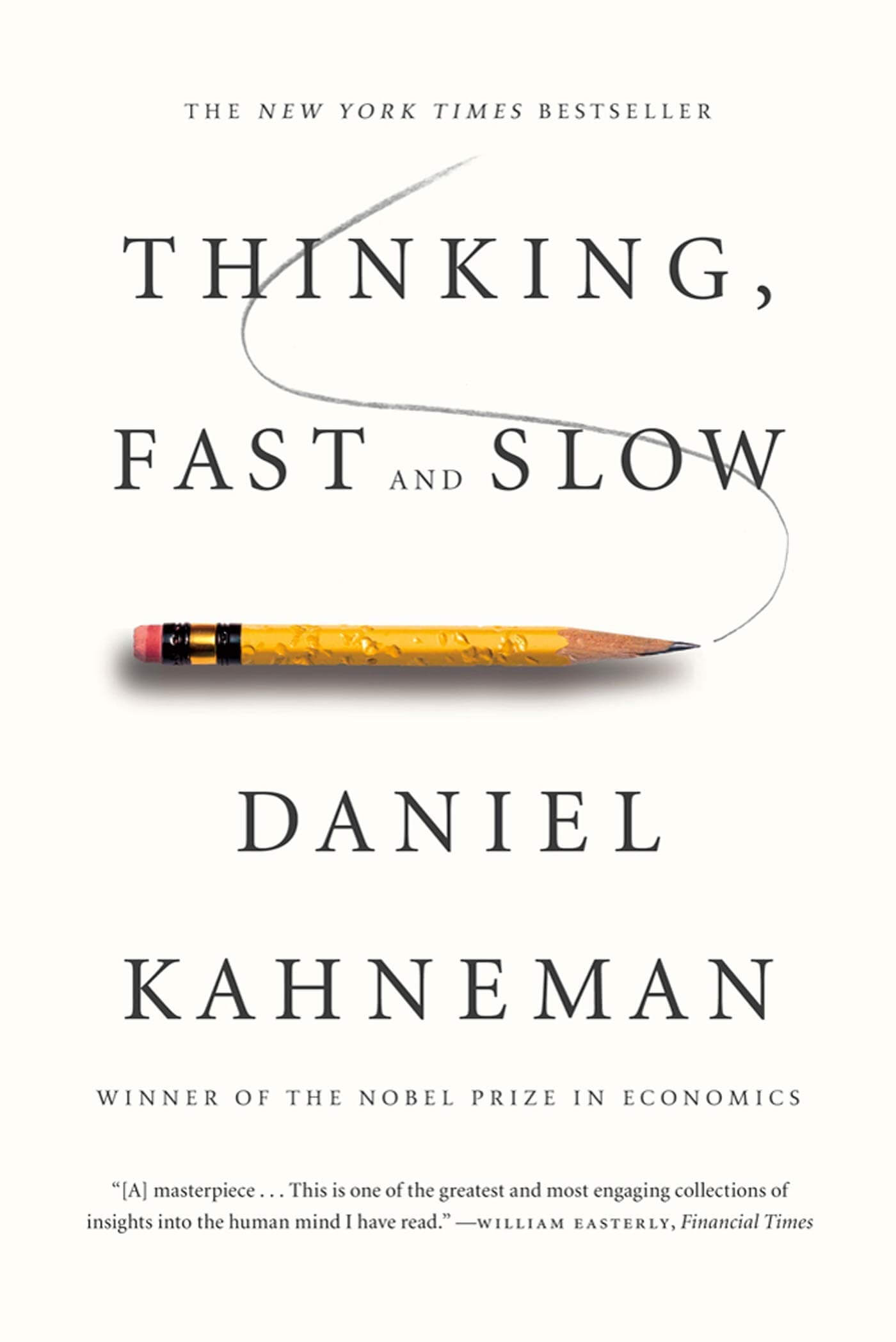
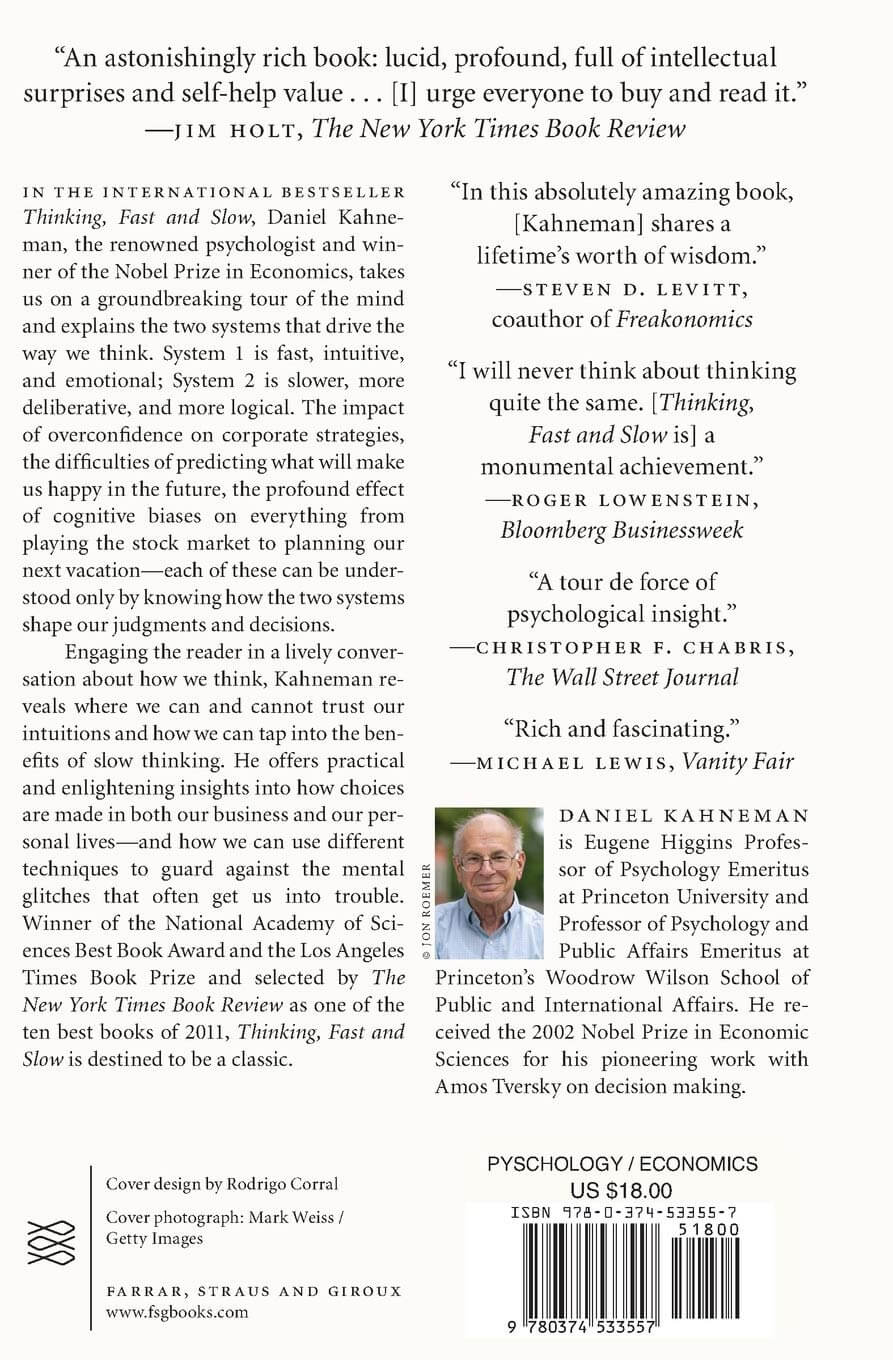


Thinking, Fast and Slow by Daniel Kahneman
Thinking Fast and Slow by Daniel Kahneman is a landmark book about how people think, make decisions, judge risks, form opinions, and fall into predictable mental errors.
Kahneman was a psychologist and Nobel Prize winner whose research helped shape behavioral economics.
In this book, he explains that human thinking can be understood through two broad systems.
One is fast.
The other is slow.
Together, they influence almost every decision we make.
About Thinking Fast and Slow
Thinking Fast and Slow explores how intuition and deliberate reasoning work together.
Kahneman calls the fast mode of thinking System 1.
System 1 works automatically.
It makes quick judgments.
It recognizes patterns.
It reacts emotionally.
System 2 is slower.
It requires concentration.
It handles more difficult reasoning.
Understanding these two systems helps explain why intelligent people can still make predictable mistakes.
System 1: Fast Thinking
System 1 operates quickly and with little effort.
You use it when you recognize a familiar face.
You use it when you complete an easy sentence.
You use it when you react immediately to danger.
This type of thinking is extremely useful.
Without it, everyday life would become exhausting.
But fast thinking can also make mistakes.
It often relies on shortcuts.
Those shortcuts are called heuristics.
System 2: Slow Thinking
System 2 requires attention.
You use it when solving a difficult calculation.
You use it when comparing several complicated choices.
You also use it when checking whether your first impression might be wrong.
Slow thinking can correct some mistakes made by System 1.
The problem is that it requires effort.
People therefore do not use it all the time.
7 Powerful Lessons from Thinking Fast and Slow
1. Your First Impression Can Be Wrong
One of the most important lessons in Thinking Fast and Slow is that intuition feels more reliable than it actually is.
The mind makes quick judgments automatically.
Those judgments can be useful.
But confidence does not guarantee accuracy.
Kahneman encourages readers to slow down when the decision is important.
2. Cognitive Biases Influence Everyone
People like to believe they are objective.
In reality, judgment is affected by biases.
Confirmation bias can make us notice evidence that supports what we already believe.
Anchoring can make the first number we hear influence later estimates.
Availability bias can make memorable events seem more common than they really are.
Recognizing these patterns can improve decisions.
3. Anchoring Can Distort Judgment
An anchor is an initial piece of information that influences later thinking.
For example, seeing a high price first can make a lower price seem like a bargain.
The original number may be arbitrary.
But it still affects perception.
This principle matters in negotiation, pricing, sales, and everyday judgment.
4. Losses Feel Stronger Than Gains
Kahneman and Amos Tversky developed prospect theory.
One of its major ideas is loss aversion.
People often experience the pain of losing something more strongly than the pleasure of gaining an equivalent amount.
This can influence investing.
It can influence negotiation.
It can also affect relationships and everyday choices.
5. Overconfidence Creates Risk
People often underestimate uncertainty.
Experts can become too confident in predictions.
Managers may assume a project will go exactly as planned.
Investors may believe they understand a market better than they actually do.
Thinking Fast and Slow shows why confidence should not automatically be treated as evidence.
6. Framing Changes Decisions
The way a choice is presented can change how people respond.
The underlying facts may remain identical.
But different wording can produce different decisions.
For example, describing a medical treatment in terms of survival may feel different from describing the same treatment in terms of mortality.
This is known as the framing effect.
7. Slow Thinking Is Valuable When Stakes Are High
Fast thinking is efficient.
It is necessary for everyday life.
But important decisions deserve more deliberate attention.
Financial decisions.
Hiring decisions.
Medical decisions.
Major purchases.
Strategic business choices.
When mistakes are costly, activating System 2 can help reduce impulsive judgment.
Heuristics and Mental Shortcuts
Heuristics are mental shortcuts.
They help people make decisions quickly.
Without them, ordinary life would become extremely difficult.
But shortcuts can also introduce error.
People may substitute an easier question for a difficult one.
Instead of asking, “How satisfied am I with my life overall?”
They may unconsciously answer, “How do I feel right now?”
That substitution can distort judgment.
The Availability Heuristic
People often judge probability based on how easily examples come to mind.
A dramatic plane accident receives heavy media coverage.
As a result, flying may temporarily feel more dangerous.
A quieter but more common risk may receive less attention.
The vivid event therefore has greater psychological impact.
This demonstrates how memory can influence estimates of probability.
Anchoring in Business and Negotiation
Anchoring has practical implications.
The first salary number mentioned in a negotiation can shape the entire discussion.
The original asking price of a product can influence what customers consider reasonable.
An early forecast can shape later planning.
Even when people know an anchor might be arbitrary, it can still influence them.
Understanding this effect helps people become more careful.
Loss Aversion
Loss aversion helps explain why people sometimes hold losing investments too long.
Selling would make the loss feel final.
It can also explain why people resist change.
Changing a familiar process creates the possibility of losing something they already have.
The potential gain may be objectively larger.
But psychologically, the possible loss can feel stronger.
The Planning Fallacy
Projects often take longer than expected.
Budgets often become larger than planned.
Kahneman discusses the planning fallacy.
People tend to focus on the specific plan in front of them.
They may ignore how similar projects performed in the past.
A better approach is to use an outside view.
Look at comparable cases.
Then base expectations on real historical outcomes.
The Halo Effect
One positive quality can influence how people judge unrelated qualities.
A confident speaker may appear more competent.
An attractive product may seem better designed.
A successful executive may be assumed to have made brilliant decisions even when luck played an important role.
This is known as the halo effect.
Recognizing it can improve evaluation.
Regression to the Mean
Extreme results are often followed by more ordinary results.
A student who performs unusually badly on one test may naturally improve next time.
An athlete who has an extraordinary performance may later return closer to their typical level.
People sometimes create stories to explain these changes.
But statistics may provide a simpler explanation.
Intuition and Expertise
Thinking Fast and Slow does not say intuition is always bad.
Expert intuition can be valuable.
But it develops best in environments with regular patterns and reliable feedback.
A chess master can develop strong intuition.
Some highly unpredictable environments do not provide the same opportunity.
This distinction helps explain why expert confidence is sometimes reliable and sometimes misleading.
Money and Decision-Making
The ideas in the book are particularly relevant to finance.
Investors may become overconfident.
They may sell winning investments too early.
They may hold losing ones too long.
They may follow recent trends.
They may also assume that past performance guarantees future success.
Behavioral economics helps explain these patterns.
Business and Management
Managers make decisions under uncertainty every day.
Which employee should be hired?
Which project deserves investment?
How long will a project take?
Which strategy is most promising?
Biases can affect all these choices.
Kahneman’s work encourages leaders to use evidence, structured processes, and statistical information rather than relying entirely on intuition.
Happiness and Memory
The book also examines happiness.
Kahneman distinguishes between the experiencing self and the remembering self.
The experiencing self lives through events.
The remembering self later creates a story about them.
Those two perspectives may evaluate the same experience differently.
This helps explain why memory can influence future decisions in surprising ways.
Who Should Read This Book?
Thinking Fast and Slow is ideal for readers interested in psychology, behavioral economics, business, investing, decision-making, and human behavior.
Entrepreneurs can apply its lessons to strategy.
Managers can use them when evaluating people and projects.
Investors can use them to understand emotional decision-making.
Students of psychology and economics will also find the book highly relevant.
It is detailed, so readers may prefer to read it gradually rather than rush through it.
About Daniel Kahneman
Daniel Kahneman was a psychologist and one of the most influential researchers in decision science and behavioral economics.
He worked extensively with psychologist Amos Tversky.
Their research challenged the idea that people always make perfectly rational economic decisions.
Kahneman received the 2002 Nobel Prize in Economic Sciences for his work on judgment and decision-making under uncertainty.
He died in 2024.
His work continues to influence psychology, economics, finance, public policy, and business.
Readers can learn more through the official Macmillan page for Thinking, Fast and Slow.
Product Details
Title: Thinking, Fast and Slow
Author: Daniel Kahneman
Genre: Psychology / Behavioral Economics / Decision-Making / Business
Language: English
Original Publication: October 25, 2011
Original Publisher: Farrar, Straus and Giroux
Original Hardcover ISBN-13: 9780374275631
Original Hardcover Pages: 512
Different paperback and international editions have different ISBNs, page counts, cover designs, weights, and dimensions.
Always check the ISBN printed on your physical copy before entering final WooCommerce specifications.
Explore More Psychology and Business Books
Thinking Fast and Slow changes the way readers think about thinking itself.
It shows why intuition can be brilliant.
It also shows why intuition can fail.
The book explains cognitive biases, loss aversion, anchoring, overconfidence, framing, and many other forces that influence judgment.
The core lesson is not that fast thinking should disappear.
We need it.
The lesson is to recognize when an important decision deserves more careful thought.
Readers interested in psychology and human behavior can explore more Self-Help & Psychology Books at Bargain Books.
Readers interested in behavioral economics and decision-making can also explore Business, Finance & Economics Books at Bargain Books.
For readers who want to understand why people make irrational decisions and how better judgment can be developed, Thinking Fast and Slow remains one of the most important books on human decision-making.
| Author | Daniel Kahneman |
|---|---|
| Language | English |
| Type | Paperback Printed Book (Second Quality Copy) |
Be the first to review “Thinking Fast & Slow by Daniel Kahneman”
Related products
Out of stock
Non-Fiction & Knowledge
රු1,600.00
3 X Rs. 533.33 or 8% Cashback with


or 3 X රු533.33 with


or up to 4 X රු400.00 with

රු2,000.00
3 X Rs. 666.67 or 8% Cashback with
or 3 X රු666.67 with
or up to 4 X රු500.00 with
Out of stock
Self-Help & Psychology
රු2,200.00
3 X Rs. 733.33 or 8% Cashback with
or 3 X රු733.33 with
or up to 4 X රු550.00 with
Out of stock
Self-Help & Psychology
රු1,900.00
3 X Rs. 633.33 or 8% Cashback with
or 3 X රු633.33 with
or up to 4 X රු475.00 with
Non-Fiction & Knowledge
රු2,250.00
3 X Rs. 750.00 or 8% Cashback with
or 3 X රු750.00 with
or up to 4 X රු562.50 with
-24%
Non-Fiction & Knowledge
Original price was: රු2,300.00.රු1,750.00Current price is: රු1,750.00.
3 X Rs. 583.33 or 8% Cashback with
or 3 X රු583.33 with
or up to 4 X රු437.50 with
Out of stock
Autobiography
රු2,750.00
3 X Rs. 916.67 or 8% Cashback with
or 3 X රු916.67 with
or up to 4 X රු687.50 with
-23%
Non-Fiction & Knowledge
Original price was: රු2,200.00.රු1,700.00Current price is: රු1,700.00.
3 X Rs. 566.67 or 8% Cashback with
or 3 X රු566.67 with
or up to 4 X රු425.00 with
Reviews
There are no reviews yet.