
No products in the cart.
-19%
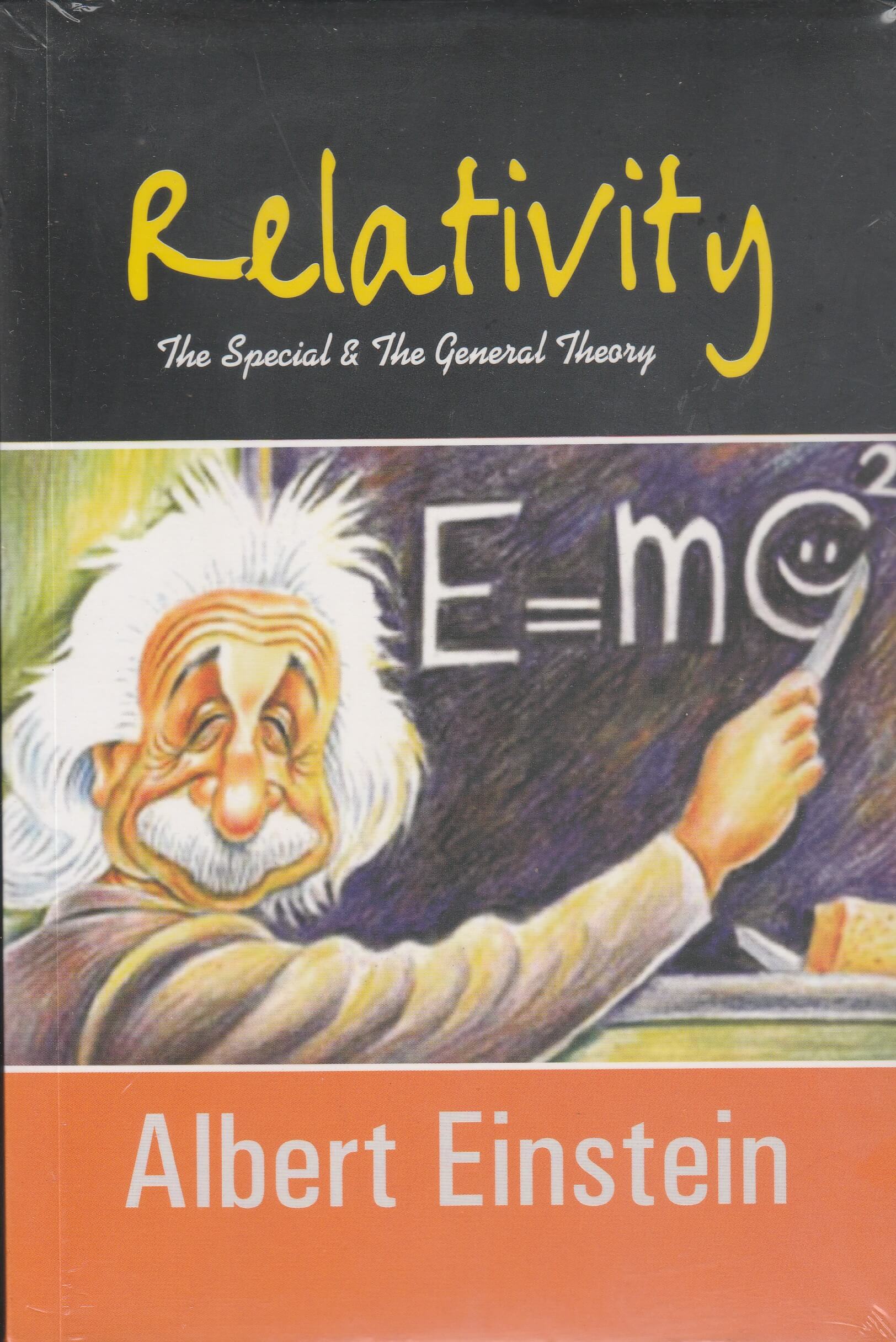
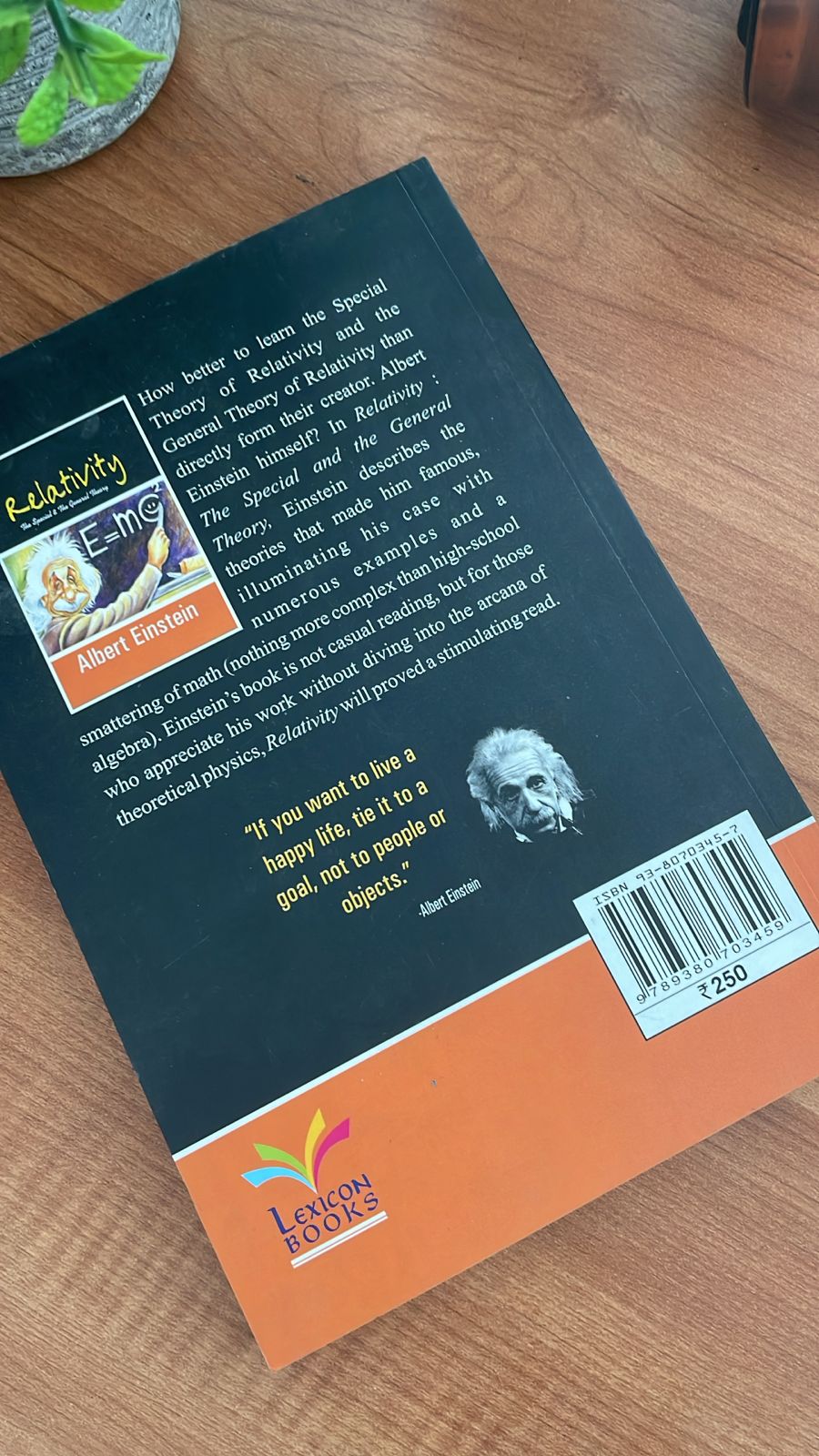
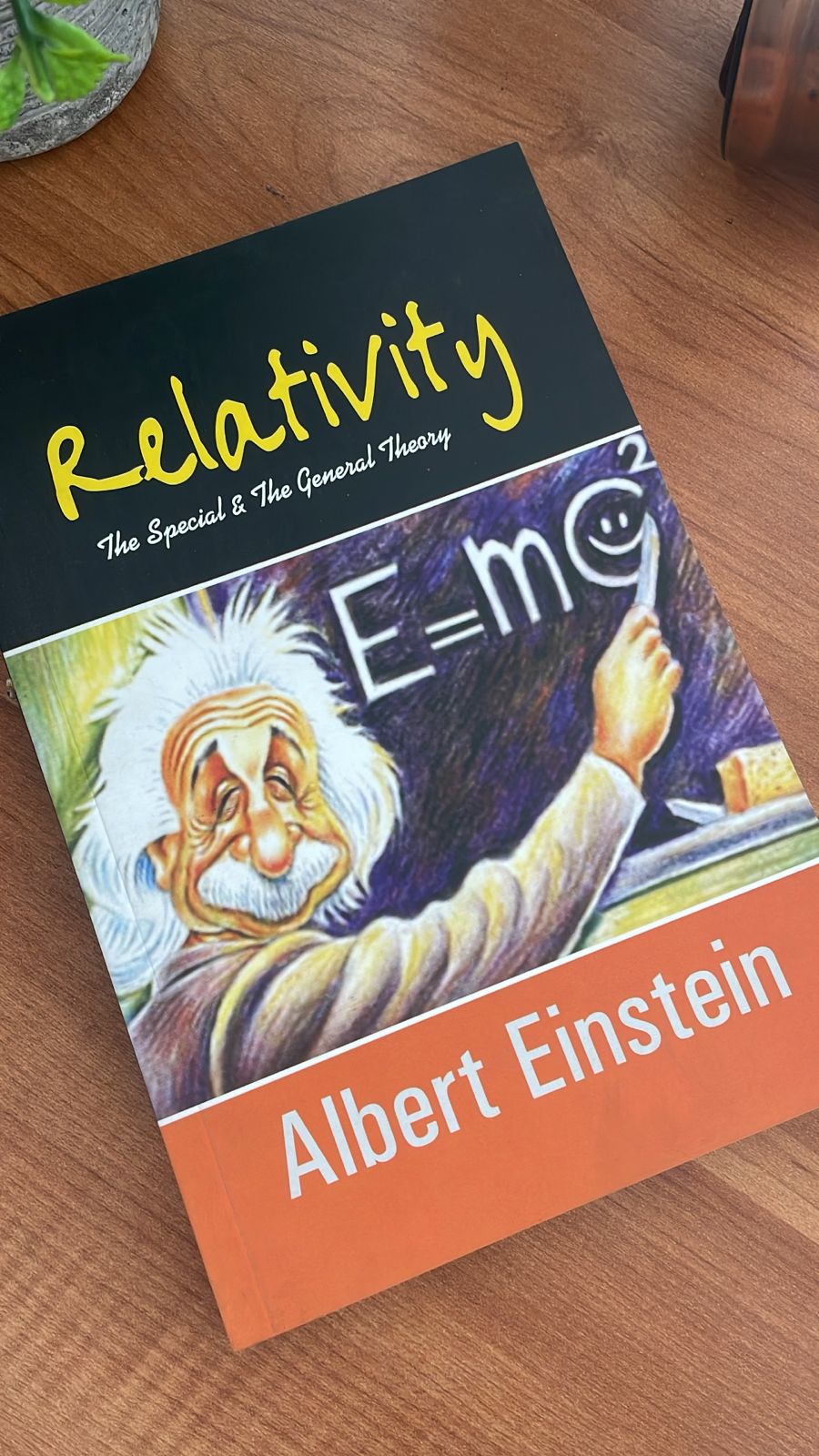
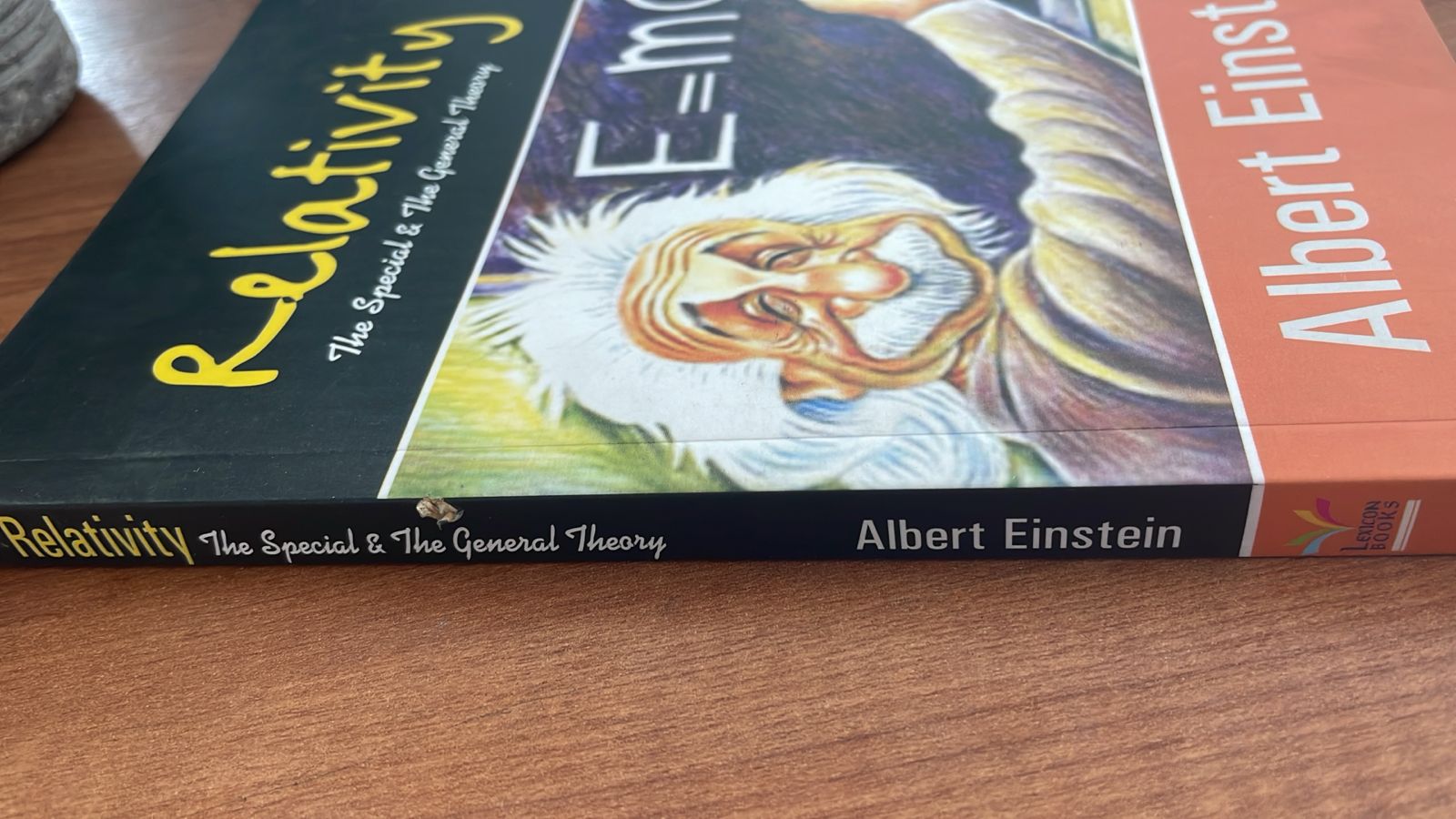
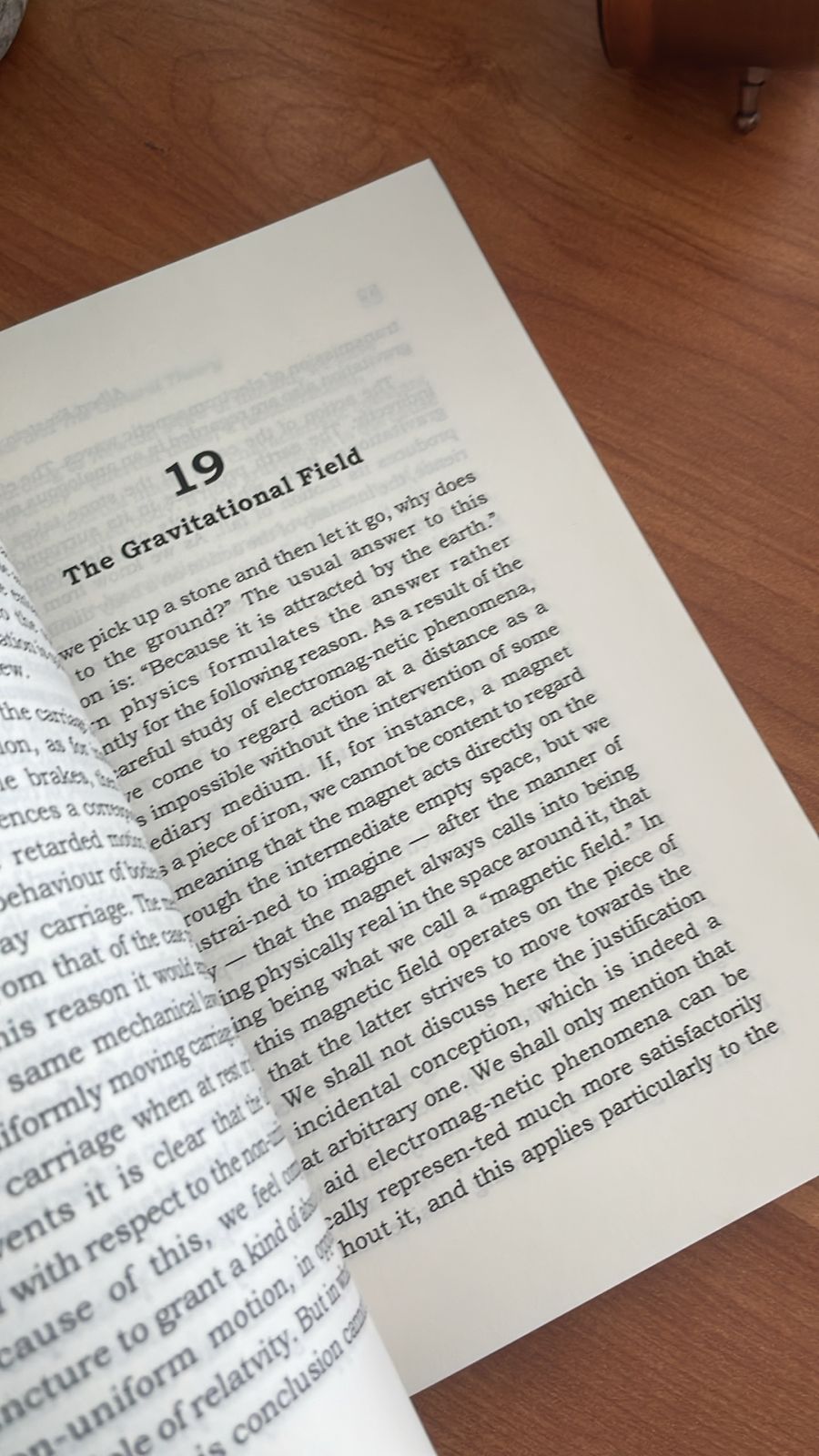

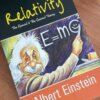


Relativity by Albert Einstein


Original price was: රු2,600.00.රු2,100.00Current price is: රු2,100.00.
3 X Rs. 700.00 or 8% Cashback with


or 3 X රු700.00 with


or up to 4 X රු525.00 with


Relativity The Special and General Theory by Albert Einstein is the classic popular-science explanation of Einstein’s revolutionary ideas about space, time, motion and gravity. Through accessible reasoning and famous thought experiments, Einstein introduces special relativity, the constancy of the speed of light, time dilation, simultaneity, mass-energy equivalence, the equivalence principle and the foundations of general relativity. An essential science classic for students, physics enthusiasts and curious readers who want to explore the ideas that transformed our understanding of the universe.
Learn more about Relativity: The Special and the General Theory by Albert Einstein on Project Gutenberg.
Explore more science and physics books at Bargain Books.
4 in stock
Relativity The Special and General Theory by Albert Einstein is the legendary physicist’s own accessible explanation of the revolutionary ideas that transformed humanity’s understanding of space, time, motion, light and gravity.
Albert Einstein’s theories of relativity changed physics forever.
Before Einstein, people commonly thought of space and time as separate and absolute.
A second was a second for everyone.
A distance was a distance regardless of who measured it.
Time moved forward at the same rate everywhere.
Einstein showed that reality is far stranger.
Time can depend on motion.
Measurements of distance can depend on the observer.
Events that appear simultaneous to one observer may not appear simultaneous to another.
The speed of light plays a unique role in the laws of physics.
And gravity is connected to the geometry of space and time themselves.
In Relativity The Special and General Theory by Albert Einstein, Einstein explains these ideas for readers who do not necessarily have advanced mathematical training.
Rather than presenting relativity primarily through complicated equations, he uses:
Thought experiments.
Trains.
Clocks.
Observers.
Light signals.
Reference frames.
Geometry.
Simple physical situations.
The result is a rare opportunity to learn one of the most important scientific theories in history directly from the scientist who developed it.
Relativity The Special and General Theory by Albert Einstein – Book Overview
Relativity The Special and General Theory by Albert Einstein introduces two major theories:
Special Relativity
and
General Relativity.
Special relativity deals mainly with motion, measurements, light and reference frames when gravity is not the central issue.
General relativity expands the picture to include gravity and accelerated motion.
Together, they transformed the foundations of modern physics.
What Is Relativity?
The word “relativity” can be misunderstood.
It does not mean:
Everything is relative.
Nothing is objectively true.
Every opinion is equally valid.
In physics, relativity concerns how measurements of space, time and motion depend on the observer’s state of motion while the laws of physics retain consistent structure.
It is a scientific theory supported by mathematical reasoning and experimental evidence.
Why Einstein Wrote This Book
Einstein wanted the central ideas of relativity to be understandable beyond a small circle of specialist physicists.
That makes this book particularly interesting.
Instead of reading only what later writers say Einstein meant, readers can encounter his own explanations.
However, “written for general readers” does not mean every section is effortless.
The concepts themselves are genuinely challenging.
Special Relativity
Special relativity begins from two fundamental ideas.
First, the laws of physics should work consistently for observers moving uniformly relative to one another.
Second, the speed of light in vacuum has a special invariant role.
From these apparently simple principles come extraordinary consequences.
Reference Frames
A reference frame is essentially a perspective from which measurements are made.
Imagine you are sitting inside a train moving smoothly.
Someone else stands beside the railway.
You throw a ball forward.
From your perspective inside the train, the ball moves at one speed.
From the perspective of the person outside, the train’s motion also matters.
Classical physics could handle many situations by simply adding velocities.
Light changes the story.
The Speed of Light
One of Einstein’s most revolutionary conclusions is that the speed of light in vacuum is the same for inertial observers, rather than behaving like an ordinary object whose measured speed simply changes through classical velocity addition.
This forces space and time themselves to behave differently from everyday intuition.
Time Is Not Absolute
Before relativity, Newtonian physics treated time as universal.
Einstein challenged this.
Two observers moving relative to one another can disagree about elapsed time between events.
This is not simply because one clock is defective.
It is built into the structure of spacetime.
Time Dilation
One famous consequence of special relativity is time dilation.
A moving clock can be measured as running differently relative to another observer’s frame.
This effect is tiny at ordinary human speeds.
It becomes important when velocities become extremely high.
Modern technology and experimental physics provide real-world contexts where relativistic timing corrections matter.
Length Contraction
Special relativity also predicts that measured lengths along the direction of motion can differ depending on the observer’s reference frame.
This is known as length contraction.
Again, the effect is negligible at ordinary speeds but becomes significant as motion approaches the speed of light.
Simultaneity
Perhaps one of the strangest ideas in Relativity The Special and General Theory by Albert Einstein concerns simultaneity.
Suppose two events happen far apart.
One observer may judge them to have occurred at the same time.
Another observer moving differently may not.
This is called the relativity of simultaneity.
It changes the very meaning of “at the same time.”
Einstein’s Train Thought Experiments
Einstein frequently uses situations involving trains, railway embankments, observers and light signals.
These examples make abstract physics more visual.
Imagine lightning striking two points along a railway.
A person standing midway between them sees the light from each strike.
Now imagine another observer moving along the railway.
Because that observer is moving relative to where the light originated, their interpretation of the timing can differ.
The point is not the train itself.
The train is a tool for thinking clearly about measurements.
Thought Experiments
Einstein became famous for using thought experiments.
Instead of immediately building an experiment, ask:
What would happen if?
What would different observers measure?
What assumptions are hidden inside the problem?
Thought experiments remain extremely useful in:
Physics.
Philosophy.
Computer science.
Engineering.
Economics.
And everyday reasoning.
Question the Obvious
One of the deepest lessons from Relativity The Special and General Theory by Albert Einstein is that common sense is not always enough.
Human intuition developed in a world where:
Speeds are relatively slow.
Gravity is moderate.
Distances are ordinary.
We do not naturally experience motion near the speed of light.
So our everyday intuition is not automatically reliable in extreme physical conditions.
Space and Time
Relativity shows that space and time are deeply connected.
Modern physics often describes this combined structure as spacetime.
An event does not simply happen at a place.
It happens at a location and a time.
The geometry connecting those events becomes fundamental.
Mass and Energy
Einstein’s work on special relativity also led to the famous relationship between mass and energy represented by:
E = mc²
The equation expresses the deep connection between mass and energy.
A small amount of mass corresponds to an enormous amount of energy because the speed of light squared is such a large quantity.
E = mc²
This is probably the world’s most famous equation.
But it is frequently presented without context.
The significance is not simply that Einstein created a memorable formula.
It reveals that mass and energy are not completely unrelated quantities.
They are connected at a fundamental physical level.
Does the Book Explain E = mc²?
Depending on the edition, Einstein’s popular treatment and appendices discuss the relationship between inertia, energy and relativity.
Readers should remember that editions can differ in appendices, translation and supplementary material.
The core book’s main purpose is broader:
To explain the conceptual foundations of special and general relativity.
General Relativity
Special relativity alone does not fully explain gravity.
Einstein spent years developing a more general theory.
The result became general relativity.
General relativity revolutionized the scientific understanding of gravitation.
Gravity
Newton described gravity extraordinarily successfully as an attractive force between masses.
Einstein introduced a deeper geometric description.
Matter and energy affect spacetime.
Objects then move through that curved spacetime.
This creates the behavior we experience as gravity.
Curved Spacetime
The idea of curved spacetime sounds strange because human beings cannot easily visualize four-dimensional geometry.
But an analogy can help.
Imagine a curved surface.
Lines that appear straight locally can behave differently across the full surface.
General relativity uses much more sophisticated mathematics, but the basic insight is that geometry itself becomes part of physics.
The Equivalence Principle
One of Einstein’s most important insights toward general relativity was the equivalence principle.
Imagine standing inside a closed elevator.
If the elevator accelerates upward, you feel pressed toward the floor.
Now imagine standing inside an elevator held stationary in a gravitational field.
Locally, these situations can have deep physical similarities.
That connection between acceleration and gravity helped Einstein develop general relativity.
Einstein’s Elevator
Like his train examples, the elevator is a thought experiment.
It asks readers to imagine:
What can someone inside detect?
Can they distinguish acceleration from gravity?
What happens to light?
These simple questions lead toward profound physics.
Light and Gravity
General relativity predicts that gravity can influence the path of light.
This was one of the theory’s dramatic early predictions.
The idea helped transform relativity from a highly theoretical proposal into a theory that could be confronted with astronomical observations.
The 1919 Eclipse
Observations during the 1919 solar eclipse became famous for measurements related to the bending of starlight near the Sun.
The event helped make Einstein internationally famous.
Modern tests of general relativity are far more precise, but the historical episode remains an important part of relativity’s story.
Gravity Affects Time
General relativity also predicts gravitational time dilation.
Clocks in different gravitational conditions can run at different rates relative to one another.
This sounds like science fiction.
It is real physics.
GPS and Relativity
Modern satellite navigation systems need to account for relativistic effects.
Satellites move rapidly and exist in different gravitational conditions from clocks on Earth’s surface.
Both special-relativistic and general-relativistic effects matter for maintaining precise timing.
This is a powerful reminder that Einstein’s theories are not merely philosophical abstractions.
They affect technology.
Geometry
Geometry becomes extremely important in general relativity.
Readers accustomed to ordinary flat geometry may find Einstein’s discussion challenging because curved spaces behave differently.
The shortest route between two points on a curved surface may not look like a straight line when represented in ordinary ways.
Euclidean Geometry
Traditional Euclidean geometry works extremely well for many everyday situations.
But general relativity requires a more flexible mathematical description when spacetime is curved by matter and energy.
Einstein introduces these ideas conceptually for non-specialist readers.
Mathematics in the Book
Relativity The Special and General Theory by Albert Einstein is often described as accessible because it avoids requiring advanced mathematics.
That does not mean there is no mathematics.
Readers should still expect:
Logical reasoning.
Geometrical concepts.
Symbols.
Equations.
Careful attention.
The main difficulty is often conceptual rather than computational.
Is This Book Good for Beginners?
Yes—with one qualification.
It is a good beginner’s introduction for someone genuinely interested in understanding Einstein’s ideas.
But it is not necessarily an “easy science book.”
Some passages may need to be read twice.
Or three times.
That is normal.
Relativity challenges assumptions people have used their entire lives.
Read Slowly
This is not a book to rush.
A useful approach is:
Read one section.
Pause.
Visualize the example.
Draw the train or coordinate system.
Ask what each observer measures.
Then continue.
Understanding matters more than speed.
Draw Diagrams
When reading about:
Trains.
Light signals.
Coordinates.
Moving observers.
draw simple diagrams.
They do not need to look professional.
A basic sketch can transform an abstract paragraph into something understandable.
Ask “Relative to What?”
This is one of the most useful habits in physics.
Someone says:
“The object is moving.”
Ask:
Relative to what?
Someone says:
“The event happened first.”
Ask:
According to which observer?
Precision begins by identifying the frame of reference.
Classical Physics Versus Relativity
Relativity did not make Newtonian physics useless.
Newtonian mechanics remains extraordinarily accurate for many everyday situations.
Cars.
Buildings.
Ordinary engineering.
Planetary calculations at appropriate precision.
Relativity becomes especially important when dealing with:
Very high speeds.
Strong gravitational fields.
Extreme precision.
Modern physics therefore often uses the simpler model when it is sufficient.
Science Builds Rather Than Simply Destroys
Scientific revolutions are sometimes described as:
Old theory wrong.
New theory right.
Reality is subtler.
Newtonian physics works extremely well within its domain.
Relativity expands the framework and explains situations where classical assumptions become inadequate.
Scientific Models
A scientific theory is not merely a guess.
In science, a theory is a structured explanatory framework supported and tested through evidence.
Relativity has survived many demanding experimental tests.
That does not mean scientists stop testing it.
Strong science remains open to further evidence.
Observation and Theory
Einstein’s work demonstrates the interaction between:
Mathematics.
Physical principles.
Thought experiments.
Observation.
A theory must eventually connect with measurable reality.
Beautiful ideas alone are not enough.
The Importance of Questions
Einstein’s achievement came partly from questioning assumptions that seemed obvious.
What is simultaneous?
What does an observer actually measure?
Why should the speed of light behave differently?
What would someone experience in free fall?
Good questions can be more revolutionary than quick answers.
Imagination in Science
Science is not opposed to imagination.
It requires it.
Einstein had to imagine situations no ordinary human experiences directly.
Then the ideas had to be translated into rigorous physics.
Imagination creates possibilities.
Evidence determines whether those possibilities describe reality.
Albert Einstein
Albert Einstein was one of the most influential physicists in history.
His work contributed fundamentally to modern understandings of:
Space.
Time.
Gravity.
Energy.
Light.
Quantum physics.
Statistical physics.
He received the 1921 Nobel Prize in Physics, particularly for his explanation of the photoelectric effect rather than for relativity itself.
That is an interesting detail because popular culture often assumes his Nobel Prize was awarded for E = mc² or general relativity.
Einstein Beyond Relativity
Although relativity is his most famous work, Einstein made major contributions to several areas of physics.
These included:
Brownian motion.
The photoelectric effect.
Quantum theory.
Statistical mechanics.
Relativity is only one part of an extraordinary scientific career.
Special Relativity and General Relativity Are Different
Readers sometimes treat “relativity” as one single theory.
It is useful to distinguish them.
Special Relativity primarily addresses inertial reference frames, light, space and time without treating gravitation as its central phenomenon.
General Relativity extends the framework to gravity, acceleration and curved spacetime.
Understanding special relativity first makes the general theory easier to approach.
Is This a Physics Textbook?
Not exactly.
Relativity The Special and General Theory by Albert Einstein is better understood as a popular exposition by Einstein himself.
It explains the conceptual ideas behind relativity.
A modern university physics course will use far more mathematics and updated notation.
Is the Science Outdated?
The core theories of special and general relativity remain foundational to modern physics.
However, this is a historical text.
Modern physics education uses newer terminology, notation, experimental evidence and mathematical teaching methods.
So the book is valuable for both:
Scientific understanding.
Historical understanding.
Historical Language
Because the work is more than a century old, some translations may feel formal compared with contemporary popular-science writing.
This should not be mistaken for incorrect science.
It reflects the writing and translation style of the period.
Different Editions
There are many editions of Einstein’s book because the work has been published and republished internationally for generations.
Your own inventory demonstrates this.
One BookLounge procurement record lists:
ISBN 9788175994652.
Another reconciliation record uses:
ISBN 9789358561579.
This means you should not copy an ISBN or page count from another website without checking the physical edition.
Your BookLounge Product
Your existing BookLounge data uses the full title:
Relativity: The Special and General Theory by Albert Einstein
and your category file places it under:
Non-Fiction > Science, Technology & Future.
That product title and category are suitable.
Who Should Read This Book?
Relativity The Special and General Theory by Albert Einstein is ideal for:
- Physics students
- Science students
- Albert Einstein readers
- Popular science fans
- Engineering students
- Mathematics enthusiasts
- Readers interested in astronomy
- Readers curious about spacetime
- Teachers
- Philosophy-of-science readers
- Science-history readers
- Anyone who has heard of relativity but wants to understand what it actually means
Important Topics
Relativity The Special and General Theory by Albert Einstein explores:
- Special relativity
- General relativity
- Space
- Time
- Motion
- Reference frames
- Speed of light
- Simultaneity
- Time dilation
- Length contraction
- Mass and energy
- Gravity
- Equivalence principle
- Geometry
- Spacetime
- Light
- Scientific reasoning
- Thought experiments
- Classical physics
- Modern physics
7 Powerful Ideas From Relativity The Special and General Theory by Albert Einstein
- Time is not universally absolute. Observers in different states of motion can measure time differently, challenging ordinary assumptions about one universal clock for the entire universe.
- Simultaneity depends on the observer. Two distant events judged simultaneous in one reference frame do not necessarily have to be simultaneous in another.
- The speed of light has a unique role in physics. Its invariance forces us to rethink ordinary ideas about how velocities, time and distance behave.
- Space and time are deeply connected. Relativity replaces the simple picture of separate absolute space and absolute time with a more unified physical framework.
- Gravity is linked with spacetime geometry. General relativity provides a revolutionary description in which mass and energy influence the geometry through which objects and light move.
- Thought experiments can transform science. Einstein’s trains, clocks, elevators and light signals demonstrate how carefully imagined situations can expose hidden assumptions in ordinary reasoning.
- Common sense has limits. Human intuition works extremely well in everyday environments, but the universe does not have to behave according to expectations formed at ordinary speeds and gravitational conditions.
Why Read Relativity The Special and General Theory by Albert Einstein?
Relativity The Special and General Theory by Albert Einstein gives readers something unusually valuable:
Einstein explaining Einstein.
Modern popular-science writers may provide easier analogies.
Modern physics textbooks may provide stronger mathematical instruction.
But few books offer the same historical connection to one of the scientific revolutions that reshaped our conception of reality.
Reading it encourages you to question basic concepts you normally never question.
What is time?
What does “now” mean?
What does motion mean?
Can two observers disagree and both be physically correct within their frames?
What is gravity?
Why does light behave differently from ordinary objects?
These are not merely academic questions.
They changed physics.
They changed astronomy.
They influenced modern technology.
And they transformed humanity’s understanding of the universe.
Relativity The Special and General Theory by Albert Einstein – Rethinking Space and Time
Relativity The Special and General Theory by Albert Einstein asks readers to perform a difficult intellectual exercise.
Forget, temporarily, what feels obvious.
Imagine two observers.
One stands beside a railway.
Another sits inside a moving train.
Imagine clocks.
Light signals.
Measurements.
Ask each observer what happened.
At ordinary speeds, their answers seem almost identical.
Increase the speed dramatically and tiny differences become fundamental.
Time changes.
Distance changes.
Simultaneity changes.
Then introduce gravity.
Now the structure of spacetime itself becomes part of the problem.
This is why relativity remains so fascinating.
Einstein did not simply add another scientific fact to a textbook.
He changed the framework through which fundamental physical events are understood.
The book also demonstrates something broader about knowledge.
Human beings often confuse familiarity with truth.
An idea feels obvious because we have experienced the world in one narrow range of conditions.
But the universe is not required to match human intuition.
Good science tests intuition.
Sometimes intuition survives.
Sometimes reality demands a better model.
For students, science enthusiasts and readers fascinated by the nature of reality, Relativity The Special and General Theory by Albert Einstein offers a direct encounter with one of the most important intellectual achievements of modern science.
It may require patience.
Some passages may need rereading.
But that difficulty is part of the experience.
You are not simply learning another scientific fact.
You are learning to think differently about the basic structure of space, time, motion and gravity.
Learn more about Relativity: The Special and the General Theory by Albert Einstein on Project Gutenberg.
Explore more science and physics books at Bargain Books.
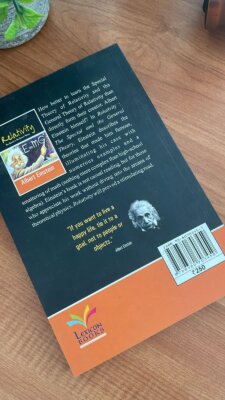
| Author | Albert Einstein |
|---|---|
| Type | Paperback Printed Book |
| ISBN/ISSN | 978-8175994652, 9788175994652 |
| Language | English |
| Pages | 164 |
Be the first to review “Relativity by Albert Einstein”
Related products
Out of stock
Damaged & Imperfect Books
රු950.00
3 X Rs. 316.67 or 8% Cashback with
or 3 X රු316.67 with
or up to 4 X රු237.50 with
-24%

Non-Fiction & Knowledge
Original price was: රු2,300.00.රු1,750.00Current price is: රු1,750.00.
3 X Rs. 583.33 or 8% Cashback with
or 3 X රු583.33 with
or up to 4 X රු437.50 with
-17%

Out of stock
Non-Fiction & Knowledge
Original price was: රු2,900.00.රු2,400.00Current price is: රු2,400.00.
3 X Rs. 800.00 or 8% Cashback with
or 3 X රු800.00 with
or up to 4 X රු600.00 with

Non-Fiction & Knowledge
රු1,950.00
3 X Rs. 650.00 or 8% Cashback with
or 3 X රු650.00 with
or up to 4 X රු487.50 with
Non-Fiction & Knowledge
රු2,450.00
3 X Rs. 816.67 or 8% Cashback with
or 3 X රු816.67 with
or up to 4 X රු612.50 with
Out of stock
Non-Fiction & Knowledge
රු1,600.00
3 X Rs. 533.33 or 8% Cashback with
or 3 X රු533.33 with
or up to 4 X රු400.00 with
-13%

Out of stock
Non-Fiction & Knowledge
Original price was: රු3,900.00.රු3,400.00Current price is: රු3,400.00.
3 X Rs. 1,133.33 or 8% Cashback with
or 3 X රු1,133.33 with
or up to 4 X රු850.00 with
-23%

Non-Fiction & Knowledge
Original price was: රු2,200.00.රු1,700.00Current price is: රු1,700.00.
3 X Rs. 566.67 or 8% Cashback with
or 3 X රු566.67 with
or up to 4 X රු425.00 with
Reviews
There are no reviews yet.