
No products in the cart.
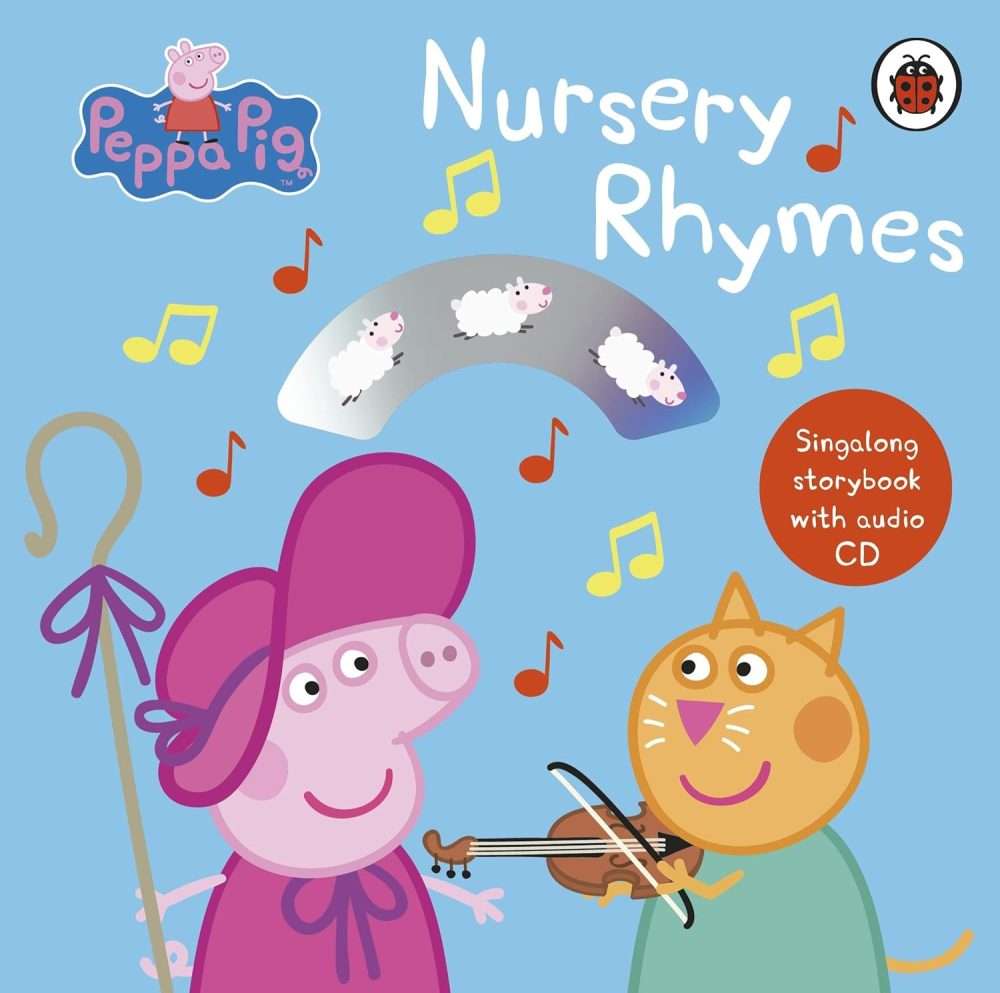
Peppa Pig: Nursery Rhymes : Storybook with Audio CD Board book
රු2,900.00
3 X Rs. 966.67 or 8% Cashback with


or 3 X රු966.67 with


or up to 4 X රු725.00 with


| Specification | Detail |
|---|---|
| Title | Peppa Pig: Nursery Rhymes – Singalong Storybook with Audio CD |
| Author / Brand | Peppa Pig |
| Format | Board Book + Audio CD |
| Publisher / Imprint | Penguin Random House Children’s, Ladybird |
| Publication Date | February 21, 2019 |
| ISBN‑13 | 978‑0241371626 |
| ISBN‑10 | 0241371627 |
| Pages | ~26 pages |
| Dimensions | 185 mm × 185 mm × ~24 mm (or 18.5 cm × 18.5 cm × 2.4 cm) |
| Weight | ~528 g |
| Age Range / Suggested Age | ~2 to 6 years old |
| Language | English |
2 in stock
Peppa Pig: Nursery Rhymes: Singalong Storybook with Audio CD
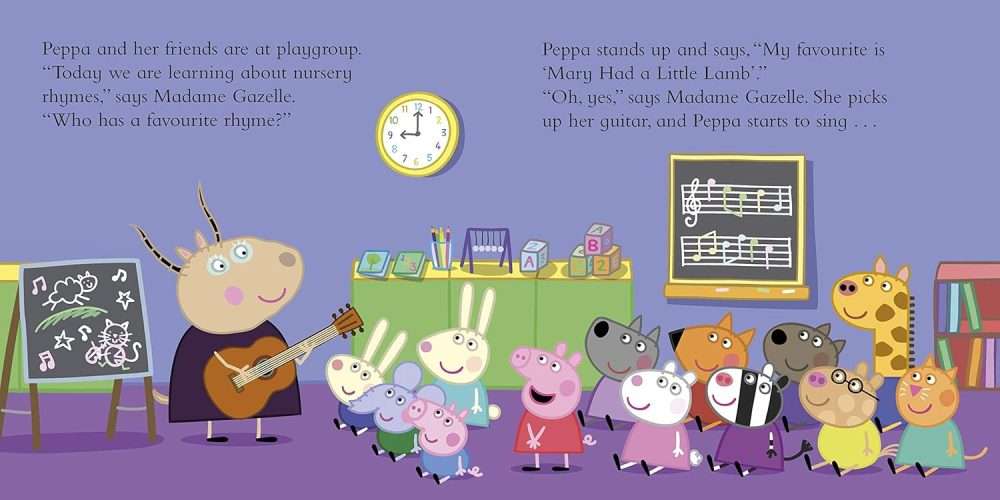
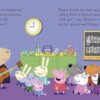
Peppa Pig: Nursery Rhymes is a chunky singalong board book accompanied by an audio CD, allowing young children to read, listen, and sing with Peppa and her friends. The story begins at playgroup, where Peppa and her classmates are learning a selection of traditional nursery rhymes.
The collection includes seven familiar rhymes, including Mary Had a Little Lamb, Little Bo-Peep, Hey Diddle Diddle, and Hickory Dickory Dock. Children can look at the colourful Peppa Pig illustrations while listening to the CD and joining in with the repeated words.
Published by Ladybird, this 26-page board book provides an entertaining introduction to nursery rhymes for children aged approximately three years and above.
Peppa and her friends are learning nursery rhymes at playgroup. Young readers can join the activity by following the words and pictures in the book and playing the accompanying audio CD.
Children do not need to know every word before participating. They can begin by listening, clapping, copying simple actions, or joining in with familiar sounds.
Parents can encourage participation by asking:
- “Which nursery rhyme shall we sing first?”
- “Can you clap to the rhythm?”
- “Which character can you see?”
- “What word comes next?”
- “Can you count along with Peppa?”
- “Which rhyme is your favourite?”
- “Can you remember the ending?”
Repeated listening can help children gradually become more confident singing independently.
The book and accompanying CD feature seven well-known nursery rhymes:
- Mary Had a Little Lamb
- Little Bo-Peep
- Hey Diddle Diddle
- Hickory Dickory Dock
- One, Two, Three, Four, Five
- The Grand Old Duke of York
- Ring-a-Ring o’ Roses
The selection combines animal characters, counting, movement, rhythm, and playful nonsense. This variety helps keep the singalong session interesting while introducing different sounds and language patterns.
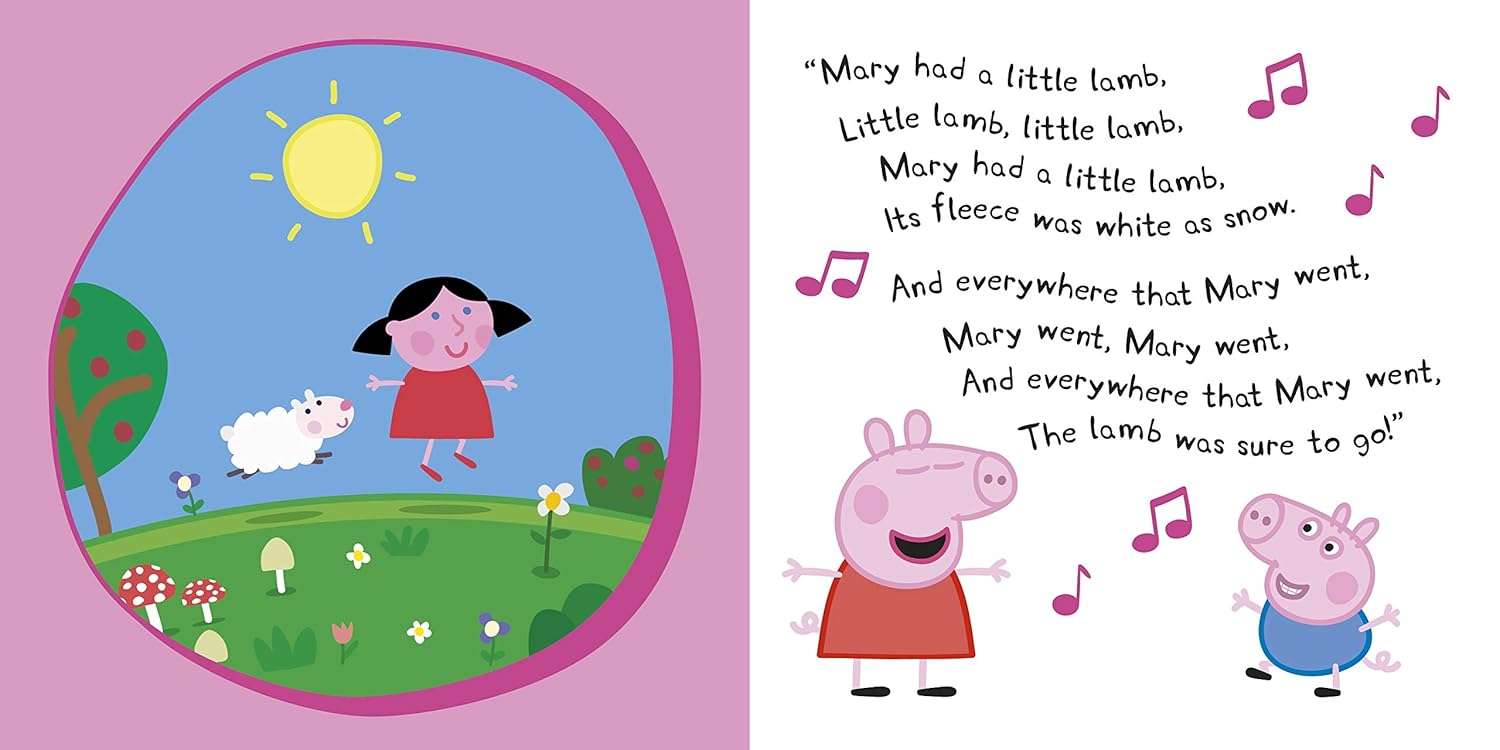
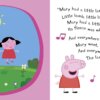
Mary Had a Little Lamb tells the familiar story of Mary and the lamb that follows her.
The rhyme can introduce words associated with animals, movement, school, and friendship. Children can pretend to be the lamb, follow an adult around the room, or make gentle sheep sounds.
Parents can ask:
- “What animal belongs to Mary?”
- “What colour is the lamb?”
- “Where does the lamb follow her?”
- “What sound does a lamb make?”
These simple questions turn singing into a listening and comprehension activity.
In Little Bo-Peep, the central character is looking for her sheep. The rhyme creates opportunities to discuss animals, searching, and position words.
Parents can hide a toy sheep or another suitable toy nearby and invite the child to look for it. Adults can use words such as “behind,” “under,” “near,” and “beside” while providing clues.
This type of search activity may support observation and spatial vocabulary.
Hey Diddle Diddle is filled with imaginative characters and unusual events. Its playful nonsense can appeal to children who enjoy funny pictures and surprising combinations.
Adults can talk about the rhyme’s characters and ask the child to identify the animal, musical instrument, dish, spoon, and moon.
Because the events are deliberately unrealistic, the rhyme can inspire imaginative questions:
- “Can a cow really jump over the moon?”
- “What music might the cat play?”
- “Where are the dish and spoon going?”
- “Can you invent another silly event?”
There is no need for logical answers—the activity is intended to encourage creativity.
Hickory Dickory Dock combines rhythm, a clock, and a small mouse. Children can listen for the repeated sounds and imitate the mouse moving up and down.
Parents can point out a clock at home and explain that clocks help people know the time. Older preschoolers can identify the numbers on a clock face without being expected to tell the time independently.
The rhyme also introduces directional language through the mouse’s movement.
One, Two, Three, Four, Five brings early counting into the nursery-rhyme collection.
Children can hold up their fingers as they count or point to objects one at a time. Parents can pause before the next number and invite the child to continue the sequence.
The activity can help reinforce:
- Number order
- Counting aloud
- One-to-one correspondence
- Listening
- Memory
- Finger coordination
The emphasis should remain on enjoyable participation rather than perfect counting.
The Grand Old Duke of York is well suited to movement. Children can march, move up and down, and respond physically to the directions in the rhyme.
Parents can create a safe marching area and invite children to follow simple actions. This helps connect spoken words with physical movement.
The rhyme may support:
- Rhythm
- Listening to instructions
- Gross motor coordination
- Directional vocabulary
- Group participation
Children should have a clear space and adult supervision while marching or moving.
Ring-a-Ring o’ Roses is traditionally enjoyed as a group movement rhyme. Children can hold hands where appropriate, move in a circle, and perform the familiar actions.
It works well for siblings, friends, nursery groups, or family members. If there is only one child, they can move with an adult or use toys as pretend participants.
Parents should ensure that the play area is clear of obstacles and that children move at a safe speed.
The accompanying audio CD allows children to hear each rhyme performed while they follow the board book. This can be particularly helpful for adults who are unfamiliar with a rhyme’s melody or rhythm.
Listening to the CD may help children:
- Hear clear rhythm and repetition
- Follow the pace of a song
- Recognise familiar words
- Practise pronunciation
- Join in at predictable points
- Develop confidence singing
- Enjoy independent listening with supervision
A compatible CD player or computer with an optical disc drive is required. Many newer phones, tablets, laptops, smart speakers, and car systems cannot play CDs directly, so customers should check that suitable equipment is available.
Nursery rhymes use repetition, sound patterns, and memorable phrases. These qualities make them useful for developing listening and early language familiarity.
Regular singalong sessions may encourage:
- Vocabulary growth
- Sound awareness
- Pronunciation
- Sentence rhythm
- Auditory memory
- Listening and concentration
- Confidence speaking aloud
- Recognition of repeated phrases
Children may begin by joining in only with the final word of a line. As the rhymes become familiar, they can gradually remember longer sections.
Repetition is one of the most valuable features of nursery rhymes. Children hear the same sounds and language patterns each time they listen.
Adults can pause before a familiar word and allow the child to complete the phrase. If the child does not remember it, the adult can continue naturally without pressure.
Rhythm can also be explored through:
- Clapping
- Tapping
- Marching
- Swaying
- Finger movements
- Simple percussion instruments
- Gentle table tapping
These actions help children experience the beat physically.
Several rhymes in this collection can be paired with actions. Children might march with the Grand Old Duke, move like Mary’s lamb, imitate the mouse in Hickory Dickory Dock, or count using their fingers.
These activities may support:
- Gross motor development
- Fine motor coordination
- Balance
- Body awareness
- Listening and response
- Following simple instructions
Adults should choose movements appropriate for the child’s age and available space.
Peppa Pig: Nursery Rhymes works well as a shared family activity. Parents, grandparents, teachers, siblings, and caregivers can sing alongside the child and demonstrate the actions.
Older preschool children may also enjoy looking through the book while listening to the CD independently. However, an adult should operate the CD equipment when necessary and ensure that the disc is handled carefully.
The set can be used during:
- Family singalong sessions
- Preschool music activities
- Nursery rhyme lessons
- Quiet play
- Rainy afternoons
- Car journeys with a compatible CD player
- Playdates
- Screen-free entertainment
The book is produced in a strong board format with thick pages that are easier for young children to hold and turn than ordinary paper pages.
Its approximately 18.5 cm square dimensions provide room for colourful illustrations while remaining manageable for preschoolers. The built-in CD storage contributes to the book’s thicker 2.4 cm depth.
Children should be taught to return the CD to its holder after use. The disc should be held around its edge to reduce fingerprints and scratches.
The combination of a physical board book and audio CD makes this an appealing gift for children who enjoy music, singing, or Peppa Pig.
It is suitable for:
- Birthdays
- Christmas
- Preschool rewards
- Nursery collections
- Musical activity sessions
- Early-learning gifts
- Family travel
- Everyday surprises
It may also be useful for parents and educators seeking a friendly introduction to classic English nursery rhymes.
Peppa Pig is a popular preschool character who lives with Mummy Pig, Daddy Pig, and her little brother George. Her stories explore family life, friendship, playgroup, music, celebrations, and everyday childhood experiences.
The Peppa Pig publishing collection includes board books, picture stories, sticker activities, sound books, colouring titles, and audio collections. These books allow children to enjoy familiar characters through reading, music, and screen-free play.
This book-and-CD collection is suitable for:
- Children aged approximately three years and above
- Young Peppa Pig fans
- Children beginning to learn nursery rhymes
- Families looking for singalong activities
- Preschool music sessions
- Nurseries and early-learning centres
- Children developing listening and rhythm
- Anyone searching for a musical Peppa Pig gift
The rhyme list, format, publication information, and specifications are confirmed by the official Penguin UK publication page.
Be the first to review “Peppa Pig: Nursery Rhymes : Storybook with Audio CD Board book”
Related products
-49%
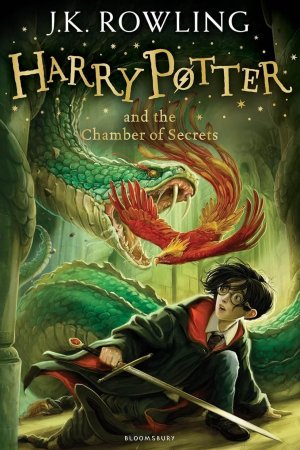
Out of stock
Children & Young Adult
Original price was: රු3,400.00.රු1,750.00Current price is: රු1,750.00.
3 X Rs. 583.33 or 8% Cashback with
or 3 X රු583.33 with
or up to 4 X රු437.50 with
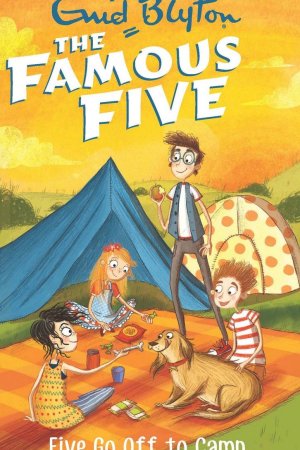
Out of stock
Children & Young Adult
Famous Five Vol 7: Five Go Off to Camp by Enid Blyton | Classic Adventure Book
රු800.00
3 X Rs. 266.67 or 8% Cashback with
or 3 X රු266.67 with
or up to 4 X රු200.00 with
Out of stock
Children & Young Adult
Famous Five Vol 6: Five on Kirrin Island Again by Enid Blyton | Classic Adventure Book
රු800.00
3 X Rs. 266.67 or 8% Cashback with
or 3 X රු266.67 with
or up to 4 X රු200.00 with
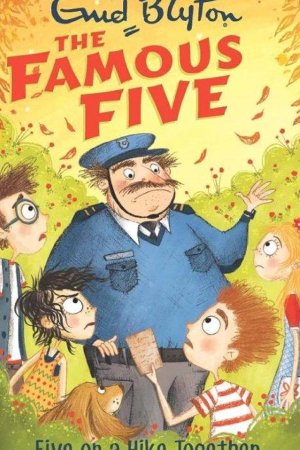
Out of stock
Children & Young Adult
Famous Five Vol 10: Five on a Hike Together by Enid Blyton | Classic Children’s Adventure Book
රු800.00
3 X Rs. 266.67 or 8% Cashback with
or 3 X රු266.67 with
or up to 4 X රු200.00 with
Out of stock
Children & Young Adult
රු1,750.00
3 X Rs. 583.33 or 8% Cashback with
or 3 X රු583.33 with
or up to 4 X රු437.50 with
Children & Young Adult
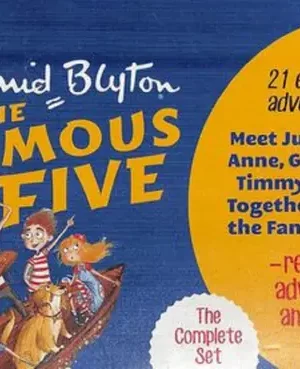
The Famous Five Complete Box Set of 21 by Enid Blyton & Eileen Soper
රු9,900.00
3 X Rs. 3,300.00 or 8% Cashback with
or 3 X රු3,300.00 with
or up to 4 X රු2,475.00 with
-21%
Children & Young Adult
Original price was: රු2,400.00.රු1,900.00Current price is: රු1,900.00.
3 X Rs. 633.33 or 8% Cashback with
or 3 X රු633.33 with
or up to 4 X රු475.00 with
-25%
Out of stock
Children & Young Adult
Original price was: රු2,000.00.රු1,500.00Current price is: රු1,500.00.
3 X Rs. 500.00 or 8% Cashback with
or 3 X රු500.00 with
or up to 4 X රු375.00 with
Reviews
There are no reviews yet.