
No products in the cart.


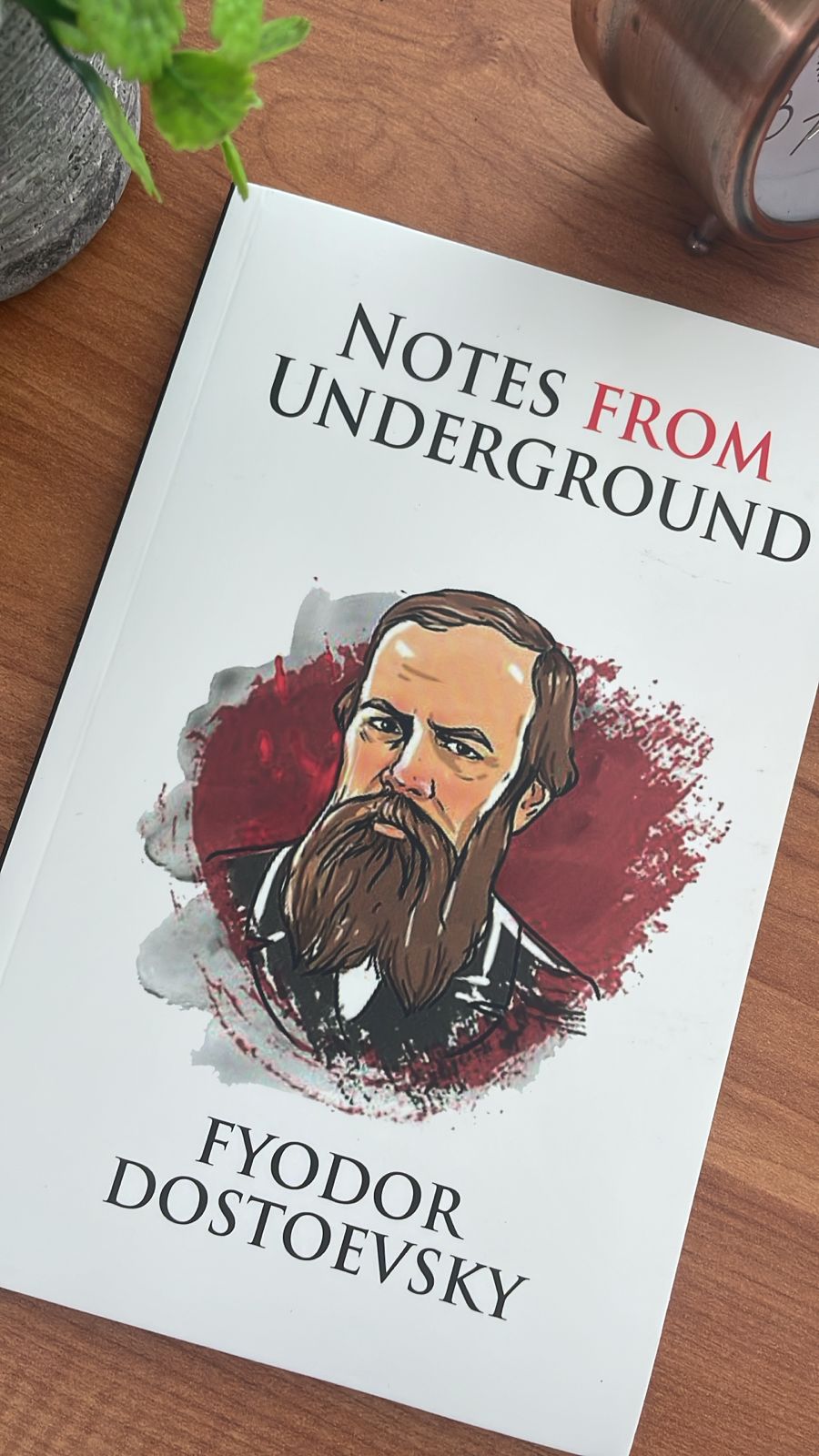
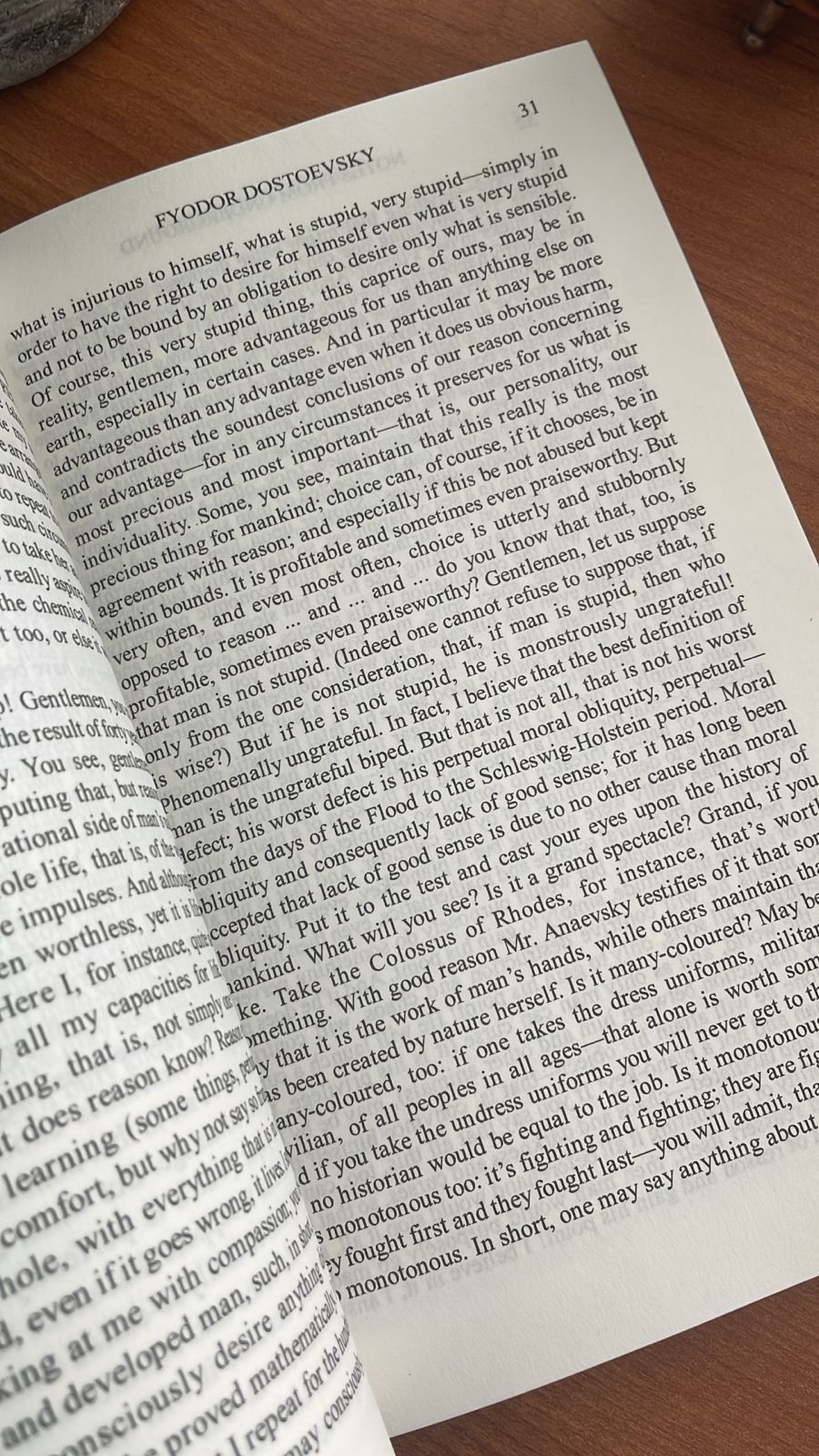
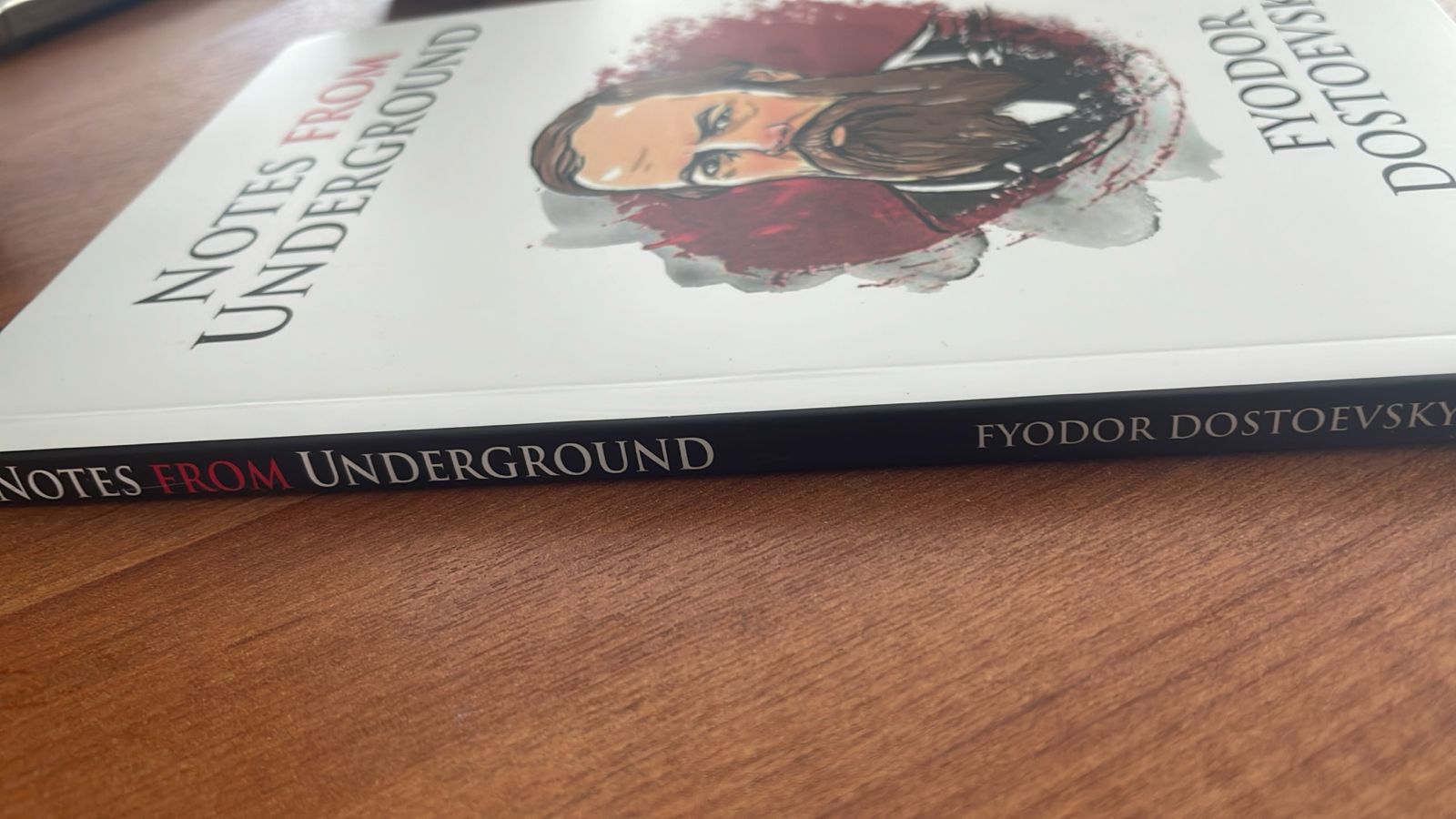







Notes from Underground by Fyodor Dostoevsky


රු1,450.00
3 X Rs. 483.33 or 8% Cashback with


or 3 X රු483.33 with


or up to 4 X රු362.50 with


Notes from Underground by Fyodor Dostoevsky is a powerful psychological and philosophical classic narrated by an isolated former civil servant living in St. Petersburg. Through his bitter reflections and painful memories, Dostoevsky explores free will, overthinking, resentment, pride, self-sabotage, loneliness and humanity’s resistance to purely rational explanations. Short but intellectually intense, it is an essential read for fans of Russian classics, existential literature and psychological fiction.
Out of stock
Email when stock available
Notes from Underground by Fyodor Dostoevsky is a dark, psychologically intense classic that explores free will, isolation, resentment, pride, self-destruction and the strange contradictions hidden inside human behavior.
The narrator is an unnamed former civil servant living alone in St. Petersburg.
He is intelligent.
Highly self-aware.
Bitter.
Contradictory.
And deeply isolated from society.
He refers to himself as a man from the “underground,” but the underground is not simply a physical place. It represents his emotional and psychological withdrawal from other people.
He spends much of his life thinking.
Analyzing.
Arguing with imagined opponents.
Remembering humiliations.
Questioning society.
Questioning himself.
And often deliberately acting against his own interests.
Why would someone knowingly choose something harmful?
Why can intelligence make action more difficult rather than easier?
Can human behavior ever be explained entirely through reason?
Would people rebel against a perfectly rational system simply to prove they are free?
These questions make Notes from Underground by Fyodor Dostoevsky one of the foundational works of psychological and existential literature.
Notes from Underground by Fyodor Dostoevsky – Book Overview
Notes from Underground by Fyodor Dostoevsky is divided broadly into two contrasting sections.
The first part is largely philosophical.
The Underground Man speaks directly to the reader and explains his beliefs about:
Reason.
Freedom.
Society.
Human desire.
Consciousness.
He attacks the idea that human beings can be reduced to predictable rational creatures.
The second part becomes more narrative.
The narrator looks back on painful episodes from his earlier life, including encounters with former classmates and a young woman named Liza.
These memories show the consequences of the philosophy introduced earlier.
The first section tells us how the Underground Man thinks.
The second shows what living that way has done to him.
The Underground Man
The narrator is never given a conventional name.
This makes him feel both specific and universal.
He is one individual.
But he also represents certain tendencies that can appear in many people.
Overthinking.
Resentment.
Self-consciousness.
Fear of humiliation.
Desire for recognition.
Fear of intimacy.
The need to feel superior.
The desire to punish oneself.
He understands many of his own problems.
Yet understanding them does not automatically make him change.
That is one of the most disturbing ideas in Notes from Underground by Fyodor Dostoevsky.
Self-Awareness Does Not Guarantee Change
Modern self-help culture often assumes:
If you understand the problem, you can solve the problem.
Dostoevsky complicates that idea.
The Underground Man frequently knows exactly what he is doing.
He recognizes his own:
Pettiness.
Cruelty.
Contradictions.
Social insecurity.
Yet he continues.
Knowledge without action becomes another form of paralysis.
Overthinking
The narrator suffers from extreme self-consciousness.
Every interaction can become a psychological battlefield.
Someone looks at him.
He interprets the look.
Then interprets his own reaction.
Then imagines what the other person thinks about that reaction.
Then feels humiliated.
Then becomes angry.
This endless mental cycle prevents spontaneous action.
Consciousness as a Burden
The Underground Man suggests that too much consciousness can become painful.
A person who analyzes everything may struggle to act decisively.
Imagine standing in front of ten possible choices and seeing every possible consequence simultaneously.
Eventually, thought can replace action.
Action Versus Analysis
This makes Notes from Underground by Fyodor Dostoevsky surprisingly relevant to modern readers.
Today people often experience:
Decision paralysis.
Overthinking.
Social anxiety.
Constant self-comparison.
Online self-consciousness.
The technology has changed.
The psychological pattern has not.
Free Will
One of the book’s most important philosophical themes is free will.
The Underground Man rejects the idea that human beings will always choose what is rationally best for them.
Even if a perfect system calculated exactly what would make everyone happy, he believes humans might deliberately choose something irrational.
Why?
Simply to prove they remain free.
The Rational Human Being
Some nineteenth-century thinkers hoped society could be improved through increasingly rational systems.
If human needs were scientifically understood, perhaps social organization could maximize happiness.
Dostoevsky asks:
What if humans do not always want what is mathematically best?
What if people value freedom even when they use that freedom badly?
Two Plus Two Equals Four
The Underground Man famously resists the idea of life becoming completely predictable.
“Two plus two equals four” represents certainty.
Logic.
Necessity.
A world where everything follows rational laws.
But the narrator fears that if human behavior could be predicted with the same certainty, individuality would disappear.
Freedom to Make Bad Choices
This produces a difficult idea.
Freedom includes the possibility of making choices that are:
Irrational.
Self-destructive.
Unproductive.
Painful.
A person who can only choose what a system defines as optimal may not feel genuinely free.
Self-Sabotage
Few literary characters demonstrate self-sabotage as clearly as the Underground Man.
He wants connection.
Then pushes people away.
He wants respect.
Then behaves in ways that make respect less likely.
He wants dignity.
Then creates situations that humiliate him.
This contradiction makes him psychologically fascinating.
Why Do People Hurt Themselves?
Not necessarily physically.
People can sabotage themselves through:
Pride.
Avoidance.
Procrastination.
Anger.
Refusing help.
Destroying relationships.
Rejecting opportunities.
The Underground Man repeatedly demonstrates these patterns.
Resentment
Resentment dominates his emotional life.
He remembers small humiliations for years.
Other people may have forgotten the event entirely.
He has not.
He mentally revisits it.
Expands it.
Rehearses revenge.
This gives the old event power over his present life.
Humiliation
The narrator is extremely sensitive to perceived humiliation.
Even insignificant social interactions can become enormous in his mind.
He wants others to respect him.
But his dependence on their approval makes him even more vulnerable to them.
Pride
Pride prevents the Underground Man from behaving honestly.
He may want friendship but refuse to admit it.
He may want affection but prefer appearing indifferent.
He wants other people to understand him while simultaneously hiding what he actually feels.
Pride therefore becomes a barrier to intimacy.
Isolation
The Underground Man withdraws from society.
At first, isolation may seem protective.
If you avoid people, people cannot embarrass you.
Reject you.
Judge you.
But isolation creates another form of suffering.
The narrator protects himself from relationships by making genuine relationships impossible.
Loneliness and Solitude
Solitude can be healthy when chosen freely.
Loneliness is different.
The Underground Man does not simply enjoy being alone.
He desperately wants recognition while resenting his dependence on others.
That contradiction traps him.
Society
The novel also examines the tension between the individual and society.
The Underground Man dislikes social expectations.
He resents people who appear to move through life easily.
He believes himself more intelligent because he sees contradictions they ignore.
But this belief also becomes an excuse for remaining disconnected.
Intelligence and Superiority
Feeling intellectually superior can become comforting.
If other people reject you, you can tell yourself:
They are shallow.
They do not understand me.
But superiority can become another defense against vulnerability.
If everyone else is beneath you, you never need to risk meeting them as equals.
Former Classmates
The second half of Notes from Underground by Fyodor Dostoevsky includes episodes involving former schoolmates.
The Underground Man desperately wants to participate socially.
At the same time, he despises the people whose acceptance he wants.
This creates painfully awkward situations.
Social Anxiety
Many modern readers may recognize the pattern.
You want to attend.
Then imagine people judging you.
Then become defensive before anything has happened.
Then behave strangely because you are anxious.
Then interpret the awkwardness as proof that everyone dislikes you.
Dostoevsky captures this self-reinforcing cycle with remarkable precision.
The Officer
One of the narrator’s memories involves an officer who appears barely aware of him.
The Underground Man interprets this insignificant encounter as a deep humiliation.
He becomes obsessed with restoring his dignity.
The important point is not the external event.
It is the enormous psychological meaning he gives it.
Imagined Battles
People often fight battles inside their own minds that the other person does not even know exist.
The Underground Man is an extreme example.
He constructs elaborate emotional conflicts around other people’s actions.
This reveals how perception can sometimes cause more suffering than the original event.
Liza
Liza becomes one of the most important characters in the novella.
She is a young woman whom the Underground Man meets during one of his humiliating social episodes.
Their relationship exposes his deepest contradictions.
He speaks to her about:
Suffering.
Dignity.
Love.
The possibility of another life.
For a moment, he appears capable of compassion.
Then the situation changes.
Compassion Versus Control
The narrator’s conversation with Liza initially appears sympathetic.
But another motive gradually becomes visible.
Helping another person can make someone feel powerful.
The Underground Man enjoys occupying the position of:
Teacher.
Savior.
Person who understands more.
When Liza later meets him under different circumstances, the power dynamic changes.
That frightens him.
Vulnerability
Liza sees something the Underground Man does not want anyone to see.
His weakness.
His poverty.
His loneliness.
His emotional need.
He can tolerate being seen as intellectually superior.
Being seen as vulnerable is much harder.
Fear of Love
The Underground Man appears to want intimacy.
But intimacy requires allowing another person to see you honestly.
That means surrendering some control.
He finds this terrifying.
So when genuine human connection becomes possible, he attacks it.
Cruelty
One of the darkest parts of Notes from Underground by Fyodor Dostoevsky is seeing how personal suffering can turn into cruelty.
Being hurt does not automatically make someone compassionate.
Sometimes hurt people hurt others.
Dostoevsky refuses to romanticize suffering.
Psychological Realism
Dostoevsky is celebrated partly because his characters often think in ways that feel uncomfortable but recognizable.
People are not perfectly consistent.
We may want two opposite things simultaneously.
Love and independence.
Recognition and privacy.
Success and safety.
Change and familiarity.
The Underground Man embodies contradiction.
An Early Existentialist Work
Notes from Underground is often described as an important precursor to existentialist literature.
It was written before philosophers such as Jean-Paul Sartre became associated with existentialism, yet it explores many related themes:
Freedom.
Responsibility.
Alienation.
Meaning.
Choice.
The conflict between rational systems and individual existence.
Existential Freedom
Freedom sounds positive.
But complete freedom also creates responsibility.
If you are free to choose, then your choices matter.
You cannot blame every failure entirely on fate or society.
This can become psychologically uncomfortable.
Freedom Can Be Frightening
People sometimes want freedom in theory but certainty in practice.
We want choice.
But too many choices create anxiety.
We want independence.
But independence removes excuses.
The Underground Man’s relationship with freedom is therefore deeply conflicted.
Nihilism?
The novel is sometimes associated with nihilistic thought, but it is more complicated than simply saying life has no meaning.
Dostoevsky is examining what happens when intellectual skepticism, isolation and resentment become disconnected from human relationship and moral responsibility.
Philosophy Through Character
One reason Notes from Underground by Fyodor Dostoevsky remains readable is that the philosophical questions are embodied in a person.
You do not simply read an abstract essay about free will.
You watch someone live according to these contradictions.
The consequences become personal.
Is the Underground Man Reliable?
Not completely.
He contradicts himself.
He changes his claims.
He admits dishonesty.
He may exaggerate.
This makes him an early and fascinating example of an unreliable narrator.
Readers must constantly ask:
Do I believe him?
Contradictions Are Intentional
At first, readers may think:
Why does he say one thing and then the opposite?
Because contradiction is the point.
Human beings are not mathematical equations.
We can believe incompatible things.
The Underground Man is extreme, but his contradictions reveal something ordinary about human psychology.
First-Person Narrative
The first-person style makes the book feel almost like entering someone else’s mind without permission.
There is little emotional distance.
Readers hear:
His arguments.
His bitterness.
His self-justifications.
His shame.
His attacks on himself.
That intensity can make the book challenging but also memorable.
St. Petersburg
The setting of St. Petersburg contributes to the atmosphere.
Dostoevsky often used the city as a place of:
Alienation.
Crowds.
Poverty.
Social hierarchy.
Psychological pressure.
The Underground Man exists physically near other people but remains emotionally separated from them.
The Underground as Symbol
The “underground” represents withdrawal.
It is a place where resentment can grow without being challenged by real relationships.
A person can construct an entire worldview while avoiding situations that might contradict it.
This makes the metaphor feel surprisingly modern.
Echo Chambers
Today, people can retreat into online communities that constantly reinforce existing beliefs.
The Underground Man does something similar psychologically.
He repeatedly rehearses the same grievances.
No one interrupts the cycle.
Isolation strengthens the worldview.
Is Notes from Underground a Novel?
It is usually classified as a novella or short novel.
It is significantly shorter than Dostoevsky’s major novels such as Crime and Punishment, The Idiot or The Brothers Karamazov.
Its shorter length makes it a good entry point for readers curious about Dostoevsky, although the ideas can still be demanding.
Is It Difficult to Read?
The book is not difficult because of plot complexity.
It is difficult because the narrator’s thoughts are dense and contradictory.
The first section can feel especially philosophical.
Readers may find it easier to read slowly rather than rushing through it.
Best Way to Read It
A useful approach is to ask:
What is the Underground Man claiming?
Why does he believe it?
Does his later behavior support or contradict that claim?
This turns the book into an investigation of character rather than a philosophy lecture.
Is It a Good First Dostoevsky Book?
Yes, with one warning.
It is shorter than many of his famous novels.
But it is psychologically dense.
Readers wanting more plot may prefer Crime and Punishment first.
Readers interested in philosophy, psychology and existential thought may find Notes from Underground by Fyodor Dostoevsky an excellent introduction.
Is It Connected to Crime and Punishment?
No.
It is a standalone work.
You do not need to read any other Dostoevsky novel before or after it.
However, readers will notice themes that later appear throughout his fiction:
Guilt.
Pride.
Freedom.
Suffering.
Alienation.
Moral responsibility.
Translation Differences
Because the original text was written in Russian, English editions vary depending on the translator.
Different translations may use slightly different wording, tone and even title formatting.
Therefore, when uploading the exact edition to WooCommerce, use the translator, ISBN and page count printed on the physical copy you are selling.
Historical Context
Notes from Underground was first published in 1864.
It emerged during a period of intense intellectual debate in Russia.
Questions about:
Reason.
Social reform.
Western influence.
Human nature.
Political change.
were being widely discussed.
Dostoevsky responds to some of these ideas through the Underground Man’s voice.
Why It Still Feels Modern
Despite being written in the nineteenth century, the psychology often feels contemporary.
The narrator experiences patterns that modern readers recognize:
Overthinking.
Self-sabotage.
Social insecurity.
Resentment.
Isolation.
Desire for validation.
Fear of intimacy.
That psychological familiarity is one reason the book remains influential.
Content Considerations
Notes from Underground by Fyodor Dostoevsky contains mature psychological themes involving depression-like despair, self-loathing, emotional cruelty, social isolation, humiliation, poverty, prostitution, manipulation and destructive relationships.
The novella is not graphically violent, but its emotional and psychological atmosphere can be bleak and intense.
Important Themes
The central themes include free will, isolation, resentment, pride, consciousness, irrationality, self-sabotage, alienation, humiliation, loneliness, responsibility, freedom, social anxiety, desire, cruelty, vulnerability and the conflict between reason and human unpredictability.
7 Powerful Insights From Notes from Underground by Fyodor Dostoevsky
- People do not always choose what is rationally best for them. Human beings sometimes choose against their own interests simply because they want to preserve a sense of freedom and independence.
- Self-awareness without action can become another trap. The Underground Man understands many of his flaws, yet that understanding does not automatically produce change.
- Resentment can keep old humiliations alive long after the event ends. The narrator repeatedly gives past experiences new power by mentally returning to them.
- Pride can block the connection we secretly want. The Underground Man longs for recognition and intimacy but often destroys both because vulnerability feels unbearable.
- Overthinking can become paralysis. Excessive analysis may make someone more conscious of every possibility while simultaneously making decisive action harder.
- Intelligence is not the same as wisdom. Being able to analyze human behavior does not guarantee that a person can manage their own emotions or relationships well.
- Freedom includes responsibility for imperfect choices. Dostoevsky challenges any worldview that reduces people to predictable machines and insists that human freedom is messy, contradictory and sometimes destructive.
Why Read Notes from Underground by Fyodor Dostoevsky?
Notes from Underground by Fyodor Dostoevsky is an excellent choice for readers interested in classic literature, existentialism, philosophy, psychology, human behavior, Russian literature and morally complicated narrators.
It is especially valuable for readers fascinated by questions such as:
Why do people sabotage themselves?
Why do intelligent people knowingly make bad decisions?
Why can humiliation remain powerful for years?
Why do people sometimes reject the love they want?
Can a perfectly rational society ever account for human freedom?
The book does not provide simple answers.
Instead, it gives readers one deeply contradictory man and allows them to watch those questions unfold inside him.
Who Should Read This Book?
Notes from Underground by Fyodor Dostoevsky may especially appeal to readers of philosophical fiction, Russian classics, existential literature, psychological novels and character studies.
It is also a strong choice for students studying Dostoevsky, existentialism, unreliable narrators or the development of modern psychological fiction.
Readers who enjoyed Crime and Punishment, Kafka, Camus, Sartre or other literature concerned with alienation and the individual may find much to explore here.
Notes from Underground by Fyodor Dostoevsky – The Mind Can Become Its Own Prison
Notes from Underground by Fyodor Dostoevsky is ultimately the story of a man who understands far more than he knows how to live with.
He recognizes his contradictions.
He knows his resentment is unhealthy.
He understands that he wants connection.
He knows that his pride damages him.
And yet he continues.
That is what makes the book unsettling.
If the Underground Man were simply ignorant, the solution would seem easy.
Teach him.
But knowledge is not the problem.
He already knows.
His real problem is that knowing what is wrong and becoming capable of changing it are two different things.
This is why the novella still feels modern.
We live in an age with enormous access to information.
People know they should:
Sleep better.
Exercise.
Communicate honestly.
Stop comparing themselves.
Leave destructive habits.
Ask for help.
Yet knowledge alone often fails to change behavior.
Dostoevsky understood this contradiction long before modern psychology gave us new vocabulary for it.
The Underground Man is trapped partly by circumstances, but also by his own patterns of thought.
He wants other people to recognize him.
Then punishes them for having power over his self-esteem.
He wants intimacy.
Then attacks anyone who gets too close.
He values freedom.
Then uses that freedom to choose misery.
He considers himself deeply conscious.
Yet that consciousness becomes another method of avoiding life.
That is the disturbing power of Notes from Underground by Fyodor Dostoevsky.
The underground is not just a room.
It is a mental condition.
A place built from resentment, fear, pride and endless thought.
For readers interested in philosophy, psychology, existentialism and the darker contradictions of human nature, this short classic offers far more than its length suggests.
Learn more about Notes from Underground by Fyodor Dostoevsky on the official Penguin Random House website.
Explore more classic literature books at Bargain Books.
Be the first to review “Notes from Underground by Fyodor Dostoevsky”
Related products
-16%

Classics & Literary Fiction
Original price was: රු3,100.00.රු2,600.00Current price is: රු2,600.00.
3 X Rs. 866.67 or 8% Cashback with
or 3 X රු866.67 with
or up to 4 X රු650.00 with
-11%

Out of stock
Classics & Literary Fiction
Original price was: රු1,800.00.රු1,600.00Current price is: රු1,600.00.
3 X Rs. 533.33 or 8% Cashback with
or 3 X රු533.33 with
or up to 4 X රු400.00 with
-19%

Out of stock
Classics & Literary Fiction
Original price was: රු2,600.00.රු2,100.00Current price is: රු2,100.00.
3 X Rs. 700.00 or 8% Cashback with
or 3 X රු700.00 with
or up to 4 X රු525.00 with

Out of stock
Adventure Fiction
Death on the Nile – Film Tie-In Edition | Agatha Christie Paperback
රු2,400.00
3 X Rs. 800.00 or 8% Cashback with
or 3 X රු800.00 with
or up to 4 X රු600.00 with
-37%

Out of stock
Classics & Literary Fiction
Original price was: රු3,000.00.රු1,900.00Current price is: රු1,900.00.
3 X Rs. 633.33 or 8% Cashback with
or 3 X රු633.33 with
or up to 4 X රු475.00 with

Out of stock
Classics & Literary Fiction
රු1,750.00
3 X Rs. 583.33 or 8% Cashback with
or 3 X රු583.33 with
or up to 4 X රු437.50 with
-28%

Out of stock
Classics & Literary Fiction
Original price was: රු1,800.00.රු1,300.00Current price is: රු1,300.00.
3 X Rs. 433.33 or 8% Cashback with
or 3 X රු433.33 with
or up to 4 X රු325.00 with
-22%

Out of stock
Classics & Literary Fiction
Original price was: රු2,250.00.රු1,750.00Current price is: රු1,750.00.
3 X Rs. 583.33 or 8% Cashback with
or 3 X රු583.33 with
or up to 4 X රු437.50 with
Reviews
There are no reviews yet.