
No products in the cart.
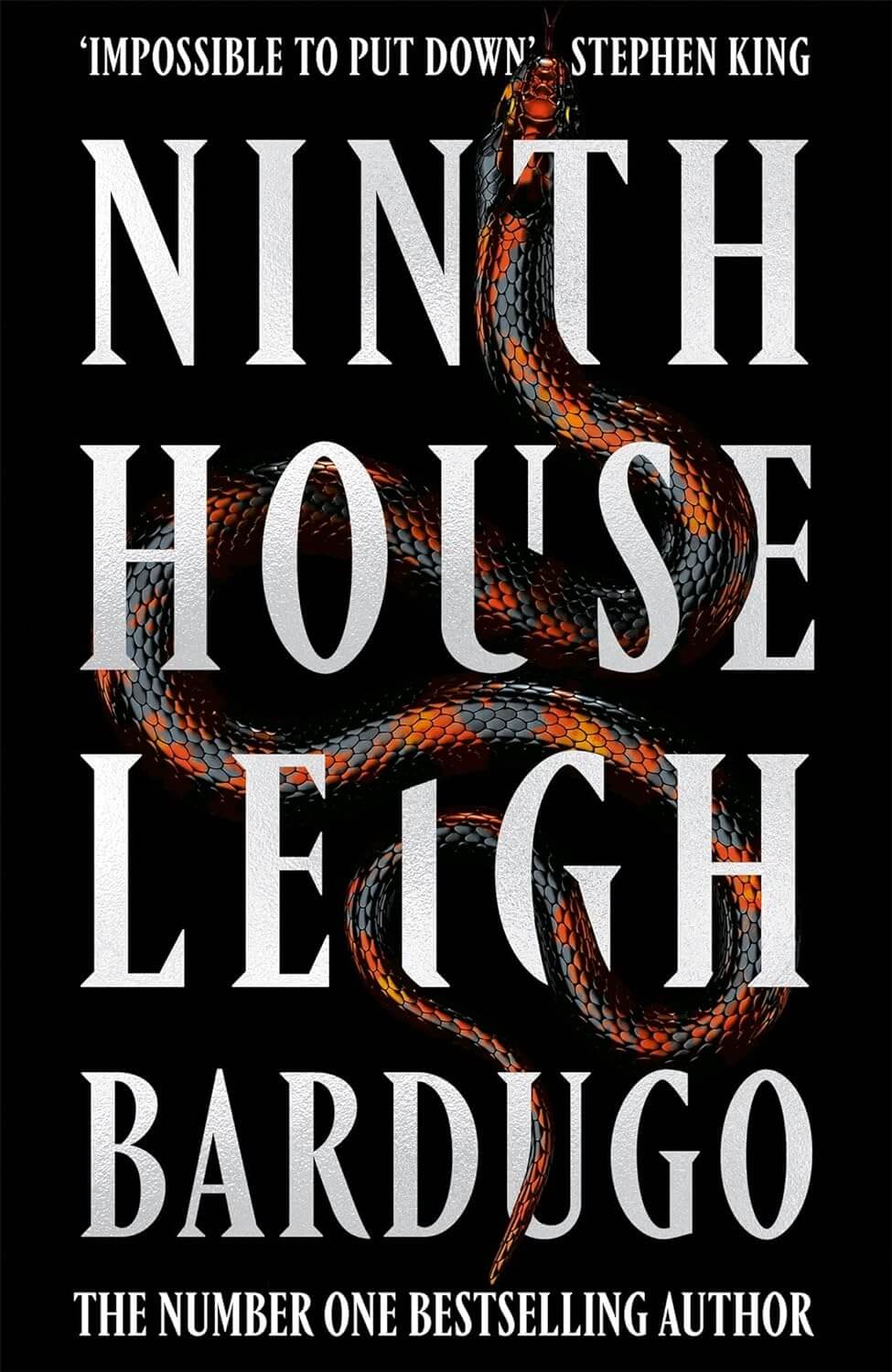
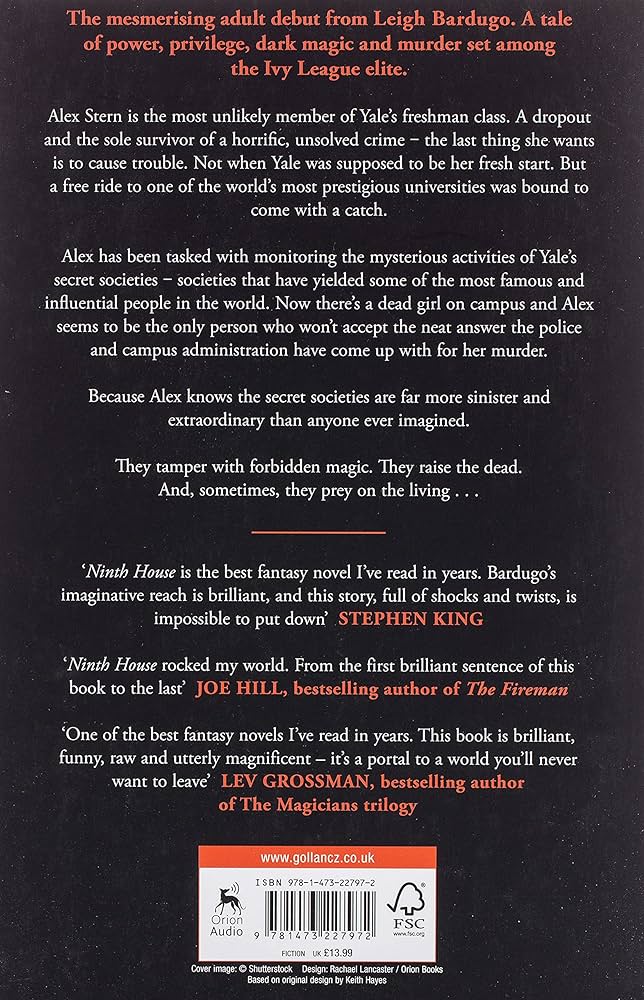
Ninth House by Leigh Bardugo


රු2,150.00
3 X Rs. 716.67 or 8% Cashback with


or 3 X රු716.67 with


or up to 4 X රු537.50 with


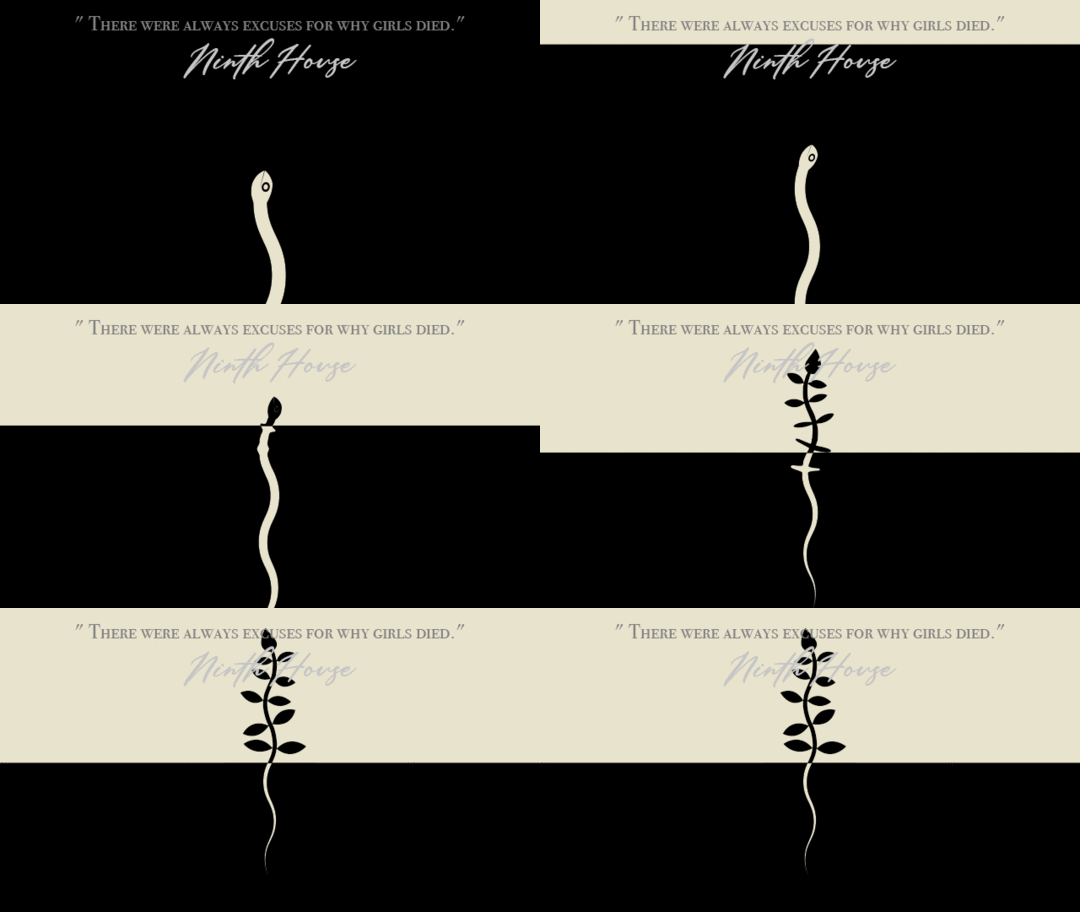 Step into the dark and mesmerizing world of Ninth House by Leigh Bardugo, a gripping fantasy thriller. Follow Alex Stern as she uncovers sinister secrets at Yale’s secret societies. Perfect for fans of dark academia and supernatural mysteries.
Out of stock
Email when stock available
Ninth House by Leigh Bardugo is a dark, atmospheric adult fantasy about secret societies, murder, ghosts, privilege and dangerous magic hidden beneath the prestigious world of Yale University.
Galaxy “Alex” Stern does not look like the typical Yale freshman.
She is a high-school dropout.
She has survived addiction, dangerous relationships, violence and a horrifying unsolved multiple homicide.
Her future appears almost completely destroyed.
Then, while recovering in a hospital, Alex receives an extraordinary offer.
A full scholarship to Yale.
No normal admissions process.
No perfect academic record.
A chance to completely rebuild her life.
There is, of course, a catch.
Alex can see Grays—the ghosts of the dead.
And someone at Yale considers that ability extremely valuable.
Yale’s famous secret societies are not merely exclusive clubs filled with wealthy and influential students.
Behind closed doors, some of them practice real magic.
They perform rituals.
Manipulate supernatural forces.
Raise the dead.
And sometimes their pursuit of power has terrible consequences.
Alex is recruited by Lethe House, the organization responsible for monitoring these secret societies and preventing their magical activities from becoming dangerously uncontrolled.
Her guide into this hidden world is Daniel Arlington, better known as Darlington, the polished, brilliant and privileged student who seems almost perfectly suited to Yale’s occult traditions.
Alex is the opposite.
She distrusts institutions.
She has survived environments where rules offered very little protection.
She understands that powerful people do not always face consequences.
That difference becomes crucial when a young woman is found dead and Alex refuses to accept the convenient explanation surrounding her murder.
The deeper she investigates, the more she discovers that magic, money and privilege can make an extremely dangerous combination.
Ninth House by Leigh Bardugo – Book Overview
Ninth House by Leigh Bardugo blends dark academia, supernatural fantasy, murder mystery and psychological suspense into a story about who gets protected by powerful institutions—and who does not.
The novel uses Yale as more than a beautiful university setting.
Its libraries, old buildings, traditions and secret societies create an atmosphere where history feels physically present.
But beneath the academic prestige is another world.
A world of rituals.
Ghosts.
Ancient magic.
Hidden rooms.
Powerful alumni.
And people willing to use supernatural forces to gain even more influence.
Galaxy “Alex” Stern
Alex is one of the most unusual fantasy protagonists in Bardugo’s work.
She is not a chosen princess.
She is not an elite student who has spent her entire life preparing for a magical academy.
She arrives at Yale carrying trauma and a history that immediately makes her feel like an outsider.
That outsider status matters.
Alex sees the university differently from people who grew up expecting to belong in places like Yale.
Where others may see:
Tradition.
Prestige.
Opportunity.
Alex is more likely to ask:
Who benefits?
Who is being exploited?
Who is being ignored?
That perspective makes her particularly suited to investigating the darker side of Yale’s magical elite.
Alex Can See Ghosts
Alex’s ability to see the dead has followed her for much of her life.
These ghosts are known as Grays.
For many people, seeing ghosts might sound like an exciting magical gift.
For Alex, it has often been frightening, invasive and traumatic.
Her ability therefore does not function like a simple superpower.
It has shaped how she experiences reality.
The Grays
The dead remain around the living world.
Most people cannot see them.
Alex can.
This gives Lethe House access to information that ordinary students and even experienced magical practitioners may not possess.
But seeing the dead also exposes Alex to dangers other people can simply ignore.
Lethe House
Lethe is effectively the watchdog overseeing Yale’s magical secret societies.
Its purpose is to observe occult rituals and prevent catastrophic consequences.
This gives the novel an unusual institutional structure.
Magic is not hidden because nobody knows it exists.
A small group knows exactly what is happening.
They have rules.
Records.
Procedures.
Responsibilities.
The problem is that institutions themselves can also become compromised.
The Ninth House
The title refers to Lethe’s special position among Yale’s occult societies.
The other houses pursue their own forms of magical power.
Lethe exists to supervise them.
That sounds reassuring.
But Ninth House by Leigh Bardugo repeatedly asks whether supervision really works when the people being supervised are:
Wealthy.
Well connected.
Prestigious.
Powerful.
Yale’s Secret Societies
Bardugo builds her fantasy around the real cultural mythology surrounding elite university secret societies, then imagines that their rituals actually work.
Different societies specialize in different magical practices.
Their members include people who may later become influential figures in:
Politics.
Finance.
Law.
Business.
This creates a powerful metaphor.
What if privilege were not merely social?
What if powerful people literally had access to magic that ordinary people did not?
Magic and Privilege
This is one of the novel’s strongest ideas.
In many fantasy stories, magic is distributed through:
Birth.
Destiny.
Training.
Ancient bloodlines.
Here, magic is also connected with institutional access.
Who knows the secret?
Who gets invited into the room?
Who has enough money to protect themselves from consequences?
Those questions give the fantasy a sharp social edge.
Power Protects Itself
Alex understands something many privileged students do not.
People with money and influence often have more ways to survive mistakes.
They have:
Connections.
Lawyers.
Reputations.
Institutions.
Someone with no protection can suffer much more severely from the same event.
The magical societies intensify this imbalance.
Darlington
Daniel Arlington, commonly called Darlington, is Alex’s mentor within Lethe.
He understands the traditions.
He loves Yale’s history.
He knows magical protocols.
He approaches the occult world almost like an academic discipline.
Where Alex sees danger and hypocrisy, Darlington often sees:
History.
Mystery.
Structure.
Knowledge.
Their differences create one of the most interesting relationships in the novel.
Alex and Darlington
Alex and Darlington do not begin as naturally compatible partners.
Darlington appears polished.
Alex appears chaotic.
He understands Yale.
She barely understands why she has been allowed to stay there.
But their contrasting perspectives also make them useful to each other.
Darlington knows the system.
Alex knows not to trust it automatically.
Pamela Dawes
Pamela Dawes is another important member of Lethe House.
She is academically gifted, highly knowledgeable and deeply involved in the research side of the organization.
Dawes demonstrates another kind of strength.
She may not have Alex’s confrontational personality, but knowledge itself becomes essential in a world where old texts and forgotten rituals can have immediate consequences.
Knowledge as Protection
In Ninth House by Leigh Bardugo, books and archives are not merely academic decorations.
Research can determine whether someone survives.
Understanding:
A ritual.
A historical event.
A ghost.
An old magical rule.
may reveal what is actually happening.
This makes the academic setting feel genuinely connected to the fantasy.
Dark Academia
The novel is widely associated with dark academia because it combines an elite educational environment with:
Old architecture.
Secret organizations.
Murder.
Scholarly obsession.
Power hierarchies.
History.
Morally questionable institutions.
Occult knowledge.
But the book is darker than the aestheticized version of dark academia often seen online.
Bardugo is interested not only in beautiful libraries and mysterious societies but in the harm powerful institutions can hide.
A Murder Mystery
A major plotline involves the death of a young woman.
Authorities appear ready to accept a straightforward explanation.
Alex is not.
Her experiences have made her suspicious of convenient stories, especially when the victim does not belong to Yale’s privileged world.
The investigation gradually connects:
Murder.
Ghosts.
Secret societies.
History.
Personal trauma.
Who Gets Believed?
One of the deeper questions behind the mystery is:
Whose story receives attention?
A prestigious Yale student may immediately be treated as important.
Someone from outside that world may be easier to dismiss.
Alex notices these inequalities because she has spent much of her own life outside respectable institutions.
Ghost Story and Crime Story
The novel works because the supernatural and criminal mysteries are intertwined.
A ghost may contain evidence.
A ritual may create a motive.
A centuries-old story may affect a modern crime.
Readers are therefore solving more than an ordinary murder.
History Does Not Stay Dead
Yale’s history constantly influences the present.
Buildings retain stories.
Organizations retain rituals.
Families retain power.
Ghosts literally remain.
This gives Ninth House by Leigh Bardugo one of its strongest recurring ideas:
The past does not disappear merely because people stop talking about it.
Trauma
Alex carries severe trauma into Yale.
The novel does not treat this simply as tragic backstory designed to make her interesting.
Her past affects:
How she trusts people.
How she reacts to danger.
How she sees power.
How she thinks about herself.
It also explains why a prestigious university cannot magically transform her life overnight.
A Second Chance Is Not a Clean Slate
Alex is given what looks like the perfect second chance.
Yale.
Scholarship.
Housing.
Education.
But opportunities do not erase trauma.
A new environment can provide possibility.
Healing still takes time.
Survival
Alex is fundamentally a survivor.
That can be both strength and burden.
Skills developed to survive dangerous circumstances may include:
Distrust.
Hyper-awareness.
Aggression.
Emotional distance.
Those strategies can keep someone alive.
They may also make ordinary relationships harder.
Morally Complicated Characters
One reason Ninth House by Leigh Bardugo feels adult is that characters are rarely divided neatly into:
Good people.
Bad people.
People can be generous in one situation and selfish in another.
Institutions can protect people while simultaneously harming others.
Characters make questionable choices for understandable reasons.
The Cost of Magic
Magic in this world is not free.
Rituals have consequences.
Power has consequences.
Attempts to control supernatural forces can hurt people.
That helps prevent the occult elements from becoming merely decorative.
Necromancy and the Dead
Some of Yale’s societies interact with death itself.
The ability to raise or communicate with the dead naturally creates enormous ethical questions.
Just because something is magically possible does not mean it should be done.
Consent
Consent is an important underlying concern throughout the novel.
Powerful groups may treat less powerful people as:
Resources.
Tools.
Bodies.
Means to an end.
The story repeatedly asks what happens when institutions value results more than the people affected by their methods.
Class
Class differences are central to Alex’s experience at Yale.
Many students come from backgrounds of enormous opportunity.
Alex does not.
This affects how she understands:
Money.
Safety.
Consequences.
Belonging.
Privilege often appears invisible to people who have always possessed it.
To Alex, it is impossible to miss.
Belonging
Yale gives Alex access to a world she never imagined entering.
But being physically present does not automatically mean feeling that you belong.
She must constantly navigate the difference between:
Being admitted
and
being accepted.
Impostor Syndrome
Alex has very practical reasons to feel academically unprepared.
Her educational background is unlike that of many classmates.
She therefore faces academic pressure alongside supernatural danger.
This grounds the fantasy in recognizable anxiety.
Academic Pressure
Deadlines still exist.
Grades still matter.
Classes continue.
Even when someone is investigating supernatural murder.
That contrast between ordinary university pressure and occult danger gives the novel much of its distinctive atmosphere.
Alex Is Not a Traditional Hero
Alex can be:
Angry.
Manipulative.
Violent.
Defensive.
Self-destructive.
Yet she also possesses a strong instinct to protect people society might ignore.
Her roughness does not erase compassion.
That contradiction makes her compelling.
Female Anger
The novel allows Alex to be angry without immediately sanitizing that anger into something polite.
Her anger comes from:
Trauma.
Injustice.
Exploitation.
Being underestimated.
Watching powerful people escape consequences.
Bardugo uses that anger as part of Alex’s agency.
Friendship
Although much of the story is dark, Alex is not completely isolated.
Relationships gradually become important.
Some people offer support.
Others challenge her.
Trust develops slowly.
This matters because Alex has learned to survive by expecting betrayal.
Trust Must Be Earned
For Alex, trust cannot be assumed.
A Yale title.
A family name.
An institution.
A polished appearance.
None automatically means someone is safe.
People must demonstrate reliability through actions.
Yale as a Character
The university itself almost functions like a character.
Beautiful.
Historic.
Prestigious.
Secretive.
Full of hidden rooms and older traditions.
Bardugo uses the contrast between Yale’s public reputation and its imagined occult underworld to create much of the book’s tension.
New Haven
The story also extends beyond campus.
New Haven contains communities and histories not represented by Yale’s elite image.
This wider setting helps reinforce the gap between the university and the people living around it.
Adult Fantasy, Not Young Adult
This is especially important for customers familiar with Leigh Bardugo through Shadow and Bone or Six of Crows.
Ninth House by Leigh Bardugo is an adult novel.
Hachette explicitly introduced it as Bardugo’s first adult novel.
The characters, content and themes are significantly more mature than those in her YA Grishaverse novels.
Is Ninth House Part of the Grishaverse?
No.
Ninth House is not part of Shadow and Bone, Six of Crows or the Grishaverse.
It is a separate world with its own characters, magic system and setting.
You do not need to read any previous Leigh Bardugo books first.
Is Ninth House the First Book?
Yes.
Macmillan officially lists Ninth House as Book 1 of the Ninth House series.
The story continues directly in Hell Bent, which is Book 2.
The publisher’s current series listing also identifies Dead Beat as the concluding third novel.
Recommended Reading Order
- Ninth House – Book 1
- Hell Bent – Book 2
- Dead Beat – Book 3 / conclusion
Read them in order because the central character arcs and major supernatural mysteries continue directly between the books.
Is Ninth House a Standalone?
No.
The main mystery of this volume has substantial resolution, but several important character and supernatural storylines continue into Hell Bent.
Readers should approach it as the beginning of a larger series.
Is Ninth House a Romance?
No.
There are complicated interpersonal relationships and emotional tension, but Ninth House by Leigh Bardugo is primarily adult dark fantasy, dark academia and supernatural mystery rather than a romance novel.
Readers purchasing it primarily for romance should expect the plot to focus much more strongly on:
Magic.
Murder.
Power.
Ghosts.
Trauma.
Secret societies.
Is Ninth House Horror?
It contains strong horror elements.
Hachette categorizes the edition under both Fantasy and Horror & Ghost Stories.
There are ghosts, disturbing occult rituals, violence, body horror and frightening supernatural scenes.
However, the overall structure also strongly resembles fantasy and mystery.
Is Ninth House Easy to Read?
Bardugo’s prose is accessible, but the story is denser than many YA fantasy novels.
Readers need to keep track of:
Secret societies.
Characters.
Different magical practices.
Timelines.
Institutional history.
The early sections deliberately introduce a large amount of information before the mystery fully develops.
Readers who stay with the setup are rewarded as those pieces begin connecting.
Leigh Bardugo
Leigh Bardugo is the bestselling author behind the Grishaverse novels, including Shadow and Bone and Six of Crows.
Ninth House marked her move into adult fantasy and won the Goodreads Choice Award for Best Fantasy in 2019. Hachette also lists it as a Sunday Times and New York Times bestseller.
Your Edition
Your inventory lists:
Title: Ninth House
Author: Leigh Bardugo
ISBN: 9781473227989
Hachette confirms 9781473227989 as the UK paperback edition, released October 20, 2020.
So unlike the ISBN issue we found with Nexus, your Ninth House ISBN is correct.
Content Considerations
Ninth House by Leigh Bardugo is an adult dark fantasy with significantly mature content. Readers should be aware of themes involving sexual assault, drug use and addiction, murder, graphic violence, exploitation, trauma, death, ghosts, occult rituals, coercion and disturbing supernatural/body-horror imagery.
This is not a light magical-school story and should not be marketed as a children’s or younger-teen fantasy simply because Bardugo also writes YA novels.
Important Themes
The novel explores power and privilege, trauma, survival, class, institutional corruption, secret societies, ghosts, death, justice, consent, exploitation, academic pressure, belonging, inequality, friendship, truth, ambition, magic and the difference between appearing respectable and actually behaving ethically.
7 Dark & Powerful Reasons to Read Ninth House by Leigh Bardugo
- Alex Stern is an unforgettable outsider protagonist. She enters Yale without the privilege, academic preparation or polished background of the people around her, giving readers a very different perspective on an elite institution.
- The dark-academia setting actually matters to the plot. Libraries, secret societies, academic traditions, old buildings and institutional history are integrated directly into the magical mystery rather than functioning only as an aesthetic.
- The magic is genuinely dangerous. Rituals can manipulate people, disturb the dead and cause terrible consequences, making the supernatural world feel threatening rather than whimsical.
- The murder mystery keeps the fantasy grounded. Alex’s investigation gives the novel a strong central question while gradually exposing deeper secrets surrounding Yale’s occult societies.
- It examines power as seriously as magic. Bardugo repeatedly asks who gets protected, who gets believed and what happens when enormous privilege is combined with supernatural abilities.
- The characters are morally complicated. Alex, Darlington and the people around them are shaped by conflicting loyalties, trauma, ambition and personal weaknesses rather than fitting neatly into heroic stereotypes.
- It begins a larger supernatural mystery. Readers who become invested in Alex, Darlington and Lethe House can continue directly into Hell Bent and the concluding Dead Beat.
Why Read Ninth House by Leigh Bardugo?
Ninth House by Leigh Bardugo is an excellent choice for readers who enjoy adult fantasy, dark academia, murder mysteries, secret societies, ghosts, occult magic and morally complex protagonists.
It is particularly suited to readers who like fantasy that asks uncomfortable questions.
What happens when magic belongs to people who already possess social power?
Who watches the powerful?
Can an institution really police itself?
Why are some victims easier to ignore?
Can a person carrying severe trauma genuinely begin again?
And what happens when the prestigious version of a place is only one layer of its reality?
The supernatural mystery makes the book entertaining.
Those questions give it depth.
Who Should Read This Book?
Ninth House by Leigh Bardugo may especially appeal to adult fantasy readers, dark-academia fans, Leigh Bardugo readers looking for her adult work, fans of supernatural mysteries, readers who enjoy morally grey characters, ghost-story fans, readers interested in elite-secret-society settings and anyone who enjoys mysteries where history and the supernatural overlap.
Readers wanting something similar in tone to a light magical boarding-school adventure should know that Ninth House is considerably darker, more violent and more mature.
Ninth House by Leigh Bardugo – What Happens When Privilege Has Magic?
Ninth House by Leigh Bardugo begins with an impossible opportunity.
Alex Stern should not be at Yale.
According to every conventional measurement of academic success, she does not belong there.
Yet someone needs what she can do.
She sees the dead.
That ability gives Alex entrance into a world most students will never know exists.
Behind the stone buildings and old traditions are secret societies performing genuine magic.
These are not powerless teenagers experimenting with harmless spells.
Their members have access to wealth, influence and institutional protection.
Magic simply gives them another form of power.
Alex therefore enters Yale with two educations happening simultaneously.
In class, she must learn how to survive academically in one of the world’s most prestigious universities.
Inside Lethe, she must learn how to survive a supernatural system built by people who have controlled power for generations.
Then a woman dies.
The easy explanation satisfies almost everyone.
Not Alex.
She knows what it feels like when respectable people prefer a convenient story.
She knows that danger does not always look dangerous.
Sometimes it wears expensive clothes.
Sometimes it has a famous family name.
Sometimes it belongs to an institution everyone assumes must be trustworthy.
And sometimes the person everyone thinks is trouble is the only one willing to keep asking questions.
That is what makes Ninth House by Leigh Bardugo such a compelling dark fantasy.
The ghosts are frightening.
The rituals are disturbing.
The murder creates suspense.
But the deepest danger comes from something completely human:
People with power believing the rules do not apply to them.
For readers ready for a mature, atmospheric story of Yale secret societies, ghosts, murder, forbidden magic and institutional privilege, Ninth House by Leigh Bardugo is a powerful beginning to Alex Stern’s dark and dangerous series.
Learn more about Ninth House by Leigh Bardugo on the official Macmillan website.
Explore more fantasy and thriller books at Bargain Books.
| Weight | 0.4 kg |
|---|---|
| Dimensions | 12.8 × 3.4 × 19.6 cm |
| Author | Leigh Bardugo |
| Type | Paperback Brand new Printed (Indian Locally published) |
| ISBN/ISSN | 1473227984 |
| Language | English |
| Pages | 480 |
Be the first to review “Ninth House by Leigh Bardugo”
Related products
-50%

Out of stock
Children & Young Adult
Original price was: රු3,400.00.රු1,700.00Current price is: රු1,700.00.
3 X Rs. 566.67 or 8% Cashback with
or 3 X රු566.67 with
or up to 4 X රු425.00 with

Damaged & Imperfect Books
රු1,300.00
3 X Rs. 433.33 or 8% Cashback with
or 3 X රු433.33 with
or up to 4 X රු325.00 with

Contemporary Fiction
Tales from the Cafe: Before the Coffee Gets Cold by Toshikazu Kawaguchi
රු1,600.00
3 X Rs. 533.33 or 8% Cashback with
or 3 X රු533.33 with
or up to 4 X රු400.00 with

Out of stock
රු3,000.00
3 X Rs. 1,000.00 or 8% Cashback with
or 3 X රු1,000.00 with
or up to 4 X රු750.00 with

3 X Rs. 0.00 or 8% Cashback with
or 3 X රු0.00 with
or up to 4 X රු0.00 with
Out of stock
Children & Young Adult
රු2,500.00
3 X Rs. 833.33 or 8% Cashback with
or 3 X රු833.33 with
or up to 4 X රු625.00 with

Children & Young Adult
රු2,100.00
3 X Rs. 700.00 or 8% Cashback with
or 3 X රු700.00 with
or up to 4 X රු525.00 with

Fantasy
රු2,400.00
3 X Rs. 800.00 or 8% Cashback with
or 3 X රු800.00 with
or up to 4 X රු600.00 with
Reviews
There are no reviews yet.