
No products in the cart.
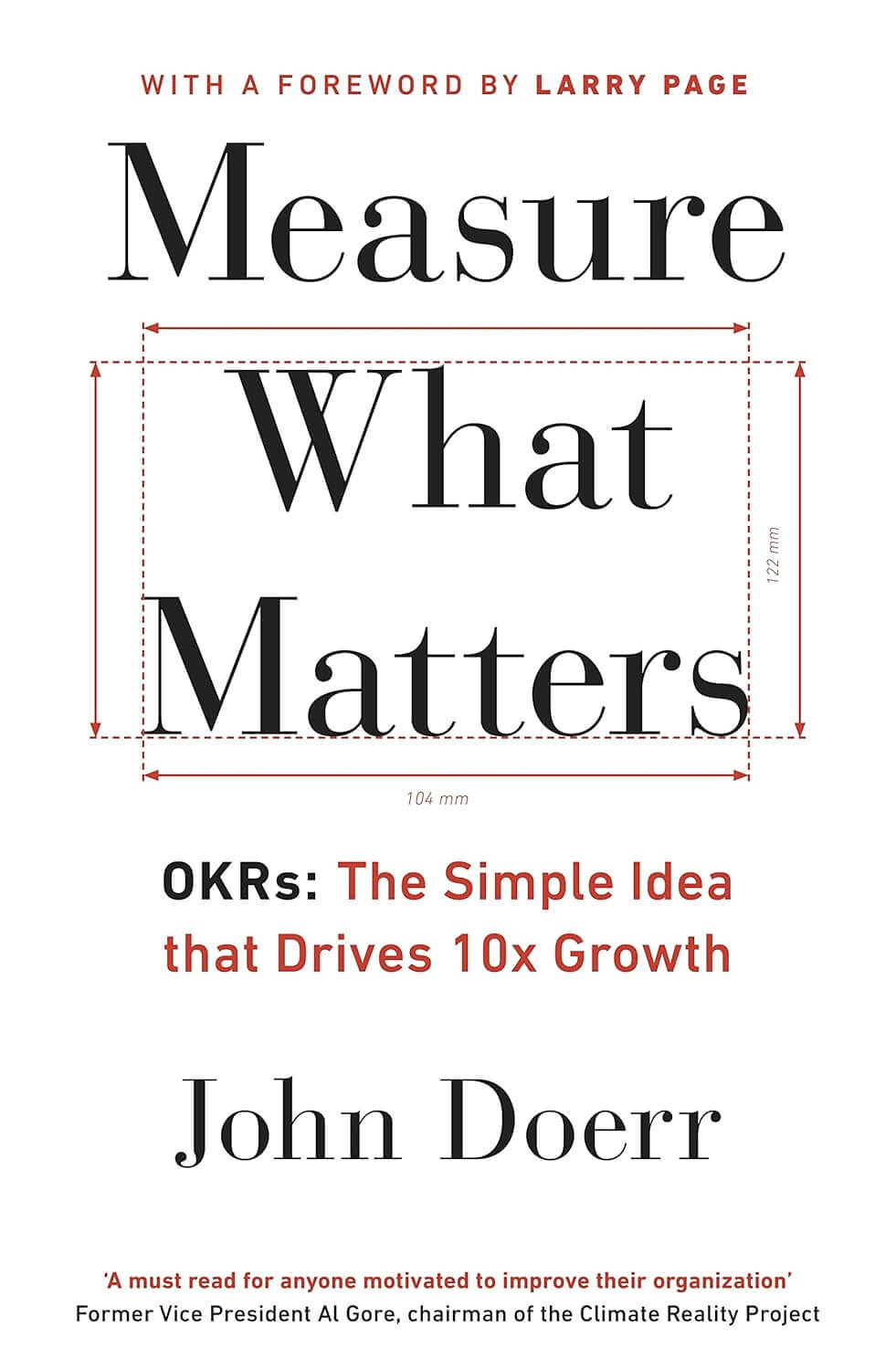
Measure What Matters by John Doerr

රු1,750.00
3 X Rs. 583.33 or 8% Cashback with


or 3 X රු583.33 with


or up to 4 X රු437.50 with


Measure What Matters by John Doerr is a bestselling business and leadership guide to OKRs — Objectives and Key Results. Drawing on examples including Intel and Google, John Doerr explains how organizations can focus on priorities, align teams, track measurable results, create accountability and pursue ambitious goals. The book also explores CFRs — Conversations, Feedback and Recognition — as tools for building stronger performance cultures. Ideal for entrepreneurs, managers, founders, project leaders and professionals who want to turn strategy into measurable execution.
Out of stock
Email when stock available
Measure What Matters by John Doerr is a practical business and leadership guide to using Objectives and Key Results, or OKRs, to set meaningful goals, measure progress, align teams and turn ambitious ideas into measurable results.
Many organizations do not fail because people are lazy.
They fail because people are working hard on too many different things.
Teams become busy.
Meetings increase.
Projects multiply.
But nobody can clearly answer:
What matters most?
What are we trying to achieve?
How will we know whether we succeeded?
John Doerr presents OKRs as a simple framework for solving this problem.
An Objective describes what you want to achieve.
A Key Result describes how you will measure whether you achieved it.
For example:
Objective: Improve customer satisfaction.
Possible Key Results:
Increase customer satisfaction score from 82% to 92%.
Reduce average response time from 12 hours to 3 hours.
Increase repeat customer rate from 35% to 45%.
The objective provides direction.
The key results provide measurable evidence.
Measure What Matters by John Doerr explains how this approach can help organizations create focus, transparency, accountability and alignment while encouraging teams to pursue ambitious goals.
Drawing on examples from technology, business, nonprofits and other organizations, Doerr shows how companies can move beyond vague intentions and build a culture where everyone understands what matters and how success will be measured.
Measure What Matters by John Doerr – Book Overview
Measure What Matters by John Doerr centers on the OKR system.
The framework became closely associated with Intel under legendary leader Andy Grove and was later introduced to Google when the company was still young.
John Doerr had learned the system at Intel.
He later brought OKRs to Google, where the framework became an important part of the company’s management approach.
The book explains how similar principles can be applied in:
Startups.
Large companies.
Nonprofits.
Schools.
Teams.
Individual careers.
The framework is simple.
But using it well requires discipline.
What Are OKRs?
OKR stands for:
Objectives and Key Results.
An Objective answers:
What do we want to achieve?
A Key Result answers:
How will we know we achieved it?
The objective should be:
Clear.
Meaningful.
Motivating.
The key results should be:
Specific.
Measurable.
Time-bound.
Outcome-focused.
Objectives
A good objective gives people direction.
Instead of:
“Improve marketing.”
you might use:
Become the most trusted bookstore brand for young readers in our market.
That creates a clearer destination.
But it still needs measurement.
That is where key results become important.
Key Results
Possible key results might include:
Increase returning customers by 25%.
Grow organic website traffic by 40%.
Increase email subscriber conversion by 20%.
Improve customer review score.
These results make progress visible.
Goals Need Measurement
One of the main ideas in Measure What Matters by John Doerr is that goals without measurement often remain intentions.
People say:
We should improve service.
We should grow.
We should become more innovative.
We should work faster.
But what does improvement actually mean?
Measurement forces clarity.
Measure Outcomes, Not Activity
One common mistake is measuring how much work people do instead of what their work achieves.
For example:
“Publish 100 social posts.”
That measures activity.
A stronger business result might be:
“Increase qualified website traffic from social media by 30%.”
The second result focuses more directly on impact.
The Four OKR Superpowers
Doerr explains four major benefits, sometimes described as the four OKR superpowers.
They are:
1. Focus and commit to priorities
2. Align and connect for teamwork
3. Track for accountability
4. Stretch for amazing
Together, these principles create a powerful management system.
Focus and Commit to Priorities
Most organizations have too many priorities.
If everything is important, nothing is truly prioritized.
A company may simultaneously want to:
Increase sales.
Build new products.
Improve service.
Open locations.
Reduce costs.
Launch campaigns.
Redesign systems.
Hire people.
Expand internationally.
All at once.
The result can be scattered attention.
Choose What Matters Most
Measure What Matters by John Doerr encourages organizations to choose a limited number of meaningful priorities.
This requires saying:
Yes.
But also:
No.
Focus means deciding what deserves attention now.
Fewer Goals Can Produce Better Execution
The purpose of OKRs is not to create a giant list of every task employees perform.
Instead, OKRs should highlight the goals that matter most during a particular period.
That makes priorities visible.
Commitment
Choosing a goal is not enough.
The organization must commit:
People.
Time.
Resources.
Management attention.
A priority without resources is often only a wish.
Align and Connect for Teamwork
One team may be trying to increase sales.
Another may be reducing inventory.
Another may be changing pricing.
Another may be launching promotions.
Without alignment, teams can accidentally work against each other.
OKRs help everyone understand how their goals connect.
Transparency
A major feature of strong OKR systems is transparency.
People should be able to see:
Company objectives.
Team objectives.
Relevant individual objectives.
This helps employees understand the larger picture.
Understand Why Your Work Matters
A person becomes more motivated when they understand how their work connects to a larger mission.
Instead of:
“I am updating product descriptions.”
the person understands:
“My work supports the objective of increasing organic search traffic and conversion.”
That creates context.
Top-Down and Bottom-Up Goals
Not every goal should come entirely from senior management.
Employees closest to:
Customers.
Products.
Operations.
Technology.
may see opportunities executives miss.
Strong OKR cultures allow some goals to emerge from teams themselves.
Connect Teams
Two departments may discover they depend on each other.
Marketing needs product information.
Sales needs inventory accuracy.
Technology needs business requirements.
Finance needs sales data.
Visible OKRs expose these connections.
Track for Accountability
Goals should not disappear after being written.
A common management failure is:
January:
Set goals.
December:
Ask what happened.
There is little tracking between.
OKRs require regular review.
Check Progress Frequently
Teams should ask:
Are we on track?
What changed?
What is blocked?
Do we need help?
Is the goal still relevant?
Tracking allows correction before it is too late.
Progress Should Be Visible
A measurable key result can be updated.
For example:
Target:
Increase online conversion from 1.8% to 2.5%.
Current:
2.1%.
Now everyone can see progress.
Accountability Without Fear
Accountability should not mean constantly punishing people.
Healthy accountability means:
We agreed to this result.
What happened?
What did we learn?
What should change?
The goal is improvement.
Stretch for Amazing
Some OKRs should encourage people to attempt something difficult.
If every goal is guaranteed to succeed, the organization may not be ambitious enough.
Doerr distinguishes between committed goals and more ambitious stretch goals.
Stretch Goals
A stretch goal deliberately pushes beyond normal expectations.
The team may not achieve 100%.
That does not automatically mean failure.
The purpose may be to encourage:
Innovation.
Creative thinking.
Higher performance.
New methods.
Ambition
Organizations often underestimate what teams can accomplish.
A challenging objective can force people to reconsider their assumptions.
Instead of:
How do we improve by 5%?
the team asks:
How could we improve by 50%?
That question may create completely different ideas.
Committed Versus Aspirational OKRs
Some goals must be achieved.
Examples might include:
Regulatory compliance.
Financial commitments.
Critical product launches.
Other goals may be aspirational.
These encourage experimentation and breakthrough thinking.
Understanding the difference is important.
Intel
Intel plays a major role in the history told in Measure What Matters by John Doerr.
John Doerr learned about goal-setting systems while working there.
Intel leader Andy Grove helped develop and popularize the management approach that later influenced modern OKRs.
Andy Grove
Andy Grove was known for disciplined management.
His approach emphasized:
Clear priorities.
Measurement.
Execution.
Accountability.
Organizations could not rely only on vague ambition.
Goals needed measurable results.
Google is one of the most famous examples associated with OKRs.
John Doerr introduced the system to Google’s founders during the company’s early years.
The company adopted OKRs as it grew.
Google’s use of OKRs helped make the framework widely known across technology and startup communities.
Why OKRs Work Well for Startups
Startups operate with limited:
Money.
People.
Time.
Attention.
They cannot afford to waste resources.
OKRs help startups decide what matters most.
Rapid Growth Creates Confusion
When a small company grows quickly, informal communication stops working.
At ten employees, everyone may know what is happening.
At one hundred employees, that becomes much harder.
Goals need to become explicit.
OKRs for Large Organizations
Large organizations face different problems.
Departments can become isolated.
Employees may understand their own tasks but not the organization’s priorities.
Transparent OKRs can improve coordination.
Mission and OKRs
An organization’s mission answers a broad question:
Why do we exist?
OKRs answer a shorter-term question:
What important progress should we make now?
The mission provides direction.
OKRs translate direction into action.
Strategy and Execution
Strategy describes where the organization wants to go.
Execution determines whether it gets there.
Many companies have excellent strategy documents but weak execution.
Measure What Matters by John Doerr helps bridge that gap.
Ideas Are Not Enough
An organization can have brilliant ideas.
But without:
Priorities.
Ownership.
Measurement.
Tracking.
ideas remain ideas.
Execution creates results.
Key Results Should Be Measurable
A weak key result:
“Improve customer service.”
A stronger key result:
“Increase customer satisfaction from 80% to 90%.”
Now performance can be evaluated.
Avoid Vague Language
Words such as:
Improve.
Enhance.
Support.
Work on.
can hide lack of clarity.
Ask:
How much?
By when?
What outcome?
Output Versus Outcome
Suppose a team launches a new website.
That is an output.
But why was the website created?
Perhaps the real objective is:
Increase online sales.
Then possible key results might include:
Increase conversion rate.
Increase average order value.
Reduce checkout abandonment.
The website is a means, not the final result.
Business Example
Imagine a bookstore wants to increase online sales.
Objective:
Build the strongest online customer experience in our market.
Key Results:
Increase website conversion from 2% to 3%.
Reduce checkout abandonment by 20%.
Increase returning customer rate by 25%.
Reach 1,000 verified customer reviews.
Now the team can measure whether customer experience actually improved.
Sales OKRs
A sales team might use:
Objective: Build predictable monthly revenue growth.
Key Results:
Increase monthly revenue by 20%.
Increase repeat orders by 15%.
Increase average order value by 10%.
Reduce canceled orders by 20%.
Each key result provides evidence.
Marketing OKRs
Marketing might use:
Objective: Become the first bookstore customers think of online.
Key Results:
Increase organic website traffic by 40%.
Grow email subscribers by 5,000.
Increase social-to-website conversion by 25%.
Generate a specific number of qualified leads.
Again, outcomes matter more than simply posting content.
Technology OKRs
A software team might use:
Objective: Make the website faster and more reliable.
Key Results:
Reduce average page-load time below two seconds.
Maintain 99.9% uptime.
Reduce critical production errors by 50%.
Improve checkout completion rate.
Technical work becomes connected with customer results.
Personal OKRs
Individuals can also use OKRs.
For example:
Objective: Become a stronger software engineer.
Key Results:
Complete two advanced backend projects.
Contribute to five production releases.
Learn automated testing and apply it to a real application.
Complete one cloud certification.
The system turns personal ambition into measurable progress.
OKRs Are Not To-Do Lists
A common mistake is creating OKRs that look like:
Send emails.
Attend meetings.
Create presentation.
Update document.
These are tasks.
OKRs should focus on meaningful outcomes.
Tasks Support OKRs
Tasks still matter.
But they exist underneath the goal.
Objective:
Increase customer retention.
Key Result:
Increase repeat purchases from 30% to 40%.
Tasks might include:
Launch loyalty campaign.
Improve follow-up emails.
Analyze customer complaints.
The tasks support the result.
KPIs Versus OKRs
OKRs and KPIs are related but different.
A KPI often monitors ongoing business health.
Examples:
Revenue.
Conversion rate.
Customer satisfaction.
Inventory turnover.
An OKR usually describes a specific improvement you want to achieve.
KPI Example
KPI:
Website conversion rate.
OKR:
Increase conversion rate from 2% to 3% this quarter.
The KPI is the metric.
The OKR creates a goal around improving it.
CFRs
Measure What Matters by John Doerr also discusses the importance of CFRs:
Conversations
Feedback
Recognition
These help create a healthier performance culture around goals.
Conversations
Managers and employees should speak regularly.
Not only once a year.
Useful conversations include:
What is going well?
What is blocked?
What support do you need?
What should change?
Feedback
Feedback helps people improve.
Good feedback should be:
Specific.
Timely.
Constructive.
Actionable.
Waiting twelve months to discuss a problem is rarely useful.
Recognition
People want to know that good work is noticed.
Recognition does not always require money.
It can include:
Public appreciation.
A thank-you.
Acknowledging improvement.
Celebrating meaningful achievement.
Continuous Performance Management
Traditional annual performance reviews can become disconnected from daily work.
Doerr supports more continuous communication.
Goals change.
Business conditions change.
People need feedback throughout the year.
OKRs and Employee Performance
OKRs can inform performance discussions.
However, organizations should be careful about linking every stretch OKR directly to compensation.
If employees believe missing an ambitious target will automatically reduce their salary or bonus, they may intentionally set easy goals.
That destroys the purpose of stretch goals.
Psychological Safety
People need enough safety to attempt ambitious work.
If every failed experiment leads to punishment, employees will stop experimenting.
A learning culture asks:
What did we discover?
Failure
Not hitting every OKR is not automatically failure.
Sometimes the target was intentionally ambitious.
Sometimes conditions changed.
Sometimes the strategy was wrong.
The important step is learning.
Review the Goal
At the end of a cycle, ask:
What percentage did we achieve?
Why?
What worked?
What failed?
Should this continue?
What should we change?
Review converts results into learning.
Scoring OKRs
Some organizations use simple scoring systems to evaluate progress.
The exact scoring method matters less than having an honest way to assess results.
The objective is not manipulating the number.
It is understanding performance.
Transparency Creates Responsibility
When goals are visible, people understand:
Who owns what.
What progress has been made.
Where help is needed.
This can reduce unnecessary meetings.
Alignment Prevents Duplicate Work
Without visibility, two teams may unknowingly work on similar projects.
Another critical task may have no owner.
Transparent goals expose these problems.
Ownership
Every important result needs clear ownership.
Someone should know:
I am responsible for driving this result.
This does not mean they work alone.
It means responsibility is clear.
Leadership
Leaders must participate.
If executives ask employees to use OKRs but ignore the framework themselves, people will quickly stop taking it seriously.
Leadership must model the system.
Leaders Need to Say No
Focus requires trade-offs.
Every new initiative consumes:
Time.
Money.
Attention.
Leadership must protect priorities from constant distraction.
Culture
OKRs work best when supported by a healthy culture.
A spreadsheet alone will not transform an organization.
People still need:
Trust.
Communication.
Accountability.
Honesty.
Respect.
Culture and Results
A company can have excellent objectives and still fail if teams hide problems.
Data without honesty becomes misleading.
People must feel able to say:
We are behind.
This strategy is not working.
We need help.
Data-Driven Management
One of the broader lessons in Measure What Matters by John Doerr is the power of data-driven management.
Instead of asking:
Do we feel successful?
ask:
What does the evidence show?
Measurement reduces self-deception.
What Gets Measured Gets Attention
When something is measured regularly, people notice it.
That makes choosing metrics extremely important.
Measure the wrong thing and behavior can become distorted.
Choose Metrics Carefully
Suppose customer service is measured only by:
Number of tickets closed.
Employees may rush to close tickets.
Customer satisfaction could decrease.
A better measurement system includes quality.
Avoid Vanity Metrics
Vanity metrics look impressive but may not create business value.
Examples can include:
Followers.
Page views.
Downloads.
These may matter.
But only if they connect with outcomes.
Ask:
Does this metric help us make better decisions?
Leading and Lagging Indicators
Some metrics measure final outcomes.
Others provide earlier signals.
Revenue is often a lagging indicator.
Qualified leads may be a leading indicator.
Good management monitors both.
Learning From Results
Measurement should lead to questions.
Why did revenue increase?
Which campaign worked?
Which customer segment grew?
What caused churn?
Data should create understanding.
Doerr’s Investment Perspective
John Doerr is a venture capitalist who has worked with many technology companies.
His experience gives the book a strong focus on:
Growth.
Leadership.
Execution.
Innovation.
Scaling.
The stories show how ambitious companies use structured goals while expanding rapidly.
OKRs Beyond Technology
Although Google and Intel are famous examples, the principles are not limited to technology companies.
OKRs can be useful in:
Retail.
Education.
Healthcare.
Nonprofits.
Manufacturing.
Professional services.
Personal development.
Any environment with goals and measurable outcomes can potentially use them.
Nonprofits
Nonprofits also need measurement.
A mission may be inspiring.
But organizations still need to know:
Are people’s lives improving?
Are programs working?
Are resources being used effectively?
Measurement helps connect good intentions with real impact.
Stretch Without Burnout
Ambitious goals should not become an excuse for permanently unrealistic workloads.
Stretch goals should encourage creative thinking.
They should not require employees to work unsustainably.
Sustainable performance still matters.
Adaptability
Goals should provide direction without becoming rigid.
If major circumstances change, an organization may need to update an OKR.
Continuing a meaningless goal simply because it was written months ago is not discipline.
It is bureaucracy.
Quarterly Planning
Many organizations use quarterly OKR cycles.
A quarter is long enough to make progress but short enough to adjust regularly.
The exact schedule can differ depending on the organization.
Annual Goals and Quarterly OKRs
A company may have annual strategic priorities.
Quarterly OKRs can break those ambitions into shorter execution cycles.
This creates a connection between long-term direction and daily action.
Weekly Check-Ins
Regular check-ins help teams avoid surprises.
Questions might include:
What is on track?
What is at risk?
What changed?
Where do we need support?
Small corrections prevent larger problems.
OKRs for Entrepreneurs
Entrepreneurs often have too many ideas.
A founder may simultaneously want to:
Improve the website.
Open another location.
Launch advertising.
Develop software.
Build partnerships.
Hire employees.
Introduce new products.
OKRs force prioritization.
Do the Most Important Thing First
A useful question is:
If we could achieve only three meaningful things this quarter, what should they be?
That question creates focus.
OKRs for Small Businesses
Small businesses may benefit even more from simplicity.
They do not need a complicated software platform.
A simple document can track:
Objective.
Key Results.
Owner.
Progress.
Deadline.
The value comes from discipline, not the tool.
OKRs for Bookstores and Retailers
A bookstore might use an objective such as:
Become the easiest bookstore to shop from online and in-store.
Key Results could include:
Increase online monthly sales by 25%.
Maintain inventory accuracy above 98%.
Reduce average order-processing time by 30%.
Increase repeat customer rate by 15%.
Achieve customer satisfaction above 90%.
This makes strategy measurable.
OKRs for ERP and Software Projects
A software project might use:
Objective: Make inventory management accurate and reliable.
Key Results:
Reach 99% stock accuracy.
Reduce manual inventory adjustments by 50%.
Reduce stock-sync errors to below 1%.
Cut monthly reconciliation time from eight hours to two hours.
The objective gives direction while the results define success.
Is Measure What Matters a Business Book?
Yes.
Measure What Matters by John Doerr is primarily a book about:
Business management.
Leadership.
Goal setting.
Execution.
Organizational culture.
Performance management.
It is especially popular among founders, managers and team leaders.
Is Measure What Matters Good for Beginners?
Yes.
Readers do not need advanced management knowledge.
The OKR concept is straightforward.
The challenge is applying it consistently.
Is It Only for Large Companies?
No.
OKRs can be adapted for:
One person.
A small team.
A startup.
A nonprofit.
A multinational organization.
The complexity of the system should match the size of the organization.
Is Measure What Matters About KPIs?
Not exactly.
KPIs and OKRs can work together, but they serve different purposes.
KPIs help monitor ongoing performance.
OKRs help define important change or improvement.
Is It Useful for Project Managers?
Yes.
Project managers can use OKR thinking to connect projects with measurable outcomes.
Instead of asking only:
Did we finish the project?
also ask:
Did the project create the result we wanted?
Is It Useful for Employees?
Yes.
Employees can use the framework to understand:
Priorities.
Expected outcomes.
How their work connects with company strategy.
What success looks like.
Clarity can reduce wasted effort.
Important Themes
Measure What Matters by John Doerr explores themes including:
- OKRs
- Objectives and Key Results
- Goal setting
- Leadership
- Business strategy
- Execution
- Focus
- Prioritization
- Accountability
- Transparency
- Alignment
- Teamwork
- Stretch goals
- Performance management
- CFRs
- Feedback
- Recognition
- Company culture
- Measurement
- Growth
7 Powerful Lessons From Measure What Matters by John Doerr
There are many lessons in Measure What Matters by John Doerr, but seven stand out:
- Focus on a small number of meaningful priorities – When everything is treated as important, teams struggle to understand what truly deserves attention.
- Make success measurable – Clear key results turn vague ambitions into outcomes that can actually be tracked.
- Align teams around shared goals – Transparent objectives help employees understand how their work contributes to larger organizational priorities.
- Track progress continuously – Goals should be reviewed regularly rather than forgotten until the end of the year.
- Use ambitious stretch goals to encourage innovation – Some objectives should push teams beyond ordinary expectations and force creative thinking.
- Combine goals with conversations, feedback and recognition – Measurement alone is not enough; healthy performance cultures require regular human communication.
- Measure outcomes instead of simply measuring activity – Completing tasks matters only if those tasks produce the results the organization actually needs.
Why Read Measure What Matters by John Doerr?
Measure What Matters by John Doerr is an excellent choice for readers interested in:
- OKRs
- Goal setting
- Business management
- Leadership
- Google management
- Intel
- John Doerr
- Business strategy
- Team management
- Performance management
- Accountability
- Productivity
- Startups
- Entrepreneurship
- Company culture
- Team alignment
- Business growth
- Strategic planning
- Management systems
- Measurable goals
It is particularly useful for anyone responsible for turning strategy into execution.
Who Should Read This Book?
Measure What Matters by John Doerr may especially appeal to:
- Entrepreneurs
- Startup founders
- Business owners
- CEOs
- Managers
- Team leaders
- Project managers
- Product managers
- HR professionals
- Software teams
- Marketing managers
- Sales managers
- Students studying business
- Nonprofit leaders
- Professionals interested in goal setting
- Anyone trying to improve team focus and execution
Measure What Matters by John Doerr – Turn Ambition Into Measurable Results
Measure What Matters by John Doerr addresses one of the most common problems in business.
Organizations know roughly what they want.
Growth.
Better service.
Innovation.
Higher productivity.
Stronger teams.
But knowing what you want is not the same as creating a system that gets you there.
OKRs create that bridge.
Start with an objective.
Make it important.
Make it clear.
Then ask:
What measurable results would prove we achieved it?
Suddenly vague ambition becomes specific.
Teams can see:
Where they are going.
Who owns the result.
How progress is measured.
Whether the strategy is working.
That clarity creates focus.
And focus creates another important benefit:
The ability to say no.
Not every project deserves attention.
Not every idea belongs in the current quarter.
Not every metric matters.
Organizations become stronger when they concentrate resources on a small number of goals that genuinely move the business forward.
But measurement alone is not enough.
People still need:
Conversations.
Feedback.
Recognition.
Trust.
Good leadership.
OKRs do not replace management.
They make management clearer.
That is why Measure What Matters by John Doerr has become such an influential business book.
It gives organizations a practical language for connecting ambitious strategy with measurable execution.
For founders, managers, entrepreneurs and professionals who want teams to stop being merely busy and start becoming focused on meaningful results, the book offers a simple but powerful principle:
Decide what matters. Measure it. Review it. Learn from it. Then improve.
Learn more about Measure What Matters by John Doerr on the official What Matters website.
Explore more business and leadership books at Bargain Books.
Be the first to review “Measure What Matters by John Doerr”
Related products
-34%

Self-Help & Psychology
Original price was: රු2,350.00.රු1,550.00Current price is: රු1,550.00.
3 X Rs. 516.67 or 8% Cashback with
or 3 X රු516.67 with
or up to 4 X රු387.50 with
Out of stock
රු1,990.00
3 X Rs. 663.33 or 8% Cashback with
or 3 X රු663.33 with
or up to 4 X රු497.50 with
-13%

Out of stock
Original price was: රු4,000.00.රු3,500.00Current price is: රු3,500.00.
3 X Rs. 1,166.67 or 8% Cashback with
or 3 X රු1,166.67 with
or up to 4 X රු875.00 with
Business
Coffee Can Investing by Sanjay Bakshi – A Simple, High-Reward Strategy for Building Long-Term Wealth
රු1,750.00
3 X Rs. 583.33 or 8% Cashback with
or 3 X රු583.33 with
or up to 4 X රු437.50 with
-12%
Out of stock
Biography
Original price was: රු2,600.00.රු2,300.00Current price is: රු2,300.00.
3 X Rs. 766.67 or 8% Cashback with
or 3 X රු766.67 with
or up to 4 X රු575.00 with
Out of stock
රු1,750.00
3 X Rs. 583.33 or 8% Cashback with
or 3 X රු583.33 with
or up to 4 X රු437.50 with
Business, Finance & Economics
රු1,750.00
3 X Rs. 583.33 or 8% Cashback with
or 3 X රු583.33 with
or up to 4 X රු437.50 with
Out of stock
Self-Help & Psychology
රු2,200.00
3 X Rs. 733.33 or 8% Cashback with
or 3 X රු733.33 with
or up to 4 X රු550.00 with
Reviews
There are no reviews yet.