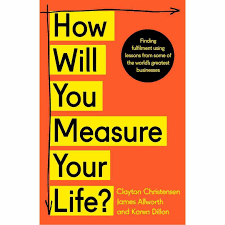
How Will You Measure Your Life by Clayton Christensen is a thoughtful personal-development and business book about finding meaning, building fulfilling relationships, choosing a satisfying career, protecting your integrity, and deciding what genuine success should look like in your life.
Written by Clayton M. Christensen with James Allworth and Karen Dillon, the book takes ideas normally associated with business strategy and applies them to some of life’s biggest questions.
How can you build a career that gives you genuine satisfaction?
How can you create lasting relationships with your family and friends?
How can you make sure success does not slowly pull you away from the people and principles that matter most?
And when your life is eventually measured, what will you want that measurement to be based on?
Instead of presenting simple motivational slogans, How Will You Measure Your Life by Clayton Christensen encourages readers to think strategically about their choices.
The decisions that shape a meaningful life are often not one enormous decision.
They are smaller choices repeated over many years.
Where you spend your time.
Where you invest your energy.
What work you prioritize.
Who you make time for.
What compromises you accept.
Those decisions gradually create the life you eventually have.
How Will You Measure Your Life by Clayton Christensen – Book Overview
How Will You Measure Your Life by Clayton Christensen grew from Christensen’s reflections on how principles used to understand businesses could also help individuals make better personal decisions.
The book focuses on three broad questions.
How can I find satisfaction in my career?
How can my relationships become enduring sources of happiness?
How can I live with integrity?
These questions sound simple.
But they can become surprisingly difficult when ambition, money, responsibilities, career opportunities, and everyday pressures compete for attention.
The book argues that people should think about these questions early rather than waiting until problems appear.
A career can look successful from the outside while producing little personal satisfaction.
A family can gradually become distant because work always receives the first priority.
Integrity can be compromised through many small decisions rather than one dramatic moment.
The authors therefore encourage readers to think deliberately about the kind of life they are building.
Define What Success Means to You
One of the most important lessons in How Will You Measure Your Life by Clayton Christensen is that success should not automatically be defined by money, promotions, status, or recognition.
Those things may matter.
But they are not the only possible measures of a successful life.
A person may become financially successful while feeling deeply dissatisfied.
Someone may reach an impressive professional position while neglecting relationships that once mattered greatly.
Another person may earn less money but experience meaningful work, strong relationships, and a deep sense of purpose.
The important question becomes:
What are you actually trying to optimize your life for?
If you never answer that question consciously, society may answer it for you.
Salary.
Job title.
Possessions.
Followers.
Prestige.
Recognition.
These are easy things to measure.
But the easiest things to measure are not always the most important.
Career Satisfaction
Career satisfaction is one of the major themes in How Will You Measure Your Life by Clayton Christensen.
People spend a large portion of their lives working.
A satisfying career therefore matters greatly to overall happiness.
The book encourages readers to think beyond salary when choosing work.
Money matters.
People need financial security.
But money alone does not guarantee satisfaction.
Work can become more meaningful when it provides opportunities for:
- Responsibility
- Learning
- Achievement
- Recognition
- Personal growth
- Contribution
- Creativity
- Solving meaningful problems
A highly paid job that offers none of these things may eventually feel empty.
Understanding what truly motivates you can help you make better career choices.
Motivation Matters
How Will You Measure Your Life by Clayton Christensen distinguishes between factors that prevent dissatisfaction and factors that create genuine motivation.
People naturally care about salary, working conditions, job security, and management.
Poor conditions in these areas can make work miserable.
But simply improving them does not automatically make someone deeply motivated.
Greater motivation often comes from meaningful work.
Being trusted with responsibility.
Developing mastery.
Seeing progress.
Receiving recognition for meaningful contribution.
This distinction can help people make better career decisions.
A job offer with the highest salary may not necessarily create the highest long-term satisfaction.
Sometimes a role with better learning opportunities and more responsibility creates a stronger foundation for future success.
Have a Strategy for Your Career
Businesses need strategies.
The book suggests individuals need them too.
How Will You Measure Your Life by Clayton Christensen encourages readers to think about career strategy as something that combines deliberate planning with openness to unexpected opportunities.
You may have a clear idea of the career you want.
That direction is useful.
But life rarely follows a perfect plan.
A new technology may appear.
An unexpected job opportunity may arise.
A conversation may introduce you to a completely different industry.
Your priorities may change.
A good personal strategy therefore needs both direction and flexibility.
Know what matters to you.
But remain willing to change the route when better opportunities appear.
Opportunities Can Change Your Plan
One important idea in How Will You Measure Your Life by Clayton Christensen is that plans should not become prisons.
Young professionals sometimes believe they must decide exactly what their entire career will look like.
But careers develop through experience.
You discover what you enjoy.
You discover what you dislike.
You develop new skills.
You encounter opportunities you could not have predicted.
The better approach is often to have a direction while remaining open to learning.
A career that looks perfect on paper may feel completely different once you experience it.
Real-world feedback matters.
Where You Allocate Resources Shapes Your Life
Companies may claim that something is important.
But their real priorities become visible through where they invest money and people.
The same principle applies to individuals.
How Will You Measure Your Life by Clayton Christensen encourages readers to look at how they allocate personal resources.
Your most important resources include:
- Time
- Energy
- Attention
- Money
- Talent
You may say your family is your highest priority.
But if every available hour goes to work, your actual resource allocation tells another story.
You may say health matters.
But if exercise and rest are always postponed, your behaviour reveals a different priority.
Intentions matter.
But resource allocation often determines outcomes.
Don’t Invest Only in Your Career
Career progress often produces immediate rewards.
You complete a project.
You receive praise.
You earn a promotion.
You receive a bonus.
Relationships work differently.
Spending time with a child may not produce an obvious professional-style reward today.
Having dinner with your partner may not create a measurable achievement.
Calling a close friend may not improve your résumé.
Because the rewards from relationships often develop slowly, work can easily take priority.
How Will You Measure Your Life by Clayton Christensen warns against this pattern.
Career success can be rewarding.
But relationships also require long-term investment.
If they receive only leftover time, they may eventually weaken.
Relationships Are Long-Term Investments
Strong relationships rarely appear automatically.
They require repeated attention.
How Will You Measure Your Life by Clayton Christensen encourages readers to think about family and friendships with a long-term perspective.
Relationships need:
- Time
- Communication
- Trust
- Patience
- Shared experiences
- Emotional support
- Presence
The difficulty is that the consequences of neglect may not appear immediately.
You can miss one dinner.
Then another.
Then another.
Nothing dramatic happens.
But over years, small decisions create distance.
The same is true in the opposite direction.
Small acts of attention repeated consistently can create strong relationships.
Understand What People Really Need
Another important principle connected to How Will You Measure Your Life by Clayton Christensen is understanding what people actually need rather than assuming.
In business, customers may “hire” a product to solve a particular problem.
In relationships, people also have needs that may not always be obvious.
A child may need time rather than gifts.
A partner may need attention rather than advice.
A friend may need someone to listen.
A colleague may need recognition.
Understanding another person’s real need can improve relationships dramatically.
This requires listening rather than simply assuming that the solution you prefer is the solution they need.
Family Culture Matters
Businesses develop cultures through repeated behaviours and expectations.
Families do too.
How Will You Measure Your Life by Clayton Christensen encourages readers to think deliberately about family culture.
What values are rewarded?
How are disagreements handled?
How do family members treat each other?
How are responsibilities shared?
What happens when someone makes a mistake?
Children learn values partly by watching repeated behaviour.
If parents say honesty matters but regularly behave dishonestly, the observed culture may become stronger than the spoken rule.
Culture develops gradually.
That makes small everyday behaviours extremely important.
Teach Children Through Experience
Parenting is another theme explored in How Will You Measure Your Life by Clayton Christensen.
Parents naturally want their children to become capable adults.
But capability develops through experience.
If parents solve every problem for a child, the child may have fewer opportunities to develop judgment and resilience.
Skills grow when people actually practise them.
Responsibility develops through responsibility.
Problem-solving develops by solving problems.
Confidence develops by overcoming difficulty.
The lesson extends beyond parenting.
Managers who want stronger employees also need to give people opportunities to handle meaningful challenges.
Don’t Outsource Everything Important
Modern life encourages outsourcing.
People outsource cleaning.
Food preparation.
Transportation.
Administrative work.
In business, companies outsource functions to specialists.
Sometimes this is efficient.
But How Will You Measure Your Life by Clayton Christensen raises a deeper concern.
If you repeatedly outsource experiences that help build important abilities, you may gradually lose those capabilities.
Families can experience something similar.
If every meaningful responsibility is delegated elsewhere, children may miss opportunities to learn.
Convenience is useful.
But not every difficult task should automatically disappear.
Some difficult experiences create valuable skills.
Integrity Is Built Through Small Decisions
Integrity is one of the most powerful themes in How Will You Measure Your Life by Clayton Christensen.
People often imagine ethical failure as one huge decision.
In reality, serious problems can begin with something much smaller.
“One time won’t matter.”
“I’ll make an exception this once.”
“Nobody will notice.”
The danger is that one exception makes the next exception easier.
Soon the boundary has moved.
The book encourages readers to define important principles clearly and avoid repeatedly negotiating with themselves when pressure appears.
The Danger of “Just This Once”
The phrase “just this once” represents an important warning in How Will You Measure Your Life by Clayton Christensen.
Suppose someone has a rule.
They will not lie to customers.
They will not cheat.
They will not behave dishonestly.
Then an unusual situation appears.
Breaking the rule seems convenient.
Only once.
The immediate cost appears small.
But the long-term cost can be larger.
Once you accept the idea that your principle changes whenever circumstances become inconvenient, it becomes easier to create another exception later.
Strong integrity often depends on deciding certain boundaries before pressure arrives.
Marginal Thinking Can Cause Problems
Businesses sometimes make decisions based on marginal costs.
If an additional action appears inexpensive, it may seem attractive.
But this can become dangerous when long-term consequences are ignored.
How Will You Measure Your Life by Clayton Christensen applies a similar idea to personal decisions.
A person may think:
“One extra late night at work won’t hurt my family.”
“One dishonest decision won’t matter.”
“One missed commitment isn’t important.”
Individually, each decision may appear small.
But repeated small compromises can produce large long-term consequences.
Thinking only about the immediate cost can hide the cumulative effect.
Be Careful What You Measure
People naturally focus on measurable results.
Salary.
Revenue.
Grades.
Promotions.
Awards.
These provide clear numbers.
But How Will You Measure Your Life by Clayton Christensen asks readers to consider whether the most meaningful parts of life can always be measured so easily.
How strong is your relationship with your family?
How many people trust you?
Did you help someone become better?
Did your work contribute something meaningful?
Did you live according to your values?
These questions are more difficult to place on a spreadsheet.
But difficulty measuring something does not make it unimportant.
Purpose Gives Direction
Purpose is central to How Will You Measure Your Life by Clayton Christensen.
Without a clear sense of purpose, everyday decisions can become disconnected.
A person may pursue whatever opportunity appears most impressive.
A larger purpose creates a filter.
Does this opportunity move me toward the kind of person I want to become?
Does this job fit the life I want to build?
Does this decision support my values?
Purpose does not mean knowing every detail of your future.
It means understanding enough about what matters to make better decisions today.
Balance Ambition With Meaning
Ambition is not presented as something negative.
Career achievement can be meaningful.
Building businesses can create value.
Leadership can help people.
Financial success can create security and opportunity.
But How Will You Measure Your Life by Clayton Christensen encourages readers to consider ambition within a larger life.
What are you sacrificing for success?
Is the trade-off temporary or permanent?
Are you investing in the people you care about?
Will achieving the goal actually produce the life you expect?
These questions help prevent ambition from becoming automatic.
Short-Term Rewards Can Distract From Long-Term Happiness
One reason careers receive so much attention is that professional rewards can appear quickly.
Recognition.
Bonuses.
Promotions.
Successful projects.
Relationships often provide slower rewards.
How Will You Measure Your Life by Clayton Christensen encourages readers to resist evaluating everything through immediate feedback.
The most valuable investments in life may take years before their full value becomes visible.
Raising children.
Building trust.
Developing expertise.
Creating a reputation for integrity.
Maintaining a marriage or friendship.
Long-term thinking is therefore essential.
Learn From Business Without Treating Life Like a Business
The book’s unusual strength is the way it uses business theories without suggesting that life should become a corporation.
How Will You Measure Your Life by Clayton Christensen does not tell readers to measure family members like employees or optimize every minute.
Instead, business frameworks become tools for asking better questions.
Strategy helps with career direction.
Resource allocation helps reveal priorities.
Culture helps explain family behaviour.
Motivation theory helps people choose meaningful work.
Innovation theory helps readers understand choices and change.
The concepts are translated into personal decisions.
7 Powerful Lessons From How Will You Measure Your Life
How Will You Measure Your Life by Clayton Christensen contains many valuable ideas, but seven lessons stand out:
- Define success for yourself – Do not automatically accept money or status as your only measures of achievement.
- Choose meaningful work – Career satisfaction depends on more than salary.
- Allocate resources according to your real priorities – Your time and attention reveal what truly matters.
- Invest in relationships early – Strong relationships require consistent long-term effort.
- Build the culture you want – Values develop through repeated behaviour, not simply words.
- Protect your integrity – Small compromises can become larger patterns.
- Live with purpose – A clear sense of meaning helps guide difficult decisions.
Why Read How Will You Measure Your Life by Clayton Christensen?
How Will You Measure Your Life by Clayton Christensen is an excellent choice for readers interested in:
- Personal development
- Purpose
- Career planning
- Leadership
- Life strategy
- Relationships
- Family
- Personal values
- Integrity
- Decision-making
- Work-life balance
- Career satisfaction
- Business strategy
- Long-term happiness
- Meaningful success
The book is particularly valuable because it connects business thinking with personal questions that nearly everyone eventually faces.
Who Should Read This Book?
How Will You Measure Your Life by Clayton Christensen may especially appeal to:
- University students
- Young professionals
- Managers
- Entrepreneurs
- Business owners
- Parents
- Career changers
- Leaders
- MBA students
- Professionals reconsidering their priorities
- Readers interested in self-development
- People seeking more meaningful careers
- Anyone thinking about work-life balance
- Anyone asking what genuine success means
It can be especially useful during major transitions such as graduation, career changes, promotions, marriage, parenthood, or periods of personal reflection.
A Powerful Guide to Building a Meaningful Life
How Will You Measure Your Life by Clayton Christensen asks readers to look beyond the most visible signs of success.
A successful life is not created only through impressive achievements.
It develops through repeated choices.
How you spend your time.
How you treat people.
Which opportunities you pursue.
What relationships you protect.
What values you refuse to compromise.
And what purpose guides your decisions.
Professional achievement matters.
But careers are only one part of life.
Relationships matter.
Integrity matters.
Contribution matters.
Meaning matters.
The book encourages readers to think about these things before years pass and priorities become difficult to change.
For readers interested in career success, personal purpose, relationships, leadership, work-life balance, integrity, and creating a life that feels meaningful rather than merely impressive, How Will You Measure Your Life by Clayton Christensen offers a thoughtful and practical framework for deciding what truly deserves your time and attention.
Learn more about How Will You Measure Your Life? by Clayton M. Christensen, James Allworth, and Karen Dillon on the official Harvard Business Review website.
Explore more business and personal development books at Bargain Books.


Reviews
There are no reviews yet.