
No products in the cart.
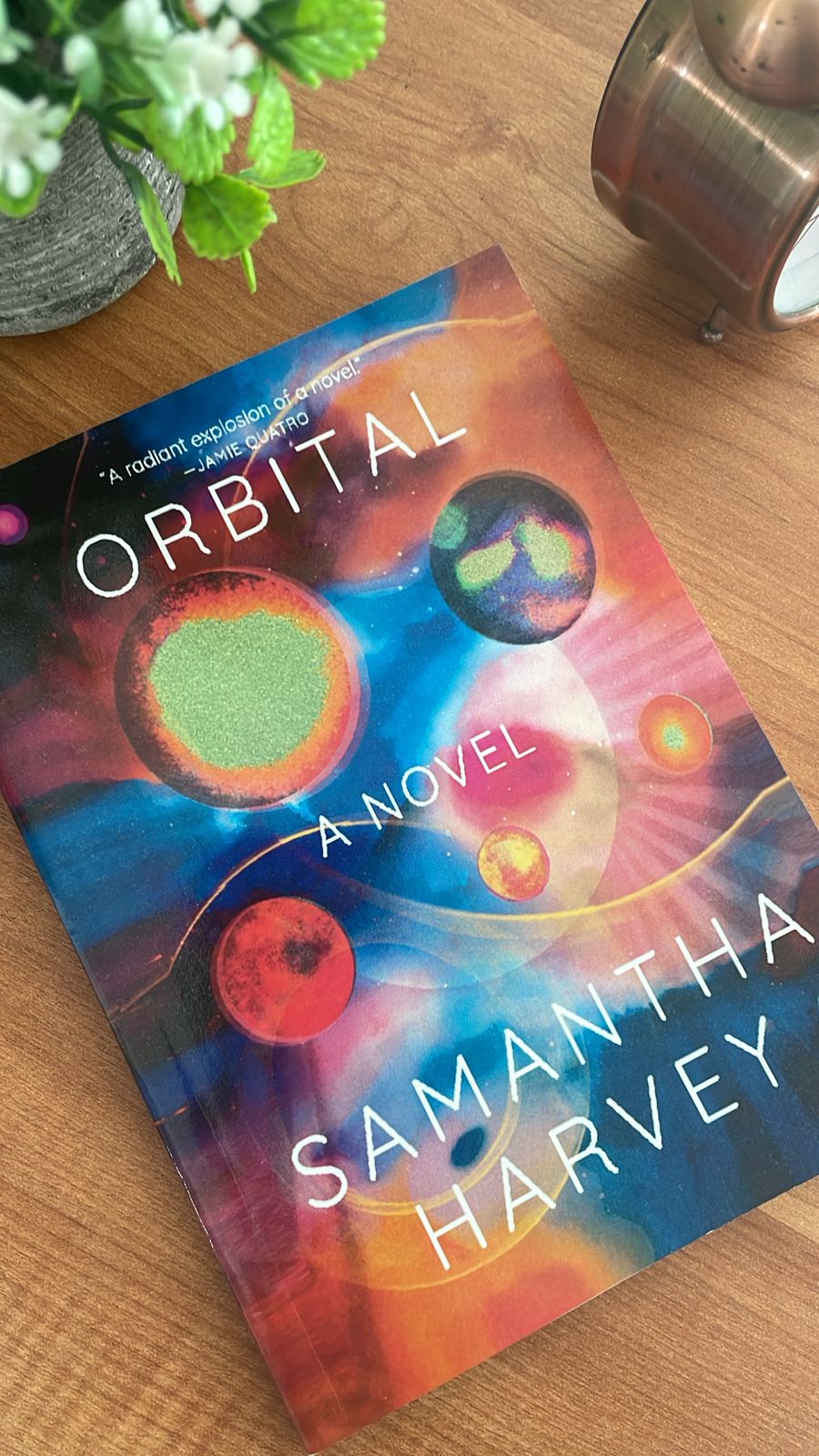
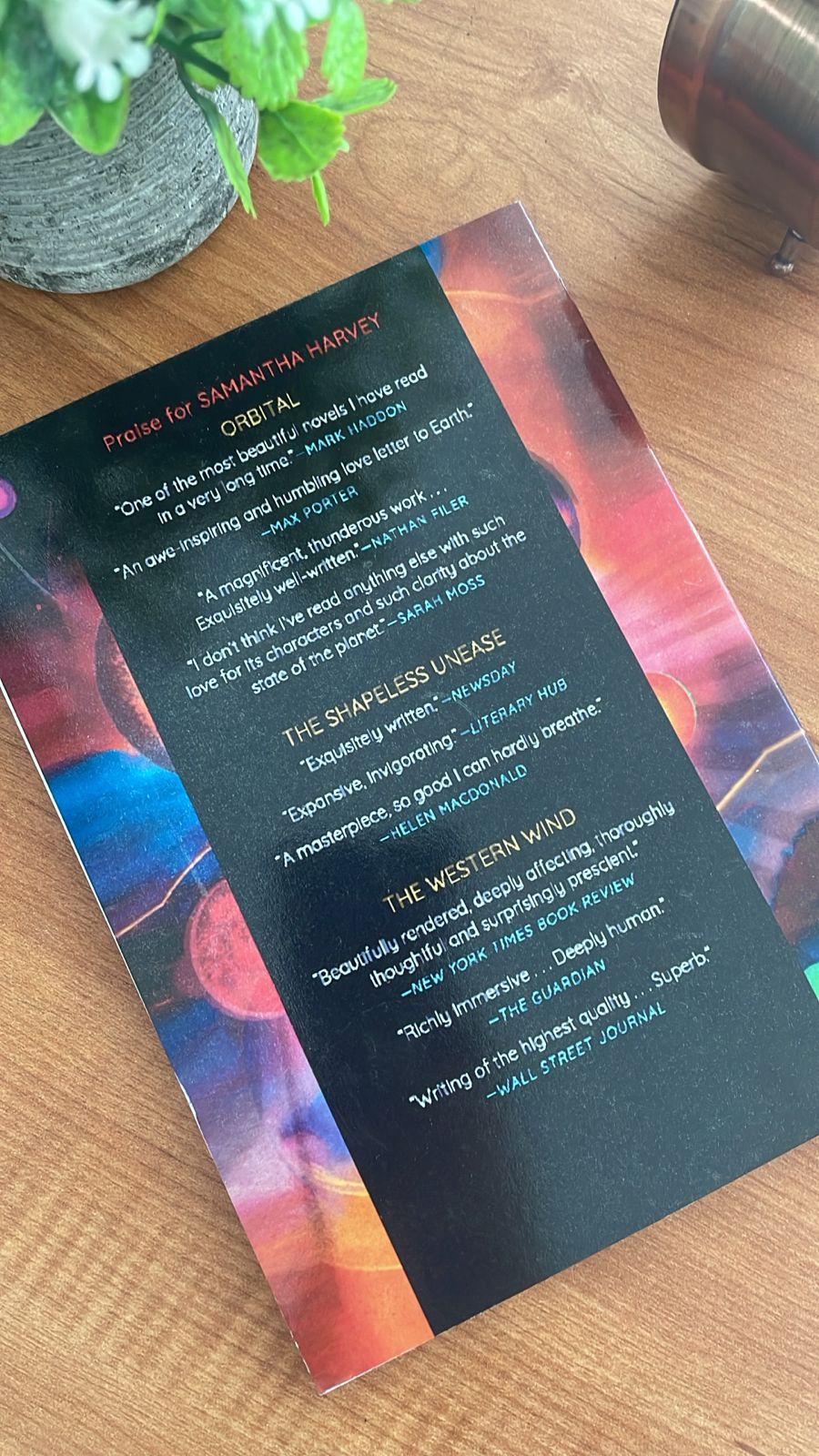
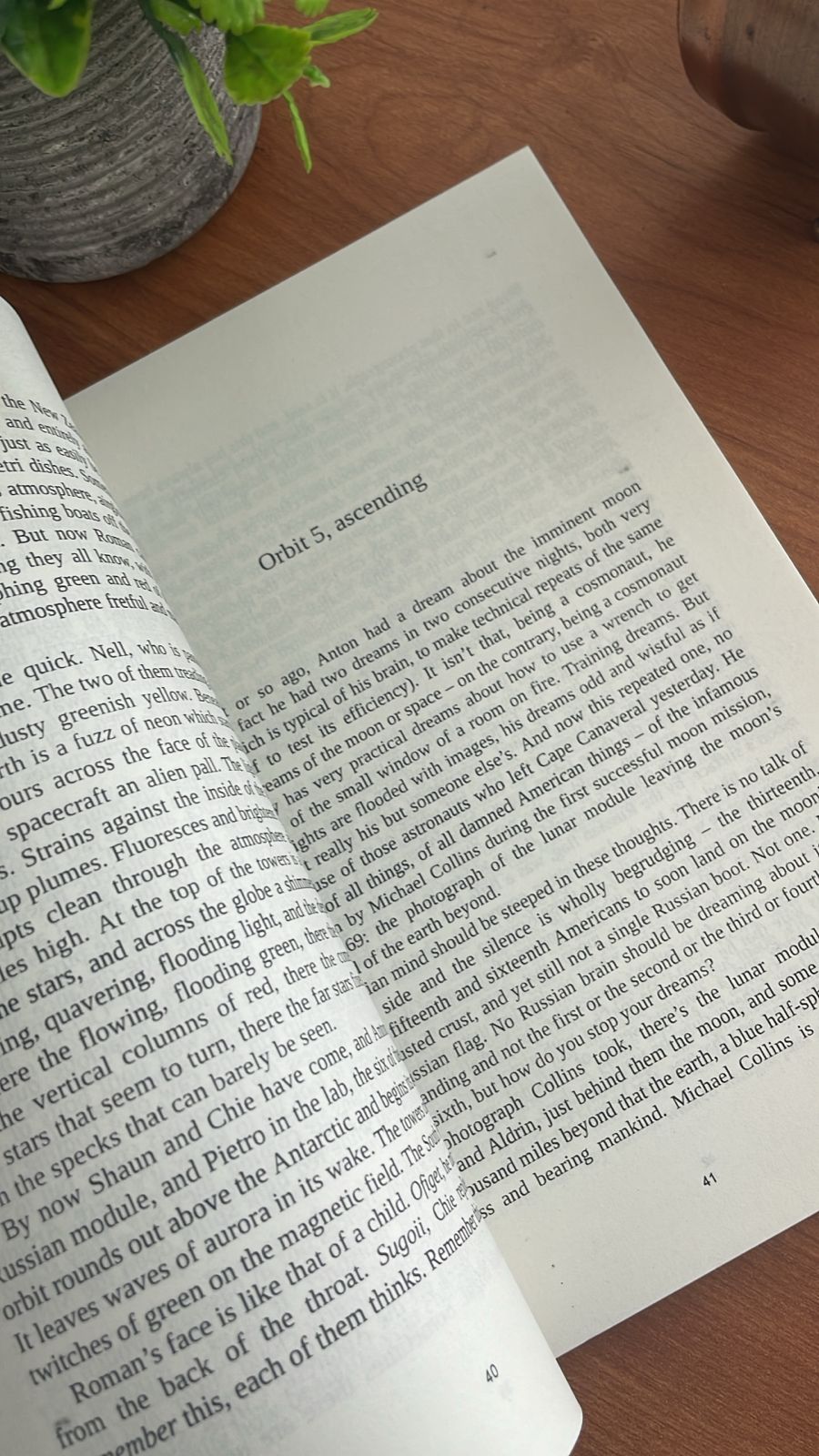




Orbital by Samantha Harvey is a breathtaking, meditative literary novel that takes readers aboard the International Space Station for one extraordinary day, following six astronauts and cosmonauts as they circle Earth sixteen times and see humanity’s home from a perspective almost none of us will ever experience.
Far above the planet, six people from different nations live together inside a small spacecraft.
They conduct scientific experiments, collect data, exercise to protect their bodies from the effects of microgravity and perform the ordinary routines required to survive in orbit.
But much of the novel is about something simpler.
They look.
Below them is Earth.
Oceans.
Mountains.
Deserts.
Cities.
Cloud systems.
Glaciers.
Night.
Day.
A typhoon gathering over an island.
From space, borders vanish.
Countries become difficult to distinguish.
Political divisions that feel enormous on the ground appear almost invisible.
And humanity itself begins to seem both incredibly important and impossibly small.
Orbital by Samantha Harvey turns this extraordinary viewpoint into a meditation on life, death, climate, time, family, faith, technology and our relationship with the only planet we have.
It is not a conventional space adventure filled with aliens, battles or catastrophic equipment failures.
Instead, Samantha Harvey uses space to make Earth look new again.
Orbital by Samantha Harvey – Book Overview
Orbital by Samantha Harvey takes place during approximately twenty-four hours aboard the International Space Station.
That may sound like a very small amount of time.
In orbit, however, a single Earth day feels completely different.
The crew travels around the planet roughly sixteen times.
Daylight arrives.
Darkness arrives.
Then daylight returns.
Again and again.
Cities pass beneath them.
Continents appear and disappear.
Storm systems grow.
Oceans stretch beyond imagination.
The astronauts experience time according to clocks and mission schedules while simultaneously watching Earth’s ordinary ideas of morning and evening become almost meaningless.
Six People Above the Earth
The crew consists of six people from different countries: Roman and Anton are Russian cosmonauts, Chie is Japanese, Pietro is Italian, Shaun is American and Nell is British.
They bring different:
Personal histories.
Beliefs.
Relationships.
Temperaments.
Memories.
Yet aboard the station, nationality becomes strangely complicated.
On Earth, nations have borders.
In space, six people from different countries depend on one another inside the same fragile machine.
Roman
Roman is the commander.
Experienced and practical, he represents the technical competence required for life in orbit.
Space may inspire wonder, but survival still depends on people who understand systems, procedures and equipment.
The poetic beauty of the novel never completely forgets this practical reality.
Anton
Anton is another Russian cosmonaut.
His reflections bring emotional complexity to the group, especially through his thoughts about marriage, love and the life waiting for him on Earth.
Even hundreds of kilometres above the planet, personal relationships remain powerful.
Distance does not automatically solve emotional problems.
Chie
Chie receives devastating news while in orbit:
Her mother has died.
This creates one of the novel’s most moving contrasts.
She is physically farther from home than almost any grieving person could be.
She cannot simply return immediately.
The planet carrying her family keeps passing beneath her.
Grief therefore becomes both extremely personal and strangely cosmic.
Pietro
Pietro is Italian and deeply comfortable with the identity of an astronaut.
Through characters like Pietro, the novel also explores what happens when a profession becomes more than employment.
For some of these people, spaceflight is not simply something they do.
It is part of who they are.
Shaun
Shaun is American and brings religious faith into the crew’s reflections.
The view from space can inspire completely different interpretations.
One person may see scientific magnificence.
Another may see divine creation.
Another may simply feel overwhelmed by beauty.
Orbital by Samantha Harvey allows these different responses to coexist rather than forcing one answer.
Nell
Nell is British, with a husband and home life waiting below.
Her perspective contributes to one of the novel’s recurring tensions:
Astronauts spend years trying to leave Earth, only to discover how strongly Earth continues pulling emotionally at them.
Sixteen Orbits in One Day
One of the most extraordinary facts shaping the novel is the speed of orbital life.
The International Space Station travels at more than 17,000 miles per hour, allowing its crew to circle Earth about sixteen times in a day.
This means the astronauts repeatedly move through:
Sunrise.
Day.
Sunset.
Night.
Over and over.
The familiar rhythm of a human day becomes strange.
Sixteen Sunrises and Sixteen Sunsets
The Booker judges specifically highlighted how the novel is propelled by these repeated sunrises and sunsets.
For people on Earth, sunrise usually happens once each day.
For these astronauts, beauty becomes almost overwhelming through repetition.
Yet something repeated can still remain extraordinary.
That creates one of the novel’s quiet questions:
How often do we stop noticing beautiful things simply because they are familiar?
Earth Becomes the Main Character
Although six people occupy the station, Earth often feels like the novel’s largest presence.
The astronauts constantly look downward.
They see patterns impossible to experience from the ground.
Weather crossing oceans.
Mountain ranges.
River systems.
Deserts.
Nighttime lights.
Huge stretches of uninhabited land.
The planet appears simultaneously:
Massive.
Tiny.
Powerful.
Fragile.
Borders Disappear
From orbit, political borders are mostly invisible.
There is no line floating across the planet showing where one nation ends and another begins.
Yet those invisible boundaries have enormous consequences for human beings living below.
This contrast allows Orbital by Samantha Harvey to examine nationalism and human division without becoming a conventional political novel.
One Planet
From space, the idea of humanity sharing one world becomes visually obvious.
Every:
War.
Election.
Family.
Business.
Religion.
City.
Argument.
Language.
Dream.
exists on the same moving sphere.
The astronauts’ perspective continually reduces seemingly enormous human problems to tiny events while simultaneously reminding readers that those events matter deeply to the people experiencing them.
The Overview Effect
Astronauts have often described how seeing Earth from space can change their perspective on the planet.
Orbital by Samantha Harvey imaginatively explores a similar shift.
Earth stops being background scenery.
It becomes something astonishing.
A living world suspended inside enormous darkness.
Readers are encouraged to look at their own planet almost as though seeing it for the first time.
Climate and Environmental Fragility
The novel also carries an environmental consciousness.
From orbit, astronauts can see large weather systems and geographical patterns.
They can observe Earth beautifully while also understanding that the systems maintaining life are vulnerable.
The book does not become a climate-change lecture.
Instead, concern emerges naturally through attention.
The more beautiful Earth appears, the more disturbing its fragility becomes.
The Typhoon
A typhoon develops below during the crew’s day.
From orbit, the storm can look visually magnificent.
From the ground, it can destroy lives.
That contradiction is powerful.
Something can be beautiful from one perspective and terrifying from another.
Distance changes interpretation.
Perspective
Perspective may be the central idea behind Orbital by Samantha Harvey.
From Earth, the astronauts appear extraordinary.
From the station, Earth appears extraordinary.
From one country, another country appears foreign.
From orbit, both exist on the same planet.
From inside one human life, personal grief can feel infinite.
From space, humanity appears almost unimaginably small.
Neither perspective cancels the other.
Small and Significant at the Same Time
The novel repeatedly holds two apparently opposite ideas together.
Humans are tiny.
Human lives matter.
Earth is one planet among unimaginable numbers of worlds.
Earth is everything we have ever known.
A single person is microscopic when seen from orbit.
The loss of one mother can still completely alter someone’s world.
That tension gives the book much of its emotional power.
Grief
Chie’s bereavement brings death into a setting already surrounded by enormous questions about existence.
She cannot simply leave the spacecraft and go home.
The physical distance intensifies emotional distance.
But the novel never suggests that a cosmic perspective makes grief meaningless.
Instead, personal grief remains real even against the scale of the universe.
Family
Every crew member has relationships below.
Partners.
Parents.
Families.
Homes.
Memories.
Spaceflight therefore becomes a strange experience of extreme connection and extreme separation.
Technology allows them to communicate with Earth.
Their bodies remain hundreds of kilometres above it.
Loneliness
Six people live together in a confined station, yet loneliness can still exist.
Physical proximity is not the same as emotional closeness.
Each astronaut carries private thoughts that cannot be completely shared.
This makes the novel surprisingly intimate despite its enormous setting.
The Human Body in Space
Living in microgravity changes the human body.
Astronauts must exercise regularly to reduce physical deterioration during long missions.
The body itself becomes a reminder that human beings evolved for Earth.
Gravity.
Air.
Daylight.
Ground.
Our biology expects these things.
Space travel reveals how deeply connected our bodies are to our planet.
Scientific Work
The astronauts are not simply tourists looking through windows.
Their mission includes scientific experiments, meteorological observations and research into the effects of spaceflight on the human body.
That everyday work gives the novel realism.
Space may be sublime.
It is also a workplace.
Space as a Workplace
This creates wonderful contrasts.
Outside the window:
The entire Earth.
Inside:
Schedules.
Food.
Exercise.
Equipment.
Maintenance.
Experiments.
Sleep.
Human beings can turn even one of the most extraordinary environments imaginable into routine.
Routine and Wonder
That is another important idea in Orbital by Samantha Harvey.
People adapt.
Something astonishing becomes normal.
The first sight of Earth from orbit might feel overwhelming.
After months in space, it is also the view outside the window.
The challenge becomes continuing to notice.
Time
Time behaves strangely in the novel.
The crew follows Earth-based schedules, but outside the window the sun rises repeatedly.
Political events happen below.
People age.
Someone dies.
The astronauts travel enormous distances while remaining in roughly the same orbital relationship with Earth.
Movement and stillness coexist.
A Novel About Observation
Most novels are built around characters doing things.
Orbital by Samantha Harvey is unusually interested in characters looking.
They observe.
Remember.
Think.
Compare.
Question.
This is why readers expecting a conventional action-driven science-fiction story may initially find it unusual.
The drama is philosophical and emotional rather than primarily physical.
Is Orbital Science Fiction?
It is reasonable to shelve it partly under science fiction because it takes place aboard a space station.
Your own category review currently places it under Fiction & Literature > Science Fiction with literary fiction as a secondary category.
However, Samantha Harvey herself has described wanting to approach it more as realism or a “space pastoral” than conventional science fiction. The Booker Prize has likewise emphasized its meditative observation of Earth rather than genre adventure.
For your website, Literary Fiction / Science Fiction is therefore a strong combination.
Is Orbital an Action Novel?
No.
There are no alien invasions, interplanetary wars or constant emergencies.
Readers should expect a contemplative novel.
Its tension comes from:
Human mortality.
Distance.
Weather.
Grief.
Time.
Environmental fragility.
The vastness of space.
Is Orbital Difficult to Read?
The novel is short but intellectually rich.
Its language can be poetic and reflective.
Readers looking for a fast plot may find it slower than expected, while readers who enjoy beautiful prose and philosophical fiction may find the compact format especially rewarding.
A Short Novel With Large Ideas
The Booker Prize edition is famous partly because of how much the novel accomplishes in very little space.
The prize organization describes the original winning work as just 136 pages, making it the second-shortest Booker winner, while your Vintage paperback ISBN 9781529922936 is officially listed at 144 pages because editions can differ in pagination.
This is why you should use 144 pages for your specific inventory edition.
Winner of the Booker Prize 2024
Orbital won the Booker Prize on 12 November 2024.
The judges praised its beauty, ambition and attention to the precious and precarious world humans share.
It also became the first Booker Prize-winning novel set in space.
That makes the award highly relevant for your product page.
Samantha Harvey
Samantha Harvey is a British author whose other books include The Wilderness, All Is Song, Dear Thief, The Western Wind and the nonfiction work The Shapeless Unease: A Year of Not Sleeping.
Her writing often explores consciousness, memory, time and human perception, which makes the viewpoint of Orbital especially suited to her style.
Is Orbital Part of a Series?
No.
Orbital by Samantha Harvey is a standalone novel.
There is no earlier book required and no sequel needed to complete the story.
Content Considerations
The book is not graphically violent, but it contains themes of death and bereavement, anxiety about natural disaster, climate and environmental concerns, isolation, existential reflection, mortality and references to dangers associated with spaceflight.
Its overall tone is contemplative rather than disturbing.
7 Powerful Reasons to Read Orbital by Samantha Harvey
- It won the 2024 Booker Prize. The novel received one of the world’s most prestigious literary awards for its distinctive perspective, language and ambition.
- It lets you see Earth from a radically different viewpoint. Six astronauts circling the planet sixteen times transform familiar continents, oceans and weather systems into something astonishing.
- It proves a short novel can contain enormous ideas. In little more than a hundred pages, Harvey explores time, grief, climate, borders, faith, science, family and what it means to be human.
- The space setting feels unusually realistic. Rather than relying on aliens or futuristic technology, the novel focuses on the International Space Station, scientific work and the psychological experience of observing Earth from orbit.
- Its environmental message emerges naturally. The book does not need long speeches about protecting Earth; simply seeing the planet’s beauty and isolation makes its vulnerability powerful.
- The prose is designed for readers who love literary writing. Harvey turns clouds, oceans, darkness, light and orbital movement into a deeply poetic reading experience.
- It changes the scale of ordinary human problems. From space humanity looks tiny, yet one death, one marriage, one family and one person’s grief still matter enormously.
Why Read Orbital by Samantha Harvey?
Orbital by Samantha Harvey is especially rewarding for readers who enjoy literary fiction, Booker Prize winners, space exploration, environmental fiction, philosophical novels and books that focus more on ideas and observation than conventional action.
It asks unusual questions.
What does Earth look like when there are no visible national borders?
What happens to our understanding of time when the sun rises sixteen times in a day?
What does a human life mean against the scale of the universe?
Does seeing Earth from outside make humanity appear insignificant—or more precious?
How can a planet look so permanent and so fragile at the same time?
Harvey does not force simple answers.
The novel instead gives readers a new angle from which to think.
Who Should Read This Book?
Orbital by Samantha Harvey is an excellent choice for readers who enjoy award-winning literary fiction, beautifully written short novels, stories set in space, philosophical fiction, environmental themes and reflective books about human existence.
It may especially appeal to readers who loved the contemplative side of science fiction but do not necessarily want:
Aliens.
Space battles.
Complicated futuristic technology.
Instead, the most extraordinary object in this book is something familiar.
Earth.
Orbital by Samantha Harvey – A Love Letter to the Planet Below
Orbital by Samantha Harvey takes readers farther from Earth in order to bring them emotionally closer to it.
Six people float above the world.
They move at extraordinary speed.
Yet their daily lives still contain ordinary concerns.
Work.
Food.
Exercise.
Family.
Faith.
Memory.
Grief.
They look down and see a planet without the boundaries humans spend so much energy defending.
They see storms moving toward people who cannot simply escape them.
They see oceans connecting continents that politics divides.
They see day becoming night and night becoming day again before one ordinary Earth afternoon has finished.
And somewhere inside that repeated orbit, the planet begins to look different.
Not simply like:
A collection of countries.
A source of resources.
A map.
A place humans own.
But like something rare.
A living world surrounded by darkness.
The astronauts left Earth because human beings are curious enough to ask what lies beyond it.
Yet from above, their greatest discovery may be the thing they left behind.
That is the quiet power of Orbital by Samantha Harvey.
It is a space novel in which space makes Earth more important.
A novel about extraordinary astronauts that continually returns to ordinary human lives.
A book about enormous distances that ultimately asks why people remain so deeply connected.
For readers who enjoy literary fiction that combines scientific wonder, environmental awareness and philosophical reflection, Orbital by Samantha Harvey is a compact but remarkably expansive novel about the fragile planet carrying every human story that has ever existed.
Learn more about Orbital by Samantha Harvey on the official Penguin Books website.
Explore more literary fiction books at Bargain Books.
Be the first to review “Orbital by Samantha Harvey”
Related products

Out of stock
Classics & Literary Fiction
රු1,800.00
3 X Rs. 600.00 or 8% Cashback with


or 3 X රු600.00 with


or up to 4 X රු450.00 with

-48%

Out of stock
Classics & Literary Fiction
Original price was: රු3,000.00.රු1,550.00Current price is: රු1,550.00.
3 X Rs. 516.67 or 8% Cashback with
or 3 X රු516.67 with
or up to 4 X රු387.50 with
-17%
Out of stock
Classics & Literary Fiction
Original price was: රු2,900.00.රු2,400.00Current price is: රු2,400.00.
3 X Rs. 800.00 or 8% Cashback with
or 3 X රු800.00 with
or up to 4 X රු600.00 with

Fiction & Literature
රු9,900.00
3 X Rs. 3,300.00 or 8% Cashback with
or 3 X රු3,300.00 with
or up to 4 X රු2,475.00 with
Fiction & Literature
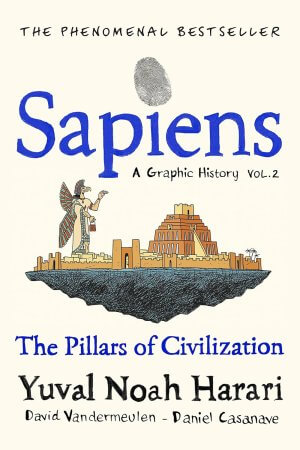
Sapiens A Graphic History Volume 2 (Hardcover) by Yuval Noah Harari
රු2,400.00
3 X Rs. 800.00 or 8% Cashback with
or 3 X රු800.00 with
or up to 4 X රු600.00 with
Out of stock
Classics & Literary Fiction
රු1,750.00
3 X Rs. 583.33 or 8% Cashback with
or 3 X රු583.33 with
or up to 4 X රු437.50 with
Science Fiction
රු1,950.00
3 X Rs. 650.00 or 8% Cashback with
or 3 X රු650.00 with
or up to 4 X රු487.50 with
-19%
Out of stock
Classics & Literary Fiction
Original price was: රු2,600.00.රු2,100.00Current price is: රු2,100.00.
3 X Rs. 700.00 or 8% Cashback with
or 3 X රු700.00 with
or up to 4 X රු525.00 with
Reviews
There are no reviews yet.