
No products in the cart.
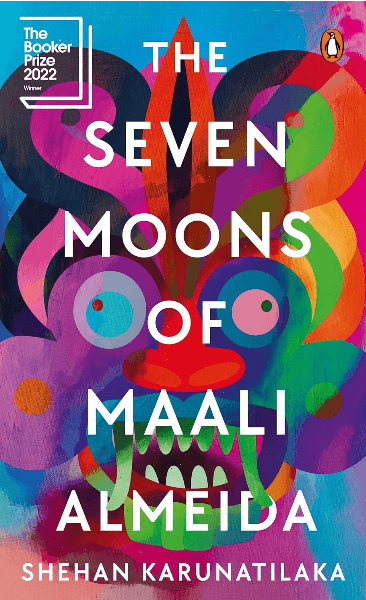
The Seven Moons of Maali Almeida by Shehan Karunatilaka

රු1,950.00
3 X Rs. 650.00 or 8% Cashback with


or 3 X රු650.00 with


or up to 4 X රු487.50 with


The Seven Moons of Maali Almeida by Shehan Karunatilaka is the 2022 Booker Prize-winning novel about a dead war photographer who has seven moons to discover who killed him and guide his friends toward a hidden cache of photographs.
Set in 1990 Colombo, it blends literary fiction, mystery, supernatural fantasy, dark comedy and political satire.
Format: Paperback
Pages: 400
Publisher: Penguin Random House India
ISBN: 9780143459675
10 in stock
The Seven Moons of Maali Almeida by Shehan Karunatilaka
The Seven Moons of Maali Almeida by Shehan Karunatilaka is an inventive, darkly comic literary novel set in Colombo, Sri Lanka, in 1990.
The story begins with a striking premise:
Maali Almeida is dead.
Maali, a war photographer, gambler and fixer, wakes in a strange bureaucratic afterlife with no clear memory of how he died.
His body is somewhere in Colombo.
He does not know who killed him.
And he has only seven moons to discover what happened and complete unfinished business among the living.
Penguin Random House describes the novel as a satire set amid the violence and political turmoil of Sri Lanka’s civil-war era, following Maali as he tries to contact the people closest to him and lead them to a hidden collection of photographs.
Maali Almeida
Maali is not presented as a conventional hero.
He is:
- A war photographer
- A gambler
- A risk-taker
- A fixer
- A man with secrets
- A sharp observer of Sri Lankan society
His work has taken him into dangerous places where he has photographed violence that many people would prefer to remain unseen.
Those photographs become one of the central elements of the story.
Even after death, Maali is trying to make sure that certain images reach the right people.
The Seven Moons
The title refers to the limited amount of time Maali is given in the afterlife.
He has seven moons to understand:
- What happened to him
- Who may have killed him
- How to contact the living
- How to protect the people he cares about
- What to do with the photographs he left behind
This gives the novel the structure of both a mystery and a countdown.
A Murder Mystery
At its core, The Seven Moons of Maali Almeida contains a murder mystery.
Maali has many possible enemies.
His work exposed him to:
- Armed groups
- Political operatives
- Security forces
- Criminal networks
- Journalists
- Activists
- People with secrets to protect
Because Maali moved between different groups and documented dangerous events, the list of people who might have wanted him dead is long.
The novel gradually reveals more about his life as Maali tries to reconstruct the events that led to his death.
Colombo in 1990
The novel is deeply connected to Sri Lanka.
The main setting is Colombo in 1990, during a period marked by civil conflict, political violence and fear.
Karunatilaka uses real historical conditions as the backdrop for a fictional story.
The novel refers to themes involving:
- The Sri Lankan civil war
- Political violence
- Disappearances
- Journalism
- Armed groups
- State institutions
- Ethnic tensions
- Corruption
- Fear and survival
The novel is fiction and satire, so its characters and narrative should not be treated as a literal historical record.
Photography and Truth
Maali’s profession is central to the book.
As a photographer, he has documented things other people may deny, hide or forget.
His photographs raise questions about:
- Evidence
- Memory
- Truth
- Propaganda
- Responsibility
- Who controls historical narratives
The hidden photographs are therefore more than a plot device.
They represent the possibility that visual evidence can challenge powerful versions of events.
The Afterlife
One of the most distinctive features of the novel is its version of the afterlife.
Rather than a simple heaven or hell, Maali encounters something closer to a chaotic administrative system.
The dead:
- Wait
- Argue
- Receive instructions
- Encounter ghosts
- Struggle with unfinished business
- Try to understand what comes next
This supernatural framework allows Karunatilaka to combine political satire with fantasy and dark comedy.
Ghosts and Sri Lankan Folklore
The novel also draws on supernatural ideas and Sri Lankan folklore.
Ghosts, spirits and other beings move through Maali’s afterlife.
This gives the story elements of:
- Magical realism
- Fantasy
- Horror
- Mythology
- Satire
The supernatural elements are used both for atmosphere and for examining the consequences of violence.
Dark Humour
Despite its serious subject matter, the novel is frequently funny.
Karunatilaka uses:
- Sarcasm
- Absurdity
- Irony
- Bureaucratic humour
- Sharp dialogue
The humour does not erase the violence surrounding the characters.
Instead, it often highlights the absurdity and tragedy of the world they inhabit.
Satire
The book is also a strong work of satire.
It examines institutions and people involved in Sri Lanka’s political and social life without presenting the conflict as a simple story with one uncomplicated side.
Different groups are shown through Maali’s cynical perspective.
The novel questions:
- Power
- Ideology
- Loyalty
- Nationalism
- Violence
- Political narratives
Its political interpretations belong to the novel and its characters rather than serving as a neutral historical account.
Love and Friendship
Behind the politics and supernatural mystery, the story is also deeply personal.
Maali is trying to reach the people who mattered most to him.
His relationships reveal:
- Love
- Friendship
- Jealousy
- Secrecy
- Loyalty
- Regret
The emotional stakes increase as his seven moons begin to run out.
Memory
Memory is another major theme.
Maali does not immediately have access to everything he knew while alive.
He must piece together his past.
That creates questions about:
- What we remember
- What we choose to forget
- What societies suppress
- How personal memories become history
The structure allows the reader to discover Maali’s life alongside him.
The 2022 Booker Prize
The Seven Moons of Maali Almeida won the 2022 Booker Prize. Penguin Random House India currently markets the edition as the 2022 Booker Prize winner, while Sort of Books also identifies the novel as the prize-winning work.
The award significantly increased the novel’s international readership.
Earlier Version
There is an important publication-history note.
An earlier version of the novel appeared in the Indian subcontinent under the title:
Chats with the Dead
The later internationally published The Seven Moons of Maali Almeida is a revised version.
A library catalogue for the Penguin edition notes that an earlier version was published under Chats with the Dead in 2020.
Themes
The novel explores:
- Death
- Memory
- War
- Photography
- Truth
- Political violence
- Friendship
- Love
- Identity
- Corruption
- Justice
- History
- Grief
- The afterlife
Content Considerations
Readers should expect mature material involving:
- War
- Murder
- Death
- Graphic or disturbing imagery
- Political violence
- Suicide bombings
- Disappearances
- References to torture
- Sexuality
- Alcohol and gambling
The novel deals with difficult historical and social themes through fiction, satire and supernatural storytelling.
Who May Enjoy This Book?
This novel may appeal to readers interested in:
- Literary fiction
- Sri Lankan fiction
- Booker Prize winners
- Magical realism
- Political satire
- Historical fiction
- Dark comedy
- Mystery
- Supernatural fiction
- South Asian literature
It may particularly appeal to readers looking for fiction rooted strongly in Sri Lankan history, culture and urban life.
About Shehan Karunatilaka
Shehan Karunatilaka is a Sri Lankan novelist.
His works include:
- Chinaman: The Legend of Pradeep Mathew
- The Seven Moons of Maali Almeida
Penguin notes that he emerged internationally after Chinaman won major literary awards, while The Seven Moons of Maali Almeida later won the 2022 Booker Prize.
For customers looking to buy The Seven Moons of Maali Almeida by Shehan Karunatilaka in Sri Lanka, ISBN 9780143459675 is the Penguin Random House India paperback edition used for this listing.
Be the first to review “The Seven Moons of Maali Almeida by Shehan Karunatilaka”
Related products
-5%

Contemporary romance
Original price was: රු1,850.00.රු1,750.00Current price is: රු1,750.00.
3 X Rs. 583.33 or 8% Cashback with
or 3 X රු583.33 with
or up to 4 X රු437.50 with

Classics & Literary Fiction
රු1,750.00
3 X Rs. 583.33 or 8% Cashback with
or 3 X රු583.33 with
or up to 4 X රු437.50 with

Out of stock
Adventure Fiction
Death on the Nile – Film Tie-In Edition | Agatha Christie Paperback
රු2,400.00
3 X Rs. 800.00 or 8% Cashback with
or 3 X රු800.00 with
or up to 4 X රු600.00 with

Classics & Literary Fiction
රු1,750.00
3 X Rs. 583.33 or 8% Cashback with
or 3 X රු583.33 with
or up to 4 X රු437.50 with

Out of stock
Children & Young Adult
රු3,200.00
3 X Rs. 1,066.67 or 8% Cashback with
or 3 X රු1,066.67 with
or up to 4 X රු800.00 with
-22%

Classics & Literary Fiction
Original price was: රු2,250.00.රු1,750.00Current price is: රු1,750.00.
3 X Rs. 583.33 or 8% Cashback with
or 3 X රු583.33 with
or up to 4 X රු437.50 with

Classics & Literary Fiction
රු1,650.00
3 X Rs. 550.00 or 8% Cashback with
or 3 X රු550.00 with
or up to 4 X රු412.50 with

History & Criticism
රු1,950.00
3 X Rs. 650.00 or 8% Cashback with
or 3 X රු650.00 with
or up to 4 X රු487.50 with
Reviews
There are no reviews yet.