
No products in the cart.
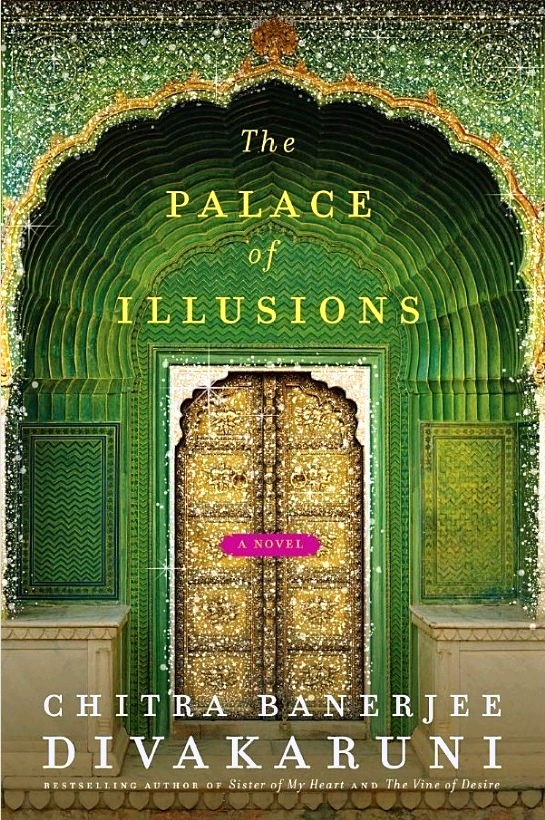
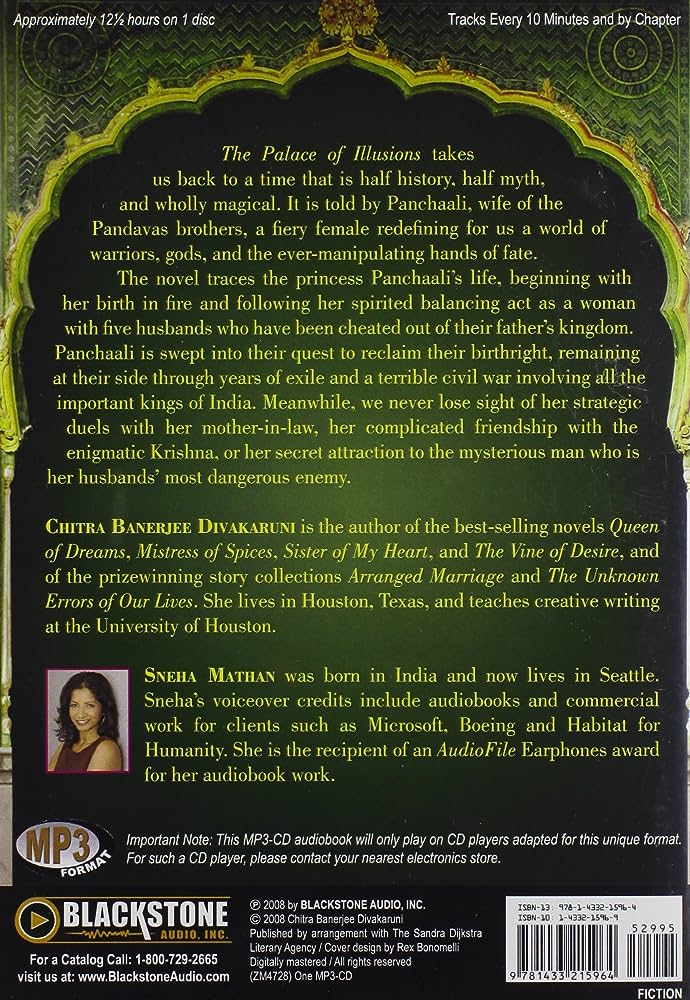

Palace of Illusions by Chitra Banerjee Divakaruni


රු1,700.00
3 X Rs. 566.67 or 8% Cashback with


or 3 X රු566.67 with


or up to 4 X රු425.00 with


The Palace of Illusions by Chitra Banerjee Divakaruni is a powerful feminist retelling of the Mahabharata told through Draupadi, or Panchaali—the fire-born princess who becomes wife to the five Pandavas and a central figure in an epic struggle for power. From her extraordinary birth and friendship with Krishna to her complicated feelings for Karna, royal life, exile, humiliation and the devastating Kurukshetra war, Divakaruni reimagines the ancient epic through a deeply personal female voice. Ideal for readers of Indian mythology, historical fiction, literary retellings and powerful stories about fate, identity and war.
16 in stock
The Palace of Illusions by Chitra Banerjee Divakaruni is a powerful retelling of the ancient Indian epic Mahabharata, placing the legendary Draupadi—also called Panchaali—at the center of a story traditionally dominated by kings, warriors, gods and great battles.
Born from fire and surrounded by prophecy, Panchaali grows up knowing that her life will change history.
But knowing that you are destined for greatness does not mean controlling your destiny.
She becomes the wife of the five Pandava brothers.
She enters a world of royal rivalry, political ambition, family conflict and dangerous questions of honor.
She experiences extraordinary wealth in the magnificent Palace of Illusions.
She loses almost everything.
She survives humiliation.
She follows her husbands into exile.
And eventually she becomes one of the central figures surrounding the terrible war of Kurukshetra.
Yet Chitra Banerjee Divakaruni does something more than retell famous events.
She asks what those events might have felt like from Draupadi’s perspective.
What did she want?
What did she fear?
Whom did she love?
How did she feel about being married to five men?
How did she understand Krishna?
What did she think about the rules created by men around her?
And how much control did she really possess over the destiny others believed had already been written for her?
The result is a lyrical, intimate and deeply human reimagining of one of literature’s great epic stories.
The Palace of Illusions by Chitra Banerjee Divakaruni – Book Overview
The Palace of Illusions by Chitra Banerjee Divakaruni retells the Mahabharata primarily through the voice of Panchaali, better known as Draupadi.
The author’s official synopsis describes her as the fire-born heroine of the epic, married to the five Pandava brothers after they have been denied their rightful kingdom. Divakaruni follows her through exile, political conflict and civil war while also exploring her complicated bond with Krishna and her attraction to the mysterious warrior who becomes one of her husbands’ greatest enemies.
This change of perspective transforms familiar mythology.
Instead of seeing Draupadi mainly as:
A princess.
A wife.
A cause of conflict.
A symbol.
Readers encounter her as a person.
Draupadi / Panchaali
Panchaali is the heart of the novel.
She is intelligent.
Proud.
Curious.
Ambitious.
Passionate.
Sometimes impulsive.
Sometimes angry.
Sometimes wrong.
That complexity is important.
Divakaruni does not turn her into a perfect modern heroine dropped into an ancient story.
She remains deeply connected to the world of the epic while questioning many of the expectations surrounding her.
Born From Fire
Panchaali’s birth immediately marks her as extraordinary.
She and her brother Dhrishtadyumna emerge from a sacrificial fire connected to their father King Drupad’s desire for vengeance.
Her brother’s purpose appears easier to understand.
Panchaali’s destiny is more mysterious.
She grows up with the knowledge that her life may affect history.
That expectation becomes both empowering and burdensome.
A Woman With a Destiny
Prophecy sounds glamorous from the outside.
But imagine being told that your existence is tied to enormous events.
You may begin wondering:
Which choices are actually mine?
Which have already been decided?
Can I escape what has been predicted?
This tension between choice and fate runs throughout The Palace of Illusions by Chitra Banerjee Divakaruni.
The Mahabharata Through a Woman’s Eyes
The Mahabharata contains hundreds of characters, political conflicts, philosophical questions and legendary battles.
Traditional retellings often focus heavily on:
Warriors.
Kings.
Dynasties.
Divine interventions.
Divakaruni changes the emotional center.
She asks readers to watch events through a woman whose life is profoundly affected by decisions made in royal courts and battlefields.
The author’s own website describes the novel as a feminist interpretation of the epic.
A Feminist Retelling
Calling the book feminist does not simply mean that its heroine is strong.
The novel asks questions about:
Who gets to make decisions?
Whose honor matters?
What is expected of women?
How are women used within political alliances?
Why are men’s ambitions celebrated while women’s desires are often treated differently?
These questions give the ancient story striking modern relevance.
Marriage to the Five Pandavas
One of the most famous aspects of Draupadi’s story is her marriage to all five Pandava brothers.
The novel explores the emotional complexity behind this arrangement.
The Pandavas are:
Yudhishthira
Bhima
Arjuna
Nakula
Sahadeva
Each brother is different.
Each relationship with Panchaali carries different emotions and expectations.
Arjuna
Arjuna holds a particularly important place in the story.
A legendary archer and warrior, he is central to Panchaali’s marriage story and to the eventual conflict between the Pandavas and Kauravas.
But the novel complicates Panchaali’s feelings and expectations surrounding him.
The person we think destiny has chosen for us may not become the person we imagined.
Karna
One of the boldest elements of The Palace of Illusions by Chitra Banerjee Divakaruni is Panchaali’s complicated attraction to Karna.
Karna is one of the most tragic and fascinating figures in the Mahabharata.
A powerful warrior.
An outsider.
A loyal friend to Duryodhana.
A man whose birth and identity contain enormous secrets.
And an enemy of the Pandavas.
Divakaruni’s reimagining creates an emotional connection between Panchaali and Karna that adds another layer of longing, regret and possibility to the epic.
Love That Cannot Be Simple
The relationship with Karna raises one of the novel’s recurring questions:
What might a life have looked like if one choice had been different?
This is not simply romance.
It is about:
Timing.
Pride.
Identity.
Social position.
Misunderstanding.
Destiny.
Some relationships remain powerful precisely because they never become what they might have been.
Krishna
Krishna is another central figure in Panchaali’s life.
Their relationship is one of the most compelling in the novel.
He is:
Friend.
Guide.
Mystery.
Divine presence.
Sometimes teasing.
Sometimes impossible to understand.
Panchaali repeatedly turns toward Krishna, even when she does not fully understand his motives.
Friendship With Krishna
The author’s official description specifically highlights Panchaali’s complicated friendship with Krishna.
Their bond is unusual because it does not fit neatly into one category.
It contains:
Affection.
Trust.
Frustration.
Spiritual connection.
Mystery.
Krishna frequently seems to understand far more than he is willing to explain.
The Palace of Illusions
The title refers directly to the magnificent palace connected with the Pandavas’ kingdom.
The palace is extraordinary.
Beautiful.
Magical.
Full of illusions.
Surfaces do not always behave as expected.
Things appear to be one thing and become another.
The setting therefore becomes a perfect symbol for the novel itself.
Why the Palace Matters
Panchaali sees the palace as more than royal architecture.
It becomes associated with:
Home.
Power.
Achievement.
Belonging.
Identity.
For someone whose life is repeatedly controlled by movement, marriage, politics and exile, having a place that feels truly hers becomes emotionally significant.
Divakaruni has described the palace as Panchaali’s one true home and connects it to the novel’s larger exploration of illusion and belonging.
Illusion
The concept of illusion extends far beyond the palace.
People create illusions about:
Power.
Love.
Honor.
Victory.
Identity.
Control.
Heroism.
Characters often believe they understand what they want.
Events repeatedly challenge those beliefs.
Maya
The idea of Maya, or the illusory nature of worldly appearances, gives the title philosophical depth.
What looks permanent may disappear.
What appears victorious may contain defeat.
What seems like humiliation may change history.
What appears to be destiny may still contain choice.
The Dice Game
One of the central turning points in the epic involves the disastrous dice game.
Yudhishthira’s decisions lead to catastrophic consequences for the Pandavas and Panchaali.
The scene raises difficult questions about:
Honor.
Gambling.
Authority.
Responsibility.
Patriarchy.
Loyalty.
Draupadi’s Humiliation
One of the darkest and most famous episodes in the Mahabharata concerns Draupadi being dragged before the royal court and subjected to public humiliation after the dice game.
Divakaruni centers Panchaali’s experience rather than treating the event merely as a trigger for male revenge.
That shift matters.
The question becomes not only:
What will the Pandavas do afterward?
But:
What was done to Panchaali, and why was a room full of powerful men willing to allow it?
Silence Can Be Complicity
The court scene exposes one of the novel’s strongest ideas.
Injustice does not require everyone to actively participate.
Sometimes injustice survives because people with the power to intervene remain silent.
That gives the ancient episode enormous contemporary relevance.
Honor
Characters repeatedly talk about honor.
But whose honor?
A family’s?
A king’s?
A warrior’s?
A husband’s?
A woman’s?
The novel repeatedly exposes how the language of honor can be used selectively.
Exile
After losing their kingdom, the Pandavas and Panchaali face years of exile.
Royal life disappears.
Comfort disappears.
The future becomes uncertain.
Exile transforms the characters.
Losing Status
One of the interesting things about exile is how quickly status can change.
A queen can become a wanderer.
A palace can become a memory.
Political power can disappear.
This reinforces the novel’s theme of impermanence.
Revenge
Humiliation creates anger.
Anger creates a desire for revenge.
Revenge creates new suffering.
This cycle gradually pushes the world toward war.
The characters often believe vengeance will restore what was lost.
The novel asks whether revenge can ever truly achieve that.
The Kurukshetra War
The story ultimately moves toward the devastating war of Kurukshetra.
This is one of the defining events of the Mahabharata.
Family fights family.
Teachers face students.
Friends become enemies.
Great warriors die.
Victory becomes increasingly difficult to distinguish from catastrophe.
The Cost of War
Divakaruni has said that one of her goals was to emphasize the immense costs of war and how easy conflict can be to begin compared with how difficult it is to end.
That perspective gives The Palace of Illusions by Chitra Banerjee Divakaruni strong relevance beyond mythology.
Wars may begin through:
Pride.
Territory.
Honor.
Political rivalry.
Revenge.
But ordinary people bear the consequences.
Victory Can Feel Like Defeat
Epic stories often celebrate victory.
This novel asks what remains afterward.
If:
Families are destroyed.
Children are dead.
Kingdoms are devastated.
Entire generations are lost.
what exactly has the winner won?
That question gives the later sections of the novel particular emotional weight.
Destiny Versus Choice
Characters often speak of fate.
Prophecies exist.
Krishna appears to understand events beyond ordinary human perception.
Yet characters still make decisions.
This creates one of the novel’s most fascinating tensions.
If destiny exists, are people responsible for their actions?
The book does not give a simple answer.
Pride
Panchaali’s pride is both strength and weakness.
Pride helps her resist humiliation.
But pride can also intensify conflict.
The same is true for many male characters.
The novel demonstrates how a quality can be admirable in one situation and destructive in another.
Anger
Panchaali is allowed to be angry.
This matters.
Women in traditional stories are sometimes praised most when they:
Endure.
Forgive.
Remain silent.
Panchaali does not always do that.
Her anger is sometimes justified.
Sometimes dangerous.
Always human.
Female Agency
Panchaali does not control every event.
In fact, many crucial decisions are made around her.
But agency does not require total control.
She interprets.
Questions.
Acts.
Resists.
Remembers.
Her voice itself becomes an act of agency.
Who Gets to Tell History?
This may be the most important question in the entire novel.
The events of the Mahabharata are already famous.
Divakaruni does not need to invent a new war.
Instead, she changes the narrator.
That alone changes the meaning.
History depends partly on:
Who speaks.
Who is remembered.
Whose feelings are recorded.
Whose suffering is considered important.
Retelling as Reinterpretation
A retelling does not necessarily claim the original was wrong.
It asks:
What happens if we look from somewhere else?
A famous event can appear very different from the perspective of:
A king.
A soldier.
A wife.
A servant.
A defeated enemy.
Perspective changes interpretation.
Women in Epic Stories
Epic literature often contains powerful women whose inner lives receive less attention than those of male heroes.
Modern retellings can explore those missing emotional spaces.
The Palace of Illusions by Chitra Banerjee Divakaruni is one of the best-known examples of this approach in contemporary Indian fiction.
Brothers and Rivalry
The rivalry between the Pandavas and Kauravas drives much of the larger story.
This is not conflict between strangers.
It is conflict within a family.
That makes the eventual war even more tragic.
Duryodhana
Duryodhana is one of the major opponents of the Pandavas.
He represents:
Ambition.
Resentment.
Pride.
Political competition.
But as with many Mahabharata characters, simple labels are not always enough.
The epic is powerful partly because its characters contain contradictions.
Karna and Duryodhana
Karna’s loyalty to Duryodhana becomes especially important.
Duryodhana gives Karna recognition when others judge him according to social status.
That loyalty later becomes morally complicated.
A person can feel genuine gratitude toward someone while still becoming involved in destructive choices.
Caste and Social Status
Questions of birth and social standing influence the way characters are treated.
Karna’s position is especially important here.
The novel engages with how society decides:
Who belongs?
Who deserves respect?
Who may compete?
Who is considered worthy?
These questions remain relevant far beyond the ancient setting.
Motherhood
Mothers also influence the epic in powerful ways.
Kunti.
Gandhari.
Panchaali herself.
Motherhood is connected with:
Love.
Duty.
Secrets.
Sacrifice.
Loss.
In wartime, mothers often experience consequences created by political choices they did not fully control.
Kunti
Kunti, mother of the Pandavas, has an especially complicated relationship with Panchaali.
The novel explores tensions familiar in many families:
Authority.
Expectation.
Duty.
Competition for influence.
Generational differences.
Home
Panchaali repeatedly searches for a place where she genuinely belongs.
Her father’s palace is not fully hers.
Marriage changes her identity.
The Palace of Illusions becomes deeply meaningful.
Then even that is lost.
This creates a larger question:
Is home a building?
A family?
A person?
A memory?
Identity Beyond Relationships
Panchaali is constantly described through relationships:
Daughter of Drupad.
Sister.
Wife of the Pandavas.
Queen.
Mother.
But she wants to understand herself beyond those labels.
That desire gives the novel a distinctly modern emotional quality.
Names
Panchaali has several names and identities.
Draupadi connects her to her father Drupad.
Panchaali connects her to the kingdom of Panchala.
Names reveal how strongly identity can be shaped by other people and places.
One of her deeper struggles is defining herself on her own terms.
Desire
The novel does not pretend women lack desire.
Panchaali experiences:
Love.
Attraction.
Jealousy.
Longing.
Regret.
These emotions make her a fuller character instead of an idealized symbol of virtue or suffering.
Regret
Knowing what happened does not mean knowing what would have happened if another choice had been made.
Panchaali repeatedly looks back at moments that might have changed everything.
Regret lives in those imagined alternative lives.
Forgiveness
The story asks whether forgiveness is possible after enormous betrayal and violence.
Forgiveness is not presented as easy.
Nor is it always equivalent to forgetting.
Sometimes understanding arrives only after consequences can no longer be reversed.
Krishna and Spirituality
Krishna gives the story a spiritual dimension without removing its human complexity.
Characters struggle with:
Duty.
Fate.
Action.
Attachment.
Mortality.
Krishna’s presence suggests that events may contain meanings the characters cannot fully understand while living through them.
Mortality
Even legendary warriors die.
Even magnificent palaces disappear.
Even kingdoms fall.
The epic scale ultimately reinforces a simple truth:
Human power is temporary.
What Makes Someone Heroic?
Men in the epic are often celebrated for:
Battle skill.
Courage.
Honor.
Victory.
The novel asks whether heroism might also involve:
Endurance.
Compassion.
Speaking against injustice.
Surviving humiliation.
Understanding the cost of violence.
Mythology and Modern Relevance
Although the story comes from an ancient epic, the themes remain recognizable.
Family rivalry.
Political ambition.
Gender inequality.
War.
Social hierarchy.
Love.
Jealousy.
Power.
These are not ancient problems.
They are human problems.
Is The Palace of Illusions a Direct Translation of the Mahabharata?
No.
This is extremely important.
The Palace of Illusions by Chitra Banerjee Divakaruni is a literary retelling, not a translation of the Mahabharata.
Divakaruni preserves major characters and events but reimagines psychology, perspective and relationships through Panchaali’s voice.
Readers studying the original epic academically should consult a recognized translation of the Mahabharata as well.
Do You Need to Know the Mahabharata First?
No.
The author’s official site specifically notes that the book can be enjoyed whether or not readers already know the epic.
The story gives enough context for a newcomer to follow Panchaali’s journey.
Readers already familiar with the Mahabharata may enjoy it differently because they can compare Divakaruni’s reinterpretation with more traditional versions.
Is It Historical Fiction or Fantasy?
It fits across several genres.
Your BookLounge category Historical Fiction is reasonable.
It can also be described as:
Mythological fiction.
Literary fiction.
Epic fantasy.
Feminist retelling.
Penguin Random House includes it under literary fiction and epic fantasy-related classifications.
Is It a Romance?
No.
Romantic longing and complicated attraction are important, especially involving Panchaali and Karna.
But the novel is not primarily a romance.
Its larger focus includes:
Identity.
War.
Power.
Family.
Fate.
Gender.
Belonging.
Is It a Standalone?
Yes.
The Palace of Illusions by Chitra Banerjee Divakaruni is a complete standalone novel.
You do not need to buy another volume to finish Panchaali’s story.
Is The Forest of Enchantments a Sequel?
No.
Divakaruni’s The Forest of Enchantments is another mythological retelling, this time centered on Sita and the Ramayana.
It can appeal to readers who enjoy The Palace of Illusions, but it is not Book 2 of the same storyline.
Chitra Banerjee Divakaruni
Chitra Banerjee Divakaruni is an acclaimed author known for novels and short stories involving women, migration, mythology, family and identity.
Her works include:
The Mistress of Spices
Sister of My Heart
Before We Visit the Goddess
Oleander Girl
The Forest of Enchantments
and others.
Her official site describes The Palace of Illusions as an international bestseller taught at more than 100 colleges and universities.
Official Edition Details
Your inventory edition matches the Vintage paperback:
Title: The Palace of Illusions
Author: Chitra Banerjee Divakaruni
ISBN-13: 9781400096206
Publisher: Vintage
Format: Paperback
Pages: 384
Publication Date: February 10, 2009
Your procurement file contains the same ISBN.
Content Considerations
The Palace of Illusions by Chitra Banerjee Divakaruni contains mature and potentially sensitive themes including:
- War and battlefield violence
- Death and mass loss
- Public humiliation of a woman
- Threatened sexualized violence and disrobing
- Misogyny and patriarchal expectations
- Caste and class discrimination
- Gambling
- Revenge
- Family conflict
- Exile
- Grief
- Political betrayal
- Forced or constrained marriage expectations
- Destruction caused by war
The novel is literary and mythological rather than graphically violent throughout, but some major episodes are emotionally intense.
Important Themes
The Palace of Illusions by Chitra Banerjee Divakaruni explores identity, womanhood, power, fate, free will, love, desire, marriage, motherhood, family, revenge, war, honor, humiliation, caste, social hierarchy, friendship, home, illusion, spirituality, ambition, grief and the question of who gets to tell history.
7 Powerful Reasons to Read The Palace of Illusions by Chitra Banerjee Divakaruni
- It gives Draupadi her own voice. Instead of remaining a figure described mainly through male heroes, Panchaali becomes the narrator of her own life, desires, anger and regrets.
- It makes the Mahabharata accessible to new readers. You do not need deep prior knowledge of the epic to follow the story, while readers who already know it can discover a fresh perspective.
- The Panchaali-Karna relationship adds powerful emotional tension. Divakaruni’s reimagining explores attraction, missed possibilities and the painful question of what might have happened under different circumstances.
- Krishna and Panchaali share one of the novel’s most memorable relationships. Their mysterious friendship combines affection, spirituality, humor and questions about destiny.
- The book examines the real cost of war. Heroic victories become much more complicated when seen through the suffering left behind.
- The Palace of Illusions becomes a beautiful symbol of home and impermanence. Its magic reflects the larger novel, where things are rarely exactly what they appear to be.
- Ancient themes feel strikingly modern. Questions about women’s agency, political power, inherited conflict, social status, public humiliation and who gets to control the story remain deeply relevant today.
Why Read The Palace of Illusions by Chitra Banerjee Divakaruni?
The Palace of Illusions by Chitra Banerjee Divakaruni is an excellent choice for readers interested in Indian mythology, the Mahabharata, Draupadi, feminist retellings, historical fiction, mythological fiction, literary fiction, Karna, Krishna, the Pandavas and character-driven epic stories.
It is especially suitable for readers who enjoy retellings that do more than repeat familiar events.
Divakaruni asks readers to reconsider them.
What if the character standing beside the heroes was experiencing an entirely different story?
What if the person history remembers as a cause of war saw herself instead as someone trapped inside systems of pride, politics and destiny?
What if the woman described through her relationships to men finally described those men through her own eyes?
Those questions make the book memorable.
Who Should Read This Book?
The Palace of Illusions by Chitra Banerjee Divakaruni may especially appeal to readers who enjoy:
- Indian mythology
- The Mahabharata
- Draupadi / Panchaali
- Feminist retellings
- Historical fiction
- Mythological fiction
- Literary fiction
- Epic family sagas
- Karna
- Krishna
- Powerful female narrators
- Stories about war and politics
- Complex relationships
- Books about fate and free will
- Retellings such as Circe
- South Asian literature
- Character-driven mythology
It is also an excellent option for readers who have always heard the Mahabharata from traditional viewpoints and want to experience the familiar story through a very different voice.
The Palace of Illusions by Chitra Banerjee Divakaruni – When a Woman Tells the Epic Herself
The Palace of Illusions by Chitra Banerjee Divakaruni begins with fire.
Panchaali is born into a story already in motion.
A king wants revenge.
A prophecy predicts history.
Men around her have ambitions.
Kingdoms compete for power.
And before she is old enough to understand the scale of it, other people already expect her life to mean something.
But Panchaali wants more than simply fulfilling someone else’s prophecy.
She wants to know who she is.
She wants:
Love.
A home.
Respect.
Control.
She wants the freedom to feel things women in epic stories are not always permitted to say aloud.
That includes anger.
Desire.
Jealousy.
Pride.
Regret.
Her life brings her extraordinary things.
Five royal husbands.
A magical palace.
Friendship with Krishna.
Political influence.
But it also brings humiliation, exile and devastating war.
And through everything, the novel asks a question that reaches far beyond mythology:
Who owns a story?
The warrior who wins the battle?
The king who records the victory?
The poet who tells the epic?
Or the woman standing inside the event, experiencing consequences no official history fully records?
Divakaruni gives Panchaali the opportunity to answer.
The result is not a replacement for the Mahabharata.
It is a conversation with it.
A reimagining.
A different window into a familiar world.
The heroes remain.
The battles remain.
Krishna remains.
Karna remains.
The Pandavas remain.
But the emotional center changes.
And when the center changes, everything around it can look different.
For readers who enjoy literary mythology, powerful female narrators, complicated love, epic family conflict and stories where ancient questions still feel painfully modern, The Palace of Illusions by Chitra Banerjee Divakaruni is a rich and memorable retelling of one of India’s greatest epics.
Learn more about The Palace of Illusions by Chitra Banerjee Divakaruni on the official author website.
Explore more historical and mythological fiction books at Bargain Books.
| Author | Chitra Banerjee Divakaruni |
|---|---|
| Type | Paperback Printed Book |
| ISBN/ISSN | 9386215969, 978-9386215963 |
| Language | English |
| Pages | 384 |
Be the first to review “Palace of Illusions by Chitra Banerjee Divakaruni”
Related products
-11%

Classics & Literary Fiction
Original price was: රු1,800.00.රු1,600.00Current price is: රු1,600.00.
3 X Rs. 533.33 or 8% Cashback with
or 3 X රු533.33 with
or up to 4 X රු400.00 with
-20%

Classics & Literary Fiction
Original price was: රු2,500.00.රු1,990.00Current price is: රු1,990.00.
3 X Rs. 663.33 or 8% Cashback with
or 3 X රු663.33 with
or up to 4 X රු497.50 with
-28%

Out of stock
Classics & Literary Fiction
Original price was: රු1,800.00.රු1,300.00Current price is: රු1,300.00.
3 X Rs. 433.33 or 8% Cashback with
or 3 X රු433.33 with
or up to 4 X රු325.00 with

Out of stock
Classics & Literary Fiction
රු1,800.00
3 X Rs. 600.00 or 8% Cashback with
or 3 X රු600.00 with
or up to 4 X රු450.00 with
-17%

Classics & Literary Fiction
Original price was: රු2,900.00.රු2,400.00Current price is: රු2,400.00.
3 X Rs. 800.00 or 8% Cashback with
or 3 X රු800.00 with
or up to 4 X රු600.00 with

Classics & Literary Fiction
රු2,590.00
3 X Rs. 863.33 or 8% Cashback with
or 3 X රු863.33 with
or up to 4 X රු647.50 with
-19%

Classics & Literary Fiction
Original price was: රු2,700.00.රු2,200.00Current price is: රු2,200.00.
3 X Rs. 733.33 or 8% Cashback with
or 3 X රු733.33 with
or up to 4 X රු550.00 with
Classics & Literary Fiction
රු1,850.00
3 X Rs. 616.67 or 8% Cashback with
or 3 X රු616.67 with
or up to 4 X රු462.50 with
Reviews
There are no reviews yet.