
No products in the cart.
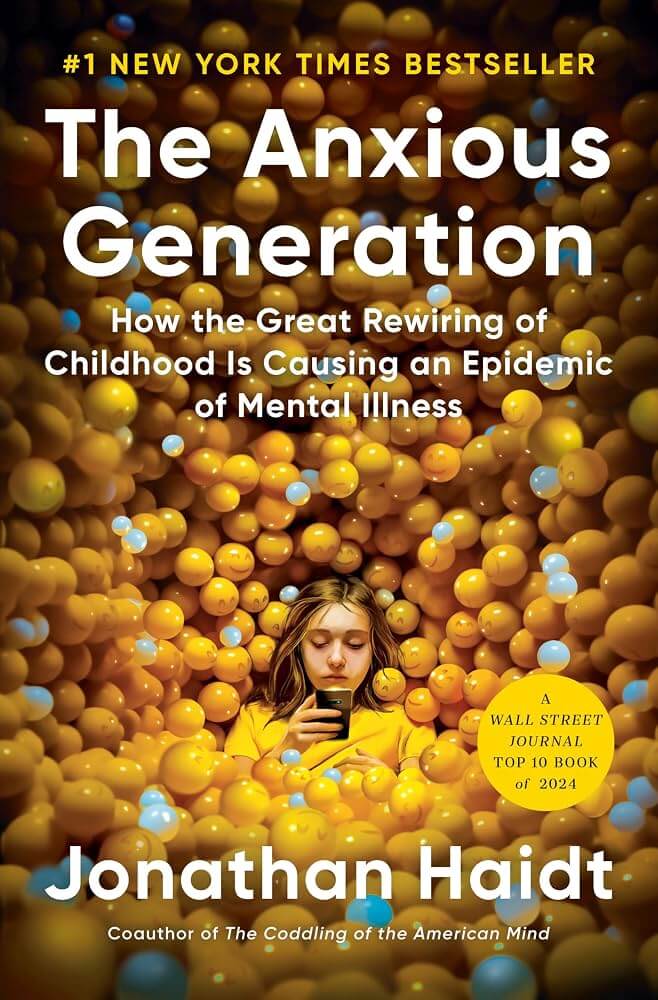
The Anxious Generation by Jonathan Haidt
රු2,950.00
3 X Rs. 983.33 or 8% Cashback with


or 3 X රු983.33 with


or up to 4 X රු737.50 with


Why did childhood change so dramatically after the arrival of smartphones and social media?
In The Anxious Generation, social psychologist Jonathan Haidt argues that the shift from a play-based childhood toward a phone-based childhood has contributed to major changes in adolescent development and mental health.
The book explores:
- Smartphones and social media
- Sleep and attention
- Face-to-face interaction
- Free play and independence
- Girls’ and boys’ online experiences
- Parenting and schools
- Teen mental health
Haidt’s causal interpretation is influential but debated within current research, making this an important book for readers interested in psychology, education, technology and contemporary childhood.
Paperback | 464 pages | Penguin | ISBN 9781802063271
10 in stock
The Anxious Generation by Jonathan Haidt
The Anxious Generation is a widely discussed work of psychology and social commentary by Jonathan Haidt, examining dramatic changes in childhood, adolescence and digital life since the early 2010s.
Haidt argues that childhood underwent what he calls a “great rewiring” as smartphones and social-media platforms became central to teenage social life while independent play, face-to-face interaction and unsupervised childhood experiences declined.
This Penguin paperback edition, ISBN 9781802063271, contains 464 pages and was published in the UK on 2 January 2025.
From a Play-Based Childhood to a Phone-Based Childhood
The central idea of the book is Haidt’s distinction between a play-based childhood and a phone-based childhood.
He argues that children traditionally developed important social and emotional abilities through activities such as:
- Unstructured play
- Face-to-face friendships
- Exploring independently
- Taking manageable risks
- Solving disagreements without constant adult intervention
- Spending time away from adult supervision
According to Haidt, these opportunities began declining before smartphones became dominant.
He then argues that the widespread adoption of smartphones and social media accelerated the transformation by moving a significant portion of young people’s social lives online.
Penguin summarises Haidt’s position as linking the decline of free play and rise of phone-centred childhood with increases in adolescent distress.
Four Ways Haidt Says Phone-Based Childhood Can Affect Development
Haidt organises much of his argument around four mechanisms through which heavy smartphone and social-media use may disrupt healthy development:
Sleep deprivation – late-night phone use and notifications can interfere with healthy sleep.
Social deprivation – online interaction may replace some face-to-face time with friends and family.
Cognitive fragmentation – constant alerts, feeds and switching between activities may make sustained attention more difficult.
Addiction or compulsive use – some platforms are designed around repeated engagement and reward cycles.
These mechanisms form an important part of Haidt’s explanation for why digital life may affect young people differently from adults.
Girls, Boys and Different Online Experiences
The book also separates some of its analysis by sex.
Haidt argues that social-media dynamics can affect teenage girls particularly strongly through social comparison, appearance pressures, reputation and online relationship networks.
His discussion of boys focuses more heavily on withdrawal from in-person activity into online entertainment, gaming and digital environments.
These are Haidt’s interpretations of population-level trends, and individual experiences vary considerably.
The publisher describes the book as offering separate analyses of changes affecting girls and boys.
Mental Health and the Evidence Debate
An important note for a responsible product listing is that the book’s strongest causal claim is actively debated among researchers.
Haidt argues that smartphones and social media have been major contributors to rising adolescent anxiety, depression and other forms of psychological distress.
Other researchers agree that digital environments can create risks but dispute whether the evidence establishes smartphones or social media as a dominant population-level cause.
For example, psychologist Candice Odgers, writing in Nature, argued that evidence linking screen and social-media use to the broader rise in adolescent depression and anxiety remains equivocal and warned against interpreting parallel trends as proof of causation.
Haidt and collaborators have continued publishing research and reviews arguing that multiple lines of evidence support meaningful harms from social media, including experimental, correlational and platform-internal evidence.
For bookstore purposes, the most accurate description is therefore:
The Anxious Generation presents Jonathan Haidt’s influential and debated argument about how smartphones, social media and reduced childhood independence may be contributing to adolescent mental-health problems.
It should not be presented as though every causal claim in the book represents settled scientific consensus.
Parenting, Schools and Social Change
The book is not limited to diagnosis.
Haidt proposes practical changes aimed at shifting childhood away from excessive digital dependence.
His recommendations include delaying smartphone access, delaying social-media use, creating more phone-free school environments and giving children greater independence and opportunities for unsupervised play.
These recommendations have become an important part of broader public debates about smartphones in schools, age limits on social platforms and children’s digital lives.
The proposals are best understood as Haidt’s policy and parenting recommendations, rather than personalised medical or psychological advice.
Psychology, Sociology and Technology
Although frequently shelved under psychology, The Anxious Generation crosses several subject areas.
It discusses:
- Developmental psychology
- Social psychology
- Parenting
- Education
- Adolescence
- Social media
- Technology
- Sociology
- Mental health
- Childhood independence
- Digital culture
Google Books similarly categorises the title across social media, adolescent development, children’s studies and psychology.
About Jonathan Haidt
Jonathan Haidt is a social psychologist and the Thomas Cooley Professor of Ethical Leadership at New York University’s Stern School of Business.
His other major books include:
- The Righteous Mind
- The Coddling of the American Mind — co-authored with Greg Lukianoff
- The Happiness Hypothesis
Penguin identifies Haidt as a social psychologist whose work has focused on morality, culture, political division and, more recently, childhood and technology.
Who Should Read The Anxious Generation?
The book may particularly interest:
- Parents
- Teachers
- School administrators
- Psychology students
- Sociology students
- People researching social media
- Readers interested in Gen Z
- Readers concerned about smartphone use
- Education and youth-policy readers
- People interested in child and adolescent development
Readers should approach it as an influential contribution to an ongoing scientific and public debate, particularly when interpreting claims about causation.
Buy The Anxious Generation in Sri Lanka
For readers looking to buy The Anxious Generation by Jonathan Haidt in Sri Lanka, ISBN 9781802063271 is the official 2025 Penguin paperback edition.
With 464 pages, it offers an extensive examination of childhood, smartphones, social media, independent play and adolescent well-being, together with Haidt’s recommendations for parents, schools and communities.
Be the first to review “The Anxious Generation by Jonathan Haidt”
Related products

Out of stock
Non-Fiction & Knowledge
The Decision Book : 50 Models for Strategic Thinking by Mikael Krogerus
රු1,550.00
3 X Rs. 516.67 or 8% Cashback with
or 3 X රු516.67 with
or up to 4 X රු387.50 with

Non-Fiction & Knowledge
රු1,750.00
3 X Rs. 583.33 or 8% Cashback with
or 3 X රු583.33 with
or up to 4 X රු437.50 with
-24%

Non-Fiction & Knowledge
Original price was: රු2,300.00.රු1,750.00Current price is: රු1,750.00.
3 X Rs. 583.33 or 8% Cashback with
or 3 X රු583.33 with
or up to 4 X රු437.50 with

Non-Fiction & Knowledge
රු1,700.00
3 X Rs. 566.67 or 8% Cashback with
or 3 X රු566.67 with
or up to 4 X රු425.00 with

රු2,200.00
3 X Rs. 733.33 or 8% Cashback with
or 3 X රු733.33 with
or up to 4 X රු550.00 with
Out of stock
Non-Fiction & Knowledge
රු1,600.00
3 X Rs. 533.33 or 8% Cashback with
or 3 X රු533.33 with
or up to 4 X රු400.00 with
-20%

Out of stock
Original price was: රු2,500.00.රු2,000.00Current price is: රු2,000.00.
3 X Rs. 666.67 or 8% Cashback with
or 3 X රු666.67 with
or up to 4 X රු500.00 with

රු1,950.00
3 X Rs. 650.00 or 8% Cashback with
or 3 X රු650.00 with
or up to 4 X රු487.50 with
Reviews
There are no reviews yet.