No products in the cart.
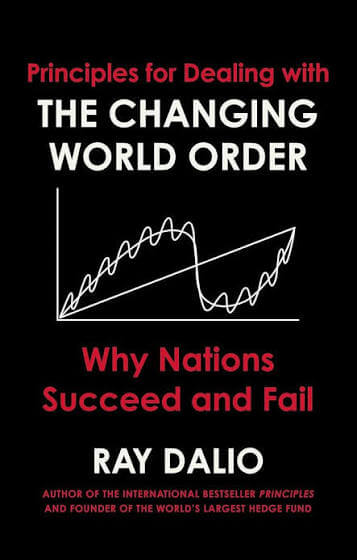
Principles for Dealing with the Changing World Order: Why Nations Succeed or Fail by Ray Dalio

රු2,600.00
3 X Rs. 866.67 or 8% Cashback with


or 3 X රු866.67 with


or up to 4 X රු650.00 with


Principles for Dealing with the Changing World Order by Ray Dalio examines five centuries of economic history to explore why nations, currencies and empires rise and decline.
Through historical comparisons, charts and economic analysis, Dalio examines debt cycles, reserve currencies, innovation, inequality and changes in global power.
Subtitle: Why Nations Succeed or Fail
Format: Hardcover
Pages: 576
Publisher: Simon & Schuster UK
ISBN: 9781471196690
2 in stock
Principles for Dealing with the Changing World Order by Ray Dalio
Principles for Dealing with the Changing World Order: Why Nations Succeed or Fail by Ray Dalio is a large-scale study of economic history, global power, debt cycles, reserve currencies and the recurring forces that contribute to the rise and decline of nations.
Dalio is best known as the founder of Bridgewater Associates and the author of Principles: Life and Work.
In this book, he takes a much broader historical view.
Rather than concentrating primarily on individual investing or personal decision-making, Dalio looks across roughly five centuries of economic and geopolitical history to identify patterns that he believes repeatedly appear when global leadership changes.
Simon & Schuster describes the book as Dalio’s study of major empires including the Dutch, British and American systems, using recurring economic, social and political patterns to examine why countries rise and decline.
Why Nations Rise and Fall
The central question is contained in the subtitle:
Why Nations Succeed or Fail
Dalio argues that major powers tend to develop through recurring stages.
A nation may begin with:
- Strong institutions
- Education
- Innovation
- Productivity
- Competitive industries
- Increasing trade
- Strong financial markets
Over time, success can strengthen its currency and international influence.
But later stages may bring different pressures, including:
- Rising debt
- Wealth inequality
- Political division
- Declining competitiveness
- Currency pressures
- Internal conflict
- Challenges from emerging powers
Dalio refers to the broad pattern connecting these developments as a Big Cycle.
Five Hundred Years of Economic History
A major feature of the book is its historical scope.
Dalio examines major powers across several centuries rather than analysing only recent events.
Among the systems discussed are:
- The Dutch Empire
- The British Empire
- The United States
- China and its historical cycles
The goal is to compare different periods and search for repeated relationships involving:
- Debt
- Money
- Trade
- Education
- Innovation
- Military strength
- Reserve currencies
- Internal stability
Google Books describes the book as an examination of repeating patterns in wealth and power over approximately five hundred years.
The Big Cycle
Dalio’s Big Cycle framework is one of the book’s central ideas.
In simplified form, he argues that major powers often move through periods of:
- Building
- Rising productivity
- Increasing wealth
- Expanding financial influence
- Rising debt and inequality
- Internal tension
- Increased external competition
- Restructuring or decline
Dalio presents this as a framework for understanding historical change rather than as a guaranteed formula.
Readers should therefore distinguish between the historical evidence he discusses and his own interpretation of recurring patterns.
Money and Debt
Debt plays a major role in Dalio’s analysis.
Governments, businesses and households often borrow during periods of expansion.
Borrowing can support growth.
But very high debt levels can eventually create pressure.
Dalio examines how countries have historically responded through combinations of:
- Interest-rate changes
- Spending adjustments
- Currency creation
- Debt restructuring
- Taxation
- Inflation
His analysis connects debt cycles with broader shifts in economic power.
Reserve Currencies
Another important topic is the role of reserve currencies.
Historically, globally influential currencies have been associated with powerful trading and financial systems.
Dalio examines transitions involving:
- The Dutch guilder
- The British pound
- The US dollar
He explores how currency strength can reflect economic and financial power while also creating incentives and pressures for the country issuing the currency.
Internal Order and Disorder
The book also examines conditions within countries.
Dalio argues that internal stability can be influenced by factors such as:
- Wealth distribution
- Political division
- Opportunity
- Education
- Institutional trust
- Social mobility
When tensions become severe, countries may experience increasing political conflict or institutional change.
These are analytical claims within Dalio’s framework, not universally accepted laws of political development.
External Conflict
Competition between major powers is another recurring theme.
Dalio examines how established powers respond when a new country gains economic, technological or military influence.
The book discusses this dynamic in historical cases and also applies the framework to the modern relationship between the United States and China.
The book presents Dalio’s interpretation of these relationships rather than a definitive forecast of future geopolitical outcomes.
Education and Innovation
Dalio places strong emphasis on education and innovation.
Countries capable of developing:
- Skilled workers
- New technologies
- Competitive companies
- Scientific knowledge
- Efficient institutions
may strengthen their economic position.
Over time, these advantages can support:
- Productivity
- Trade
- Financial markets
- Military capacity
- Currency influence
The book therefore treats economic strength as the result of multiple connected systems rather than one single factor.
Economic Competitiveness
Competitiveness is another repeated theme.
A country needs to produce goods and services that remain valuable internationally.
Dalio looks at factors such as:
- Productivity
- Labour costs
- Technology
- Infrastructure
- Education
- Capital markets
If these weaken while costs rise, a country’s relative economic position may change.
Historical Charts and Data
One of the book’s distinctive features is its extensive use of:
- Charts
- Historical comparisons
- Economic indicators
- Long-term trend analysis
- Timelines
The book is therefore visually and physically larger than many standard business books.
The hardcover edition runs to 576 pages according to the official Simon & Schuster UK product record.
Investing and Positioning
Although the book contains economic and investment-related material, it is not simply a stock-picking manual.
Dalio uses historical analysis partly to think about how investors, businesses and policymakers might prepare for changing conditions.
Topics relevant to investors include:
- Currency risk
- Debt
- Inflation
- Economic cycles
- Geographic diversification
- Political stability
However, the book should be treated as general educational material rather than personalised investment advice.
Not a Simple Prediction Book
It is important not to interpret Principles for Dealing with the Changing World Order as a book claiming to know exactly what will happen next.
Dalio’s approach is based on identifying historical similarities and using them to think about possible future developments.
Historical patterns can provide context, but political and economic outcomes remain uncertain.
Different economists and historians may interpret the same evidence differently.
Who May Enjoy This Book?
This book may appeal to readers interested in:
- Economics
- Economic history
- Investing
- Global markets
- Geopolitics
- Debt cycles
- International trade
- Reserve currencies
- History of empires
- Macroeconomics
- Financial markets
It may especially appeal to readers who enjoyed:
- Principles
- The Changing World Order
- The Psychology of Money
- The Lessons of History
- The Rise and Fall of the Great Powers
- Books about economic cycles and financial history
About Ray Dalio
Ray Dalio is an investor, author and founder of Bridgewater Associates.
Simon & Schuster describes him as a global macro investor with more than five decades of experience and notes that he built Bridgewater into the world’s largest hedge fund during his leadership.
His books include:
- Principles: Life and Work
- Principles for Dealing with the Changing World Order
- Principles for Navigating Big Debt Crises
For readers looking to buy Principles for Dealing with the Changing World Order by Ray Dalio in Sri Lanka, ISBN 9781471196690 is the Simon & Schuster UK hardcover edition used for this listing.
Be the first to review “Principles for Dealing with the Changing World Order: Why Nations Succeed or Fail by Ray Dalio”
Related products
රු1,950.00
3 X Rs. 650.00 or 8% Cashback with
or 3 X රු650.00 with
or up to 4 X රු487.50 with
Economics
රු1,950.00
3 X Rs. 650.00 or 8% Cashback with
or 3 X රු650.00 with
or up to 4 X රු487.50 with

Business, Finance & Economics
රු1,700.00
3 X Rs. 566.67 or 8% Cashback with
or 3 X රු566.67 with
or up to 4 X රු425.00 with
රු3,200.00
3 X Rs. 1,066.67 or 8% Cashback with
or 3 X රු1,066.67 with
or up to 4 X රු800.00 with
Economics
රු2,200.00
3 X Rs. 733.33 or 8% Cashback with
or 3 X රු733.33 with
or up to 4 X රු550.00 with
Reviews
There are no reviews yet.