No products in the cart.
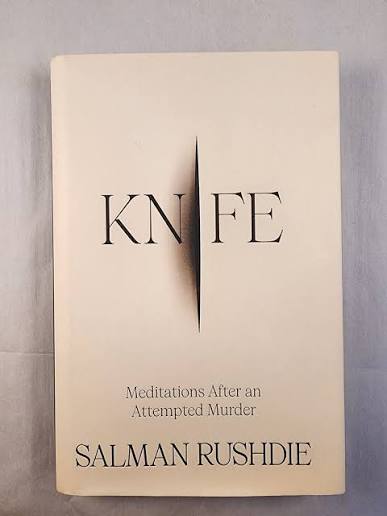
Knife: Meditations After an Attempted Murder by Salman Rushdie

රු1,750.00
3 X Rs. 583.33 or 8% Cashback with


or 3 X රු583.33 with


or up to 4 X රු437.50 with


Knife: Meditations After an Attempted Murder by Salman Rushdie is a powerful memoir about survival, recovery, love and literature following the 2022 attack that nearly killed him.
Rushdie reflects on trauma, mortality, family and the decision to continue living and writing.
Format: Paperback
Pages: 224
Publisher: Vintage
ISBN: 9781529921168
5 in stock
Knife by Salman Rushdie
Knife: Meditations After an Attempted Murder by Salman Rushdie is an intimate memoir about survival, recovery, love, literature and the effort to rebuild a life after an act of violence.
On 12 August 2022, Rushdie was preparing to speak at the Chautauqua Institution in New York when he was attacked onstage and seriously injured.
Rather than writing a conventional account focused only on the attack itself, Knife reflects on what came afterward: physical recovery, psychological adjustment, family, love, art, mortality and the meaning of continuing to write.
Penguin Random House describes the book as Rushdie’s meditation on life, death and the sustaining power of love following the attack.
A Memoir of Survival
At the centre of Knife is survival.
Rushdie writes about the immediate consequences of the attack as well as the longer process of recovery.
The book considers:
- Physical rehabilitation
- Pain
- Fear
- Vulnerability
- Mortality
- Emotional recovery
- Family support
- Returning to public life
- Returning to writing
The memoir does not treat recovery as a simple or instant transformation.
Instead, it examines the many ways a traumatic event can reshape a person’s relationship with their body, identity and future.
Love and Family
One of the strongest elements in the memoir is Rushdie’s relationship with his wife, writer and artist Rachel Eliza Griffiths.
The support of his family becomes central to the story of what allowed him to continue moving forward.
Penguin Random House highlights this aspect of the memoir, describing love and family as essential parts of Rushdie’s response to the attack.
This gives Knife an unexpectedly tender dimension.
Although the book begins with violence, it becomes increasingly concerned with the relationships that make survival meaningful.
Literature and Freedom
Rushdie has spent much of his career writing about identity, religion, politics, migration, imagination and freedom.
In Knife, those themes become intensely personal.
The attack forces him to revisit questions about:
- Freedom of expression
- The role of writers
- Public life
- Violence against artists
- Fear
- Courage
- The purpose of literature
The memoir asks what it means to continue creating when artistic expression has become connected to personal danger.
The Meaning of the Knife
The title is deliberately simple.
A knife is the weapon used in the attack.
But the word also becomes symbolic.
It represents:
- Violence
- Vulnerability
- Memory
- The interruption of ordinary life
- The challenge of transforming trauma into language
Rushdie responds to an act of violence with writing.
The book itself becomes a way of reclaiming control over the story.
Recovery and Identity
Serious trauma can divide life into a clear “before” and “after.”
Rushdie reflects on that division throughout the memoir.
He considers what changes and what remains.
Questions emerge around:
- Who he was before the attack
- Who he became afterward
- How public identity differs from private experience
- How other people view survivors
- How a person learns to inhabit a changed body
These reflections give the memoir a philosophical quality without losing its personal focus.
Art After Trauma
Another important question is whether creative work can continue after a traumatic event.
For Rushdie, writing becomes part of the process of making sense of what happened.
The book therefore functions both as memoir and as reflection on the purpose of art.
Rather than allowing the attack to become the final definition of his life, Rushdie turns it into material he can examine, question and narrate.
A Personal Rather Than Political Memoir
Although Rushdie’s public life has long been connected with political controversy, Knife is primarily personal.
It focuses less on abstract debate and more on:
- His body
- His marriage
- Recovery
- Fear
- Writing
- Memory
- Gratitude
- Survival
That makes the book accessible even to readers who have not read Rushdie’s fiction or followed the earlier controversies surrounding his career.
Style
Rushdie writes with directness but also with the literary energy associated with his fiction.
Readers can expect:
- Personal reflection
- Philosophical observation
- Memoir
- Cultural commentary
- Dark humour
- Literary references
- Emotional honesty
The book is relatively short, but its subject matter is substantial.
Awards and Recognition
The US edition of Knife was named a 2024 National Book Award finalist for Nonfiction. Penguin Random House currently lists the book as a finalist for that award.
The book also became a number-one Sunday Times bestseller in the UK. Penguin UK notes this achievement on its author and book materials.
Content Considerations
Because the memoir deals directly with an attempted murder and recovery from serious injury, readers should expect discussion of:
- Violence
- Physical injury
- Medical treatment
- Trauma
- Fear
- Death and mortality
- Psychological recovery
The subject matter can be intense.
The book should be understood as one person’s memoir of surviving and processing trauma rather than as a clinical guide to trauma recovery.
Who May Enjoy This Book?
Knife may appeal to readers interested in:
- Memoir
- Salman Rushdie
- Literary nonfiction
- Survival stories
- Writing and creativity
- Freedom of expression
- Resilience
- Contemporary literary culture
- Autobiography
- Reflections on mortality
It may also appeal to readers interested in how writers respond when major historical or public events become deeply personal.
About Salman Rushdie
Salman Rushdie is an internationally acclaimed novelist and essayist.
His books include:
- Midnight’s Children
- The Satanic Verses
- Shame
- The Moor’s Last Sigh
- The Ground Beneath Her Feet
- Quichotte
- Victory City
- Joseph Anton
- Knife
Penguin Random House notes that Midnight’s Children won the Booker Prize and later received both the Booker of Bookers and Best of the Booker honours.
For readers looking to buy Knife by Salman Rushdie in Sri Lanka, ISBN 9781529921168 is the current Vintage UK paperback edition used for this listing.
Be the first to review “Knife: Meditations After an Attempted Murder by Salman Rushdie”
Related products

Biography & Autobiography
Hillbilly Elegy: A Memoir of a Family and Culture in Crisis by J. D. Vance
රු1,750.00
3 X Rs. 583.33 or 8% Cashback with
or 3 X රු583.33 with
or up to 4 X රු437.50 with
Reviews
There are no reviews yet.