
No products in the cart.
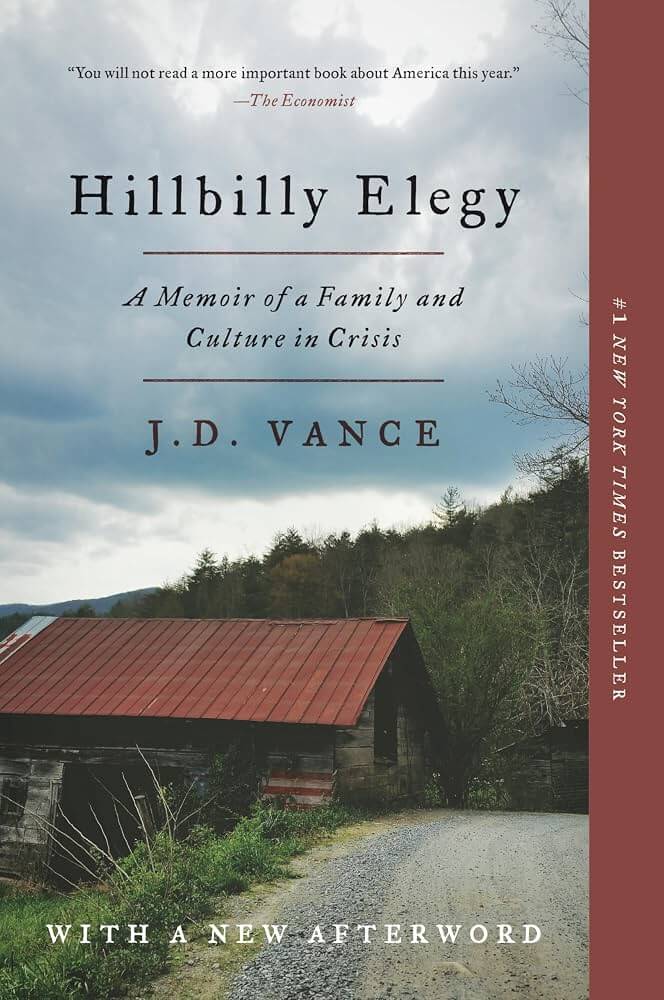
Hillbilly Elegy: A Memoir of a Family and Culture in Crisis by J. D. Vance
රු1,750.00
3 X Rs. 583.33 or 8% Cashback with


or 3 X රු583.33 with


or up to 4 X රු437.50 with


Hillbilly Elegy: A Memoir of a Family and Culture in Crisis by J. D. Vance is a bestselling memoir exploring family, poverty, class, education and social mobility.
Drawing on his family’s roots in Appalachian Kentucky and his childhood in Ohio, Vance reflects on:
- Family relationships
- Poverty and economic insecurity
- Addiction
- Education
- Social mobility
- Appalachian identity
- Rust Belt communities
- Personal responsibility
- Family trauma and resilience
This Harper Paperbacks edition includes a new afterword.
Paperback | 288 pages recommended | Harper Paperbacks | ISBN 9780062300553
14 in stock
Purchase & earn 18 points!
Categories: Biography & Autobiography, Memoir, Social Science
Hillbilly Elegy by J. D. Vance
Hillbilly Elegy: A Memoir of a Family and Culture in Crisis by J. D. Vance combines personal memoir with social commentary about family, poverty, class, addiction, education and upward mobility in the United States.
Vance recounts his childhood and family history through the experiences of relatives whose roots were in the Appalachian region of Kentucky and whose lives later became connected to the industrial communities of Ohio.
The publisher presents the book as both a family story and Vance’s personal interpretation of some of the economic and social struggles affecting parts of the American white working class.
Because the book moves between autobiography and broader social interpretation, it is best categorised as:
- Memoir
- Biography & Autobiography
- Social Science
- Sociology
- American Studies
- Family & Social Mobility
A Family Story
At the centre of Hillbilly Elegy is the Vance family.
Vance traces his family roots to Kentucky, where his grandparents grew up before moving to Ohio.
Like many families who moved from Appalachia to industrial areas in the twentieth century, they hoped that employment and greater economic opportunity would give the next generation more stability.
The memoir follows that family across generations.
It examines the gap between the hope of upward mobility and the instability that continued inside the household.
Vance writes about:
- Poverty
- Family conflict
- Economic insecurity
- Addiction
- Alcohol abuse
- Domestic instability
- Education
- Social expectations
- Family loyalty
- Personal responsibility
- Upward mobility
The result is both a coming-of-age memoir and an account of how family circumstances can shape a person’s expectations and opportunities.
Growing Up Between Kentucky and Ohio
The book is strongly connected to two geographical settings:
Appalachian Kentucky and the Rust Belt of Ohio.
Vance’s grandparents moved north from Kentucky, and much of his childhood was shaped by a family identity that remained closely connected to Appalachian traditions even after relocation.
This gives the memoir an intergenerational structure.
It is not only about one person’s childhood.
It also explores how attitudes, habits, economic conditions and family relationships can persist across generations.
Poverty and Economic Change
One of the major subjects in Hillbilly Elegy is economic insecurity.
Vance describes communities affected by changes in industrial employment and by limited opportunities for some families.
However, the book is not primarily an economic history.
It is a memoir.
Its discussion of poverty and working-class life comes largely through Vance’s own family experiences and his interpretation of the community around him.
That distinction is important for an accurate bookstore description.
The book should not be presented as representing every person from Appalachia, Ohio, Kentucky or the American working class.
It is one individual’s account combined with his broader observations.
Family Instability
Vance writes openly about a childhood affected by instability.
His memoir discusses difficult subjects including:
- Addiction
- Substance abuse
- Domestic conflict
- Emotional volatility
- Childhood instability
- Poverty
- Family trauma
At the same time, he writes about relatives who provided structure and support.
His grandmother, often referred to as Mamaw, is one of the most significant figures in the memoir.
Family relationships in Hillbilly Elegy are therefore complicated rather than simply positive or negative.
The same family can provide:
- Love
- Loyalty
- Protection
- Conflict
- Instability
- Pressure
- Support
This tension is one of the memoir’s central themes.
Education and Social Mobility
Education becomes an important part of Vance’s personal story.
The narrative follows his movement from an unstable childhood into adulthood, including military service, higher education and law school.
The book uses this personal trajectory to examine what upward mobility can feel like for someone moving between different social and economic environments.
The publisher describes the memoir as an exploration of the experience of moving from economic hardship toward a different social position while continuing to carry the effects of family history.
Personal Responsibility and Structural Forces
One of the book’s recurring tensions concerns the relationship between:
- Individual choices
- Family culture
- Economic conditions
- Education
- Social institutions
- Community expectations
Vance discusses both circumstances outside an individual’s control and the role he believes personal decisions can play in changing a person’s direction.
These are the author’s interpretations, not universally accepted conclusions about poverty or working-class communities.
For WooCommerce, the safest and most accurate wording is to describe the book as:
“J. D. Vance’s memoir and personal analysis of family, class, poverty and social mobility in Appalachian and Rust Belt communities.”
This keeps the listing factual without presenting the author’s broader social conclusions as settled sociological findings.
Memoir and Social Commentary
Hillbilly Elegy is unusual because it sits between several categories.
It can be read as:
A Memoir
Vance tells the story of his own childhood, family and education.
A Family History
The experiences of his grandparents, mother and extended family play major roles.
Social Commentary
Vance uses those experiences to discuss broader questions about class, economic decline and working-class communities.
A Story About Social Mobility
The memoir follows the transition between poverty and greater educational and professional opportunity.
This combination explains why the book is often stocked in both Biography & Memoir and Social Science / Sociology sections.
New Afterword
ISBN 9780062300553 is the paperback edition that includes a new afterword.
Library catalogues specifically identify it as the First Harper paperback edition and note “With a new afterword” on the cover.
The original hardcover was published separately in 2016.
Therefore, customers buying this ISBN should receive the later paperback edition rather than the original hardcover.
Page Count
An important metadata discrepancy exists for this ISBN.
Current HarperCollins-supplied commercial metadata lists:
288 pages.
Bookshop.org and several current booksellers also list:
288 pages.
However, library catalogues describe some copies of the same paperback ISBN as:
272 pages.
This likely reflects differences between printings, bibliographic counting methods or how supplementary material is included.
For a current WooCommerce product using ISBN 9780062300553, I recommend following the current HarperCollins trade feed:
288 pages
If your physical copy is already in stock, check the final numbered page before publishing.
About J. D. Vance
J. D. Vance is the author of Hillbilly Elegy.
The memoir describes his family background, childhood, military service, education and later experiences moving between different social and economic environments.
For this bookstore listing, it is most useful to focus on his role as author and memoirist, since the product itself is a personal memoir rather than a campaign or policy book.
Who May Be Interested in Hillbilly Elegy?
This book may appeal to readers interested in:
- Memoirs
- American social history
- Appalachia
- The Rust Belt
- Sociology
- Poverty and class
- Social mobility
- Family history
- Education
- Contemporary American society
It may also interest readers studying how personal narratives are used to discuss larger questions about culture and economic change.
Content Note
The memoir contains discussion of:
- Addiction and substance abuse
- Domestic conflict
- Childhood instability
- Poverty
- Family trauma
- Emotional and physical conflict
It is best marketed for an adult/general nonfiction audience.
Buy Hillbilly Elegy in Sri Lanka
For readers looking to buy Hillbilly Elegy by J. D. Vance in Sri Lanka, ISBN 9780062300553 identifies the Harper Paperbacks 2018 paperback edition with a new afterword.
Current HarperCollins trade data lists 288 pages, 8.32 oz weight and dimensions of 5.31 × 8 × 0.72 inches.
Converted for WooCommerce, that is approximately:
0.236 kg / 20.3 × 13.5 × 1.8 cm
Reviews
There are no reviews yet.