
No products in the cart.
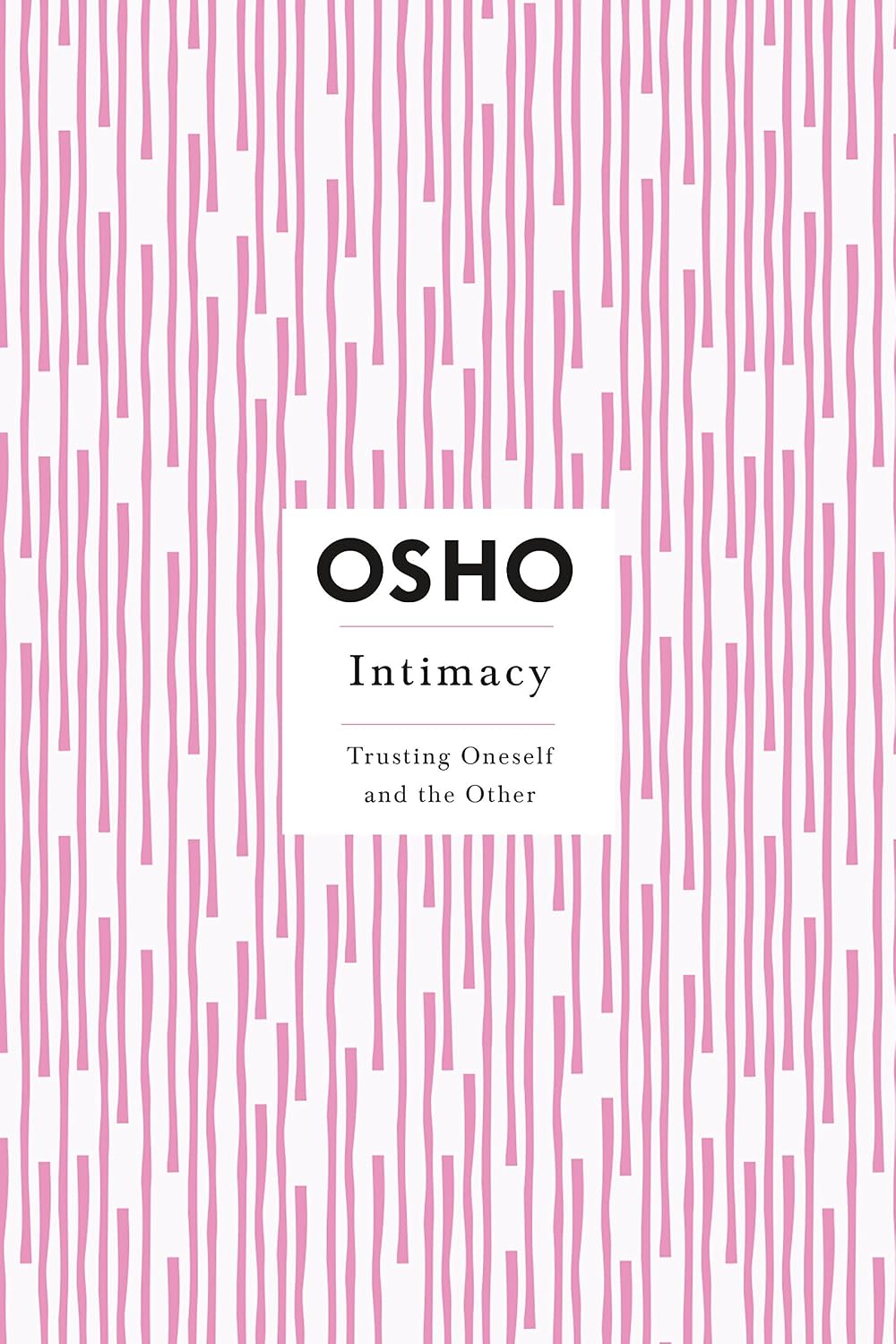
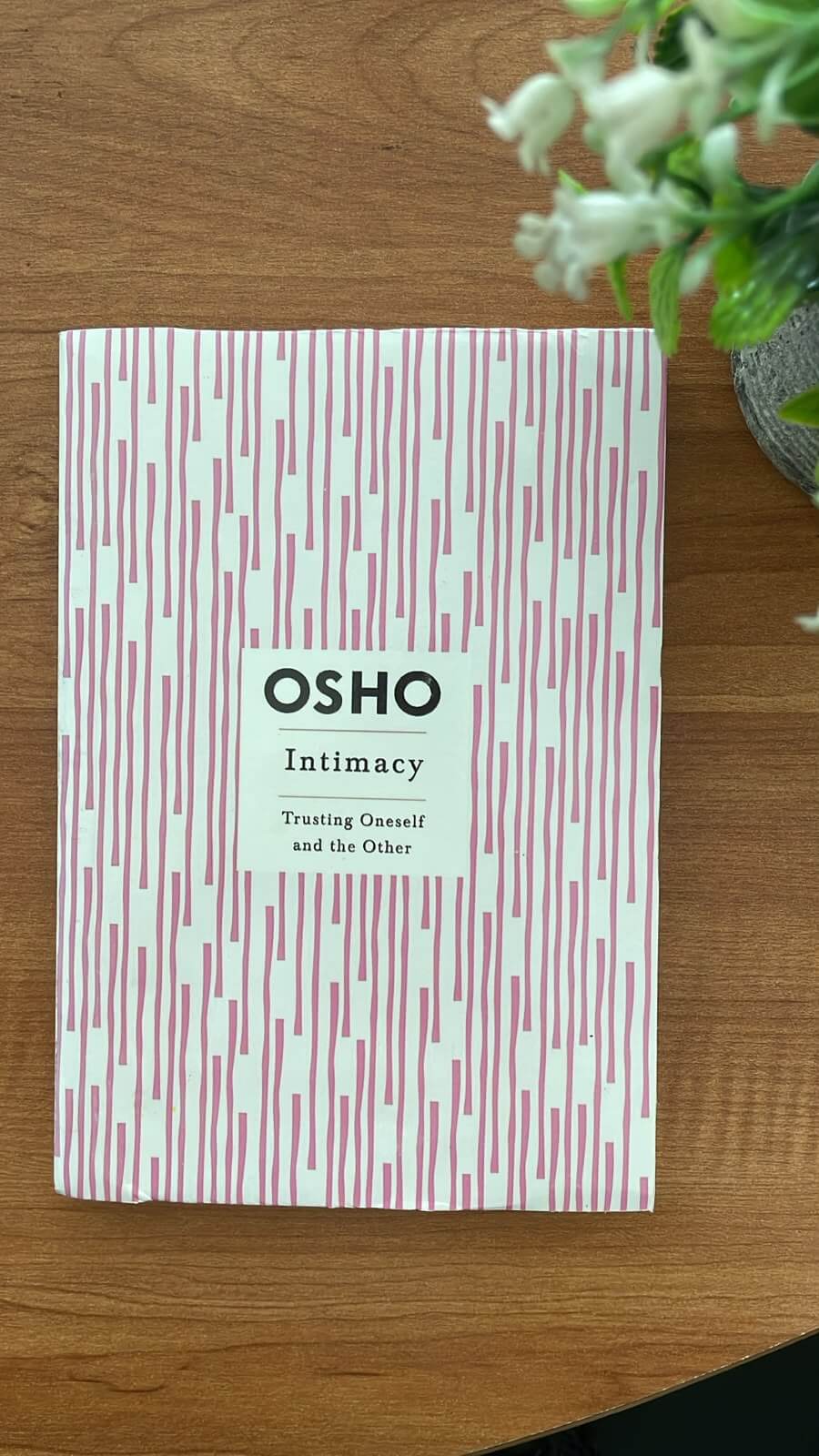








Intimacy (Osho Insights for a New Way of Living) by Osho


රු900.00
3 X Rs. 300.00 or 8% Cashback with


or 3 X රු300.00 with


or up to 4 X රු225.00 with


Book Details / WooCommerce
| Field | Enter This |
|---|---|
| Title | Intimacy |
| Subtitle | Trusting Oneself and the Other |
| Author | Osho |
| ISBN-13 | 9780312275662 |
| ISBN-10 | 0312275668 |
| Series | Osho Insights for a New Way of Living |
| Format | Trade Paperback |
| Publisher / Imprint | St. Martin’s Griffin |
| Publisher Group | St. Martin’s Publishing Group / Macmillan |
| Publication Date | 14 December 2001 |
| Pages | 192 |
| Language | English |
| Audience | Adult / General |
| Genre | Self-Help / Relationships / Spirituality / Personal Growth |
| Weight | 0.179 kg recommended |
| Length | 21.0 cm |
| Width | 14.0 cm |
| Height / Thickness | 1.5 cm |
| Dimensions | 21.0 × 14.0 × 1.5 cm |
1 in stock
Intimacy by Osho
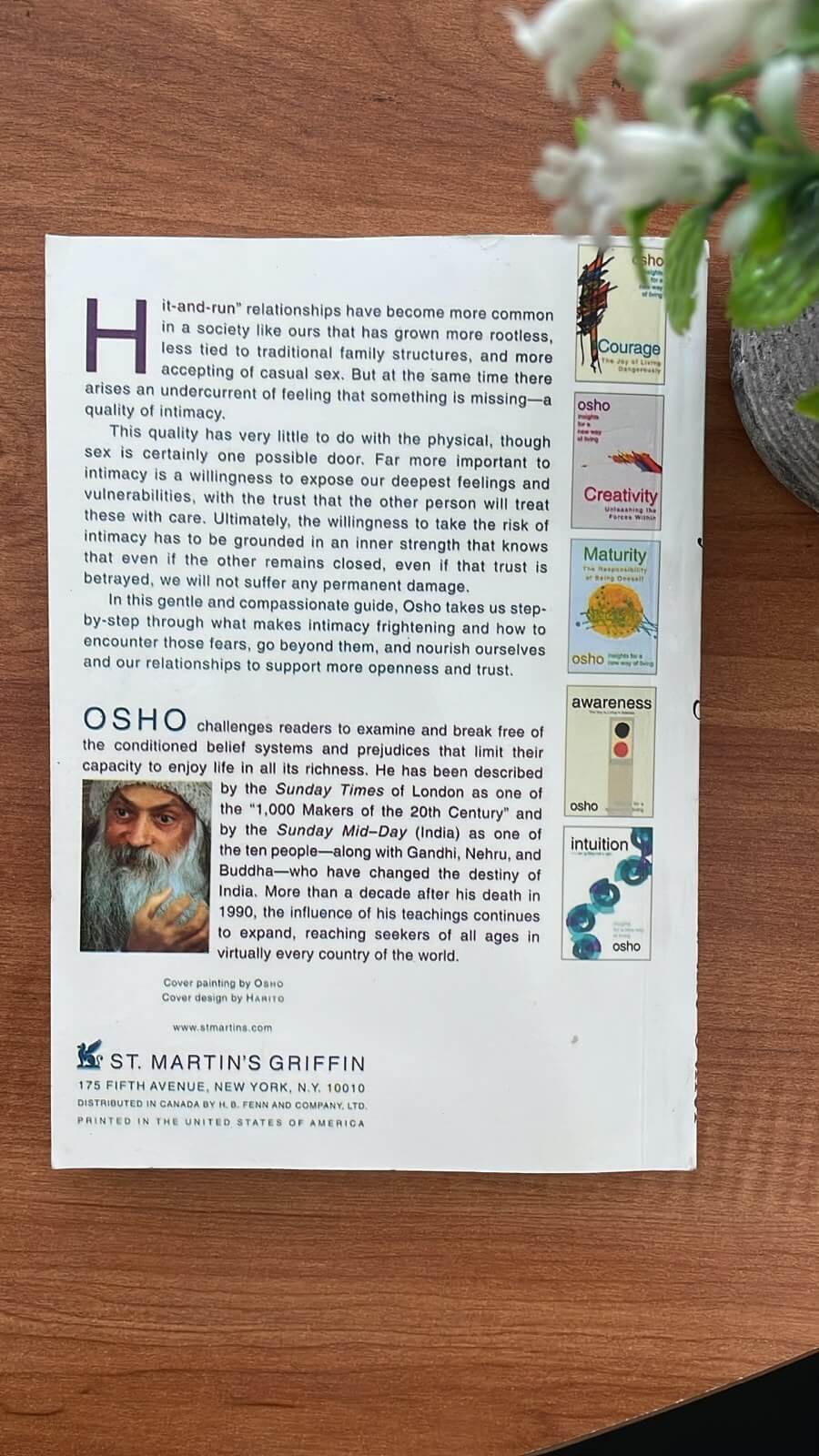
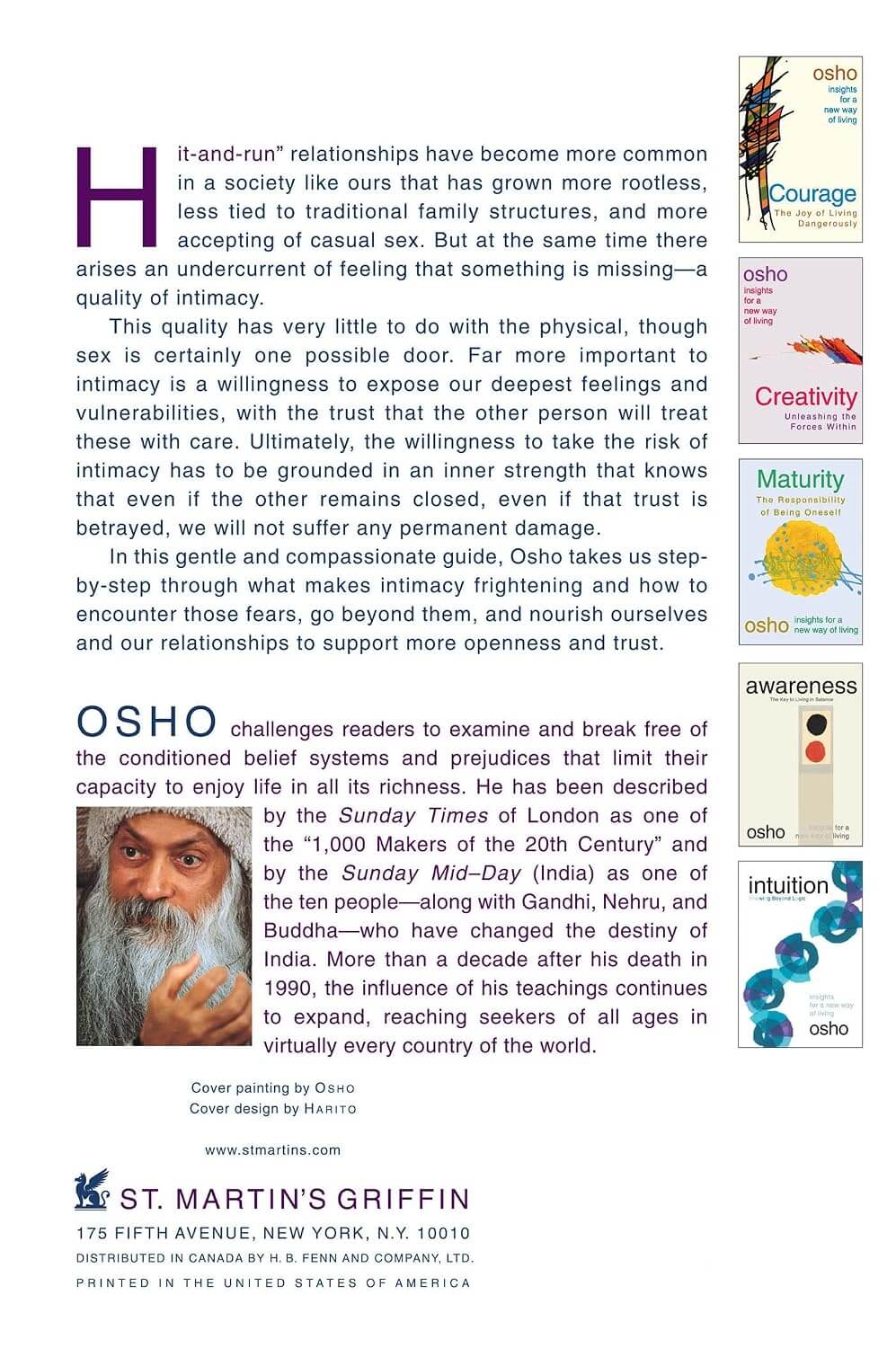
Intimacy: Trusting Oneself and the Other by Osho is a reflective guide to trust, vulnerability, relationships, emotional openness and the inner strength required to form deeper connections with other people.
Part of the Osho Insights for a New Way of Living series, the book explores why genuine intimacy can feel so difficult even when people strongly desire closeness.
Osho’s central argument is that intimacy involves much more than physical attraction or romantic relationships.
It requires the courage to allow another person to see aspects of ourselves that we normally protect.
Macmillan describes the book as a guide to understanding why people fear intimacy, how they can encounter those fears and how greater openness and trust can be cultivated in relationships.
What Is Intimacy?
People often associate intimacy primarily with romance or physical closeness.
Osho approaches the subject more broadly.
For him, intimacy involves allowing another person to encounter the real person beneath:
- Social roles
- Defences
- Expectations
- Carefully controlled appearances
- Fear of judgment
This means intimacy can exist in romantic relationships, friendships and other meaningful human connections.
The challenge is that genuine openness also creates vulnerability.
If another person knows what matters deeply to you, they also have the potential to hurt you.
That tension between the desire for closeness and the fear of being hurt forms one of the book’s central themes.
Why People Fear Intimacy
Many people want deeper relationships while simultaneously protecting themselves from them.
Past experiences can create emotional habits such as:
- Avoiding difficult conversations
- Hiding insecurity
- Controlling how others see us
- Withdrawing when relationships become serious
- Distrusting affection
- Expecting rejection
- Avoiding vulnerability
Osho asks readers to examine where these patterns come from.
Some are influenced by previous relationships.
Others may come from family expectations, cultural conditioning or fear of being judged.
Understanding these fears is presented as an important first step toward greater openness.
Trusting Yourself First
The subtitle is:
Trusting Oneself and the Other
That order matters.
Osho suggests that the foundation of intimacy is not simply finding a perfectly trustworthy person.
It begins with developing enough confidence in yourself that vulnerability no longer feels completely dangerous.
If your entire emotional security depends on another person never disappointing you, intimacy can become dominated by fear.
Inner strength creates another possibility.
You can care deeply about another person while also knowing that you can survive disappointment, disagreement or change.
Macmillan’s official description emphasises this idea: the courage required for intimacy must be grounded in inner strength rather than complete dependence on the other person’s behaviour.
Vulnerability and Openness
Real intimacy requires some degree of vulnerability.
That may mean admitting:
- Fear
- Uncertainty
- Desire
- Insecurity
- Mistakes
- Emotional needs
People often hide these things because they want to appear strong.
But constant self-protection can make deeper connection difficult.
Osho encourages readers to examine whether the effort to avoid emotional risk may also be preventing them from experiencing meaningful closeness.
The book does not suggest that every person should automatically be trusted.
Instead, it explores the internal courage required to be honest and present when a relationship is worthy of that openness.
Conditioning and Relationships
Another recurring theme in Osho’s work is conditioning.
People inherit ideas about:
- Love
- Marriage
- Sexuality
- Gender
- Commitment
- Family
- Success
- Respectability
These expectations can influence relationships without being consciously examined.
Osho challenges readers to question whether inherited beliefs actually support healthy connection or simply create fear and limitation.
Google Books describes the book as encouraging readers to break free from conditioned beliefs and prejudices that restrict their ability to experience life more fully.
Love Without Possession
Intimacy can become difficult when love is confused with control.
People may believe that loving someone gives them the right to:
- Control decisions
- Demand constant reassurance
- Restrict independence
- Expect complete emotional ownership
Osho’s broader philosophy of relationships places strong emphasis on maintaining individuality.
A healthy relationship, in this framework, allows closeness without eliminating personal freedom.
This creates a different understanding of intimacy:
being deeply connected without trying to possess the other person.
Being Comfortable with Yourself
The ability to be alone can strengthen the ability to be close to others.
This may sound contradictory.
But someone who is terrified of being alone may enter relationships mainly to escape loneliness.
That can create dependency rather than genuine intimacy.
Osho’s approach encourages readers to develop a relationship with themselves first.
When people become more comfortable with their own thoughts, emotions and individuality, relationships can become less about filling an internal emptiness and more about sharing life freely.
Honesty in Relationships
Intimacy also requires honesty.
This does not mean saying everything impulsively or without consideration.
It means reducing the distance between:
what we genuinely feel
and
what we allow another person to see.
A relationship built entirely around maintaining appearances may look stable while lacking emotional depth.
Osho encourages readers to consider how much of themselves they hide simply because they fear another person’s reaction.
Fear of Rejection
One reason people protect themselves is the fear of rejection.
If another person never sees the real you, then their rejection may feel less personal.
But that protection comes at a cost.
If people only see a carefully managed version of you, acceptance can also feel less meaningful.
The book explores the courage required to accept that authentic relationships always involve some emotional uncertainty.
There is no guarantee that openness will always be rewarded.
The goal is not to eliminate all risk.
It is to become strong enough to tolerate that risk.
Relationships as Opportunities for Growth
Osho presents relationships not simply as sources of comfort but also as opportunities for self-discovery.
Relationships can reveal:
- Jealousy
- Fear
- Attachment
- Expectations
- Insecurity
- Generosity
- Compassion
- Patience
When another person triggers a strong emotional response, the reaction may reveal something worth examining internally.
Seen this way, relationships become mirrors.
They show us parts of ourselves that might remain hidden when we are alone.
Intimacy Beyond Romance
Although romantic relationships are an important part of the discussion, the central ideas extend beyond romance.
Intimacy can exist between:
- Friends
- Family members
- Partners
- People sharing deeply meaningful conversations
The essential elements remain similar:
- Trust
- Honesty
- Presence
- Vulnerability
- Respect
- Acceptance
This broader understanding makes the book relevant even for readers who are not currently in romantic relationships.
A Spiritual Approach to Relationships
Intimacy is not a conventional psychology textbook.
It reflects Osho’s spiritual and philosophical approach to personal development.
The book draws from talks and teachings rather than from a clinical therapeutic programme.
Macmillan categorises the book within self-help, while bibliographic records also place it within spirituality and personal growth.
Readers should therefore approach it as:
spiritual and philosophical relationship guidance
rather than professional counselling or psychological treatment.
About Osho
Osho was an Indian spiritual teacher whose talks explored meditation, awareness, relationships, freedom, consciousness and personal transformation.
His teachings have been published in numerous books, including:
- Love, Freedom, Aloneness
- The Book of Secrets
- Courage
- Maturity
- Awareness
- Intimacy
Macmillan identifies Intimacy as part of the Osho Insights for a New Way of Living collection.
Who Will Enjoy Intimacy?
This book may especially appeal to readers interested in:
- Relationships
- Emotional intimacy
- Trust
- Vulnerability
- Self-awareness
- Personal growth
- Spirituality
- Love
- Emotional freedom
- Osho’s teachings
It can be particularly interesting for readers who want to examine why they sometimes desire closeness while simultaneously protecting themselves from it.
Be the first to review “Intimacy (Osho Insights for a New Way of Living) by Osho”
Related products
Out of stock
Autobiography
රු2,750.00
3 X Rs. 916.67 or 8% Cashback with
or 3 X රු916.67 with
or up to 4 X රු687.50 with
-13%

Out of stock
Non-Fiction & Knowledge
Original price was: රු3,900.00.රු3,400.00Current price is: රු3,400.00.
3 X Rs. 1,133.33 or 8% Cashback with
or 3 X රු1,133.33 with
or up to 4 X රු850.00 with

Non-Fiction & Knowledge
රු1,950.00
3 X Rs. 650.00 or 8% Cashback with
or 3 X රු650.00 with
or up to 4 X රු487.50 with
-19%

Out of stock
Non-Fiction & Knowledge
Original price was: රු2,650.00.රු2,150.00Current price is: රු2,150.00.
3 X Rs. 716.67 or 8% Cashback with
or 3 X රු716.67 with
or up to 4 X රු537.50 with
-23%

Non-Fiction & Knowledge
Original price was: රු2,200.00.රු1,700.00Current price is: රු1,700.00.
3 X Rs. 566.67 or 8% Cashback with
or 3 X රු566.67 with
or up to 4 X රු425.00 with
-24%
Out of stock
Non-Fiction & Knowledge
Original price was: රු2,100.00.රු1,600.00Current price is: රු1,600.00.
3 X Rs. 533.33 or 8% Cashback with
or 3 X රු533.33 with
or up to 4 X රු400.00 with

Non-Fiction & Knowledge
රු1,550.00
3 X Rs. 516.67 or 8% Cashback with
or 3 X රු516.67 with
or up to 4 X රු387.50 with

Out of stock
Self-Help & Psychology
රු2,200.00
3 X Rs. 733.33 or 8% Cashback with
or 3 X රු733.33 with
or up to 4 X රු550.00 with
Reviews
There are no reviews yet.