
No products in the cart.
-8%
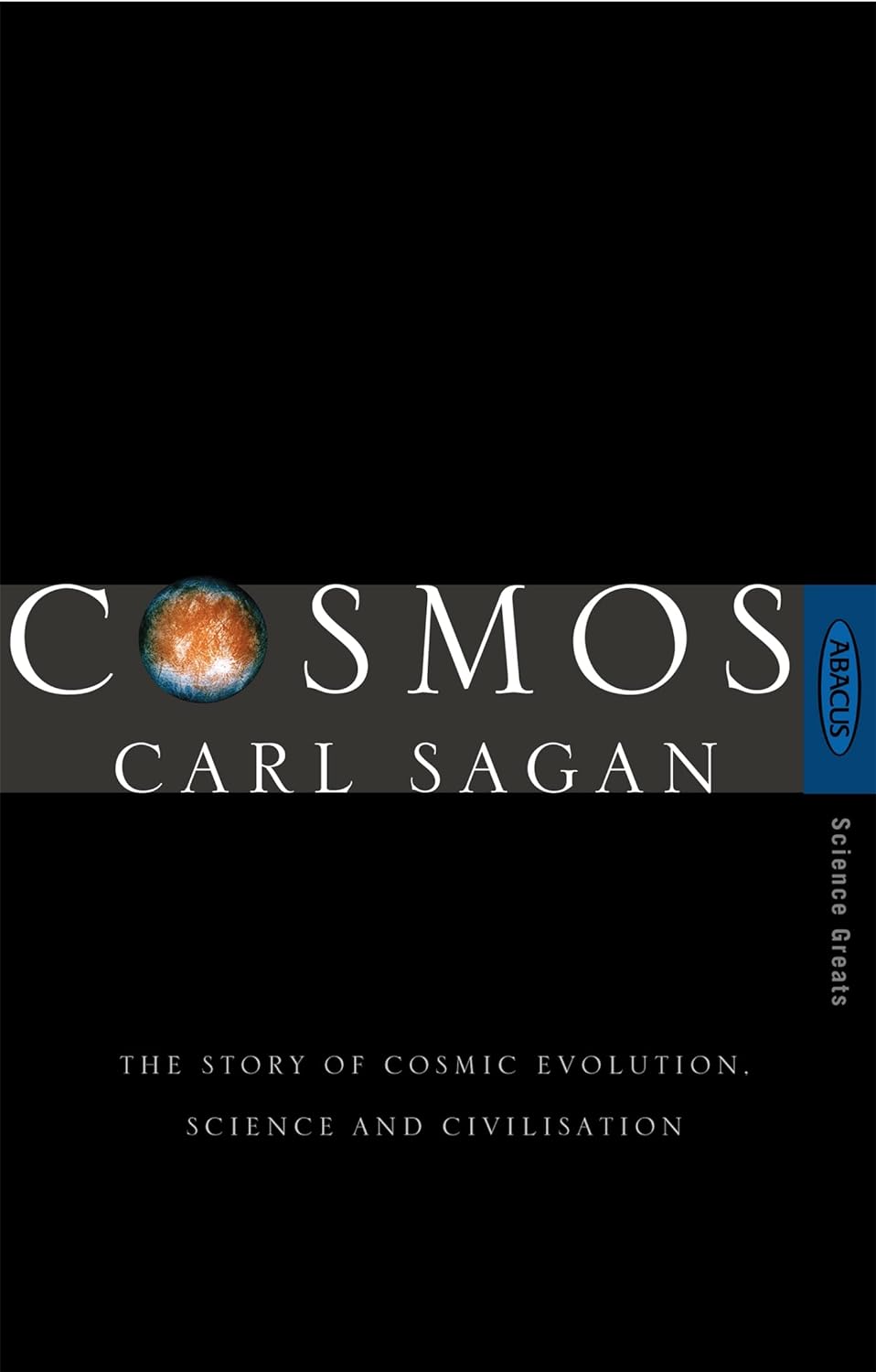
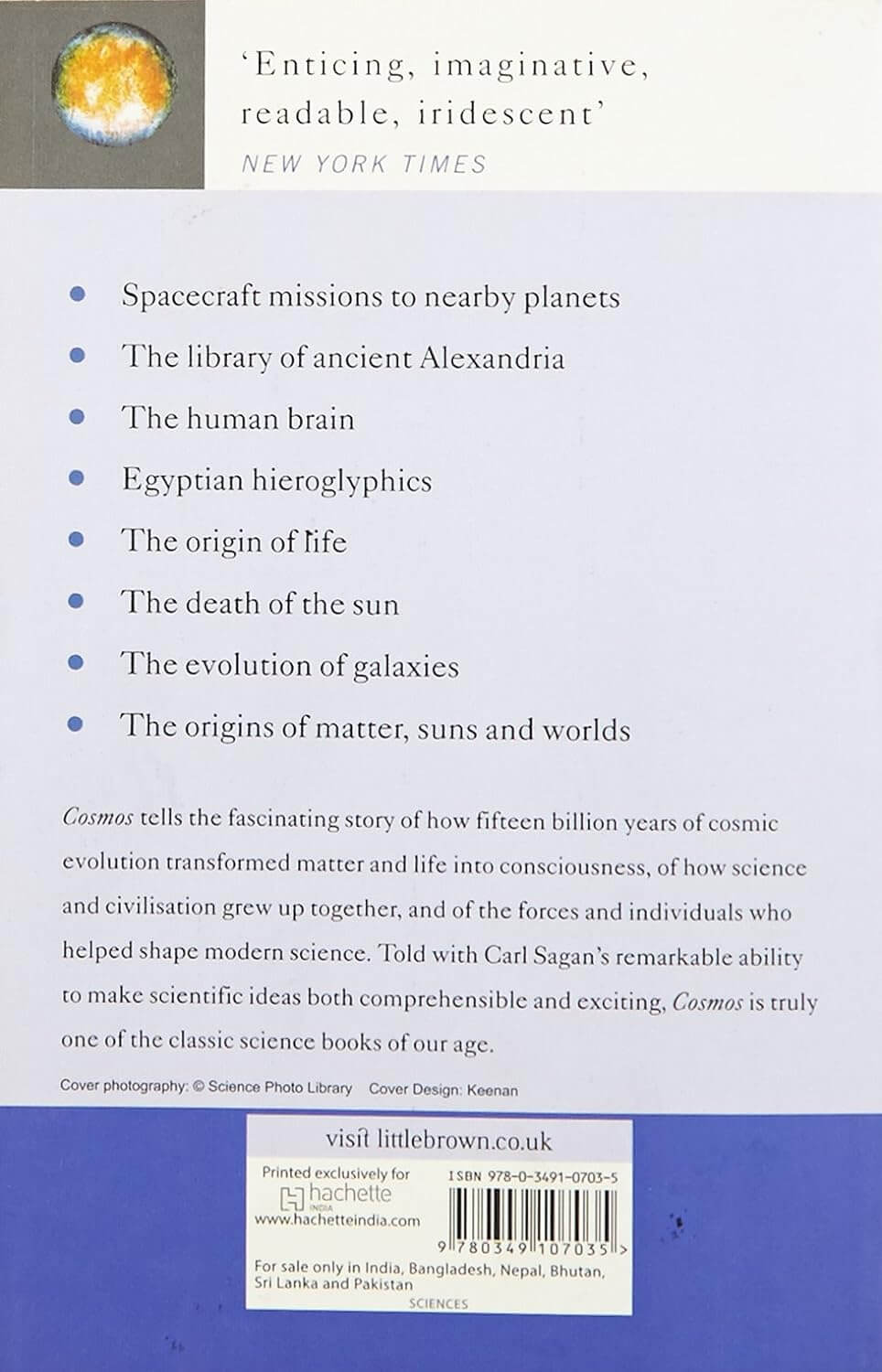
Cosmos by Carl Sagan


Original price was: රු2,390.00.රු2,200.00Current price is: රු2,200.00.
3 X Rs. 733.33 or 8% Cashback with


or 3 X රු733.33 with


or up to 4 X රු550.00 with


Dive into the wonders of the universe with ‘Cosmos’ by Carl Sagan. This timeless classic explores the mysteries of space, science, and humanity’s place in the cosmos. Perfect for fans of astronomy, scientific exploration, and philosophical inquiry.
Out of stock
Email when stock available
Cosmos by Carl Sagan is a fascinating journey through the universe, science, astronomy and the history of human discovery.
Written by renowned astronomer and science communicator Carl Sagan, the book explores some of humanity’s biggest questions about space, life, planets, stars and our place in the universe.
Cosmos by Carl Sagan makes complex scientific ideas accessible to general readers through clear explanations, historical stories and thought-provoking reflections.
It is an excellent choice for readers interested in astronomy, space exploration, physics, science history and the mysteries of the universe.
Why Read Cosmos by Carl Sagan?
Cosmos by Carl Sagan invites readers to look beyond everyday life and consider the enormous universe surrounding our planet.
The book explores how humanity gradually developed an understanding of Earth, the planets, stars and galaxies.
Sagan also examines the development of scientific thinking and the individuals whose discoveries changed our understanding of nature.
Rather than presenting science as a collection of facts, the book presents it as a continuing journey of discovery.
13 Chapters Exploring the Cosmos
Cosmos by Carl Sagan contains 13 illustrated chapters that correspond to the episodes of the original Cosmos television series.
Across these chapters, Sagan explores astronomy, biology, history, planetary science and human civilization.
The scope of the book is enormous.
Readers travel from the smallest elements of life to stars, galaxies and the vast structure of the universe.
Explore the Scale of the Universe
One of the most fascinating themes in Cosmos by Carl Sagan is the extraordinary scale of space.
Earth may feel enormous from a human perspective.
However, on a cosmic scale, our planet is only a tiny part of a much larger universe.
Sagan introduces readers to stars, planets and galaxies while helping them understand the distances involved in astronomy.
This broader perspective encourages readers to reconsider humanity’s position in the universe.
The Story of Scientific Discovery
Science did not develop overnight.
Human understanding of nature gradually expanded as generations of thinkers questioned existing beliefs and searched for better explanations.
Cosmos by Carl Sagan explores this development by connecting scientific discoveries with the history of civilization.
Readers encounter ideas about astronomy, mathematics and scientific reasoning.
The book demonstrates how curiosity and evidence can transform our understanding of the world.
Planets, Stars and Galaxies
Astronomy is at the heart of Cosmos by Carl Sagan.
Readers are introduced to the incredible variety of objects found throughout space.
Planets orbit stars.
Stars gather into enormous galaxies.
Galaxies themselves exist across distances that are difficult to imagine.
Sagan helps readers understand these ideas without requiring advanced scientific knowledge.
This accessibility is one reason the book has become such a well-known work of popular science.
The Possibility of Life Beyond Earth
Are humans alone in the universe?
This question appears naturally when considering the enormous number of stars and planetary systems throughout space.
Cosmos by Carl Sagan explores the possibility of life beyond Earth while distinguishing scientific investigation from unsupported claims.
Sagan encourages curiosity about extraterrestrial life while maintaining the importance of evidence.
This combination of imagination and scientific thinking makes the discussion especially engaging.
Life on Earth
The book does not focus only on distant stars.
Cosmos by Carl Sagan also examines life on our own planet.
Sagan discusses biological development and the relationship between life and the wider universe.
The book considers concepts involving cells, DNA and evolution as part of the larger story of nature.
This helps readers see biology and astronomy not as completely separate subjects but as connected parts of the same cosmic history.
Humanity and the Cosmos
A major strength of Cosmos by Carl Sagan is the way it connects science with human civilization.
Our understanding of the universe has changed dramatically over time.
Ancient societies looked toward the sky and developed explanations for the movements they observed.
Later discoveries gradually transformed those explanations into modern astronomy.
Sagan shows how each generation builds upon the discoveries of those who came before.
Space Exploration
Human beings have always been curious about what exists beyond familiar boundaries.
Modern space exploration turned some of that curiosity into scientific investigation.
Cosmos by Carl Sagan discusses both human and robotic exploration of space.
Spacecraft allow scientists to examine environments that humans cannot easily visit.
These missions can provide information about planets, moons and other parts of our solar system.
Science and Critical Thinking
Cosmos by Carl Sagan also demonstrates the importance of scientific thinking.
Scientific knowledge develops through observation, evidence, experimentation and the willingness to question existing explanations.
This approach requires curiosity.
It also requires accepting that an idea may need to change when better evidence becomes available.
Sagan presents science as a method for understanding reality rather than simply memorising information.
A Book About Wonder and Discovery
Although Cosmos by Carl Sagan contains scientific ideas, its appeal goes beyond traditional science textbooks.
The book captures the sense of wonder that comes from understanding the universe.
Learning how stars form, how planets move and how life developed can change the way readers view ordinary existence.
The universe becomes not only something distant to study but something humanity is physically connected to.
What You Can Learn From Cosmos by Carl Sagan
Readers can explore topics including:
- Astronomy and cosmology
- Stars and galaxies
- Planets and planetary systems
- Space exploration
- Scientific discovery
- The history of astronomy
- Human civilization
- Evolution and biology
- DNA and life
- The possibility of extraterrestrial life
- Scientific reasoning
- Humanity’s place in the universe
- The scale and age of the cosmos
Who Should Read Cosmos by Carl Sagan?
Cosmos by Carl Sagan is suitable for readers interested in science, astronomy and space.
Students can use the book to develop a broader interest in scientific ideas.
Readers who normally avoid technical science books may appreciate Sagan’s accessible approach.
It is also an excellent choice for people fascinated by planets, stars, galaxies or questions about life beyond Earth.
Fans of science documentaries and space exploration may particularly enjoy the way Sagan combines scientific information with storytelling.
A Classic Popular Science Book
Cosmos by Carl Sagan has become one of Sagan’s best-known works and an influential example of popular science writing.
Its broad scope allows readers to explore everything from human history and biology to astronomy and the structure of the universe.
The book demonstrates that understanding science can also inspire curiosity, humility and wonder.
For anyone who has ever looked at the night sky and wondered what exists beyond Earth, Cosmos by Carl Sagan offers a fascinating journey through science and the universe.
Learn more about Cosmos by Carl Sagan, a landmark exploration of the universe, cosmic evolution, science, and humanity’s place in space, on the official Penguin Random House website.
| Author | Carl Sagan |
|---|---|
| Type | Paperback Printed Book |
| ISBN/ISSN | 0349107033 |
| Language | English |
| Pages | 416 |
Be the first to review “Cosmos by Carl Sagan”
Related products
-19%

Out of stock
Biography
Original price was: රු2,400.00.රු1,950.00Current price is: රු1,950.00.
3 X Rs. 650.00 or 8% Cashback with
or 3 X රු650.00 with
or up to 4 X රු487.50 with
Out of stock
Non-Fiction & Knowledge
රු1,600.00
3 X Rs. 533.33 or 8% Cashback with
or 3 X රු533.33 with
or up to 4 X රු400.00 with

Non-Fiction & Knowledge
රු1,950.00
3 X Rs. 650.00 or 8% Cashback with
or 3 X රු650.00 with
or up to 4 X රු487.50 with
-24%

Out of stock
Non-Fiction & Knowledge
Original price was: රු2,500.00.රු1,900.00Current price is: රු1,900.00.
3 X Rs. 633.33 or 8% Cashback with
or 3 X රු633.33 with
or up to 4 X රු475.00 with

Non-Fiction & Knowledge
රු2,250.00
3 X Rs. 750.00 or 8% Cashback with
or 3 X රු750.00 with
or up to 4 X රු562.50 with
-34%

Non-Fiction & Knowledge
Original price was: රු2,250.00.රු1,490.00Current price is: රු1,490.00.
3 X Rs. 496.67 or 8% Cashback with
or 3 X රු496.67 with
or up to 4 X රු372.50 with
-13%

Out of stock
Non-Fiction & Knowledge
Original price was: රු3,900.00.රු3,400.00Current price is: රු3,400.00.
3 X Rs. 1,133.33 or 8% Cashback with
or 3 X රු1,133.33 with
or up to 4 X රු850.00 with
-24%
Out of stock
Non-Fiction & Knowledge
Original price was: රු2,100.00.රු1,600.00Current price is: රු1,600.00.
3 X Rs. 533.33 or 8% Cashback with
or 3 X රු533.33 with
or up to 4 X රු400.00 with
Reviews
There are no reviews yet.