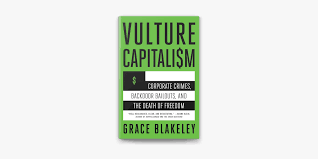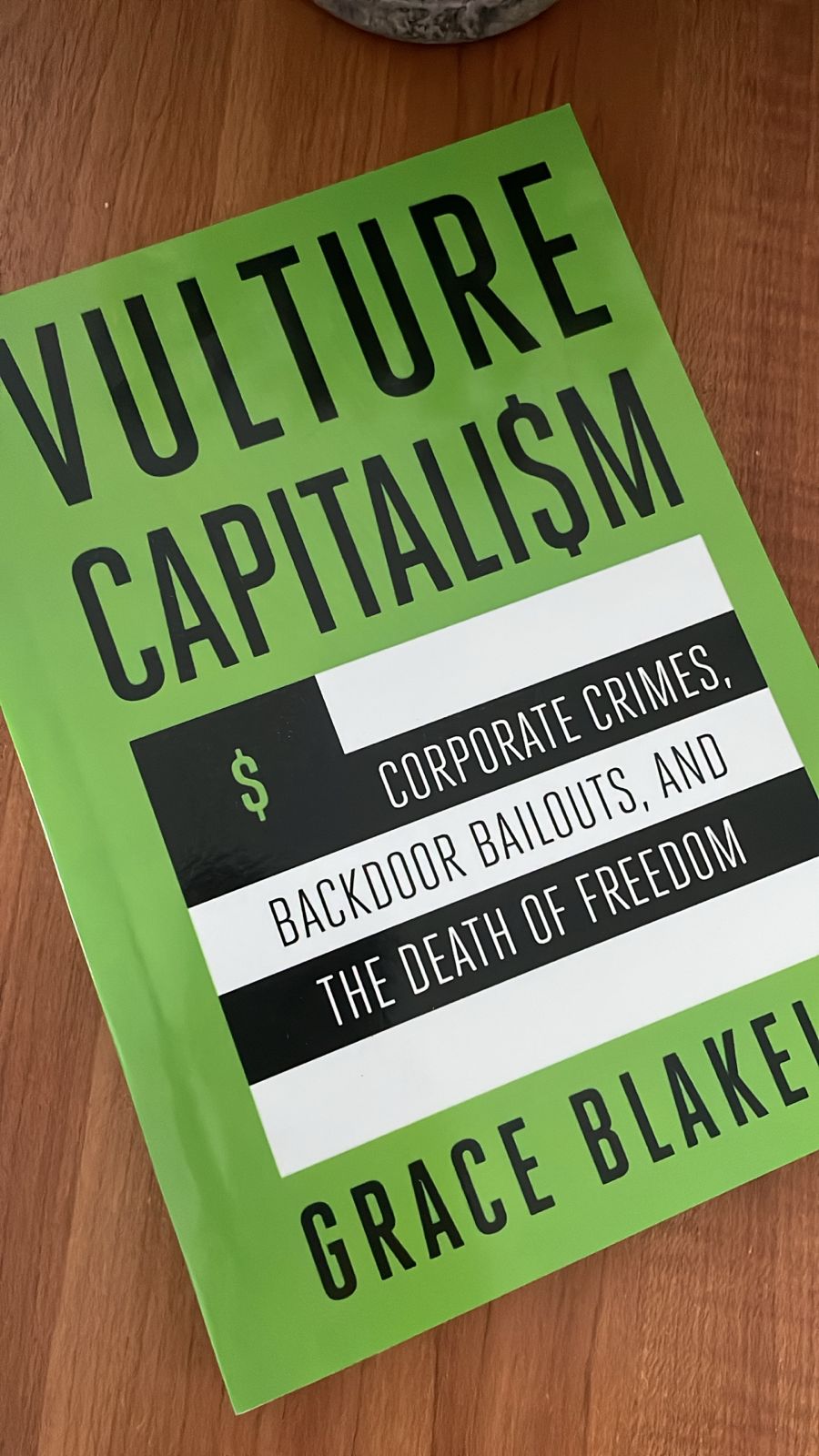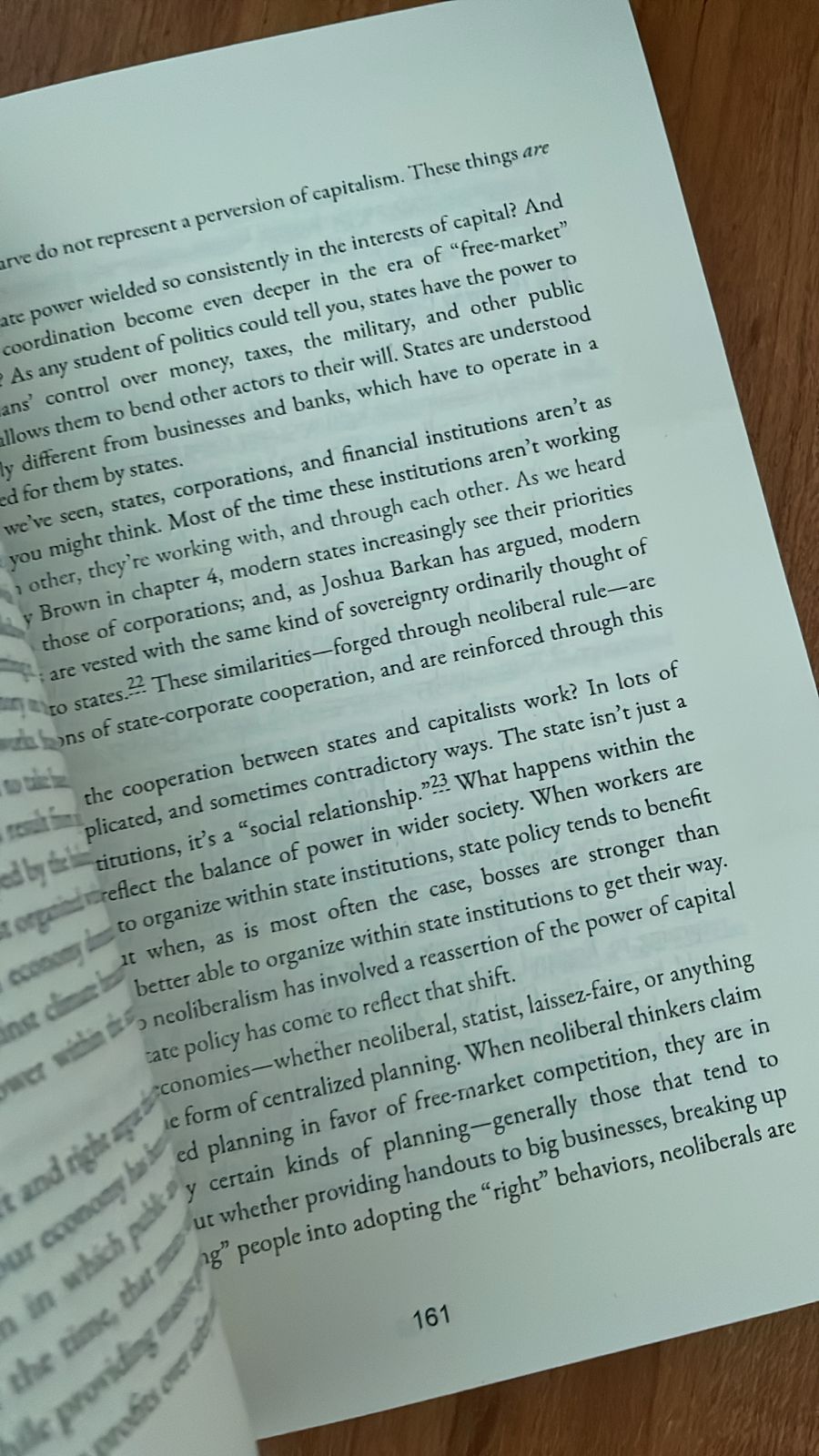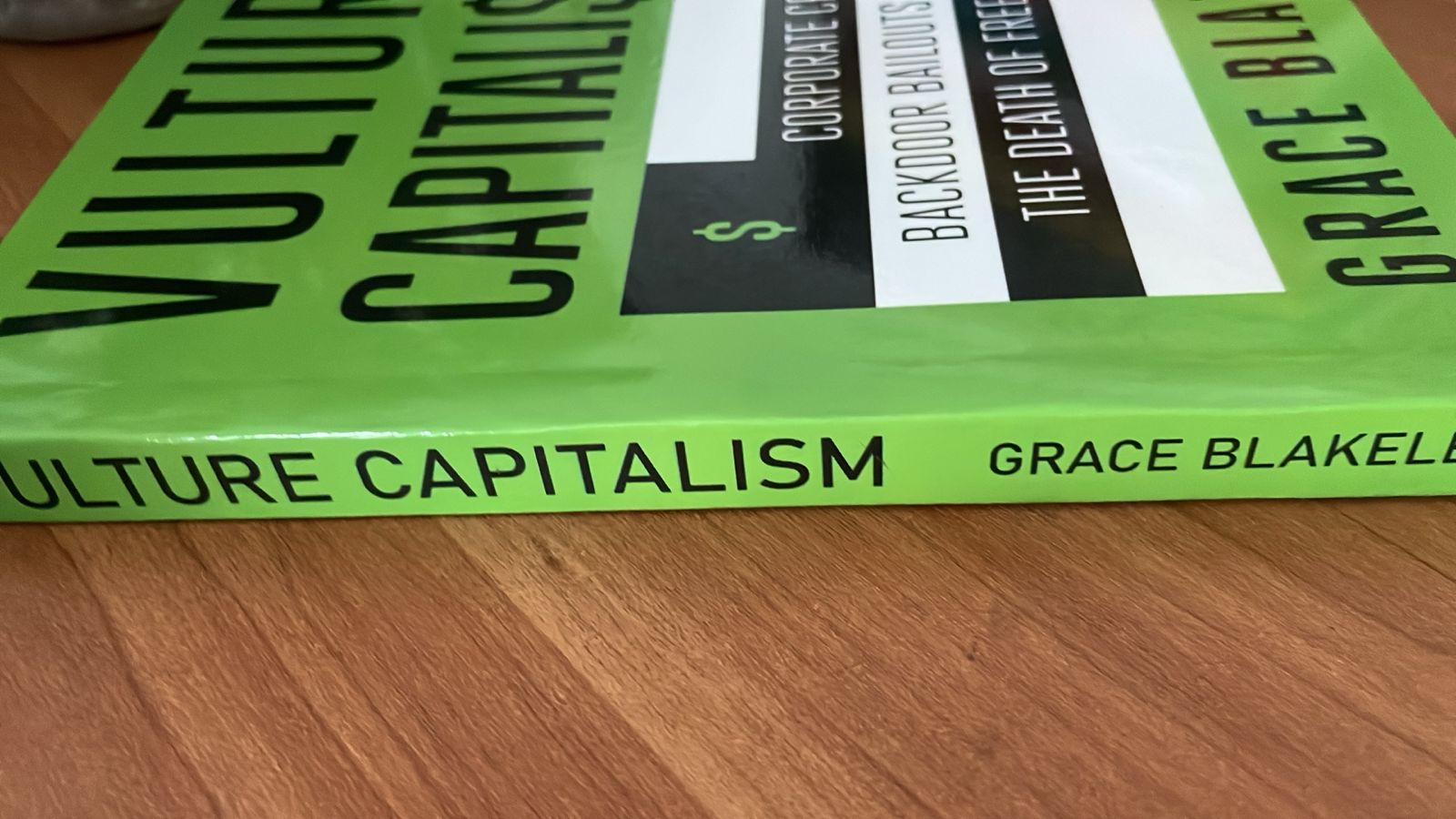
Vulture Capitalism by Grace Blakeley
Vulture Capitalism by Grace Blakeley is a provocative economics and politics book about corporate power, market concentration, government intervention, financial crises, inequality, and the way large institutions influence modern economic life.
Blakeley challenges the common idea that capitalism operates mainly through free, competitive markets.
Instead, she argues that major corporations and governments frequently rely on planning, coordination, subsidies, bailouts, lobbying, and concentrated decision-making.
The book combines economic history, political argument, company case studies, and examples from financial crises.
It is written from Blakeley’s openly left-wing and anti-capitalist perspective, so readers should understand it as an argument rather than a neutral textbook.
About Vulture Capitalism
Vulture Capitalism examines how power operates inside large companies, financial institutions, and governments.
Blakeley argues that modern capitalism is often presented as a system driven by free markets and individual choice.
Her central claim is different.
She argues that many important economic decisions are already planned.
Large corporations plan production.
Banks decide where capital flows.
Governments intervene during crises.
Investors influence corporate strategy.
Lobbyists influence public policy.
From this perspective, the real debate is not simply whether planning exists.
It is about who controls the planning.
7 Key Ideas in Vulture Capitalism
1. Markets Are Not Always as Free as They Appear
One of Blakeley’s main arguments is that large companies do not operate like small firms in perfectly competitive markets.
Major corporations can influence prices, wages, supply chains, investment, and regulation.
They may also have enough market power to make competition less effective.
The book uses examples from banking, technology, manufacturing, and other industries to support this argument.
2. Large Corporations Plan Internally
Vulture Capitalism emphasizes that big companies rely heavily on planning.
They forecast demand.
Allocate capital.
Coordinate supply chains.
Set production targets.
Choose investment priorities.
Control budgets.
In other words, large corporations already operate through extensive internal planning.
Blakeley uses this to challenge the idea that planning and markets are simple opposites.
3. Governments Often Support Private Markets
The book discusses government support for businesses during crises.
This can include bailouts.
Emergency lending.
Subsidies.
Tax incentives.
Public guarantees.
Infrastructure spending.
Blakeley argues that state intervention is not an exception to capitalism but a recurring feature of modern economic systems.
Readers may interpret these interventions differently depending on their economic viewpoint.
Some economists see them as necessary responses to market failure or systemic risk, while critics may see them as evidence of corporate influence over public policy.
4. Financial Power Matters
Banks, asset managers, private equity firms, and major investors can influence the economy.
They decide which companies receive capital.
They can influence corporate restructuring.
They may pressure companies to prioritize particular financial goals.
Blakeley argues that financial institutions therefore exercise substantial economic power even when they are not directly producing goods or services.
5. Corporate Power Can Affect Democracy
Another theme in Vulture Capitalism is the relationship between economic and political power.
Large companies can spend money on lobbying.
They can influence regulation.
They may fund political advocacy.
They can also threaten to move investment elsewhere.
Blakeley argues that these capabilities can give wealthy firms and investors influence beyond ordinary market transactions.
This is a politically contested interpretation, and readers may find useful comparisons with other economic perspectives on lobbying, regulation, and corporate governance.
6. Crises Reveal Hidden Structures
Financial crises often expose relationships that are harder to see during stable periods.
The book discusses bailouts and emergency interventions.
When governments step in to stabilize banks, corporations, or markets, Blakeley argues that this reveals how dependent private economic activity can be on public institutions.
Supporters of such interventions often argue that they prevent wider economic collapse.
Blakeley focuses more heavily on who benefits, who bears the costs, and what those interventions reveal about economic power.
7. Democratic Planning Is Blakeley’s Alternative
The book does not only criticize existing institutions.
Blakeley proposes forms of democratic economic planning.
She discusses worker participation.
Public ownership.
Cooperatives.
Participatory budgeting.
Community decision-making.
And other ways economic choices might be made more democratically.
These proposals reflect Blakeley’s political and economic perspective rather than a universally accepted policy consensus.
Corporate Power
Corporate power is one of the biggest themes in Vulture Capitalism.
A company with millions of customers and enormous financial resources can have influence beyond ordinary business activity.
It can shape employment.
Investment.
Technology.
Housing.
Transportation.
Media.
The book asks whether companies this large should be understood only as private businesses or also as institutions with significant social power.
Planning Inside Capitalism
Blakeley argues that planning already exists throughout capitalism.
A large corporation does not ask the market to make every internal decision.
Managers decide budgets.
Executives decide priorities.
Boards approve investments.
Supply chains are coordinated months or years in advance.
This leads to one of the book’s central questions.
If planning already exists, who should control it?
JPMorgan and Finance
The book discusses major financial institutions such as JPMorgan.
Blakeley uses banking as an example of concentrated financial power.
Large banks can influence investment, credit, and risk throughout the economy.
They may also become deeply connected to government policy during crises.
The book interprets these relationships as evidence that finance and the state are often closely intertwined.
Boeing and Corporate Governance
Boeing appears as another example.
Blakeley discusses corporate decision-making, management incentives, and the consequences of prioritizing financial performance.
Her broader argument is that corporate structures can shape behavior in ways that affect employees, customers, and the public.
Readers interested in these examples may also want to compare Blakeley’s interpretation with independent reporting and corporate histories.
Henry Ford and Industrial Planning
The book looks back to earlier industrial capitalism as well.
Large manufacturers developed sophisticated planning systems long before today’s technology companies existed.
Factories required coordination.
Supply chains required control.
Workers had to be organized.
Production targets had to be set.
Blakeley uses such examples to argue that planning has always been central to large-scale capitalist production.
Bailouts and Public Risk
Bailouts create difficult economic and political questions.
If a large company or financial institution is considered too important to fail, governments may intervene.
Supporters may argue that intervention protects jobs, savings, credit systems, or the wider economy.
Critics may argue that private actors keep profits while the public absorbs losses.
Vulture Capitalism strongly emphasizes the second concern.
Monopoly and Market Concentration
The book also discusses monopoly and market concentration.
When a small number of firms dominate an industry, competition may become weaker.
This can affect prices.
Wages.
Innovation.
Supplier relationships.
Political influence.
Economists disagree about how severe these effects are across different industries, but market concentration remains an important subject in contemporary economic policy.
Workers and Decision-Making
Blakeley argues that employees often have limited influence over major corporate decisions even though those decisions affect their livelihoods.
She proposes greater worker participation in governance and economic planning.
Supporters of these ideas argue that they could make workplaces more democratic.
Critics may argue that such systems could reduce managerial flexibility or efficiency.
The book clearly favors expanded worker influence.
Participatory Budgeting
Participatory budgeting is one alternative Blakeley discusses.
This approach allows members of a community to participate directly in decisions about how public funds are spent.
The model has been used in various cities around the world.
Blakeley sees it as one example of how economic decision-making could become more democratic.
Cooperatives
Worker and consumer cooperatives are another model discussed in the book.
These organizations are owned or governed differently from conventional corporations.
Supporters argue that cooperatives distribute power more broadly.
Critics may question whether they can scale effectively in every industry.
Blakeley presents them as part of a broader alternative to concentrated private control.
The Role of the State
One of the book’s most important themes is that governments already play a major economic role.
They set rules.
Create money.
Provide infrastructure.
Support industries.
Fund research.
Respond to crises.
The question, in Blakeley’s framing, is therefore not whether governments should influence the economy.
It is whose interests that influence serves.
Freedom and Economic Power
The U.S. subtitle refers to “the death of freedom.”
Blakeley uses freedom in an economic and political sense.
She argues that people may have formal political rights while still having limited control over major economic decisions that affect their lives.
This is a normative political argument.
Readers may disagree about how much economic power should be redistributed or how freedom should be defined.
Who Should Read This Book?
Vulture Capitalism is suitable for readers interested in economics, political economy, corporate power, financial crises, inequality, labor, regulation, and alternative economic systems.
It may especially appeal to readers who want a critique of contemporary capitalism from a left-wing perspective.
Readers looking for a balanced introduction to economics may want to pair it with books representing liberal, conservative, market-oriented, institutional, or other competing viewpoints.
That comparison can make the policy debates easier to understand.
About Grace Blakeley
Grace Blakeley is a British author, journalist, and political-economic commentator.
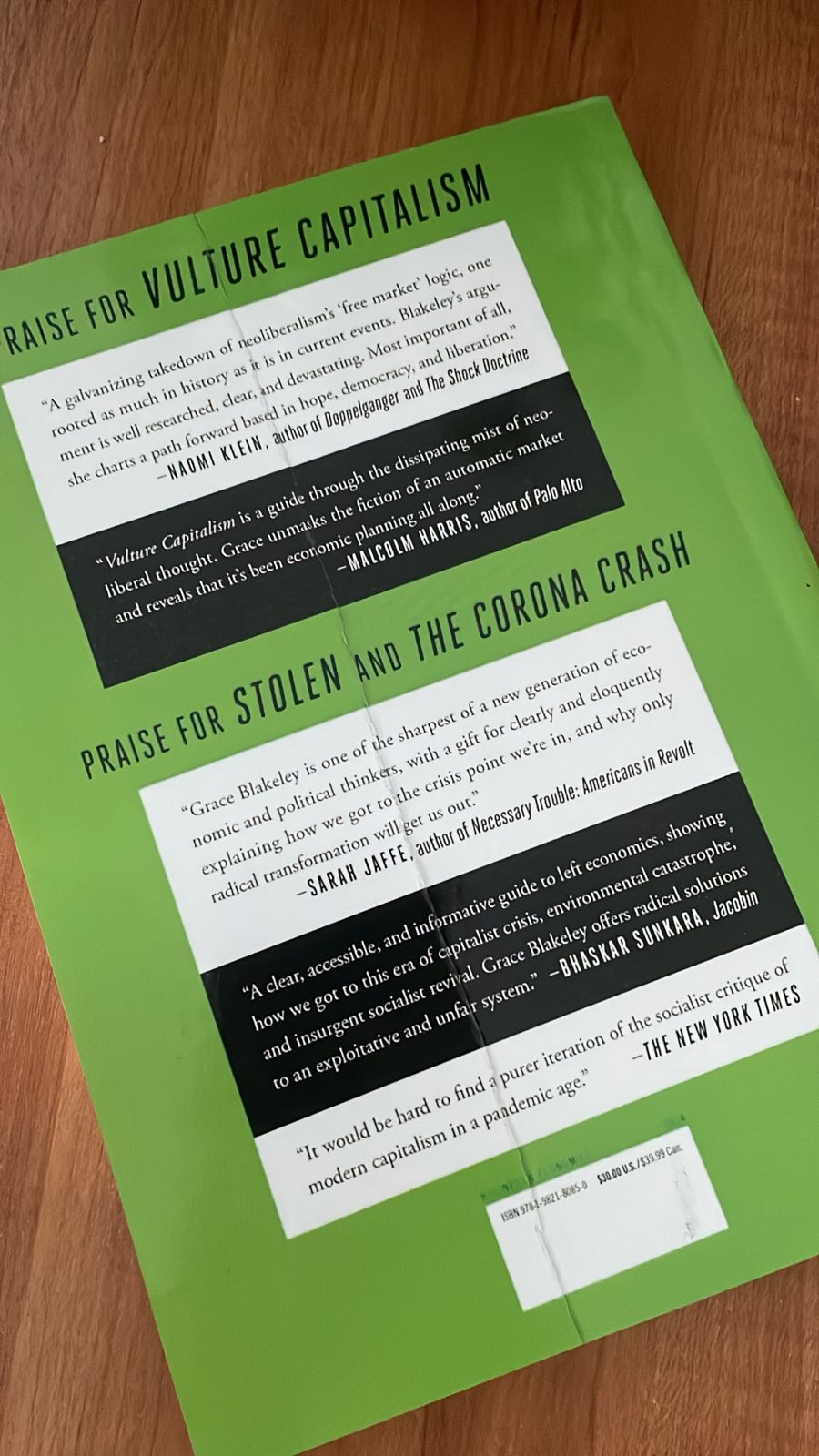
Her previous books include Stolen and The Corona Crash.
She has written on financialisation, capitalism, labor, public policy, and inequality.
Google Books lists her background in philosophy, politics, economics, and African studies, along with her work in journalism and policy research.
Readers can learn more through the official Bloomsbury page for Vulture Capitalism.
Product Details
Title: Vulture Capitalism
Author: Grace Blakeley
Genre: Economics / Political Economy / Business / Politics
Language: English
Original Publication: 2024
UK Paperback Edition
Full UK Title: Vulture Capitalism: How to Survive in an Age of Corporate Greed
Publisher: Bloomsbury Publishing
ISBN-13: 9781526638069
Format: Paperback
Pages: 416
Publication Date: March 13, 2025
Dimensions: 198 × 129 mm
U.S. Edition
Full U.S. Title: Vulture Capitalism: Corporate Crimes, Backdoor Bailouts, and the Death of Freedom
Publisher: Simon & Schuster
ISBN-13: 9781982180850
Pages: 384
Different regional editions have different subtitles, ISBNs, covers, and page counts.
Always check the ISBN printed on your physical copy before entering final WooCommerce specifications.
Explore More Economics and Business Books
Vulture Capitalism argues that modern economies are not simply governed by impersonal markets.
Large corporations plan.
Governments intervene.
Financial institutions allocate capital.
Political institutions shape the rules.
Grace Blakeley’s central argument is that these decisions should be subject to greater democratic control.
Readers looking for more economics and business books can explore Business, Finance & Economics Books at Bargain Books.
You can also explore Non-Fiction & Knowledge Books at Bargain Books.
For readers interested in corporate power, financial crises, economic planning, inequality, and debates over alternatives to modern capitalism, Vulture Capitalism offers a strongly argued and explicitly left-wing perspective on the global economy.


Reviews
There are no reviews yet.