
No products in the cart.
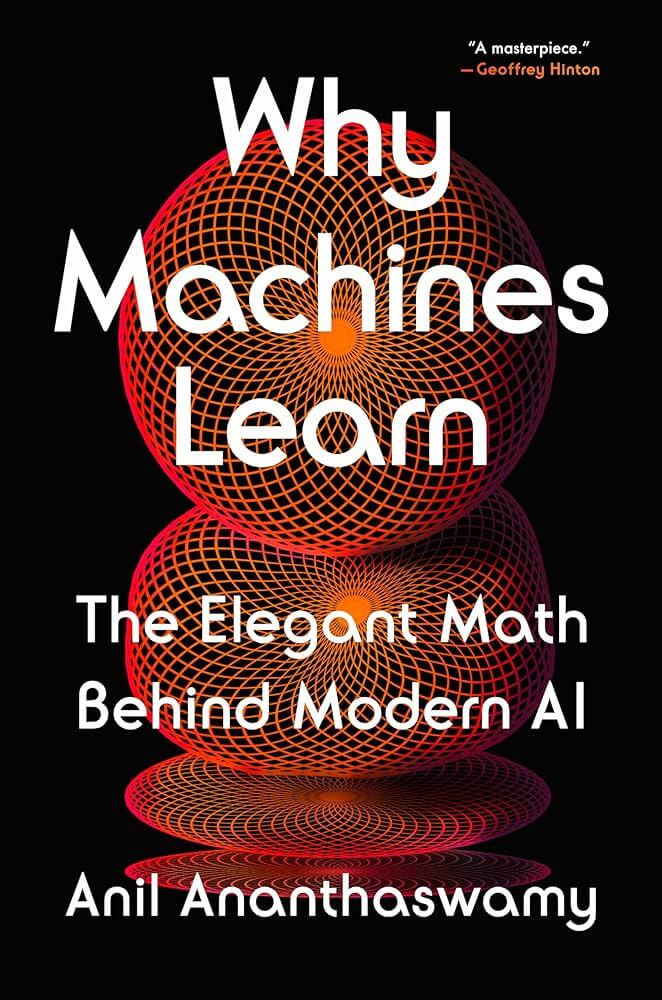
Why Machines Learn: The Elegant Math Behind Modern AI by Anil Ananthaswamy
රු2,950.00
3 X Rs. 983.33 or 8% Cashback with


or 3 X රු983.33 with


or up to 4 X රු737.50 with


How does a machine actually learn?
In Why Machines Learn: The Elegant Math Behind Modern AI, award-winning science writer Anil Ananthaswamy explains the mathematical ideas behind machine learning and today’s AI revolution.
Explore:
- Machine Learning
- Artificial Intelligence
- Neural Networks
- Linear Algebra
- Calculus
- Optimisation
- Gradient Descent
- Computer Vision
- Deep Learning
- Transformers
- Large Language Models
- AI in Science
This 2025 paperback also contains a new afterword on Transformer architecture and large language models such as ChatGPT.
Paperback | 496 pages | Dutton | ISBN 9780593185766
2 in stock
Purchase & earn 30 points!
Categories: Artificial Intelligence, Machine Learning, Popular Science
Why Machines Learn by Anil Ananthaswamy
Why Machines Learn: The Elegant Math Behind Modern AI by Anil Ananthaswamy is an accessible exploration of the mathematics, history and ideas that make modern machine learning and artificial intelligence possible.
Artificial intelligence can appear mysterious.
A machine can recognise an object in an image, generate language, discover patterns in enormous datasets and make predictions from information it has never encountered before.
But beneath these abilities are mathematical ideas.
Many of them are not new.
Ananthaswamy shows how concepts from linear algebra, calculus, probability, geometry and optimisation became the foundations of modern machine learning when combined with advances in computer science, data and increasingly powerful hardware.
Penguin Random House describes the book as a narrative explanation of the mathematics that led to the modern machine-learning revolution.
What Does It Mean for a Machine to Learn?
Traditional software is often built by giving a computer explicit instructions.
A programmer specifies what the computer should do under particular conditions.
Machine learning works differently.
Instead of writing every rule manually, developers create systems that can adjust internal parameters as they analyse data.
Through this process, a model can gradually become better at a task.
That task might involve:
- Recognising images
- Classifying information
- Making predictions
- Detecting patterns
- Processing language
- Identifying relationships in data
Why Machines Learn explains the mathematical ideas that make this possible.
Mathematics Behind Modern AI
One of the central goals of the book is to show that today’s AI revolution rests on mathematical foundations developed over centuries.
Ananthaswamy discusses ideas related to:
- Linear algebra
- Calculus
- Probability
- Optimisation
- Geometry
- Statistics
- Vector spaces
- Neural networks
These concepts allow machines to represent data numerically and adjust internal parameters to reduce errors.
The book does contain mathematics, but its purpose is not simply to present equations.
Instead, Ananthaswamy explains why the mathematics matters, how it developed historically and how it eventually became useful for machine learning.
From Mathematical Ideas to Machine Learning
Many mathematical techniques existed long before modern computers.
What changed was the ability to combine those ideas with:
- Digital computing
- Large datasets
- Faster processors
- Graphics-processing hardware
- Improved algorithms
Penguin notes that some of the mathematical ideas behind today’s systems go back to the seventeenth and eighteenth centuries, while later developments in computing and graphics hardware helped trigger today’s AI boom.
This historical perspective helps readers understand that modern AI did not suddenly appear.
It developed from decades of research and older mathematical discoveries.
Neural Networks
Neural networks are among the most important technologies discussed in the book.
Inspired loosely by the idea of interconnected biological neurons, artificial neural networks consist of layers of mathematical operations.
During training, the system adjusts numerical parameters—often called weights—so that its predictions become more accurate.
This process powers many modern applications involving:
- Image recognition
- Computer vision
- Speech
- Language processing
- Pattern recognition
- Generative AI
The mathematics explains how a network can improve after observing examples.
Learning Through Optimisation
A machine-learning system needs some way to determine whether its predictions are improving.
This is where optimisation becomes important.
A model often begins with poor predictions.
An error or loss function measures how far those predictions are from the desired result.
The system then adjusts its parameters to reduce that error.
This process may happen millions or billions of times during training.
Understanding optimisation helps explain why mathematical tools such as calculus are so important to modern machine learning.
Gradient Descent
One of the best-known optimisation methods in machine learning is gradient descent.
Imagine standing somewhere on a mountain in thick fog and trying to reach the lowest point.
You may not know the entire shape of the landscape, but you can determine which direction slopes downward.
By repeatedly moving in a downward direction, you may eventually reach a low point.
Gradient descent applies a related mathematical idea to optimisation.
A model changes its parameters in directions that reduce its error.
The concept is simple enough to visualise but extraordinarily powerful when applied across millions or billions of model parameters.
Computer Vision
The book also explores how machines learn to interpret visual information.
Computer vision systems can be trained to identify patterns in:
- Photographs
- Medical images
- Video
- Scientific observations
- Satellite imagery
Modern systems do not necessarily rely on developers manually describing every shape or visual feature.
Instead, machine-learning models can learn useful internal representations from examples.
Penguin’s academic catalogue categorises Why Machines Learn under both Artificial Intelligence and Computer Vision, reflecting the book’s coverage of these topics.
Machine Learning in Science
Machine learning is not limited to consumer technology.
Ananthaswamy describes how these systems are increasingly used in scientific fields including:
- Biology
- Chemistry
- Physics
- Genomics
- Astronomy
- Quantum systems
AI models can help researchers identify patterns within datasets that would be difficult or time-consuming to analyse manually.
Penguin notes applications involving genomes, extrasolar planets and quantum systems as examples of machine learning’s expanding role in science.
Artificial Intelligence and Natural Intelligence
One of the book’s more intriguing questions is whether some mathematical ideas behind machine learning might also help us think about natural intelligence.
Humans and machines obviously do not learn in identical ways.
But researchers can still ask whether mathematical principles relating to representation, prediction and optimisation reveal something interesting about learning itself.
Ananthaswamy uses these questions to connect computer science with broader scientific and philosophical questions about intelligence.
Transformers and Large Language Models
This exact paperback edition is particularly useful because it contains a new afterword about Transformer architecture.
Transformers have become fundamental to modern large language models.
They allow models to process relationships between different parts of a sequence and are central to systems used for modern language generation.
Penguin specifically states that the paperback-only afterword explores the Transformer architecture behind large language models such as ChatGPT and discusses emerging directions made possible by this technology.
This makes ISBN 9780593185766 especially relevant to readers studying AI after the rapid expansion of generative AI.
Understanding AI’s Capabilities and Limitations
Ananthaswamy does not present machine learning as magic.
One of the book’s broader arguments is that understanding the mathematics helps readers appreciate both what AI systems can do and where their limitations come from.
Machine-learning systems can perform impressive tasks while still depending on:
- Training data
- Mathematical objectives
- Model architecture
- Statistical patterns
- Human design decisions
Understanding these foundations helps remove some of the mystery surrounding AI.
Penguin summarises the book’s conclusion around the idea that understanding the capabilities and limitations of AI requires understanding the mathematics underlying machine learning.
History of AI and Machine Learning
Another strength of Why Machines Learn is its historical approach.
Rather than simply describing current technologies, Ananthaswamy introduces the people, discoveries and mathematical developments that helped create them.
Readers encounter the evolution of ideas that eventually contributed to:
- Artificial neural networks
- Statistical learning
- Optimisation
- Computer vision
- Deep learning
- Generative AI
This makes the book useful for readers who want to know not only how a method works but also why it was developed.
Is the Book Highly Technical?
The book includes real mathematics.
It should not be marketed as a completely equation-free introduction to AI.
However, it is written as popular science rather than as a formal university mathematics textbook.
The goal is to guide interested readers through the mathematical intuition, history and meaning behind the techniques.
Readers with some comfort around basic mathematics may get the most from the deeper sections, but the historical explanations and conceptual discussions remain useful even when every equation is not followed in detail.
About Anil Ananthaswamy
Anil Ananthaswamy is an award-winning science writer and former staff writer and deputy news editor at New Scientist.
Penguin Random House notes that he was a 2019–20 MIT Knight Science Journalism Fellow and received the Distinguished Alum Award from IIT Madras for his contributions to science writing.
His other books include:
- The Man Who Wasn’t There
- Through Two Doors at Once
His background in science journalism makes Why Machines Learn particularly focused on explaining technical ideas through narrative and history.
Who Will Enjoy Why Machines Learn?
This book may especially appeal to:
- AI enthusiasts
- Computer science students
- Software developers
- Data science students
- Machine-learning beginners
- Mathematics students
- Engineers
- Technology professionals
- Science readers
- Readers curious about ChatGPT and generative AI
It is especially useful for readers who want to understand why machine-learning algorithms work, rather than simply how to use AI applications.
Buy Why Machines Learn in Sri Lanka
For readers looking to buy Why Machines Learn by Anil Ananthaswamy in Sri Lanka, ISBN 9780593185766 identifies the physical Dutton paperback edition.
The official Penguin Random House retail specification gives:
- 496 pages
- 16 oz / approximately 454 g
- 5.96 × 8.96 × 1.04 inches
which converts to approximately:
22.8 × 15.1 × 2.6 cm.
For WooCommerce shipping, I recommend:
0.454 kg / 22.8 × 15.1 × 2.6 cm
Reviews
There are no reviews yet.