
No products in the cart.
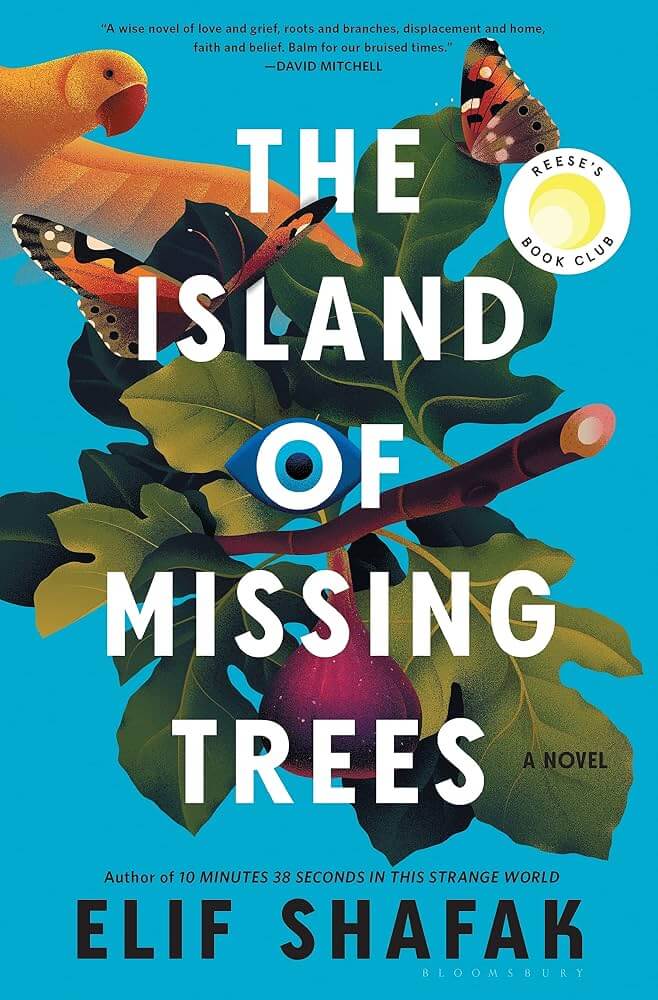
The Island of Missing Trees by Elif Shafak


රු1,750.00
3 X Rs. 583.33 or 8% Cashback with


or 3 X රු583.33 with


or up to 4 X රු437.50 with


A powerful story of love, memory, identity and belonging from bestselling author Elif Shafak.
In divided Cyprus, Greek Cypriot Kostas and Turkish Cypriot Defne fall in love in secret beneath the branches of a fig tree.
Years later in London, their daughter Ada tries to understand the island she has never visited and the family history her parents struggled to explain.
Featuring:
- Forbidden Love
- Cyprus
- Family Secrets
- Intergenerational Trauma
- Cultural Identity
- Migration & Belonging
- Magical Realism
- Eco-Fiction
- Literary Fiction
- A Remarkable Fig Tree Narrator
Women’s Prize for Fiction Shortlist | Reese’s Book Club Pick
Important ISBN note: ISBN 9781635578607 is the digital Bloomsbury eBook ISBN.
10 in stock
The Island of Missing Trees by Elif Shafak
The Island of Missing Trees by Elif Shafak is a lyrical literary novel about love, division, migration, memory, family and the lasting effects of conflict.
Set across Cyprus and London, the story follows two generations connected by a fig tree that becomes both witness and symbol.
At the centre of the novel are Kostas, a Greek Cypriot, and Defne, a Turkish Cypriot.
They meet as teenagers on the divided island of Cyprus and fall in love despite the political, cultural and social barriers surrounding them.
Their relationship unfolds in secret inside a taverna where a fig tree grows through an opening in the roof.
Bloomsbury describes the novel as a story of belonging and identity, love and trauma, nature and renewal.
Kostas and Defne
Kostas and Defne belong to communities divided by conflict.
Their love develops during a period when Cyprus is becoming increasingly dangerous.
The taverna where they meet provides temporary shelter from that divided world.
There they can talk, dream and imagine a life together.
But war and political violence eventually transform the island.
The consequences affect not only Kostas and Defne but also the next generation.
Shafak uses their relationship to explore how private lives are shaped by larger historical forces.
Ada in London
Years later, the story moves to London.
There we meet Ada Kazantzakis, the daughter of Kostas and Defne.
Ada has never visited Cyprus.
She has grown up physically distant from the island but remains deeply connected to its unresolved history through her parents.
A fig tree growing in the garden of her London home becomes one of her strongest links to a place she has never seen.
As Ada tries to understand her family, she begins uncovering:
- Hidden grief
- Family silence
- Cultural identity
- Migration
- Memory
- Trauma passed between generations
- The history her parents struggled to explain
Bloomsbury specifically frames Ada’s story around her attempt to untangle family secrets and understand her complicated identity.
The Fig Tree
One of the novel’s most distinctive features is the role of the fig tree.
The tree is more than scenery.
It becomes a witness to:
- Kostas and Defne’s meetings
- Political conflict
- Separation
- Migration
- Family memory
- Survival
- Renewal
Shafak uses the natural world as a narrative voice and symbol.
This gives the novel an eco-conscious dimension alongside its family and historical themes.
The tree represents roots, displacement and the possibility of surviving after being moved from one place to another.
Cyprus and Division
Cyprus is central to the novel.
The story is shaped by tensions between Greek Cypriot and Turkish Cypriot communities and by the violence that divided the island.
Rather than functioning simply as historical background, the conflict affects:
- Love
- Families
- Language
- Religion
- Migration
- Identity
- Memory
- Belonging
The book explores how political division can continue affecting people long after the immediate violence has ended.
Memory and Intergenerational Trauma
A major theme is the way one generation’s experiences can affect another.
Ada did not personally experience the conflict that shaped her parents’ lives.
Yet she inherits its silence, grief and unanswered questions.
The novel explores how trauma can survive through:
- Family behaviour
- Things left unsaid
- Cultural displacement
- Loss
- Memory
- Fear
- Identity
Bloomsbury describes the book as a novel of love, grief, displacement, home and history.
Belonging and Identity
The novel repeatedly asks what it means to belong somewhere.
Can a person belong to:
- A country they left?
- A culture they did not grow up inside?
- A family history they only partly understand?
- More than one identity at once?
Ada’s experience is particularly important because she lives between inherited cultural identities without having direct experience of her parents’ homeland.
Her story turns the novel into both a family saga and a coming-of-age narrative.
Google Books classifies the book under family life, coming-of-age and cultural heritage.
Nature and Renewal
Shafak also gives the natural world an important role.
The fig tree connects the novel’s human characters to broader cycles of:
- Growth
- Damage
- Survival
- Migration
- Adaptation
- Renewal
This ecological perspective makes the novel different from a conventional historical family drama.
Nature is not just background.
It carries memory.
Literary Fiction with Magical Elements
The Island of Missing Trees combines:
- Literary fiction
- Family saga
- Historical fiction
- Coming-of-age fiction
- Magical realism
- Cultural heritage
- Eco-fiction
The fig tree’s perspective gives the novel a gently magical element while the historical and family stories remain grounded in real social tensions.
Awards and Recognition
Bloomsbury identifies the novel as:
- A Reese’s Book Club Pick
- Winner of the 2022 BookTube Silver Medal in Fiction
- Shortlisted for the Women’s Prize for Fiction
Penguin also highlights the novel’s Women’s Prize shortlist recognition.
These are useful selling points for a WooCommerce product page.
About Elif Shafak
Elif Shafak is an award-winning British-Turkish novelist whose work has been translated widely around the world.
Her books include:
- The Forty Rules of Love
- 10 Minutes 38 Seconds in This Strange World
- The Island of Missing Trees
- There Are Rivers in the Sky
- The Bastard of Istanbul
- The Architect’s Apprentice
Google Books notes that The Island of Missing Trees was shortlisted for the Women’s Prize for Fiction, Costa Award and RSL Ondaatje Prize.
Her writing often explores:
- Identity
- Migration
- Culture
- Memory
- Gender
- Belonging
- History
- East-West connections
Who Will Enjoy The Island of Missing Trees?
This book may particularly appeal to readers interested in:
- Literary fiction
- Historical family stories
- Cyprus
- Forbidden love
- Intergenerational trauma
- Migration
- Cultural identity
- Magical realism
- Eco-fiction
- Elif Shafak
- Award-shortlisted fiction
- Book club novels
It may especially suit readers who enjoy novels where personal relationships are deeply connected to history and place.
Buy The Island of Missing Trees in Sri Lanka
For readers looking to buy The Island of Missing Trees by Elif Shafak in Sri Lanka, first confirm whether the edition you are selling is digital or physical.
The supplied ISBN:
9781635578607
is the Bloomsbury digital eBook ISBN.
If your stock is the common UK Penguin physical paperback, the ISBN should instead be:
9780241988725
with official specifications of:
368 pages / 0.268 kg / 19.8 × 12.9 × 2.5 cm.
Be the first to review “The Island of Missing Trees by Elif Shafak”
Related products

Literary Fiction
රු2,350.00
3 X Rs. 783.33 or 8% Cashback with
or 3 X රු783.33 with
or up to 4 X රු587.50 with
Classic Literature
රු1,650.00
3 X Rs. 550.00 or 8% Cashback with
or 3 X රු550.00 with
or up to 4 X රු412.50 with
Reviews
There are no reviews yet.