
No products in the cart.
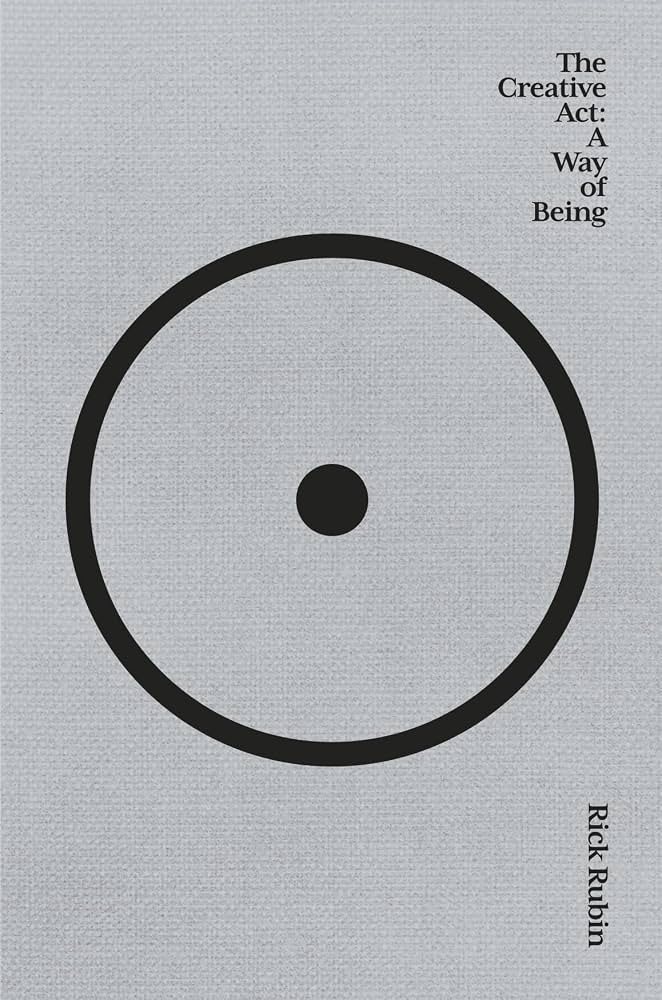
The Creative Act: A Way of Being by Rick Rubin

රු1,950.00
3 X Rs. 650.00 or 8% Cashback with


or 3 X රු650.00 with


or up to 4 X රු487.50 with


Creativity is not only about what you make—it is about how you see the world.
In The Creative Act: A Way of Being, legendary music producer Rick Rubin explores the creative process through decades of experience helping artists discover their most authentic work.
The book explores:
- Creativity
- Inspiration
- Artistic practice
- Awareness
- Experimentation
- Creative blocks
- Taste
- Editing
- Discipline
- Failure
- Collaboration
- Completing creative work
A thoughtful guide for writers, musicians, designers, artists, entrepreneurs and anyone interested in living more creatively.
#1 New York Times Bestseller
Hardcover | 432 pages | Penguin Press | ISBN 9780593652886
15 in stock
The Creative Act: A Way of Being by Rick Rubin
The Creative Act: A Way of Being by Rick Rubin
The Creative Act: A Way of Being by legendary music producer Rick Rubin is a thoughtful exploration of creativity, artistic practice and the way people relate to the world around them.
Rather than presenting creativity as something reserved only for painters, writers, musicians or professional artists, Rubin argues that creativity has a place in everyone’s life.
The book grew out of decades of experience working with artists across many genres.
Penguin Random House describes Rubin as a producer known not for imposing one particular sound, but for helping artists discover what is most authentic in their own work.
The result is not a conventional step-by-step handbook.
Instead, The Creative Act is a collection of reflections, principles and observations about:
- Inspiration
- Awareness
- Artistic practice
- Experimentation
- Discipline
- Taste
- Doubt
- Collaboration
- Editing
- Failure
- Completion
- The relationship between an artist and their work
Creativity as a Way of Living
One of the book’s central ideas is that creativity is not simply something people switch on when they sit down to make a song, write a story or paint a picture.
Rubin treats creativity as a way of being.
That means paying attention.
It means noticing what is happening around you.
It means remaining open to ideas instead of forcing them.
This perspective makes the book relevant even to readers who do not consider themselves traditional artists.
A business owner, designer, student, photographer, musician, writer, filmmaker or entrepreneur can all engage with creative thinking.
Penguin Random House categorises the book across Self-Improvement & Inspiration, Music and Philosophy, reflecting this broad approach.
The Artist’s Relationship with the World
Rubin argues that being an artist is not defined only by a finished product.
Instead, it is connected to the way a person observes and interprets the world.
Creative work often begins long before the visible act of making something.
A person may be collecting:
- Sounds
- Images
- Conversations
- Feelings
- Questions
- Memories
- Experiences
- Ideas
without immediately knowing how those pieces will become useful.
The book encourages readers to remain receptive to that material.
Ideas and Inspiration
A recurring idea in the book is that creative ideas are all around us.
Rubin often refers to a broader creative source from which ideas can emerge.
Rather than assuming creativity depends entirely on forcing original ideas into existence, he encourages artists to develop their ability to recognise possibilities.
This means paying attention to:
- Intuition
- Curiosity
- Unexpected connections
- Emotional reactions
- Environment
- Silence
- Other art
- Everyday experiences
The practical lesson is simple:
Better creative work often begins with better attention.
Experimentation
Rubin places strong value on experimentation.
Creative work does not always begin with certainty.
Often, the creator has to try something simply to discover what happens.
That may involve:
- Changing the structure
- Changing the medium
- Trying a different approach
- Removing something
- Adding something unexpected
- Starting again
- Making several versions
- Following an idea without knowing the outcome
This makes the book especially valuable for readers who struggle with perfectionism.
An experiment does not need to succeed in order to teach the creator something.
The Role of Failure
Failure is treated as part of the creative process rather than evidence that someone lacks talent.
An unsuccessful attempt can reveal:
- What does not work
- What the project actually needs
- Which assumptions were wrong
- Which direction is more interesting
- What the creator values most
Rubin’s approach encourages readers to remain curious instead of treating every imperfect attempt as a personal judgment.
This is particularly relevant to:
- Writers
- Musicians
- Designers
- Artists
- Filmmakers
- Content creators
- Entrepreneurs
- Students working on creative projects
Discipline and Practice
Although The Creative Act is often philosophical, it does not suggest that inspiration alone is enough.
Creative work still requires attention and practice.
Ideas have to be:
- Explored
- Developed
- Tested
- Refined
- Edited
- Completed
A creator may not control when inspiration appears, but they can create habits and environments that make it easier to work when ideas arrive.
This balance between openness and discipline is one of the book’s strongest themes.
Taste
Rubin also explores the importance of personal taste.
Creators often know what they admire long before they are capable of producing work at that level themselves.
That gap can become frustrating.
However, taste can also function as a guide.
It helps the creator recognise:
- What feels authentic
- What feels unnecessary
- What needs improvement
- Which direction feels right
Rather than copying admired work, the aim is to understand what qualities resonate and then develop an individual voice.
Editing and Refinement
Creation is not only about generating ideas.
It also requires deciding what should remain.
Editing may involve:
- Cutting material
- Simplifying
- Reordering
- Starting again
- Removing a favourite element
- Allowing the work to become different from the original plan
Rubin’s background as a music producer gives this aspect of the book particular weight.
Much of production is not simply adding more—it is recognising what the work already wants to be.
Creative Blocks
Readers struggling with creative blocks may find the book particularly useful.
Rubin does not treat creative difficulty as proof that the artist has nothing valuable to offer.
Instead, a block may indicate the need to:
- Change perspective
- Stop forcing an outcome
- Rest
- Gather new material
- Change environments
- Experiment
- Return to curiosity
This can help readers rethink the common pressure to be productive at all times.
Art Is Not Only About the Audience
Another important idea is the relationship between creative work and external approval.
Artists naturally care about how work will be received.
But excessive attention to:
- Reviews
- Trends
- Algorithms
- Sales
- Social-media reactions
- Other people’s expectations
can make it harder to recognise what the work itself needs.
Rubin encourages creators to develop sensitivity to their own artistic judgment.
This does not mean ignoring an audience completely.
It means avoiding the situation where external approval becomes the only measure of whether work is valuable.
78 Areas of Thought
The book is structured around a large number of short reflections rather than one continuous argument.
Critical descriptions of the book note that Rubin guides readers through 78 areas of thought relating to creativity and artistic practice.
This structure makes The Creative Act especially suitable for:
- Reading slowly
- Revisiting individual sections
- Highlighting passages
- Journaling
- Using as a creative reference
- Returning to when feeling blocked
It does not need to be treated like a textbook that must be absorbed all at once.
For More Than Musicians
Rick Rubin is famous for music production, but the book is deliberately broader.
Penguin Random House explicitly positions the creative path described in the book as one that all of us can follow, rather than something limited to professional musicians.
The book may therefore appeal to:
- Writers
- Designers
- Artists
- Photographers
- Filmmakers
- Musicians
- Producers
- Entrepreneurs
- Architects
- Content creators
- Students
- Anyone working on creative projects
About Rick Rubin
Rick Rubin is a highly influential American music producer.
Penguin Random House describes him as a nine-time Grammy-winning producer who has worked with artists across dramatically different musical styles.
His collaborators have included artists associated with rock, hip-hop, metal, pop and country music.
That range is relevant to The Creative Act because Rubin’s philosophy is built around helping creators discover their own strengths rather than making every artist conform to one style.
A #1 New York Times Bestseller
Penguin Random House identifies The Creative Act as a #1 New York Times bestseller.
The book has become particularly popular among readers interested in:
- Creativity
- Personal development
- Art
- Music
- Writing
- Philosophy
- Creative careers
Its combination of short reflections and practical creative thinking makes it suitable both for continuous reading and repeated reference.
Who Will Enjoy The Creative Act?
This book may especially appeal to readers who enjoy:
- Creativity books
- Art and design
- Writing
- Music
- Philosophy
- Self-development
- Creative careers
- Rick Rubin
- Creative process
- Inspiration and motivation
Readers who enjoyed titles such as The War of Art, Steal Like an Artist, Big Magic or On Writing may also find The Creative Act appealing.
Buy The Creative Act in Sri Lanka
For readers looking to buy The Creative Act: A Way of Being by Rick Rubin in Sri Lanka, ISBN 9780593652886 identifies the physical Penguin Press hardcover edition.
The publisher confirms:
- Hardcover
- Penguin Press
- 17 January 2023
- 432 pages
- 6 × 8½-inch trim size.
Multiple exact-ISBN physical records place the actual finished book at approximately:
0.612 kg / 22.2 × 15.9 × 3.3 cm.
Be the first to review “The Creative Act: A Way of Being by Rick Rubin”
Related products
Out of stock
Needs Category Review
රු950.00
3 X Rs. 316.67 or 8% Cashback with
or 3 X රු316.67 with
or up to 4 X රු237.50 with
Needs Category Review
රු1,700.00
3 X Rs. 566.67 or 8% Cashback with
or 3 X රු566.67 with
or up to 4 X රු425.00 with

Out of stock
Needs Category Review
රු950.00
3 X Rs. 316.67 or 8% Cashback with
or 3 X රු316.67 with
or up to 4 X රු237.50 with
Out of stock
Needs Category Review
රු10,500.00
3 X Rs. 3,500.00 or 8% Cashback with
or 3 X රු3,500.00 with
or up to 4 X රු2,625.00 with
Needs Category Review
රු1,800.00
3 X Rs. 600.00 or 8% Cashback with
or 3 X රු600.00 with
or up to 4 X රු450.00 with
Out of stock
Needs Category Review
රු18,700.00
3 X Rs. 6,233.33 or 8% Cashback with
or 3 X රු6,233.33 with
or up to 4 X රු4,675.00 with
Children & Young Adult
රු2,600.00
3 X Rs. 866.67 or 8% Cashback with
or 3 X රු866.67 with
or up to 4 X රු650.00 with

Out of stock
Needs Category Review
රු11,550.00
3 X Rs. 3,850.00 or 8% Cashback with
or 3 X රු3,850.00 with
or up to 4 X රු2,887.50 with
Reviews
There are no reviews yet.