
No products in the cart.
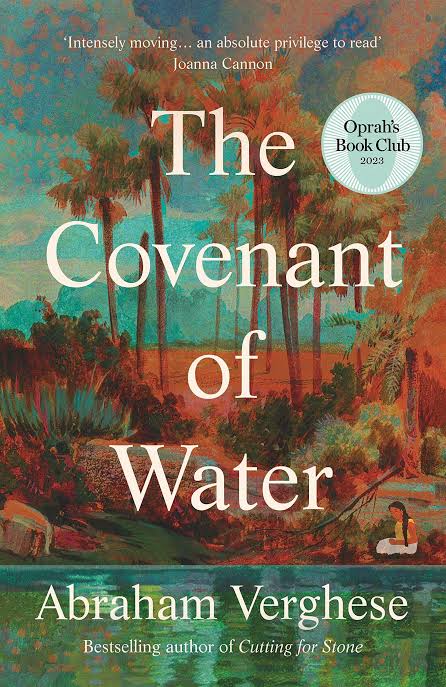
The Covenant of Water by Abraham Verghese – Hardcover Edition

රු3,200.00
3 X Rs. 1,066.67 or 8% Cashback with


or 3 X රු1,066.67 with


or up to 4 X රු800.00 with


The Covenant of Water by Abraham Verghese – Hardcover Edition is an extraordinary historical fiction novel spanning three generations of a family in Kerala, South India.
From the bestselling author of Cutting for Stone comes a deeply moving story of love, family, faith, medicine and the secrets that connect generations.
Beginning in 1900, the novel follows a twelve-year-old girl who is sent to marry an older widower. Over the following decades, she grows into a beloved family matriarch known as Big Ammachi.
But her family carries a mysterious affliction: in every generation, at least one person dies by drowning.
In a region surrounded by rivers, canals and monsoon rains, the recurring tragedy creates a haunting mystery.
As Big Ammachi witnesses extraordinary changes across nearly eight decades, her family’s story becomes intertwined with scientific discovery, medicine, sacrifice and the enduring power of love.
Beautifully written and emotionally compelling, The Covenant of Water is an unforgettable literary journey through twentieth-century India.
Product Highlights:
- Written by bestselling author Abraham Verghese
- A celebrated Oprah’s Book Club selection
- Hardcover edition
- A sweeping family saga spanning 1900–1977
- Set in Kerala on India’s Malabar Coast
- Explores three generations of one family
- Combines historical fiction with a fascinating medical mystery
- Explores love, faith, family, grief and resilience
- Perfect for fans of Cutting for Stone and Pachinko
- An excellent addition to a literary fiction collection
Buy The Covenant of Water by Abraham Verghese hardcover online in Sri Lanka from Book Lounge and discover an unforgettable story of family, love and the mysteries that connect generations.
1 in stock
An Extraordinary Story of Love, Family, Faith and the Mysteries of Life
The Covenant of Water by Abraham Verghese is an unforgettable historical fiction novel that explores the lives of three generations of a family living in Kerala, South India. Spanning nearly eight decades, this extraordinary literary masterpiece weaves together family secrets, medical mysteries, enduring love, faith, sacrifice and the remarkable resilience of the human spirit.
From the bestselling author of Cutting for Stone, this sweeping family saga transports readers to the beautiful landscapes of Kerala’s Malabar Coast, where water shapes both the land and the lives of its people.
The story begins in 1900.
A twelve-year-old girl from Kerala’s Saint Thomas Christian community is sent to marry a much older widower.
Still grieving the death of her father, she must leave behind her childhood and begin an unfamiliar life in a household that will eventually become her own.
Over the years, she grows into a beloved matriarch known as Big Ammachi.
Her life unfolds through extraordinary social and personal changes as India moves through the twentieth century.
However, the family she joins carries a mysterious and frightening affliction.
Across generations, at least one member of the family dies by drowning.
The recurring tragedy is particularly haunting because Kerala is a land surrounded by rivers, canals, lakes and monsoon rains.
Water is essential to daily life, but for this family, it also represents an ever-present source of fear.
As Big Ammachi raises her family and witnesses the changing world around her, she becomes determined to understand the strange condition affecting those she loves.
The search for answers gradually connects family history with developments in medicine, science and human understanding.
Through deeply emotional storytelling, Abraham Verghese reveals how the lives of ordinary people can become part of something extraordinary.
The Covenant of Water is a moving novel about the connections between generations, the mysteries inherited by families and the power of compassion in the face of suffering.
Atlantic Books+1
Big Ammachi – The Heart of a Multigenerational Family Saga
Big Ammachi is one of the central figures in the novel.
Her journey begins when she is still a child.
The responsibilities placed upon her are far greater than those normally expected of someone her age.
She must adapt to marriage, family expectations and the unfamiliar environment of her husband’s household.
Over time, she becomes an important emotional foundation for her family.
Her strength does not come from extraordinary powers or public recognition.
Instead, it develops through patience, compassion and the determination to care for those around her.
As the decades pass, Big Ammachi witnesses births, marriages, illnesses and heartbreaking losses.
Her experiences reveal the changing roles of women within family and society.
She learns to navigate difficult circumstances while maintaining her personal beliefs and commitment to those she loves.
Her character gives readers a deeply personal perspective on the history of Kerala and the wider transformations occurring in India.
Kerala – A Landscape Shaped by Water
The setting of The Covenant of Water is essential to the story.
Kerala, located along India’s southwestern coast, is known for its waterways, tropical landscapes and distinctive cultural traditions.
Its rivers, backwaters, monsoon rains and agricultural communities provide an immersive setting.
Water becomes both a practical necessity and a powerful literary symbol.
It sustains crops, connects communities and influences the rhythms of everyday life.
Yet the mysterious drowning tragedies affecting Big Ammachi’s family transform this familiar element into a source of anxiety.
Verghese uses the landscape to create a strong sense of place.
The natural environment is closely connected to the characters’ experiences.
The book also introduces readers to the traditions, beliefs and social structures of communities living along Kerala’s Malabar Coast.
A Family Mystery Spanning Three Generations
One of the novel’s most compelling elements is the recurring mystery surrounding the family’s history.
Across generations, a strange pattern of drowning deaths continues.
The family struggles to understand why these tragedies occur.
What initially appears to be a curse raises questions about inheritance, medical conditions and the limits of human knowledge.
The mystery becomes part of the family’s collective identity.
It influences relationships, fears and decisions.
As medical understanding develops over the decades, new possibilities emerge.
The novel gradually connects personal suffering with the broader progress of scientific discovery.
Readers who enjoy literary fiction with an underlying mystery will appreciate how the story brings together family history and medicine.
Medicine, Science and the Desire to Heal
Medicine plays an important role in The Covenant of Water.
Abraham Verghese draws upon his experience as a physician to explore the development of medical knowledge and the lives of people who practise healing.
The novel examines the relationship between scientific discovery and human compassion.
Illness affects not only the person experiencing it but also their family and community.
Medical professionals must therefore confront emotional as well as scientific challenges.
The story explores how advances in medicine change the possibilities available to patients.
It also considers the importance of understanding an individual’s life beyond a diagnosis.
Verghese presents healing as a practice that involves observation, knowledge, patience and empathy.
These themes give the novel a distinctive character compared with conventional historical family sagas.
Love, Marriage and Personal Sacrifice
Love is central to the lives of the novel’s characters.
The story begins with a marriage shaped by social expectations rather than romantic choice.
As Big Ammachi grows older, her understanding of relationships develops.
Family connections become sources of comfort, responsibility and sorrow.
The novel explores different expressions of love.
Romantic affection exists alongside parental devotion, friendship and the bonds connecting generations.
Characters frequently face difficult decisions involving personal sacrifice.
Their experiences demonstrate that love does not always protect people from suffering.
Instead, it can provide the emotional strength necessary to endure difficult circumstances.
Faith and the Saint Thomas Christian Community
The novel provides an intimate portrait of a Saint Thomas Christian family in Kerala.
Religious traditions influence the family’s everyday life and understanding of the world.
Faith becomes especially significant during periods of uncertainty and loss.
The story explores how spiritual beliefs can offer comfort while individuals confront questions that do not have simple answers.
Its portrayal of religious life is closely connected to family traditions and the historical setting.
The novel also examines the relationship between faith and developments in scientific knowledge.
Rather than treating medicine and spirituality as entirely separate subjects, it explores how both can influence a person’s search for meaning.
Family Secrets and the Burden of Inheritance
Families transmit more than possessions and traditions.
They also pass down memories, fears and unresolved questions.
In The Covenant of Water, the mysterious pattern of drowning deaths creates a troubling inheritance.
Each generation must confront the possibility that the past will influence its future.
The novel explores how secrets can shape relationships.
Information that remains hidden may affect decisions made years later.
As the characters search for answers, the distinction between family memory and historical truth becomes increasingly important.
The story suggests that understanding the past can help individuals make sense of their present lives.
Women, Family and Changing Social Expectations
Spanning the years 1900 to 1977, the novel portrays significant changes in Indian society.
Women’s lives are influenced by family expectations, education and opportunities for independence.
Big Ammachi’s journey allows readers to consider these changes across several generations.
Her experiences begin within a traditional household.
Over time, she witnesses new ideas and changing possibilities for the younger members of her family.
The novel explores how individuals respond differently to social change.
It also demonstrates that personal strength can take many forms.
Through its female characters, the story examines responsibility, resilience and the difficult balance between personal aspirations and family obligations.
Historical India Across Nearly Eight Decades
The historical scope of The Covenant of Water is one of its defining strengths.
The narrative begins during British colonial rule and continues into independent India.
As the decades pass, political and social changes influence the lives of ordinary people.
The novel does not rely solely on major historical events.
Instead, it explores history through personal experiences.
Changes in medicine, transportation, education and social expectations gradually reshape the world surrounding the family.
The result is a rich portrait of life in southern India across the twentieth century.
Readers gain a sense of how large historical transformations affect individual families.
Grief, Resilience and Hope
The story contains moments of profound loss.
The family’s recurring tragedy creates emotional uncertainty across generations.
Characters must confront illness, death and difficult choices.
However, the novel is not solely a story about suffering.
It also celebrates resilience.
Its characters find meaning through friendship, family connections, work and acts of compassion.
Big Ammachi’s long life demonstrates how hope can survive extraordinary hardship.
The novel examines how people continue building meaningful lives even when the future remains uncertain.
Its emotional depth makes it especially appealing to readers who appreciate character-driven literary fiction.
The Power of Human Connection
Human relationships are at the heart of the novel.
The connections between parents and children, spouses, friends and medical caregivers shape the story.
Verghese explores how seemingly ordinary interactions can influence an individual’s future.
Acts of kindness may have consequences extending across generations.
The novel also examines how compassion can connect people with different experiences and social positions.
Its characters are united by a shared vulnerability to illness, loss and uncertainty.
Through their relationships, the story celebrates the importance of recognising the humanity of others.
An Epic Literary Novel With a Medical Mystery
The Covenant of Water combines several literary traditions.
It is a multigenerational family saga.
It is historical fiction grounded in the social and cultural changes of twentieth-century India.
It contains a medical mystery involving an unusual inherited affliction.
It is also a deeply emotional exploration of love, identity and resilience.
These elements are woven into a complex narrative featuring interconnected characters and storylines.
Readers who appreciate expansive novels with detailed settings and carefully developed relationships will find much to explore.
An Oprah’s Book Club Selection
The Covenant of Water was selected for Oprah’s Book Club and became an international bestseller.
The novel has received significant critical recognition for its ambitious scope, emotional storytelling and portrayal of medicine and family life.
Its combination of literary depth and a compelling central mystery has made it a popular choice for book clubs and readers interested in substantial historical fiction.
Grove Atlantic
Is The Covenant of Water a Standalone Novel?
Yes. The Covenant of Water is a standalone literary fiction novel.
It is not part of the Cutting for Stone storyline.
Readers can enjoy it independently without reading any of Abraham Verghese’s earlier books.
Its complete multigenerational narrative makes it suitable for readers seeking an immersive standalone novel.
Who Should Read The Covenant of Water?
This book is recommended for readers who enjoy historical fiction, literary fiction, family sagas, emotional novels, medical fiction, stories set in India and books that explore the connections between generations.
It may particularly appeal to readers of Cutting for Stone, A Fine Balance, Pachinko, The Mountains Sing and The House of the Spirits.
About the Author – Abraham Verghese
Abraham Verghese is a physician, professor and internationally bestselling author.
His books combine medical knowledge with compassionate storytelling and complex human relationships.
He is the author of Cutting for Stone, My Own Country, The Tennis Partner and The Covenant of Water.
A graduate of the Iowa Writers’ Workshop, Verghese has received the United States National Humanities Medal and is a member of the National Academy of Medicine.
His writing frequently explores medicine, cultural identity, family history and the relationship between doctors and patients.
The Covenant of Water represents a return to the expansive literary storytelling that made Cutting for Stone internationally successful.
Grove Atlantic
Discover The Covenant of Water in Sri Lanka
The Covenant of Water by Abraham Verghese – Hardcover is an excellent addition to any literary fiction collection.
Its exploration of family, medicine, faith and the mysteries of inheritance offers readers an emotionally rich journey through twentieth-century Kerala.
The substantial hardcover edition is suitable for readers who enjoy collecting memorable literary novels and gifting meaningful books.
Buy The Covenant of Water hardcover by Abraham Verghese online in Sri Lanka from Book Lounge and discover an extraordinary story of love, resilience and the enduring bonds between generations.
Be the first to review “The Covenant of Water by Abraham Verghese – Hardcover Edition”
Related products

Classics & Literary Fiction
රු1,950.00
3 X Rs. 650.00 or 8% Cashback with
or 3 X රු650.00 with
or up to 4 X රු487.50 with
-20%

Contemporary romance
Original price was: රු2,050.00.රු1,650.00Current price is: රු1,650.00.
3 X Rs. 550.00 or 8% Cashback with
or 3 X රු550.00 with
or up to 4 X රු412.50 with
-19%

Out of stock
Classics & Literary Fiction
Original price was: රු2,600.00.රු2,100.00Current price is: රු2,100.00.
3 X Rs. 700.00 or 8% Cashback with
or 3 X රු700.00 with
or up to 4 X රු525.00 with
-22%

Out of stock
Fiction & Literature
Original price was: රු2,250.00.රු1,750.00Current price is: රු1,750.00.
3 X Rs. 583.33 or 8% Cashback with
or 3 X රු583.33 with
or up to 4 X රු437.50 with

Out of stock
Classics & Literary Fiction
රු1,500.00
3 X Rs. 500.00 or 8% Cashback with
or 3 X රු500.00 with
or up to 4 X රු375.00 with

Out of stock
Children & Young Adult
රු3,200.00
3 X Rs. 1,066.67 or 8% Cashback with
or 3 X රු1,066.67 with
or up to 4 X රු800.00 with
-18%

Out of stock
Fiction & Literature
Original price was: රු1,950.00.රු1,600.00Current price is: රු1,600.00.
3 X Rs. 533.33 or 8% Cashback with
or 3 X රු533.33 with
or up to 4 X රු400.00 with
-48%

Classics & Literary Fiction
Original price was: රු3,000.00.රු1,550.00Current price is: රු1,550.00.
3 X Rs. 516.67 or 8% Cashback with
or 3 X රු516.67 with
or up to 4 X රු387.50 with
Reviews
There are no reviews yet.