
No products in the cart.
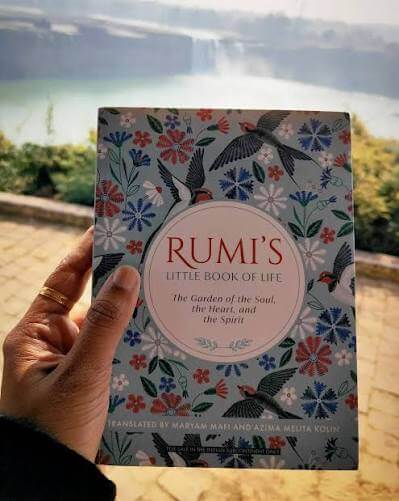
Rumi’s Little Book of Life: The Garden of the Soul, the Heart, and the Spirit by Rumi


රු1,500.00
3 X Rs. 500.00 or 8% Cashback with


or 3 X රු500.00 with


or up to 4 X රු375.00 with


Rumi’s Little Book of Life is a beautiful collection of 196 poems by Rumi exploring love, the soul, the heart, spiritual growth and the inner journey.
Translated by Maryam Mafi and Azima Melita Kolin, this compact volume is ideal for readers of poetry, spirituality and Sufi mysticism.
Format: Trade Paperback
Pages: 224
Publisher: Hampton Roads Publishing
ISBN: 9781571746894
8 in stock
Rumi’s Little Book of Life
Rumi’s Little Book of Life: The Garden of the Soul, the Heart, and the Spirit is a collection of mystical poetry by the 13th-century Persian poet and Sufi mystic Rumi.
Translated by Maryam Mafi and Azima Melita Kolin, the book brings together 196 poems focused on the inner journey of life.
The collection is designed as a companion for readers interested in:
- Love
- Spirituality
- Self-reflection
- Inner peace
- The soul
- The heart
- Divine longing
- Personal transformation
Rather than following a narrative, the book presents short poetic reflections that can be read slowly and revisited over time.
The Inner Journey
One of the central ideas in this collection is that human life includes an inner journey as well as an outer one.
Rumi’s poetry frequently turns attention inward.
The poems invite the reader to consider:
- What the heart truly wants
- What separates a person from inner peace
- How love can transform perception
- The difference between surface appearances and deeper reality
- The relationship between the self and the Divine
The publisher describes the book as a guide for readers who wish to explore the “garden within,” moving beyond the everyday world toward a deeper experience of heart and spirit.
Love
Love is one of the most important themes in Rumi’s writing.
However, love in his poetry is often broader than romantic love.
It can refer to:
- Divine love
- Love of truth
- Love of beauty
- Love as transformation
- Love as spiritual awakening
Rumi often uses love as a force that breaks down rigid ideas of the self.
In this sense, love is not simply an emotion.
It is a way of seeing.
The Soul
The soul appears throughout the collection as something deeper than social identity or material success.
Many of the poems ask the reader to look beyond:
- Status
- Possessions
- Reputation
- Ego
- Fear
- Habit
The goal is not necessarily to reject ordinary life, but to see it from a wider spiritual perspective.
The Heart
The heart is another major symbol.
For Rumi, the heart is often presented as a place of:
- Understanding
- Love
- Spiritual perception
- Compassion
- Inner truth
The subtitle—The Garden of the Soul, the Heart, and the Spirit—reflects this emphasis.
The poems move through these connected ideas as part of a larger inner journey.
Spiritual Growth
Rumi’s poetry frequently explores growth through surrender.
The reader is encouraged to loosen attachment to:
- Fear
- Pride
- Certainty
- Ego
- Control
This creates space for a different kind of awareness.
The poems do not offer a step-by-step self-help system.
Instead, they invite reflection.
Sufi Mysticism
Rumi is one of the most famous poets associated with Sufi mysticism.
Sufism is a spiritual tradition within Islam that places strong emphasis on direct experience of the Divine, love, remembrance and inner purification.
Rumi’s poetry uses imagery such as:
- Wine
- Music
- Dance
- Gardens
- Light
- The beloved
- Birds
- The moon
- The sea
These images are often symbolic rather than literal.
They point toward spiritual states, longing and union.
A Collection of 196 Poems
Simon & Schuster’s official publisher page confirms that this volume includes 196 poems, many of which were presented as previously unavailable in English when the collection was released.
This makes the book especially appealing to readers who want a compact volume of Rumi’s shorter mystical writings.
Translation
The book is translated by Maryam Mafi and Azima Melita Kolin.
Google Books and the British Council catalogue both identify them as the translators for this edition.
Their role is important because the original poems were written in Persian.
Translation therefore involves not only converting words but also preserving:
- Imagery
- Rhythm
- Emotional tone
- Spiritual meaning
A Book for Slow Reading
This is not the kind of book that must be read from beginning to end in one sitting.
Many readers may prefer to:
- Read one or two poems at a time
- Reflect on a passage
- Return to favourite poems
- Use the book for meditation or journaling
- Revisit different sections depending on mood
That makes it suitable as a bedside or reflective reading book.
Themes in Rumi’s Little Book of Life
The collection explores themes including:
- Love
- Spirituality
- The soul
- The heart
- Inner peace
- Transformation
- Longing
- Beauty
- Divine presence
- Self-knowledge
- Surrender
- Joy
These themes help explain why Rumi’s poetry continues to attract readers far beyond its original historical setting.
Historical Context
Rumi lived in the 13th century.
He was a Persian poet, scholar and Sufi mystic.
His work became deeply influential across Persian, Turkish, South Asian and later global literary traditions.
His poetry has continued to be translated and reinterpreted for modern readers.
Who May Enjoy This Book?
Rumi’s Little Book of Life may appeal to readers interested in:
- Poetry
- Rumi
- Sufi poetry
- Spirituality
- Mysticism
- Love poetry
- Self-reflection
- Philosophy
- Inspirational writing
- Persian literature
It may especially suit readers who enjoy short, reflective passages rather than long narrative works.
About Rumi
Rumi, also known as Jalal al-Din Rumi, was a 13th-century Persian poet, Islamic scholar, theologian and Sufi mystic.
His poetry has become globally influential and is frequently translated into English.
His major works include:
- Masnavi
- Divan-e Shams-e Tabrizi
- Various collections of ghazals and quatrains
Bookshop.org identifies him as a 13th-century Persian Sunni Muslim poet, jurist, Islamic scholar, theologian and Sufi mystic.
For readers looking to buy Rumi’s Little Book of Life in Sri Lanka, ISBN 9781571746894 is the Hampton Roads paperback edition used for this listing.
Be the first to review “Rumi’s Little Book of Life: The Garden of the Soul, the Heart, and the Spirit by Rumi”
Related products
Fiction & Literature
රු1,590.00
3 X Rs. 530.00 or 8% Cashback with
or 3 X රු530.00 with
or up to 4 X රු397.50 with

Out of stock
රු1,600.00
3 X Rs. 533.33 or 8% Cashback with
or 3 X රු533.33 with
or up to 4 X රු400.00 with
-18%

Out of stock
Fiction & Literature
Original price was: රු2,750.00.රු2,250.00Current price is: රු2,250.00.
3 X Rs. 750.00 or 8% Cashback with
or 3 X රු750.00 with
or up to 4 X රු562.50 with

poetry
රු1,500.00
3 X Rs. 500.00 or 8% Cashback with
or 3 X රු500.00 with
or up to 4 X රු375.00 with
-18%
Out of stock
Fiction & Literature
Original price was: රු1,950.00.රු1,600.00Current price is: රු1,600.00.
3 X Rs. 533.33 or 8% Cashback with
or 3 X රු533.33 with
or up to 4 X රු400.00 with

රු1,600.00
3 X Rs. 533.33 or 8% Cashback with
or 3 X රු533.33 with
or up to 4 X රු400.00 with
රු2,200.00
3 X Rs. 733.33 or 8% Cashback with
or 3 X රු733.33 with
or up to 4 X රු550.00 with
Reviews
There are no reviews yet.