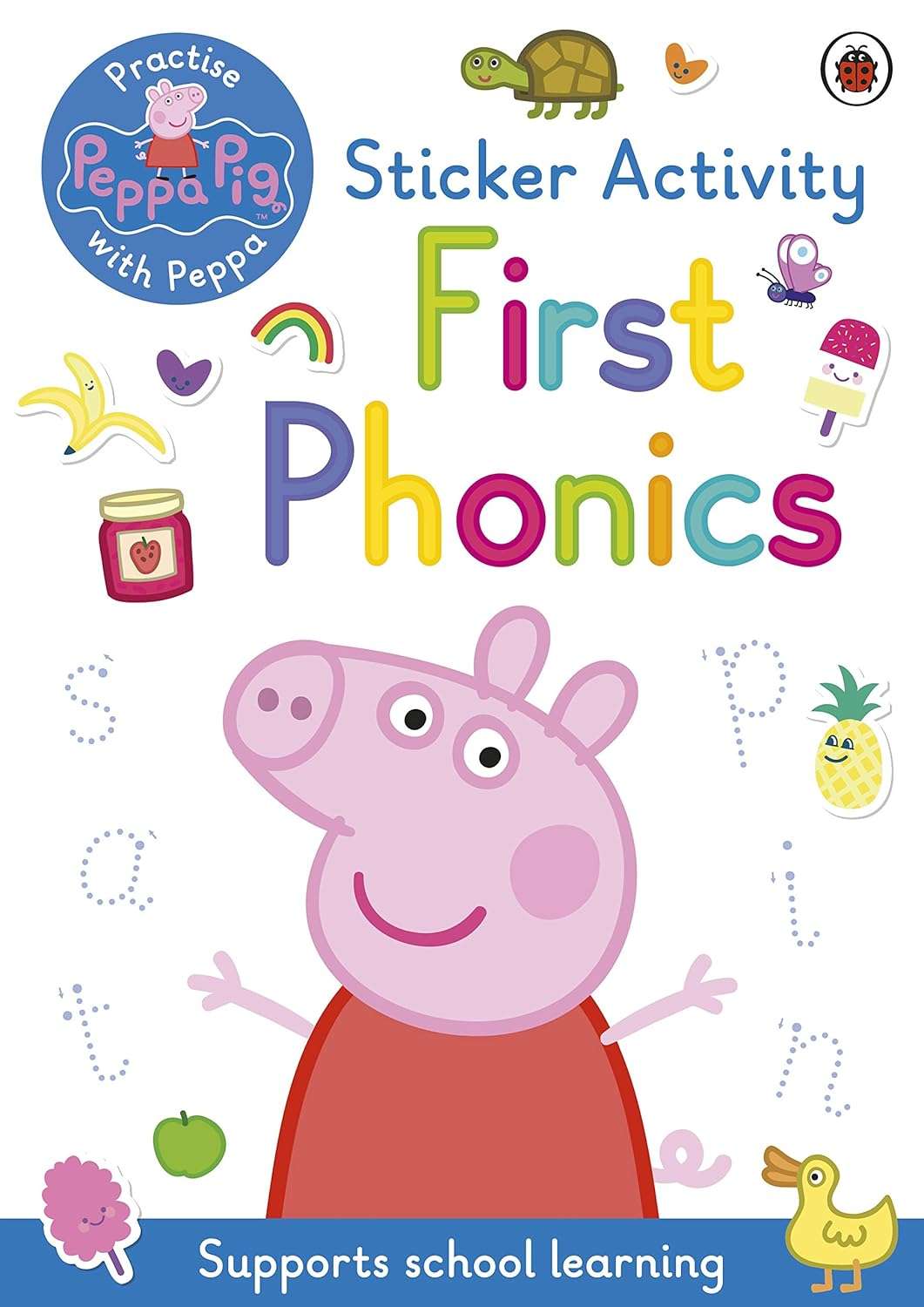
Peppa Pig: Practise with Peppa: First Phonics – Sticker Activity Book
Peppa Pig: Practise with Peppa: First Phonics is a colourful educational sticker activity book that introduces young children to their first letters and sounds. With Peppa Pig and her friends providing encouragement, children can complete structured activities that build early confidence in phonics, reading, and spelling.
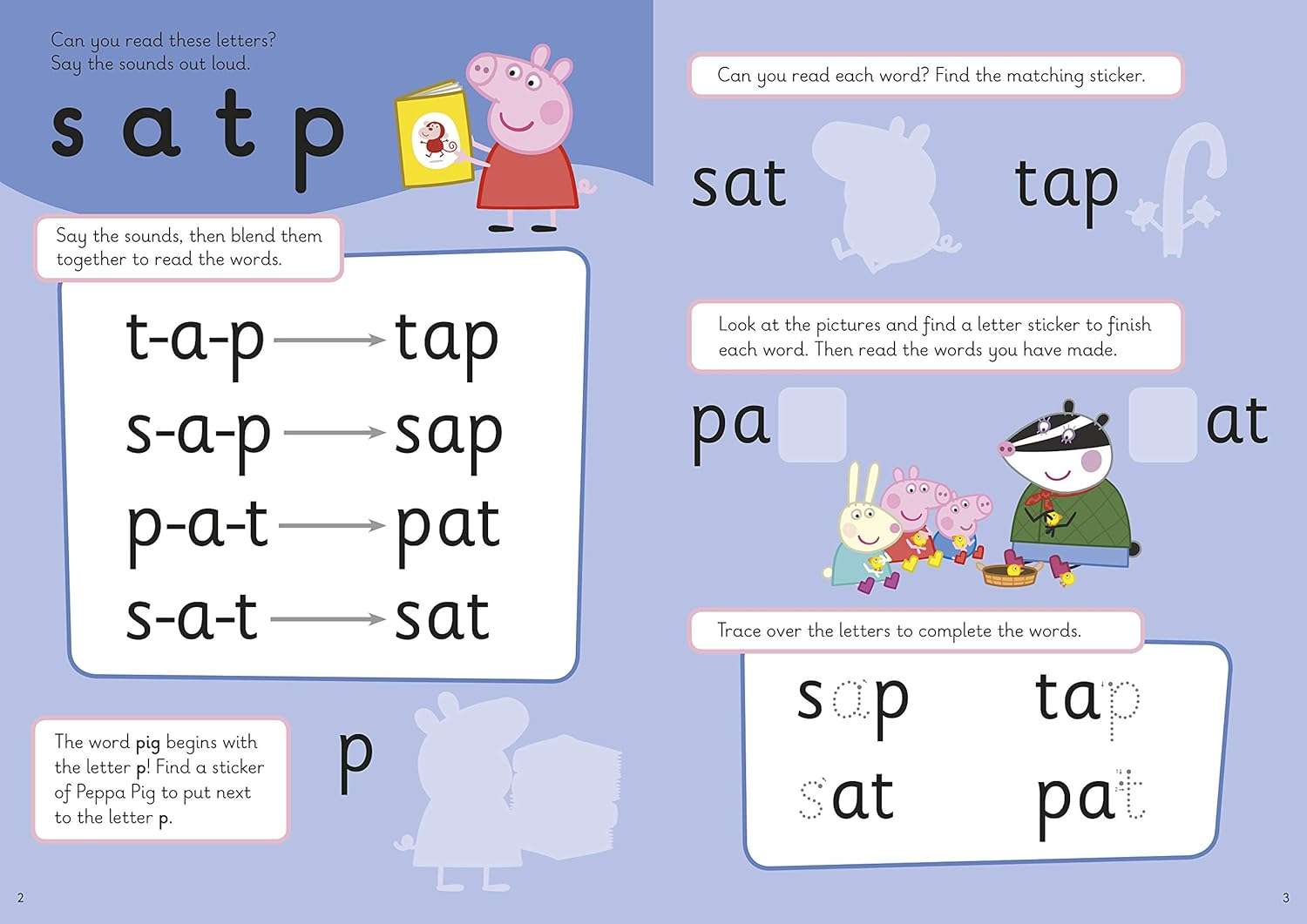
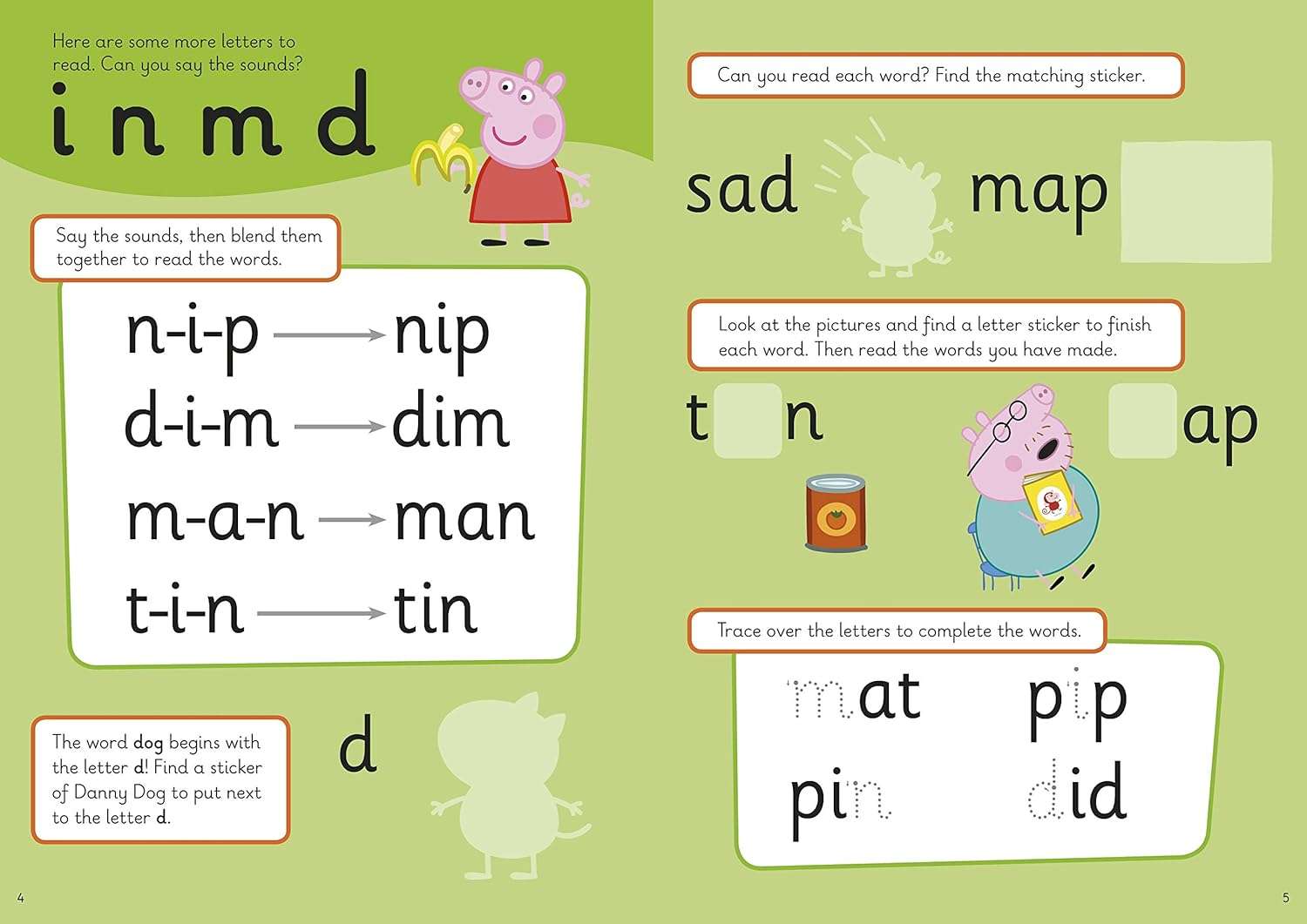
The book introduces individual letters and their associated sounds in a systematic order. Each set of activities follows a familiar structure, allowing children to concentrate on the sound being taught instead of learning a completely different activity style on every page.
Designed for children learning at home or preparing to start school, this 16-page Ladybird paperback combines early literacy practice with familiar characters and entertaining stickers. The official Penguin UK listing confirms its educational approach, physical specifications, and ISBN 9780241488430.
Learn First Phonics with Peppa Pig
Phonics teaches children to connect written letters with spoken sounds. This understanding helps young learners begin reading unfamiliar words rather than relying only on memorisation.
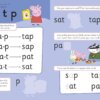
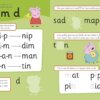
Practise with Peppa: First Phonics starts with single letters and sounds presented in a planned sequence. Children can look at a letter, listen to its sound, identify pictures or words containing it, and complete the related activity.
Parents can support each session by:
- Saying the sound clearly
- Inviting the child to repeat it
- Looking for the letter on the page
- Naming the illustrated objects
- Listening for the sound in words
- Helping with the stickers
- Praising effort and progress
- Revisiting difficult pages later
The exact letter-sound pronunciation used at the child’s school should be followed where possible, as phonics teaching methods and accents can vary.
Letters and Sounds in a Systematic Order
Instead of presenting letters randomly, the book introduces them in a systematic sequence. This allows children to build their knowledge gradually and use previously learned sounds while exploring new words.
A planned order is useful because children do not necessarily learn phonics most effectively by progressing directly from A to Z. Phonics programmes often introduce letters according to how useful they are for creating and reading early words.
The publisher does not list the precise sequence of letters in its product description, so families should check the physical pages if they need to compare the book with a particular school programme.
A Consistent Activity Structure
Every set of activities follows the same general structure. Once children understand what they are expected to do, they can focus more easily on the letter or sound being introduced.
This predictable format may help children:
- Understand instructions more quickly
- Work with greater independence
- Concentrate on the target sound
- Recognise familiar task patterns
- Build confidence through repetition
- Review skills without unnecessary confusion
Parents can complete one activity set at a time rather than attempting the entire book in a single session. Short, positive practice periods are often more manageable for preschool children.
Build Confidence in Early Reading
As children learn to connect sounds with letters, they can begin blending those sounds to read simple words. The activities in this book are designed to help learners encounter and read new vocabulary with Peppa and her friends.
Parents can encourage children to look carefully at each word, say the individual sounds, and then bring them together. If a child struggles, the adult can model the process without turning the activity into a test.
Working through the book may support:
- Letter recognition
- Sound recognition
- Listening for sounds in words
- Early blending
- Picture-and-word matching
- Vocabulary development
- Reading confidence
- Attention and concentration
Children develop at different speeds. Some may quickly remember a sound, while others need repeated exposure across several days.
Support Early Spelling Skills
Phonics is also useful for spelling. When children hear a simple word, they can begin identifying the sounds it contains and considering which letters represent them.
At this early stage, attempts do not need to be perfectly spelled. The aim is to help children understand that spoken words can be broken into sounds and represented in writing.
Adults can reinforce this idea by saying a familiar word slowly and asking:
- “What sound can you hear at the beginning?”
- “Which letter makes that sound?”
- “Can you find the matching letter?”
- “Which picture begins with this sound?”
- “Can you say another word with the same sound?”
These questions can be adapted to suit the child’s confidence and attention span.
Reinforce Learning with Stickers
Stickers add a playful reward and hands-on element to the phonics activities. Children may need to identify the correct letter, picture, or answer before placing the corresponding sticker.
This combination of learning and sticker play can make repeated practice feel more enjoyable.
Using stickers may support:
- Fine motor development
- Finger strength
- Hand-eye coordination
- Visual matching
- Spatial awareness
- Following instructions
- Independent decision-making
- Task completion
Younger children may require help peeling smaller stickers from the backing sheet. The publisher does not state the exact number of included stickers.
Familiar Peppa Pig Characters
Peppa and her friends make the learning activities feel friendly and recognisable. Children who already enjoy the television series may be more willing to attempt a new literacy task when familiar characters appear on the pages.
Adults can use the illustrations to introduce extra vocabulary and conversation. A child might name a character, explain what is happening, or identify an object beginning with the sound being practised.
The characters provide motivation, but the book’s main purpose is educational phonics practice rather than telling a complete Peppa Pig story.
Ideal for Learning at Home
Practise with Peppa: First Phonics is designed to be used at home, particularly by children preparing to start school or beginning formal literacy learning.
Parents do not need to complete the pages in one sitting. A simple home routine could involve:
- Reviewing a previously learned sound.
- Introducing one new sound.
- Completing the matching activity.
- Adding the relevant sticker.
- Finding another word containing the sound.
- Ending with encouragement.
The book can supplement school learning, but it does not replace professional teaching or a complete phonics programme.
Helpful for Children Starting School
Beginning school introduces children to new routines, expectations, and learning activities. A familiar Peppa Pig workbook can help early phonics practice feel less intimidating.
The book may be useful for:
- Preschool preparation
- Reception-year practice
- Home learning
- School-holiday revision
- Additional phonics reinforcement
- Parent-and-child learning sessions
- Early-years classrooms
- Children building reading confidence
Penguin also recommends this title among its resources for children preparing to begin school through its Ladybird school activity collection.
Developing Pencil and Activity Skills
Although this is primarily a phonics sticker book, completing page-based activities can also help children practise skills required for classroom work.
These may include:
- Following instructions
- Sitting with a task for a short period
- Looking from left to right
- Matching pictures and letters
- Controlling a pencil or crayon
- Completing an activity before moving on
- Checking answers with an adult
The paperback pages are intended for one-time written and sticker activities; they are not described as wipe-clean.
Part of the Practise with Peppa Collection
This title focuses on introductory phonics and can be used alongside other early-learning books in the series.
Companion titles named by the publisher include:
- Practise with Peppa: First Letters
- Practise with Peppa: First Words
- Practise with Peppa: First Writing
Children ready to continue their phonics journey can later progress to Practise with Peppa: Super Phonics and Practise with Peppa: Amazing Phonics, which introduce additional letters and sounds.
About Peppa Pig
Peppa Pig is a popular preschool character whose stories feature George, Mummy Pig, Daddy Pig, and many friends. Her adventures explore family life, friendship, play, new experiences, and early learning through colourful illustrations and gentle humour.
Ladybird publishes Peppa Pig picture books, activity books, board books, sticker titles, and educational resources. Additional official books can be explored through Penguin’s Peppa Pig series page.
Who Is This Phonics Book For?
This book is suitable for:
- Children aged three years and above
- Preschool learners
- Children preparing to start school
- Beginners learning letter sounds
- Young Peppa Pig fans
- Families practising phonics at home
- Early-years classrooms
- Children needing extra reading practice
The corresponding physical edition is listed for children from three years by Hatcha
Peppa Pig: Practise with Peppa: First Phonics – Sticker Activity Book
Peppa Pig: Practise with Peppa: First Phonics is a colourful educational sticker activity book that introduces young children to their first letters and sounds. With Peppa Pig and her friends providing encouragement, children can complete structured activities that build early confidence in phonics, reading, and spelling.
The book introduces individual letters and their associated sounds in a systematic order. Each set of activities follows a familiar structure, allowing children to concentrate on the sound being taught instead of learning a completely different activity style on every page.
Designed for children learning at home or preparing to start school, this 16-page Ladybird paperback combines early literacy practice with familiar characters and entertaining stickers. The official Penguin UK listing confirms its educational approach, physical specifications, and ISBN 9780241488430.
Learn First Phonics with Peppa Pig
Phonics teaches children to connect written letters with spoken sounds. This understanding helps young learners begin reading unfamiliar words rather than relying only on memorisation.
Practise with Peppa: First Phonics starts with single letters and sounds presented in a planned sequence. Children can look at a letter, listen to its sound, identify pictures or words containing it, and complete the related activity.
Parents can support each session by:
- Saying the sound clearly
- Inviting the child to repeat it
- Looking for the letter on the page
- Naming the illustrated objects
- Listening for the sound in words
- Helping with the stickers
- Praising effort and progress
- Revisiting difficult pages later
The exact letter-sound pronunciation used at the child’s school should be followed where possible, as phonics teaching methods and accents can vary.
Letters and Sounds in a Systematic Order
Instead of presenting letters randomly, the book introduces them in a systematic sequence. This allows children to build their knowledge gradually and use previously learned sounds while exploring new words.
A planned order is useful because children do not necessarily learn phonics most effectively by progressing directly from A to Z. Phonics programmes often introduce letters according to how useful they are for creating and reading early words.
The publisher does not list the precise sequence of letters in its product description, so families should check the physical pages if they need to compare the book with a particular school programme.
A Consistent Activity Structure
Every set of activities follows the same general structure. Once children understand what they are expected to do, they can focus more easily on the letter or sound being introduced.
This predictable format may help children:
- Understand instructions more quickly
- Work with greater independence
- Concentrate on the target sound
- Recognise familiar task patterns
- Build confidence through repetition
- Review skills without unnecessary confusion
Parents can complete one activity set at a time rather than attempting the entire book in a single session. Short, positive practice periods are often more manageable for preschool children.
Build Confidence in Early Reading
As children learn to connect sounds with letters, they can begin blending those sounds to read simple words. The activities in this book are designed to help learners encounter and read new vocabulary with Peppa and her friends.
Parents can encourage children to look carefully at each word, say the individual sounds, and then bring them together. If a child struggles, the adult can model the process without turning the activity into a test.
Working through the book may support:
- Letter recognition
- Sound recognition
- Listening for sounds in words
- Early blending
- Picture-and-word matching
- Vocabulary development
- Reading confidence
- Attention and concentration
Children develop at different speeds. Some may quickly remember a sound, while others need repeated exposure across several days.
Support Early Spelling Skills
Phonics is also useful for spelling. When children hear a simple word, they can begin identifying the sounds it contains and considering which letters represent them.
At this early stage, attempts do not need to be perfectly spelled. The aim is to help children understand that spoken words can be broken into sounds and represented in writing.
Adults can reinforce this idea by saying a familiar word slowly and asking:
- “What sound can you hear at the beginning?”
- “Which letter makes that sound?”
- “Can you find the matching letter?”
- “Which picture begins with this sound?”
- “Can you say another word with the same sound?”
These questions can be adapted to suit the child’s confidence and attention span.
Reinforce Learning with Stickers
Stickers add a playful reward and hands-on element to the phonics activities. Children may need to identify the correct letter, picture, or answer before placing the corresponding sticker.
This combination of learning and sticker play can make repeated practice feel more enjoyable.
Using stickers may support:
- Fine motor development
- Finger strength
- Hand-eye coordination
- Visual matching
- Spatial awareness
- Following instructions
- Independent decision-making
- Task completion
Younger children may require help peeling smaller stickers from the backing sheet. The publisher does not state the exact number of included stickers.
Familiar Peppa Pig Characters
Peppa and her friends make the learning activities feel friendly and recognisable. Children who already enjoy the television series may be more willing to attempt a new literacy task when familiar characters appear on the pages.
Adults can use the illustrations to introduce extra vocabulary and conversation. A child might name a character, explain what is happening, or identify an object beginning with the sound being practised.
The characters provide motivation, but the book’s main purpose is educational phonics practice rather than telling a complete Peppa Pig story.
Ideal for Learning at Home
Practise with Peppa: First Phonics is designed to be used at home, particularly by children preparing to start school or beginning formal literacy learning.
Parents do not need to complete the pages in one sitting. A simple home routine could involve:
- Reviewing a previously learned sound.
- Introducing one new sound.
- Completing the matching activity.
- Adding the relevant sticker.
- Finding another word containing the sound.
- Ending with encouragement.
The book can supplement school learning, but it does not replace professional teaching or a complete phonics programme.
Helpful for Children Starting School
Beginning school introduces children to new routines, expectations, and learning activities. A familiar Peppa Pig workbook can help early phonics practice feel less intimidating.
The book may be useful for:
- Preschool preparation
- Reception-year practice
- Home learning
- School-holiday revision
- Additional phonics reinforcement
- Parent-and-child learning sessions
- Early-years classrooms
- Children building reading confidence
Penguin also recommends this title among its resources for children preparing to begin school through its Ladybird school activity collection.
Developing Pencil and Activity Skills
Although this is primarily a phonics sticker book, completing page-based activities can also help children practise skills required for classroom work.
These may include:
- Following instructions
- Sitting with a task for a short period
- Looking from left to right
- Matching pictures and letters
- Controlling a pencil or crayon
- Completing an activity before moving on
- Checking answers with an adult
The paperback pages are intended for one-time written and sticker activities; they are not described as wipe-clean.
Part of the Practise with Peppa Collection
This title focuses on introductory phonics and can be used alongside other early-learning books in the series.
Companion titles named by the publisher include:
- Practise with Peppa: First Letters
- Practise with Peppa: First Words
- Practise with Peppa: First Writing
Children ready to continue their phonics journey can later progress to Practise with Peppa: Super Phonics and Practise with Peppa: Amazing Phonics, which introduce additional letters and sounds.
About Peppa Pig
Peppa Pig is a popular preschool character whose stories feature George, Mummy Pig, Daddy Pig, and many friends. Her adventures explore family life, friendship, play, new experiences, and early learning through colourful illustrations and gentle humour.
Ladybird publishes Peppa Pig picture books, activity books, board books, sticker titles, and educational resources. Additional official books can be explored through Penguin’s Peppa Pig series page.
Who Is This Phonics Book For?
This book is suitable for:
- Children aged three years and above
- Preschool learners
- Children preparing to start school
- Beginners learning letter sounds
- Young Peppa Pig fans
- Families practising phonics at home
- Early-years classrooms
- Children needing extra reading practice
The corresponding physical edition is listed for children from three years by H rds.
Important Safety Information
Warning: Not suitable for children under 36 months because the stickers contain small parts that may present a choking hazard.
Adult supervision is recommended. Keep loose stickers and backing materials away from babies and younger children. This safety warning is confirmed on the corresponding edition listing at Hatchards.
These publication specifications are confirmed by the official Penguin UK product page.


Reviews
There are no reviews yet.