
No products in the cart.
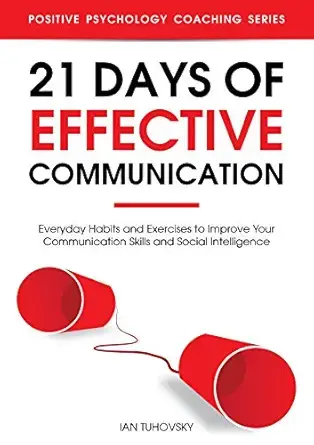
21 Days of Effective Communication by Ian Tuhovsky


රු1,650.00
3 X Rs. 550.00 or 8% Cashback with


or 3 X රු550.00 with


or up to 4 X රු412.50 with


Improve your everyday communication with 21 Days of Effective Communication by Ian Tuhovsky.
This practical self-help guide uses short exercises and habit-building strategies to help readers work on:
- Listening skills
- Conversation confidence
- Social intelligence
- Asking better questions
- Building stronger relationships
- Communicating ideas more clearly
Designed as an accessible 21-day programme, it focuses on practical application rather than complex theory.
Paperback | 124–126 pages depending on catalogue convention | CreateSpace | ISBN 9781722158804
5 in stock
21 Days of Effective Communication by Ian Tuhovsky
21 Days of Effective Communication by Ian Tuhovsky is a practical self-development guide designed to help readers examine everyday communication habits and build more effective ways of listening, speaking, asking questions and interacting with others.
Rather than presenting communication as a talent that some people naturally possess and others do not, the book approaches it as a collection of habits that can be practised and improved over time.
The full subtitle—Everyday Habits and Exercises to Improve Your Communication Skills and Social Intelligence—captures the structure of the book well. Google Books classifies the title under business communication, communication and social skills, and personal growth.
A 21-Day Practical Structure
The main idea behind the book is simple: instead of trying to transform every aspect of communication at once, readers work through practical ideas and exercises over a period of approximately three weeks.
The author focuses on everyday situations rather than highly technical communication theory.
Topics promoted in the publisher description include:
- Becoming a better listener
- Building stronger personal and professional relationships
- Asking more effective questions
- Communicating with greater confidence
- Improving social awareness
- Changing unhelpful communication habits
- Expressing support more effectively
- Handling social situations with greater ease
- Using language more deliberately
Google Play describes the book as a step-by-step guide intended to produce practical improvements through short, actionable exercises.
Listening More Effectively
One of the key communication skills emphasized throughout the book is listening.
Many conversations become less effective because participants are preparing their own responses rather than paying close attention to what the other person is saying.
Tuhovsky encourages readers to become more deliberate listeners and to pay attention not only to words but also to emotional context and the needs behind a conversation.
This can be useful in:
- Workplace discussions
- Friendships
- Family conversations
- Customer interactions
- Romantic relationships
- Social situations
Good listening is widely recognised as an important interpersonal skill, although the book’s specific exercises should be understood as practical self-help techniques rather than universally validated clinical interventions.
Confidence and Social Intelligence
Another major focus is communication confidence.
People may know what they want to say but still struggle to express themselves clearly, particularly in stressful or unfamiliar situations.
The book aims to help readers identify habits that may reduce confidence and replace them with more deliberate behaviours.
It also uses the concept of social intelligence, which broadly refers to understanding social situations and interacting effectively with other people.
Readers are encouraged to pay attention to how their language, questions, reactions and listening habits affect the quality of communication.
Questions, Persuasion and Engagement
The book also discusses the way questions can influence conversations.
Good questions can help clarify what someone means, encourage deeper discussion and prevent misunderstandings.
Tuhovsky also writes about persuasion and engagement. These sections are framed as techniques for communicating ideas more effectively rather than manipulating people.
Readers should approach persuasion ethically, particularly in personal and professional relationships where power differences or sensitive decisions may be involved.
Gratitude, Mindset and Communication
Some parts of the book connect communication with broader self-development ideas such as gratitude, mindset and personal attitude.
The promotional description makes strong claims about gratitude improving mood, mindset and well-being.
These should be understood carefully.
Research in positive psychology does suggest that gratitude practices can be associated with aspects of well-being for some people, but claims that a particular exercise will produce dramatic or guaranteed emotional improvements should not be treated as established scientific fact.
Similarly, a 21-day communication programme may help some readers practise useful habits, but there is no scientific rule that complex communication behaviour becomes permanently transformed after exactly 21 days.
The book is best viewed as a structured self-help programme, not a clinical psychology textbook.
Practical Rather Than Academic
A major feature of 21 Days of Effective Communication is its accessibility.
The author deliberately avoids highly technical language and presents the material as exercises and practical suggestions that can be tried immediately.
Google Play describes the book as avoiding lengthy theory, complicated processes and excessive jargon.
This makes it particularly suitable for readers who want an approachable introduction rather than an academic study of communication science.
Health and Psychology Note
The book includes discussion of areas such as emotional support, mindset, mindfulness and well-being.
The author’s own published disclaimer explicitly states that the book is not intended to provide medical advice, diagnose conditions or replace treatment from qualified health professionals.
Readers dealing with significant anxiety, depression, relationship abuse, trauma or other mental-health concerns should not rely on a communication self-help book as a substitute for appropriate professional support.
About Ian Tuhovsky
Ian Tuhovsky is a self-development author whose books cover communication, confidence, mindfulness, emotional intelligence, self-discipline and personal growth.
His author descriptions present him as someone interested in social psychology, mindfulness, sociology, communication and conscious self-development, while also noting professional experience in human resources consulting.
His related books include:
- Communication Skills Training
- Confidence
- Self-Discipline
- The Power of Mental Discipline
- Mindfulness
Google Play currently places 21 Days of Effective Communication as Book 1 in a broader communication-skills sequence.
Who Will Enjoy This Book?
This book may particularly appeal to:
- Students
- Professionals
- Managers
- Sales and customer-service staff
- Readers interested in personal development
- People wanting to improve listening skills
- Readers building confidence in conversations
- People interested in communication and social intelligence
Its large-format layout and exercise-driven structure may also make it useful as a workbook-style personal-development title.
Buy 21 Days of Effective Communication in Sri Lanka
For readers looking to buy 21 Days of Effective Communication by Ian Tuhovsky in Sri Lanka, ISBN 9781722158804 is the 2018 CreateSpace paperback edition.
The book provides a practical, structured introduction to communication habits, listening, confidence and social interaction. It is best suited to readers who want actionable exercises rather than academic theory.
Be the first to review “21 Days of Effective Communication by Ian Tuhovsky”
Related products

Personal Development
රු1,400.00
3 X Rs. 466.67 or 8% Cashback with
or 3 X රු466.67 with
or up to 4 X රු350.00 with
රු1,550.00
3 X Rs. 516.67 or 8% Cashback with
or 3 X රු516.67 with
or up to 4 X රු387.50 with
Reviews
There are no reviews yet.