
No products in the cart.
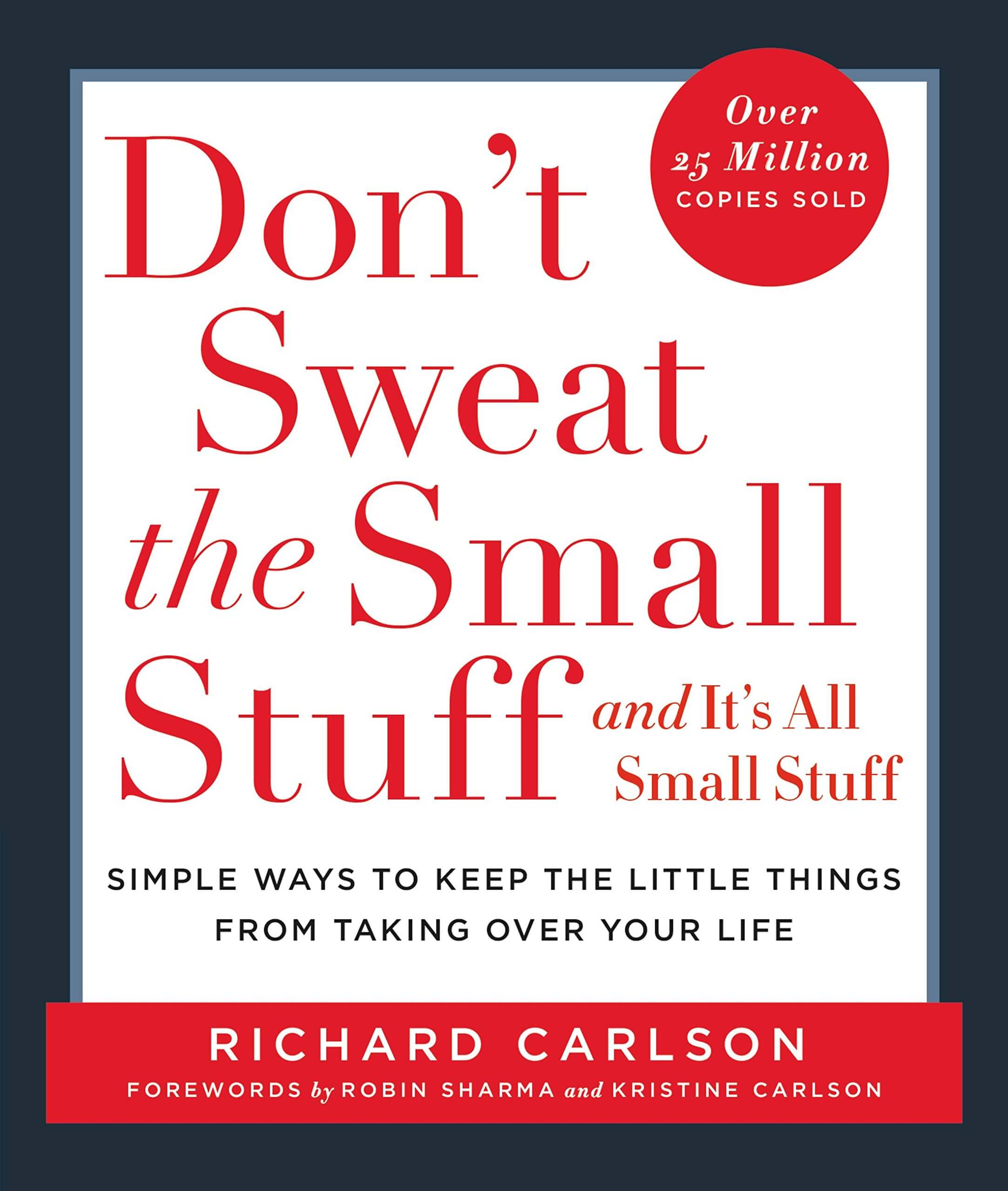
Don’t Sweat the Small Stuff . . . and It’s All Small Stuff by Richard Carlson (hardcover)

රු2,400.00
3 X Rs. 800.00 or 8% Cashback with


or 3 X රු800.00 with


or up to 4 X රු600.00 with


Learn to put everyday frustrations into perspective with Don’t Sweat the Small Stuff . . . and It’s All Small Stuff by Richard Carlson.
This classic self-help guide offers short, practical reflections on:
- Reducing everyday stress
- Accepting imperfection
- Living in the present
- Becoming more patient
- Improving relationships
- Choosing your battles wisely
- Letting go of minor frustrations
- Focusing on what truly matters
Its simple, accessible chapters are designed to help readers approach ordinary life with greater calm and perspective.
Trade Paperback | 272 pages | Hachette / Balance | ISBN 9780786881857
8 in stock
Don’t Sweat the Small Stuff by Richard Carlson
Don’t Sweat the Small Stuff . . . and It’s All Small Stuff by Richard Carlson is a bestselling self-help classic about learning to put everyday frustrations into perspective and living with greater calm, patience and awareness.
The book’s full subtitle—Simple Ways to Keep the Little Things from Taking Over Your Life—captures its central idea.
Many of the things that create daily frustration are relatively small when viewed in the context of an entire life.
Traffic.
A difficult conversation.
A mistake.
An unfinished task.
Someone behaving inconsiderately.
A plan that does not go exactly as expected.
Carlson encourages readers to notice when those small problems begin consuming disproportionate amounts of attention and emotional energy.
Hachette describes the book as a practical guide to putting challenges into perspective, reducing everyday stress through small changes and focusing more clearly on the things that matter.
Small Changes Rather Than Dramatic Reinvention
One reason Don’t Sweat the Small Stuff has remained popular is its simple structure.
The book does not ask readers to completely rebuild their lives overnight.
Instead, Carlson presents many short reflections and practical ideas that can be applied gradually.
The approach includes themes such as:
- Choosing battles carefully
- Accepting imperfection
- Staying present
- Becoming more patient
- Listening more carefully
- Reducing unnecessary urgency
- Giving other people credit
- Letting go of minor frustrations
- Paying attention to relationships
- Remembering what matters most
The official publisher description highlights practices such as living in the present, making peace with imperfection and learning not to let ordinary frustrations dominate daily life.
Putting Problems Into Perspective
The phrase “don’t sweat the small stuff” does not mean pretending that serious problems do not exist.
Rather, Carlson encourages readers to distinguish between problems that genuinely deserve significant attention and those that become stressful primarily because of how much mental energy we give them.
A small inconvenience can easily become the focus of an entire day.
A disagreement can continue long after it has served any useful purpose.
A desire to make everything perfect can create more stress than the original problem.
Carlson’s approach is to reduce this unnecessary mental escalation.
Accepting Imperfection
Perfectionism is another recurring theme.
People may believe that they will finally feel relaxed once:
- Every task is completed
- Every problem is solved
- Everyone agrees with them
- Their home is perfectly organised
- Their career reaches a particular point
- Their relationships become completely conflict-free
But everyday life rarely provides that kind of permanent completion.
There is almost always another task, another deadline or another challenge.
Carlson encourages readers to become more comfortable with imperfection rather than postponing peace until everything is exactly right.
Living in the Present
The book also emphasises present-moment awareness.
People often spend large amounts of time thinking about what already happened or worrying about what might happen next.
Carlson encourages greater attention to the experience immediately in front of us.
That does not mean abandoning planning or responsibility.
It means recognising when thinking about yesterday or tomorrow prevents someone from participating fully in today.
The official Don’t Sweat the Small Stuff organisation describes the philosophy as learning to keep minor problems from taking over life and making calmer choices about what deserves attention.
Relationships and Patience
Many chapters focus on relationships.
Small disagreements often grow because both people feel the need to:
- Prove they are right
- Defend themselves immediately
- Correct every detail
- Win an argument
- Respond emotionally before listening
Carlson encourages a less reactive approach.
Sometimes allowing another person to speak, accepting a small imperfection or choosing not to escalate a disagreement can improve a relationship more than proving a point.
These ideas apply across:
- Family relationships
- Friendships
- Romantic relationships
- Workplaces
- Everyday encounters with strangers
Slowing Down the Sense of Urgency
Modern life can make nearly everything feel urgent.
Emails.
Messages.
Deadlines.
Appointments.
Phone calls.
Work problems.
Carlson asks readers to consider whether every task truly requires the same level of emotional intensity.
The book suggests that living in a constant emergency mindset can make ordinary life more difficult than necessary.
By consciously reducing that sense of urgency, people may approach tasks more calmly and deliberately.
Choosing Your Battles
Not every disagreement deserves the same amount of energy.
One of Carlson’s recurring ideas is learning to decide which issues genuinely matter.
Some conflicts require action.
Others can simply be released.
This principle can apply to:
- Workplace disagreements
- Family arguments
- Minor inconveniences
- Different opinions
- Everyday mistakes
The intention is not passivity.
It is selective attention.
Readers are encouraged to reserve their emotional energy for situations that genuinely deserve it.
Gratitude and Perspective
Carlson also encourages readers to remember that many daily annoyances become less significant when placed in a wider perspective.
This may involve thinking about:
- Relationships
- Health
- Time
- Meaningful work
- Family
- Personal values
- The temporary nature of many frustrations
That broader perspective can make it easier to respond to everyday problems without allowing them to dominate the entire day.
Short, Accessible Chapters
The book is particularly approachable because its ideas are divided into short sections.
Readers do not necessarily need to read the book in long sessions.
A chapter can be read quickly and then considered throughout the day.
This makes it suitable for readers who prefer:
- Brief self-help chapters
- Daily reflection
- Practical reminders
- Accessible personal-development writing
- Books that can be revisited over time
Rather than building one long technical argument, Carlson presents a collection of small mindset shifts.
A Self-Help Classic
Hachette describes Don’t Sweat the Small Stuff as a groundbreaking inspirational guide and a classic of the self-help genre.
The original title became the foundation for a larger collection of Don’t Sweat the Small Stuff books dealing with subjects such as:
- Family
- Work
- Relationships
- Money
- Parenting
- Love
The official Don’t Sweat website describes the wider collection as more than twenty titles built around the same philosophy of keeping everyday difficulties in perspective.
Self-Help Rather Than Clinical Treatment
Although Don’t Sweat the Small Stuff frequently discusses stress, worry, calmness and emotional perspective, it should be categorised as a general self-help and personal-development book.
It is not a clinical mental-health treatment manual.
Carlson’s strategies are intended as practical reflections for everyday life.
Readers experiencing severe anxiety, depression, trauma or other significant mental-health difficulties should not treat a general self-help book as a substitute for qualified professional care.
This distinction is useful when describing the book accurately in a bookstore catalogue.
About Richard Carlson
Richard Carlson, PhD was an author and speaker known particularly for writing about stress reduction, happiness and personal perspective.
His Don’t Sweat the Small Stuff series became an international publishing success and expanded into more than twenty related titles.
Current publisher material describes Carlson as a prominent writer and speaker on happiness and stress reduction who appeared frequently on television and radio.
Other books associated with his work include:
- Don’t Sweat the Small Stuff at Work
- Don’t Sweat the Small Stuff with Your Family
- Don’t Sweat the Small Stuff in Love
- Slowing Down to the Speed of Life
- You Can Be Happy No Matter What
Carlson died in 2006 at the age of 45.
Who Will Enjoy Don’t Sweat the Small Stuff?
This book may especially appeal to readers interested in:
- Self-help
- Personal development
- Stress management
- Mindfulness
- Positive thinking
- Emotional wellbeing
- Perspective
- Relationships
- Productivity without excessive stress
- Simple daily habits
Its short chapters and straightforward writing also make it accessible to readers who do not normally read long personal-development books.
Buy Don’t Sweat the Small Stuff in Sri Lanka
For readers looking to buy Don’t Sweat the Small Stuff by Richard Carlson in Sri Lanka, ISBN 9780786881857 identifies the long-running trade paperback edition originally published in 1997.
Current Hachette metadata lists 272 pages, while exact physical-book records place the book at approximately 0.18–0.20 kg with a compact trim of roughly 16.5 × 14.0 cm.
Be the first to review “Don’t Sweat the Small Stuff . . . and It’s All Small Stuff by Richard Carlson (hardcover)”
Related products

Self Help
රු1,800.00
3 X Rs. 600.00 or 8% Cashback with
or 3 X රු600.00 with
or up to 4 X රු450.00 with

Non-Fiction & Knowledge
රු1,700.00
3 X Rs. 566.67 or 8% Cashback with
or 3 X රු566.67 with
or up to 4 X රු425.00 with
Out of stock
Non-Fiction & Knowledge
රු1,600.00
3 X Rs. 533.33 or 8% Cashback with
or 3 X රු533.33 with
or up to 4 X රු400.00 with

Christianity
රු1,400.00
3 X Rs. 466.67 or 8% Cashback with
or 3 X රු466.67 with
or up to 4 X රු350.00 with
-9%

Non-Fiction & Knowledge
Original price was: රු1,750.00.රු1,600.00Current price is: රු1,600.00.
3 X Rs. 533.33 or 8% Cashback with
or 3 X රු533.33 with
or up to 4 X රු400.00 with

Non-Fiction & Knowledge
රු1,700.00
3 X Rs. 566.67 or 8% Cashback with
or 3 X රු566.67 with
or up to 4 X රු425.00 with

Out of stock
Personal Development
රු1,850.00
3 X Rs. 616.67 or 8% Cashback with
or 3 X රු616.67 with
or up to 4 X රු462.50 with
-20%

Out of stock
Original price was: රු2,500.00.රු2,000.00Current price is: රු2,000.00.
3 X Rs. 666.67 or 8% Cashback with
or 3 X රු666.67 with
or up to 4 X රු500.00 with
Reviews
There are no reviews yet.