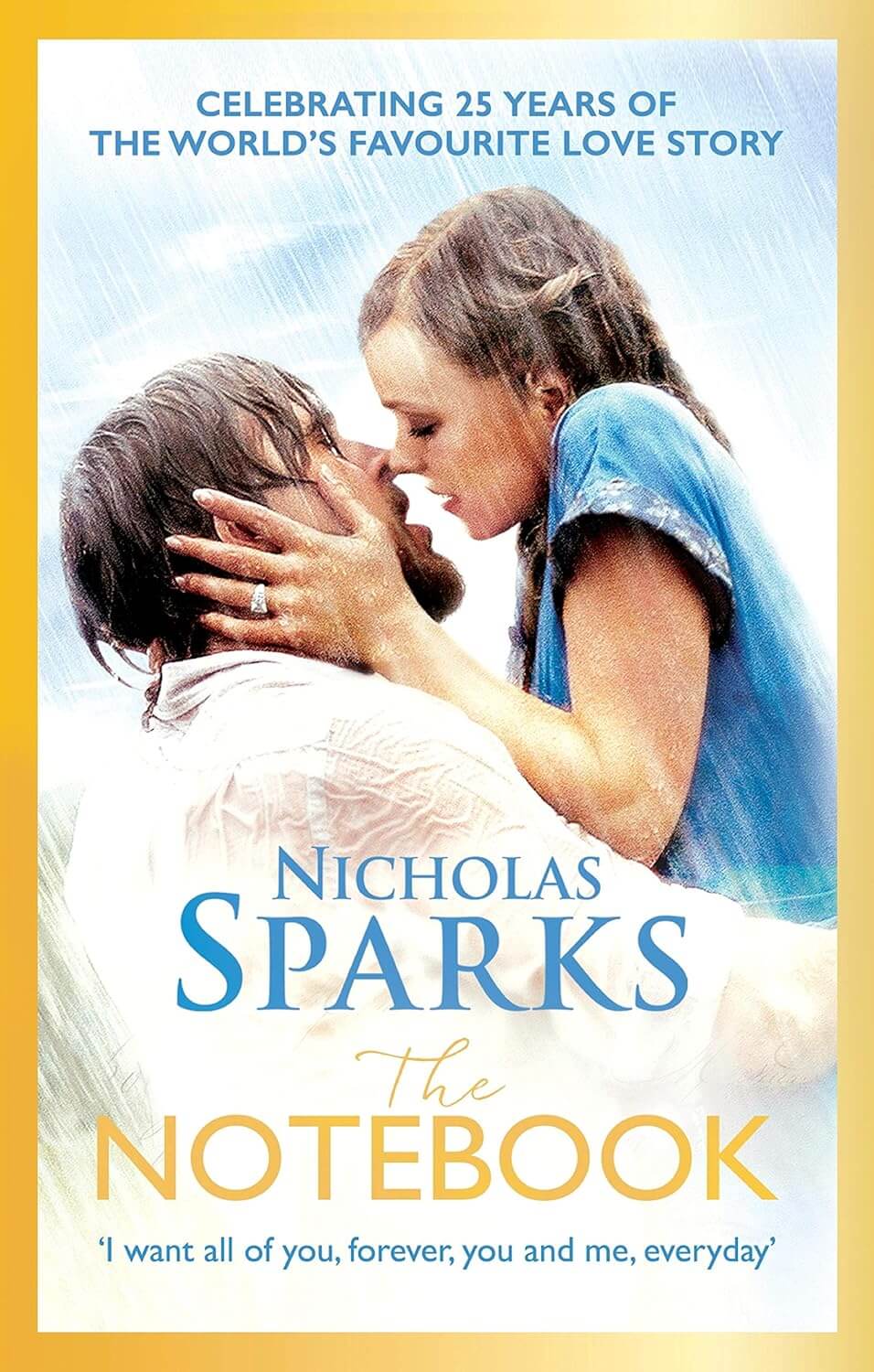
The Notebook by Nicholas Sparks is an emotional and timeless romance about first love, separation, second chances, memory and the extraordinary commitment required to continue loving someone through the changes of an entire lifetime.
In coastal North Carolina in 1946, Noah Calhoun has returned home after serving in World War II.
He is thirty-one.
He lives quietly.
He is restoring an old house.
And despite the years that have passed, he has never truly forgotten one summer—or one girl.
Her name is Allie Nelson.
Fourteen years earlier, Noah and Allie fell deeply in love.
They came from very different backgrounds.
Noah had little money.
Allie came from a wealthier family whose expectations for her future did not include him.
The relationship ended.
Time passed.
Their lives moved in different directions.
Then Allie unexpectedly returns.
She is now engaged to another man.
Her wedding is approaching.
She has built a life that appears sensible and secure.
But seeing Noah again forces her to confront emotions she believed belonged to the past.
Was their first love only a beautiful memory?
Or was it something neither of them ever truly left behind?
The Notebook by Nicholas Sparks begins as a story of young love reunited, but gradually becomes something much larger—a moving exploration of devotion, aging, memory and what it means to continue choosing another person even when life becomes painfully difficult.
The Notebook by Nicholas Sparks – Book Overview
The Notebook by Nicholas Sparks is one of the best-known modern romantic novels and the book that launched Nicholas Sparks’ publishing career.
Sparks wrote the novel before its publication in 1996, and it later became one of the works most closely associated with his name.
The story operates on more than one timeline.
Readers first encounter an older man with a notebook.
He is reading a story aloud to an elderly woman.
That story takes readers into Noah and Allie’s past.
Gradually, the connection between the reader, the woman and the love story becomes clear.
This structure makes memory itself part of the novel.
The notebook is not simply an object.
It becomes a way of preserving a life.
Noah Calhoun
Noah is introduced as a man still deeply connected to his past.
He has returned from war and is restoring an old house in North Carolina.
Outwardly, his life appears quiet.
Internally, the memory of Allie remains powerful.
He remembers the summer they spent together.
Their conversations.
Their arguments.
Their attraction.
The sense that she understood a part of him few other people could reach.
Noah’s love is not portrayed only through dramatic declarations.
It is also visible through patience, memory and persistence.
Allie Nelson
Allie comes from a different social world.
She has greater financial security and stronger expectations placed upon her.
As a young woman, loving Noah meant challenging assumptions about:
Class.
Family.
Marriage.
Respectability.
Her future.
Years later, she has apparently followed a more conventional path.
She is engaged.
Her life looks organized.
Then Noah reappears emotionally, and Allie has to reconsider whether the life that looks correct from the outside is the life she truly wants.
A Summer Romance That Never Completely Ended
Noah and Allie’s relationship begins when they are young.
Young love can sometimes be dismissed as temporary.
People say:
You will grow out of it.
You will meet someone else.
Life will move on.
For Noah and Allie, life does move on.
But emotion does not disappear as easily.
That becomes one of the central tensions in The Notebook by Nicholas Sparks.
First Love
First love has a unique emotional power because it is often connected with discovery.
The first time someone makes you feel fully seen.
The first time attraction becomes something deeper.
The first time the future seems connected to another person.
Even when that relationship ends, the memory can remain unusually vivid.
Separation
Noah and Allie do not simply fall out of love.
External circumstances contribute to their separation.
Family expectations matter.
Class matters.
Distance matters.
Communication matters.
Timing matters.
That makes their eventual reunion emotionally complicated.
Social Class
Class is an important obstacle in the story.
Allie’s family sees Noah as socially unsuitable.
This creates one of the novel’s recurring questions:
How much should family expectations determine whom someone loves?
Parents may believe they are protecting a child.
The child may experience the same decision as control.
Family Expectations
Families often imagine futures for their children.
Education.
Career.
Marriage.
Social status.
But adulthood eventually requires a person to ask:
Which part of this future is actually mine?
Allie’s return to Noah forces her to confront that question.
The Letters
Communication becomes an especially important part of Noah and Allie’s history.
Their separation is affected not only by distance but by information that does not reach its intended destination.
This gives the story a painful lesson:
Relationships can be changed by what people do not know.
Silence does not always mean indifference.
Sometimes the missing information matters most.
Second Chances
The Notebook by Nicholas Sparks is one of the most famous examples of second-chance romance.
Noah and Allie are not meeting for the first time.
They already have history.
That creates a very different romantic dynamic.
They remember:
What worked.
What hurt.
What was lost.
A second chance carries both hope and risk.
Can You Return to the Past?
Not exactly.
Even when two people reunite, they are not the same people they were years earlier.
Time changes them.
Experience changes them.
Their circumstances change.
The real question is not whether Noah and Allie can recreate one summer exactly.
It is whether the people they have become can still choose one another.
Allie’s Engagement
Allie’s situation is complicated because she is engaged to someone else.
That prevents the story from being a simple reunion.
She must confront a genuine choice.
One future represents:
Stability.
Approval.
Security.
A life that fits expectations.
The other represents:
History.
Passion.
Emotional truth.
And uncertainty.
Choice
Love stories often emphasize fate.
But The Notebook by Nicholas Sparks also emphasizes choice.
Feelings matter.
But people still have to decide what to do with those feelings.
Love does not remove responsibility.
The choices people make affect more than themselves.
Noah’s House
The house Noah restores has strong symbolic meaning.
It is more than property.
It represents:
Memory.
Hope.
A promised future.
Persistence.
The life Noah once imagined.
Restoring the house becomes connected with restoring something within himself.
Home
The idea of home appears repeatedly.
Home can mean a building.
A town.
A person.
A memory.
Noah’s house becomes emotionally powerful because it connects physical place with the relationship he never fully forgot.
North Carolina Setting
The novel’s coastal North Carolina setting gives the story much of its atmosphere.
Water.
Old houses.
Quiet landscapes.
Summer memories.
Storms.
The natural environment creates a romantic backdrop without overwhelming the character-driven story.
Nicholas Sparks’ official description specifically places the central reunion in coastal North Carolina in 1946.
Memory
Memory becomes increasingly important as The Notebook by Nicholas Sparks progresses.
At first, memory means remembering a youthful romance.
Later, memory becomes something much more fragile.
What happens when the events that made a life meaningful become difficult to remember?
Does love depend entirely on memory?
That question gives the novel its deepest emotional dimension.
The Notebook Itself
The notebook preserves a story.
Names.
Events.
Love.
A shared past.
When human memory becomes unreliable, written words can preserve what the mind may temporarily lose.
This makes storytelling itself an act of love.
Love and Aging
Many romance novels focus almost entirely on falling in love.
The Notebook by Nicholas Sparks goes further.
It asks what happens after the beginning.
What does love look like when people age?
When health changes?
When memory becomes unreliable?
When romance requires caregiving?
That is why the story often affects readers beyond the central reunion.
Alzheimer’s Disease and Memory Loss
The later portions of the story involve serious cognitive decline and memory loss associated with Alzheimer’s disease.
This changes the meaning of the notebook.
Reading is no longer merely remembering happy times.
It becomes an attempt to reach someone whose memories have become difficult to access.
The novel approaches this through romance rather than medical explanation.
Readers looking for clinical information about dementia should use medical sources rather than treating the novel as a health guide.
Love as Care
Romantic love is often represented through:
Kisses.
Dates.
Passion.
Grand gestures.
The later part of The Notebook by Nicholas Sparks presents another form of love.
Care.
Patience.
Repetition.
Remaining present.
That form of devotion may be less glamorous, but it can be more demanding.
Commitment
Commitment matters because feelings naturally change from day to day.
A long relationship eventually encounters:
Stress.
Illness.
Loss.
Aging.
Disappointment.
Commitment means that love exists not only in ideal moments.
The Difference Between Romance and Partnership
Romance asks:
Do we feel strongly about each other?
Partnership asks:
Can we build a life together?
The novel gradually moves from one question toward the other.
Noah and Allie’s youthful passion matters.
But their later devotion gives that passion a deeper meaning.
Sacrifice
Love sometimes requires sacrifice.
But healthy sacrifice should not automatically mean destroying yourself for someone else.
The emotional power of the novel comes from seeing characters make meaningful choices for people and relationships they value deeply.
Time
Time is almost another character in the novel.
Fourteen years separate Noah and Allie’s youthful romance from their reunion.
Then much more time passes.
That structure allows readers to see love at different stages of life.
Young love feels urgent.
Older love carries history.
Regret
Allie must confront the possibility of regret.
If she follows the expected path, will she always wonder about Noah?
If she changes direction, what will she give up?
Many difficult decisions are painful because there is no option that preserves everything.
The Life You Choose
Adulthood often means choosing between competing possibilities.
You cannot live every future.
Eventually, a decision closes some doors.
That gives Allie’s choice emotional weight.
Authenticity
A major theme in The Notebook by Nicholas Sparks is the difference between living according to expectations and living according to inner truth.
But authenticity is not simply doing whatever feels good in the moment.
Real choices have consequences.
The challenge is deciding which consequences you are willing to accept.
Passion Versus Security
The novel places passion and security in tension.
This is a classic romantic theme.
The familiar option may be safe.
The emotionally powerful option may be uncertain.
Sparks uses that tension to force Allie into a difficult examination of what she values most.
Love After Separation
The novel does not suggest that every former relationship should be restarted.
Sometimes relationships end for good reasons.
But Noah and Allie’s story asks a narrower question:
What happens when two people separated by circumstance discover that their emotional connection survived?
That is the foundation of its second-chance appeal.
Why Readers Find the Story Emotional
Readers already understand from the frame narrative that the love story carries significance beyond one summer.
That creates emotional anticipation.
Even happy scenes can feel bittersweet because the reader understands that time will eventually change everything.
The Older Couple
The older timeline transforms the story.
Without it, The Notebook might simply be a romantic reunion novel.
With it, the book becomes about what happens to love across decades.
That shift explains much of its enduring emotional reputation.
Storytelling as Connection
The older man reads the notebook repeatedly.
Storytelling becomes a bridge between:
Past and present.
Memory and forgetting.
Youth and age.
Reader and listener.
This is one reason the title works so effectively.
Hope
Despite grief and illness, The Notebook by Nicholas Sparks is ultimately built around hope.
Hope that people can reconnect.
Hope that love can survive change.
Hope that memory may temporarily return.
Hope that meaningful moments still matter even when they cannot last forever.
Is The Notebook a True Story?
No. It is a novel.
However, Nicholas Sparks has discussed personal inspirations behind his writing, and the book draws emotional power from recognizable experiences involving love, aging and long-term commitment.
It should still be categorized as fiction rather than biography.
Is The Notebook a Standalone?
The central Noah and Allie story can be read as a complete novel.
Nicholas Sparks later wrote The Wedding, which is connected to The Notebook through family relationships and is generally treated as a companion/sequel.
You do not need to read The Wedding to understand The Notebook by Nicholas Sparks.
Begin with The Notebook.
Do You Need to Read Nicholas Sparks Books in Order?
No.
Most Nicholas Sparks novels are standalone stories.
You can start directly with The Notebook by Nicholas Sparks without reading Message in a Bottle, A Walk to Remember or any of his other novels first.
Is The Notebook a Romance?
Yes.
It is primarily a romance / contemporary romantic drama.
However, its exploration of aging, illness, memory and long-term devotion gives it a broader emotional scope than a straightforward courtship story.
Is It a Sad Book?
It is emotionally intense and includes sadness, illness and loss.
Readers frequently describe it as heartbreaking as well as romantic.
If you prefer romance where every chapter remains light and cheerful, this may not be the best match.
Is It Spicy?
There is romantic and sexual content, but the book’s main emphasis is emotional intimacy rather than explicit erotic detail.
It is generally much more focused on:
Love.
Memory.
Commitment.
Separation.
Reunion.
The Notebook Movie
The Notebook was adapted into the famous 2004 film directed by Nick Cassavetes.
The film stars:
Ryan Gosling as young Noah.
Rachel McAdams as young Allie.
James Garner as the older Noah.
Gena Rowlands as the older Allie.
Nicholas Sparks’ official site confirms the adaptation and describes the movie as based on his bestselling novel.
Book Versus Movie
The film follows the novel’s core love story but naturally changes and dramatizes certain scenes for cinema.
Reading The Notebook by Nicholas Sparks gives readers more direct access to:
Interior thoughts.
Narrative reflection.
The role of memory.
The emotional perspective of the older characters.
Fans of the film may therefore enjoy experiencing the original source material.
Should You Read the Book Before Watching the Movie?
If possible, yes.
Reading first allows you to experience the structure and emotional revelations in the form Sparks originally created.
However, readers who already know the film can still enjoy the novel because the emotional experience of prose is different from cinema.
Nicholas Sparks
Nicholas Sparks is an American novelist particularly known for emotionally intense romantic fiction.
His works include The Notebook, Message in a Bottle, A Walk to Remember, Nights in Rodanthe, Dear John, The Last Song, Safe Haven, The Best of Me and many others.
His official biography notes that The Notebook was published in 1996 and became the first of his published novels, helping launch a career in which his books have sold widely around the world.
Themes in The Notebook
The Notebook by Nicholas Sparks explores first love, second chances, memory, aging, commitment, social class, family expectations, choice, regret, devotion, illness, caregiving, identity, time, sacrifice and the difference between remembering someone and continuing to love them.
Content Considerations
Readers should be aware that The Notebook by Nicholas Sparks includes emotionally sensitive material involving dementia/Alzheimer’s-related memory loss, aging, serious illness, grief, death, wartime background, family conflict, relationship conflict and sexual/romantic content.
The treatment is primarily emotional rather than graphic.
7 Powerful Reasons to Read The Notebook by Nicholas Sparks
- Noah and Allie’s second-chance romance has real emotional history. Their reunion matters because readers understand that years of separation did not completely erase what they shared.
- The story explores love beyond the honeymoon stage. The novel is not interested only in falling in love; it also asks what devotion looks like across decades, aging and illness.
- Memory gives the romance unusual depth. The notebook becomes a way of preserving identity, history and connection when ordinary memory begins to fail.
- The conflict between love and expectation feels timeless. Allie must decide whether to follow the future others expect from her or confront what she genuinely wants.
- The North Carolina setting creates a memorable romantic atmosphere. The restored house, water, summer memories and quieter landscape help give the story its nostalgic mood.
- It is the original story behind the famous film. Readers who know Ryan Gosling and Rachel McAdams’ adaptation can experience Noah and Allie’s relationship in Nicholas Sparks’ original novel.
- Its deepest message is about continuing to choose someone. Attraction begins Noah and Allie’s story, but persistence, caregiving and memory transform it into a broader portrait of enduring love.
Why Read The Notebook by Nicholas Sparks?
The Notebook by Nicholas Sparks is an excellent choice for readers who enjoy emotional romance, second-chance love stories, Nicholas Sparks novels, books about first love, stories adapted into famous films and romances that continue beyond the beginning of a relationship.
It may particularly appeal to readers who enjoyed A Walk to Remember, Dear John, The Best of Me, Me Before You or other emotionally intense love stories centered on difficult choices and lasting relationships.
But the main appeal goes beyond romance.
The novel asks something deeply human:
If someone you love can no longer remember the life you shared, what remains?
Noah’s answer is not philosophical.
He reads.
He stays.
He tells the story again.
That simple act gives the novel its emotional identity.
Who Should Read This Book?
The Notebook by Nicholas Sparks may especially appeal to romance readers, Nicholas Sparks fans, readers who enjoy second-chance romance, fans of emotional fiction, people who loved the 2004 movie, readers interested in stories about memory and aging, and anyone who enjoys short, accessible novels with strong emotional impact.
Readers who prefer light romantic comedy should know that this story has a much more bittersweet emotional tone.
The Notebook by Nicholas Sparks – A Love Story That Memory Cannot Easily Erase
The Notebook by Nicholas Sparks begins with a man reading from an old notebook.
That image tells us almost everything important about the novel.
Someone wrote the story down because remembering mattered.
Noah and Allie’s love begins when they are young.
For a brief time, the future seems simple.
Then the real world intervenes.
Family.
Money.
Distance.
Expectation.
Time.
They separate.
Years pass.
They become different people.
Then Allie returns.
At first, the central question appears to be:
Will they choose each other again?
But eventually, a much harder question emerges.
What happens when love survives longer than memory?
That is where the novel moves beyond ordinary romantic fantasy.
Young Noah and Allie represent the excitement of falling in love.
Older Noah and Allie represent the cost of remaining committed to that love through circumstances neither could have imagined when they first met.
The notebook itself becomes evidence.
This happened.
We loved.
We built a life.
Even if memory disappears, the story remains.
That is why The Notebook by Nicholas Sparks continues to resonate with readers decades after its original publication.
It is not simply a story about finding the right person.
It is a story about time.
Choice.
Memory.
Care.
And the hope that love can remain meaningful even when life changes almost everything else.
Learn more about The Notebook by Nicholas Sparks on Nicholas Sparks’ official website.
Explore more romance books at Bargain Books.


Reviews
There are no reviews yet.