
No products in the cart.
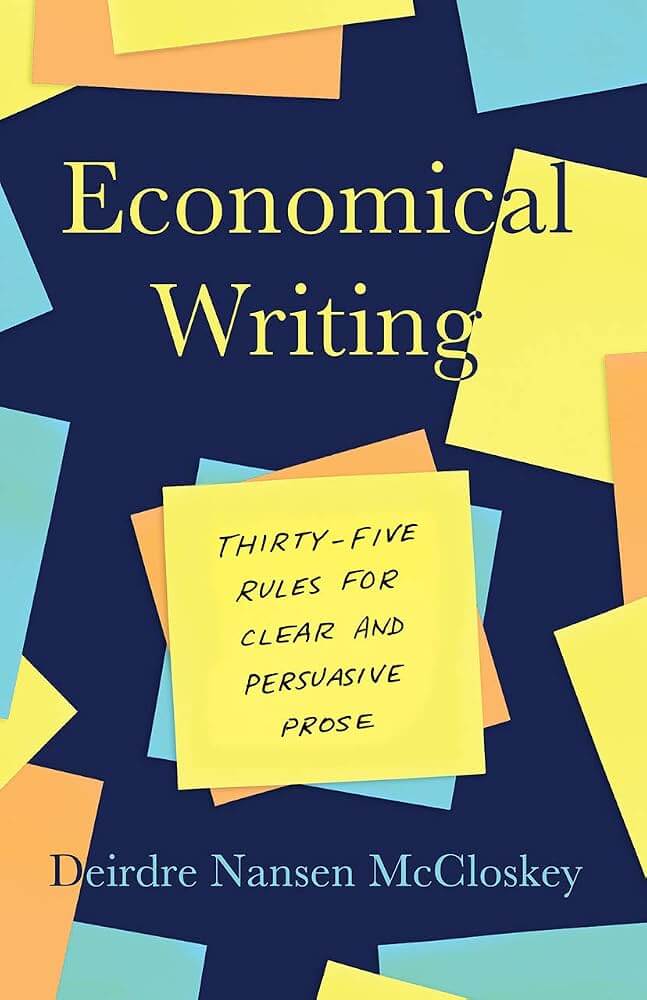
Economical Writing: Thirty-Five Rules for Clear and Persuasive Prose by Deirdre Nansen McCloskey – Third Edition
රු2,250.00
3 X Rs. 750.00 or 8% Cashback with


or 3 X රු750.00 with


or up to 4 X රු562.50 with


Improve your academic, professional and business writing with Economical Writing by Deirdre Nansen McCloskey.
This concise guide presents 35 practical rules for making prose:
- Clearer
- Shorter
- More persuasive
- Better organised
- Easier to read
- More effective
The book covers everything from large-scale argument and structure to paragraphs, sentences, individual words and revision.
Ideal for students, researchers, economists, business professionals and anyone who wants to communicate ideas more clearly.
Third Edition | Paperback | 176 pages | University of Chicago Press | ISBN 9780226448077
3 in stock
Purchase & earn 23 points!
Category: Academic Writing
Economical Writing by Deirdre Nansen McCloskey
Economical Writing: Thirty-Five Rules for Clear and Persuasive Prose by Deirdre Nansen McCloskey is a compact and practical guide to writing clearly, efficiently and persuasively.
Although the book grew from McCloskey’s experience in economics and academic writing, its advice is useful far beyond economics.
It is designed for:
- University students
- Researchers
- Economists
- Academics
- Business professionals
- Entrepreneurs
- Report writers
- Journal authors
- Anyone who wants to make complicated ideas easier to understand
The University of Chicago Press describes the book as a collection of thirty-five concise rules that move from large questions about purpose and argument to practical improvements at the level of paragraphs, sentences and individual words.
Why Clear Writing Matters
Many people assume that difficult subjects require difficult writing.
McCloskey argues against that idea.
A complicated argument does not become more intelligent simply because it is written in long sentences or filled with unnecessary jargon.
Good writing should help the reader understand the idea.
That means writers need to think carefully about:
- What they are actually trying to say
- Who the audience is
- Which details matter
- Which words can be removed
- How arguments are organised
- Whether a sentence is clear on the first reading
The title Economical Writing therefore works on two levels.
The book is associated strongly with economics, but it is also about being economical with language.
Use fewer unnecessary words.
Make every sentence contribute.
Thirty-Five Rules for Better Prose
The third edition is built around thirty-five rules.
These are not presented as rigid commandments.
McCloskey frequently challenges traditional writing advice and encourages writers to understand why a rule exists rather than following it mechanically.
The book moves from broad principles toward detailed editing.
Readers can expect advice about:
- Purpose
- Audience
- Structure
- Argument
- Paragraphs
- Sentences
- Word choice
- Revision
- Style
- Academic conventions
- Footnotes
- Jargon
- Repetition
- Clarity
- Concision
The University of Chicago Press emphasises that the book progresses from “big-picture” writing issues to concrete strategies for revision.
Writing Is Revision
One of the most important ideas in Economical Writing is that clear prose is usually not produced perfectly on the first attempt.
Strong writing comes through revision.
That may involve:
- Cutting unnecessary words
- Moving information
- Rewriting weak sentences
- Removing repeated ideas
- Making the main argument more visible
- Changing abstract language into direct language
- Improving transitions
- Checking whether examples actually support the point
McCloskey treats editing as part of thinking.
If a writer cannot express an idea clearly, that may indicate the idea itself still needs clarification.
Academic Writing Without Unnecessary Complexity
Academic writing is often criticised for becoming difficult to read.
Writers sometimes believe that complicated vocabulary or long sentences make an argument appear more serious.
McCloskey argues that this usually weakens communication.
A strong academic argument should still be readable.
This is especially useful for:
- Essays
- Research papers
- Theses
- Dissertations
- Journal articles
- Economics papers
- Business reports
- Policy documents
The University of Chicago Press places the book in its Chicago Guides to Writing, Editing, and Publishing series and categorises it for graduate students, scholars and writers working in economics and related disciplines.
Useful Beyond Economics
Despite the title, Economical Writing is not only for economists.
The official publisher description explicitly notes that its lessons apply to writing on economics or any other subject.
Clear communication is valuable anywhere people need to explain ideas.
That includes:
- Business proposals
- Professional emails
- Reports
- Research
- Articles
- Presentations
- Marketing
- Policy writing
- Technical communication
For entrepreneurs and managers, clarity can be especially important because confusing writing can create confusing decisions.
Tone and Style
McCloskey does not write like a dry grammar manual.
The book is known for being conversational, witty and opinionated.
She challenges stale conventions and sometimes mocks habits that academic writers treat too seriously.
The result is a writing guide that is meant to be read, not simply consulted.
The University of Chicago Press describes the third edition as efficient, digestible, humorous and provocative.
Paragraphs, Sentences and Words
The book becomes increasingly practical as it moves toward the sentence level.
Writers are encouraged to ask:
- Can this sentence be shorter?
- Is the subject clear?
- Is the verb strong?
- Does this paragraph have one main job?
- Is this technical term necessary?
- Can an abstract phrase be replaced with a direct one?
- Does the reader know why this information matters?
This type of editing can improve both academic and professional writing.
Avoiding Jargon
Technical vocabulary is sometimes necessary.
Economics, law, medicine, engineering and other fields all have specialist terminology.
The problem is not technical language itself.
The problem appears when jargon is used unnecessarily or when writers use complicated language where simple language would communicate the same idea better.
McCloskey encourages writers to choose words based on clarity rather than status.
Persuasion Matters
Clear writing is not only about grammar.
It is also about persuasion.
A reader must understand:
- What you are claiming
- Why the claim matters
- What evidence supports it
- How each section connects
- What conclusion follows
This makes Economical Writing useful not only for students but also for people writing:
- Business cases
- Research proposals
- Investor material
- Policy analysis
- Professional reports
- Analytical essays
Third Edition
ISBN 9780226448077 belongs to the Third Edition, published by the University of Chicago Press in 2019.
This edition includes an appendix by Stephen T. Ziliak.
BiblioVault, the University of Chicago Press’s distribution platform, confirms the paper ISBN and separately lists the electronic ISBN 9780226448107.
For WooCommerce, the supplied ISBN should therefore be listed as:
Physical Paperback – Third Edition
not eBook.
About Deirdre Nansen McCloskey
Deirdre Nansen McCloskey is an economist, historian and writer known for work on economics, rhetoric, history and liberal thought.
The University of Chicago Press and Google Books identify her as the author of numerous works including:
- The Bourgeois Virtues
- Bourgeois Dignity
- Bourgeois Equality
- Crossing: A Memoir
- The Secret Sins of Economics
- If You’re So Smart
Her experience writing across economics, history and the humanities gives Economical Writing its interdisciplinary approach.
Who Will Enjoy Economical Writing?
This book may particularly appeal to readers interested in:
- Academic writing
- Economics
- Business writing
- Research
- Editing
- Clear communication
- Persuasive writing
- Graduate study
- Professional writing
- Writing improvement
It is especially suitable for readers who want a short, practical writing guide rather than a large technical style manual.
Buy Economical Writing in Sri Lanka
For readers looking to buy Economical Writing by Deirdre Nansen McCloskey in Sri Lanka, ISBN 9780226448077 identifies the Third Edition paperback from the University of Chicago Press.
The edition contains 176 pages and is designed as a concise reference for writers who want clearer, more direct and more persuasive prose.
Reviews
There are no reviews yet.