
No products in the cart.
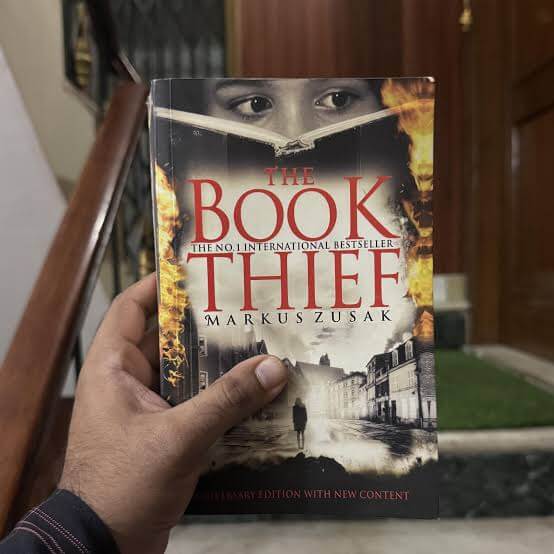
The Book Thief by Markus Zusak

රු1,950.00
3 X Rs. 650.00 or 8% Cashback with


or 3 X රු650.00 with


or up to 4 X රු487.50 with


The Book Thief by Markus Zusak is a moving historical novel about Liesel Meminger, a young girl growing up in Nazi Germany whose growing love of books gives her comfort, friendship and courage during World War II.
Narrated by Death, the novel explores the power of words, human kindness, grief and survival.
Format: Paperback
Pages: 560
Publisher: Black Swan / Transworld
ISBN: 9780552779739
15 in stock
The Book Thief by Markus Zusak
The Book Thief by Markus Zusak is a powerful historical novel set in Nazi Germany during the Second World War.
The story follows Liesel Meminger, a young girl sent to live with a foster family on Himmel Street.
Liesel arrives at a frightening and uncertain moment in history.
Her world is shaped by:
- War
- Poverty
- Political fear
- Loss
- Friendship
- Books
- The power of words
One of the novel’s most unusual features is its narrator:
Death.
Penguin UK describes the story as following nine-year-old Liesel as she lives with a foster family in Nazi Germany, steals books and experiences life as war and bombing transform her community.
Liesel Meminger
Liesel is at the emotional centre of the novel.
At the beginning of the story, she has already experienced significant loss.
She is separated from her original family and sent to live with foster parents:
- Hans Hubermann
- Rosa Hubermann
Liesel initially struggles with fear, grief and uncertainty.
Over time, her new home becomes a place where she forms important relationships.
Hans Hubermann
Hans becomes one of the most important people in Liesel’s life.
He is patient, compassionate and gentle.
One of the most meaningful parts of their relationship is the way he helps Liesel learn to read.
Books gradually become a source of:
- Comfort
- Escape
- Knowledge
- Connection
Hans’s kindness stands in contrast to the fear and cruelty surrounding the characters.
Rosa Hubermann
Rosa is often loud, blunt and difficult.
But beneath that harsh exterior is a more complicated character.
Her relationship with Liesel develops gradually.
The novel shows that love and care do not always appear in obvious forms.
Rudy Steiner
Liesel also becomes close to Rudy Steiner, her neighbour and friend.
Rudy brings humour, loyalty and youthful energy to a story set against an increasingly dangerous historical background.
Their friendship becomes one of the emotional foundations of the novel.
The Importance of Books
Books are central to the story.
Liesel begins stealing books at important moments in her life.
For her, books become more than objects.
They become connected to:
- Memory
- Resistance
- Friendship
- Education
- Identity
- Survival
The act of reading gives Liesel access to a different kind of power.
The Power of Words
Words are one of the novel’s biggest themes.
In Nazi Germany, language is used as a political tool.
Speeches, propaganda and slogans help influence entire populations.
But words can also provide:
- Comfort
- Hope
- Understanding
- Resistance
The novel repeatedly contrasts destructive uses of language with compassionate and creative ones.
Nazi Germany
The story is set during one of the darkest periods of modern European history.
Characters live under the Nazi regime and experience:
- Propaganda
- Antisemitism
- Fear
- Political control
- War
- Bombing
- Persecution
The historical setting is essential to understanding the pressures placed on the characters.
A Dangerous Secret
As the story develops, Liesel’s foster family becomes involved in a secret that could place them in serious danger.
This brings the realities of Nazi persecution directly into Liesel’s home.
The novel examines how ordinary people respond when laws and social systems demand cruelty or silence.
Death as Narrator
The narrator is one of the most distinctive parts of The Book Thief.
Death observes human beings during a period when millions are dying.
Rather than being presented simply as terrifying, Death is reflective and often puzzled by people.
This unusual perspective allows Zusak to explore:
- Mortality
- Violence
- Compassion
- Memory
- Human contradiction
It also gives the novel a voice unlike most conventional historical fiction.
Friendship
Friendship is essential to the story.
Liesel survives emotionally because of the relationships she builds.
The novel shows how small acts of kindness can become deeply meaningful during periods of fear.
Friendship provides a counterweight to the violence taking place around the characters.
Loss and Grief
Grief is present throughout the novel.
Characters lose:
- Family
- Homes
- Safety
- Certainty
- People they love
But the book is not only about loss.
It also explores how people continue living despite loss.
Courage
Courage in The Book Thief is often quiet.
It may involve:
- Offering food
- Protecting someone
- Speaking kindly
- Sharing a book
- Refusing to become completely numb
The novel shows that courage does not always look dramatic.
Sometimes small moral choices carry enormous consequences.
Historical Fiction
Although the characters are fictional, the historical setting is real.
The novel is rooted in the realities of:
- Nazi Germany
- World War II
- Jewish persecution
- Air raids
- Political indoctrination
Readers should therefore expect emotionally difficult material.
Content Considerations
The novel includes themes involving:
- War
- Death
- Grief
- Antisemitism
- Nazi persecution
- Bombing
- Violence
- Family separation
The material can be emotionally intense, particularly for younger readers.
However, the novel handles these subjects through a strong focus on humanity, friendship and the role of stories.
Film Adaptation
The Book Thief was adapted into a major motion picture.
This specific ISBN 9780552779739 is marketed as a film tie-in paperback edition.
Who May Enjoy This Book?
The Book Thief may appeal to readers interested in:
- Historical fiction
- World War II fiction
- Literary fiction
- Coming-of-age stories
- Books about friendship
- Books about reading
- Emotionally powerful novels
It may especially appeal to readers who enjoyed:
- All the Light We Cannot See
- The Boy in the Striped Pyjamas
- The Nightingale
- The Tattooist of Auschwitz
About Markus Zusak
Markus Zusak is an Australian author best known for The Book Thief.
Penguin notes that his books have been translated into more than forty languages and have achieved significant international success.
His books include:
- The Book Thief
- I Am the Messenger
- Bridge of Clay
For readers looking to buy The Book Thief by Markus Zusak in Sri Lanka, ISBN 9780552779739 is the Black Swan paperback edition used for this listing.
Be the first to review “The Book Thief by Markus Zusak”
Related products

Out of stock
Fiction & Literature
රු1,750.00
3 X Rs. 583.33 or 8% Cashback with
or 3 X රු583.33 with
or up to 4 X රු437.50 with

Classics & Literary Fiction
රු1,750.00
3 X Rs. 583.33 or 8% Cashback with
or 3 X රු583.33 with
or up to 4 X රු437.50 with

Classics & Literary Fiction
රු1,650.00
3 X Rs. 550.00 or 8% Cashback with
or 3 X රු550.00 with
or up to 4 X රු412.50 with

Out of stock
Adventure Fiction
Death on the Nile – Film Tie-In Edition | Agatha Christie Paperback
රු2,400.00
3 X Rs. 800.00 or 8% Cashback with
or 3 X රු800.00 with
or up to 4 X රු600.00 with

Classics & Literary Fiction
රු1,650.00
3 X Rs. 550.00 or 8% Cashback with
or 3 X රු550.00 with
or up to 4 X රු412.50 with
-18%

Out of stock
Fiction & Literature
Original price was: රු2,750.00.රු2,250.00Current price is: රු2,250.00.
3 X Rs. 750.00 or 8% Cashback with
or 3 X රු750.00 with
or up to 4 X රු562.50 with

Out of stock
Children & Young Adult
රු3,200.00
3 X Rs. 1,066.67 or 8% Cashback with
or 3 X රු1,066.67 with
or up to 4 X රු800.00 with
-24%

Contemporary romance
Original price was: රු2,100.00.රු1,600.00Current price is: රු1,600.00.
3 X Rs. 533.33 or 8% Cashback with
or 3 X රු533.33 with
or up to 4 X රු400.00 with
Reviews
There are no reviews yet.