
No products in the cart.
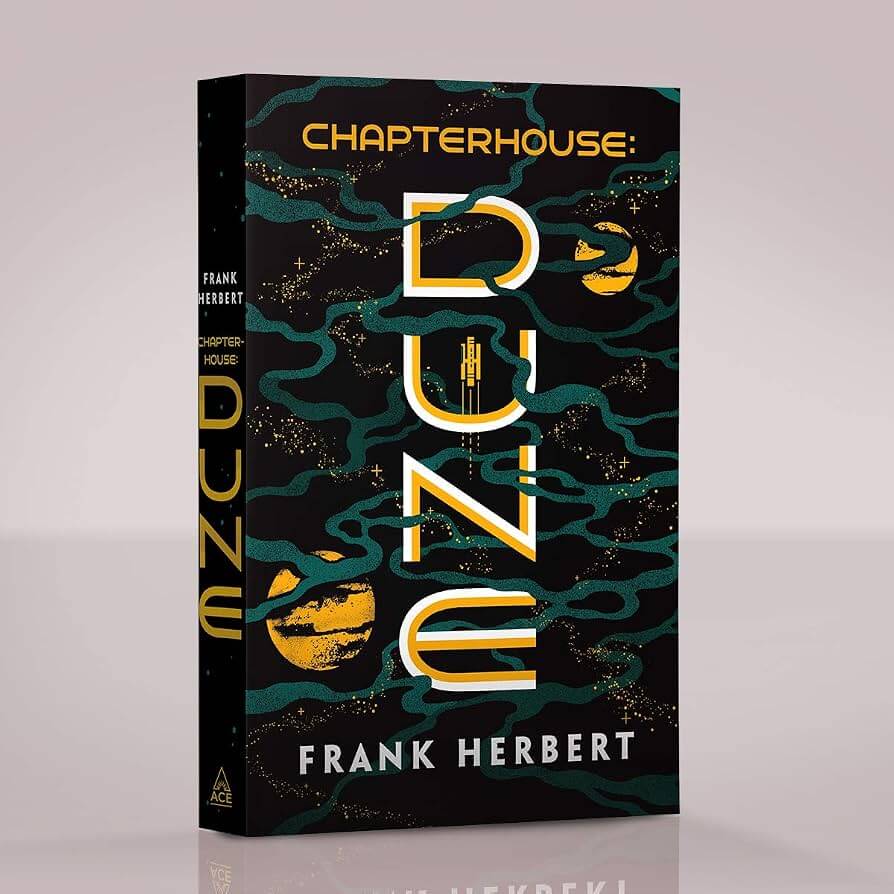
Chapterhouse: Dune by Frank Herbert

රු2,950.00
3 X Rs. 983.33 or 8% Cashback with


or 3 X රු983.33 with


or up to 4 X රු737.50 with


The desert planet Arrakis has been destroyed, the Honored Matres are expanding across the remnants of the Old Empire, and the Bene Gesserit face a struggle for survival.
On the planet Chapterhouse, the Sisterhood is transforming a green world into desert in an attempt to create a new home for sandworms and secure the future of spice production.
Chapterhouse: Dune is the sixth and final Dune novel completed by Frank Herbert, continuing directly from Heretics of Dune.
Featuring:
- Bene Gesserit
- Honored Matres
- Duncan Idaho
- Darwi Odrade
- Sandworms and spice
- Interstellar politics
- Ecology and religion
- Epic science-fiction worldbuilding
Dune Series – Book 6 | Trade Paperback | 512 pages | Ace | ISBN 9780593201770
5 in stock
Chapterhouse: Dune by Frank Herbert
Chapterhouse: Dune is the sixth novel in Frank Herbert’s original Dune series and the final Dune novel he completed before his death in 1986.
First published in 1985, it continues directly from the events of Heretics of Dune and takes the epic conflict surrounding the Bene Gesserit, the Honored Matres, spice, sandworms and humanity’s far-reaching future into a new and dangerous phase. Google Books identifies the original novel as the sixth and final book of Herbert’s six-volume Dune sequence.
The edition with ISBN 9780593201770 is the 2020 Ace trade paperback, containing 512 pages.
The Dune Universe Has Changed
By the time of Chapterhouse: Dune, the universe readers first encountered in Dune has transformed dramatically.
Arrakis—the desert planet once known simply as Dune—has been destroyed.
The political structures of the Old Empire have weakened, and new forces have emerged from the Scattering.
Among the most dangerous are the Honored Matres, an aggressive organisation whose expansion threatens almost every remaining power capable of resisting them.
One group remains particularly important:
The Bene Gesserit.
The Sisterhood that has influenced politics, bloodlines, religion and power for generations now finds itself fighting for survival.
Penguin Random House describes the Honored Matres as consuming the remnants of the Old Empire while leaving the Bene Gesserit as one of the few meaningful threats to their conquest.
The Planet Chapterhouse
The Bene Gesserit have established themselves on a green world known as Chapterhouse.
But they are doing something extraordinary to it.
They are deliberately transforming the planet into a desert.
Their objective is tied to one of the most important substances in the entire Dune universe:
spice melange.
Spice has shaped politics, commerce, power, longevity and interstellar civilisation throughout the series.
Without control of its production, the balance of power can change completely.
The Bene Gesserit therefore attempt to establish a new ecological system capable of supporting sandworms and, eventually, spice production.
The official publisher description explains that the Sisterhood is converting Chapterhouse into desert terrain so that it can breed sandworms and gain control over the production of melange.
Darwi Odrade and the Bene Gesserit
At the centre of much of the novel is Mother Superior Darwi Odrade.
Odrade carries responsibility for the future of the Bene Gesserit at a moment when the Sisterhood faces extraordinary pressure.
She must consider:
- Survival of the Bene Gesserit
- The threat of the Honored Matres
- Political alliances
- Long-term breeding plans
- Control of spice
- The transformation of Chapterhouse
- The dangerous individuals under Bene Gesserit protection
- The future of humanity itself
Her decisions reflect one of the recurring ideas in Herbert’s later Dune novels: powerful organisations may plan across generations, but human beings and historical forces remain unpredictable.
The Honored Matres
The Honored Matres are one of the major forces introduced in Heretics of Dune and developed further in Chapterhouse: Dune.
They returned from the Scattering with enormous military power and methods very different from those of the Bene Gesserit.
Although both organisations are highly disciplined and politically sophisticated, their approaches to power differ significantly.
The growing conflict between them creates much of the novel’s tension.
Rather than reducing that conflict to a simple battle between good and evil, Herbert continues his wider examination of:
- Power
- Institutional survival
- Manipulation
- Leadership
- Fear
- Political strategy
- Human adaptation
Duncan Idaho and the Long History of Dune
Another crucial figure is Duncan Idaho.
Few characters illustrate the enormous historical scale of the Dune universe as clearly as Duncan.
Through the ghola technology of the Bene Tleilax, versions of Duncan have appeared across different eras of the series.
By Chapterhouse: Dune, his accumulated importance extends far beyond his original role in the first novel.
Penguin’s description refers to the Bene Gesserit’s most important weapon as a man who has lived countless lifetimes and once served within the world shaped by the Atreides.
Readers who have followed Duncan across the preceding novels will find his role here particularly significant.
Politics, Ecology and Religion
Like the earlier Dune books, Chapterhouse: Dune operates on several levels simultaneously.
It is science fiction, but it is also deeply concerned with:
Politics
Different factions compete for survival and control, using alliances, intelligence, influence and long-term planning.
Ecology
The transformation of Chapterhouse into a desert reflects one of Herbert’s oldest interests: how ecology and human civilisation affect one another.
Religion
Religious belief and religious institutions remain powerful tools within Herbert’s universe.
Power
The novel repeatedly questions what happens when institutions gain enormous power—and what they are prepared to sacrifice in order to preserve it.
Human Evolution
The Dune series consistently explores the ways humans may change biologically, culturally and socially across immense periods of time.
These themes make the novel much more than a conventional space adventure.
A Direct Continuation of Heretics of Dune
Readers should not start the original Dune series with Chapterhouse: Dune.
The book assumes considerable familiarity with the preceding novels, particularly Heretics of Dune.
The official original-series reading order is:
- Dune
- Dune Messiah
- Children of Dune
- God Emperor of Dune
- Heretics of Dune
- Chapterhouse: Dune
Penguin Random House’s Frank Herbert biography identifies these six novels as the sequence that completed Herbert’s Dune saga.
For WooCommerce, use:
Series: Dune
Book Number: 6
Frank Herbert’s Final Completed Dune Novel
Chapterhouse: Dune has special importance because it was the last Dune novel completed by Frank Herbert.
Herbert died in 1986, leaving some larger story threads unresolved.
Later, Brian Herbert and Kevin J. Anderson continued the universe with Hunters of Dune and Sandworms of Dune, works developed using material associated with Frank Herbert’s plans for a further Dune novel.
For catalogue purposes, however, Chapterhouse: Dune should clearly remain:
Book 6 of Frank Herbert’s original Dune series.
A Complex Science-Fiction Novel
This is not a light standalone science-fiction adventure.
Readers should expect:
- Political strategy
- Philosophical dialogue
- Complex factions
- Long-term plans
- Ecological transformation
- Religious themes
- Questions about power and control
- Advanced technology
- Genetic manipulation
- Interstellar politics
- Characters carrying histories spanning generations
Readers already invested in the first five novels will benefit most from the book.
About Frank Herbert
Frank Herbert was an American science-fiction author best known for creating the Dune universe.
Penguin Random House notes that Herbert began publishing science fiction in the 1950s and achieved major recognition following the publication of Dune in 1965. He went on to write Dune Messiah, Children of Dune, God Emperor of Dune, Heretics of Dune and Chapterhouse: Dune.
His work is particularly recognised for combining science fiction with:
- Ecology
- Politics
- Religion
- Philosophy
- Sociology
- Psychology
- Human evolution
The Dune saga remains one of the most influential works in modern science fiction.
Who Will Enjoy Chapterhouse: Dune?
This book may especially appeal to readers interested in:
- The Dune series
- Frank Herbert
- Space opera
- Epic science fiction
- Political science fiction
- Ecological science fiction
- Philosophical science fiction
- Bene Gesserit stories
- Complex futuristic societies
- Large-scale worldbuilding
It is particularly recommended for readers who have already completed Heretics of Dune.
Buy Chapterhouse: Dune in Sri Lanka
For readers looking to buy Chapterhouse: Dune by Frank Herbert in Sri Lanka, ISBN 9780593201770 is the Ace trade paperback edition, published on 7 July 2020.
It contains 512 pages and concludes the six-volume original Dune sequence written by Frank Herbert.
Be the first to review “Chapterhouse: Dune by Frank Herbert”
Related products

Science Fiction
රු2,250.00
3 X Rs. 750.00 or 8% Cashback with
or 3 X රු750.00 with
or up to 4 X රු562.50 with

රු2,750.00
3 X Rs. 916.67 or 8% Cashback with
or 3 X රු916.67 with
or up to 4 X රු687.50 with

Classics & Literary Fiction
රු1,550.00
3 X Rs. 516.67 or 8% Cashback with
or 3 X රු516.67 with
or up to 4 X රු387.50 with

Science Fiction
රු2,100.00
3 X Rs. 700.00 or 8% Cashback with
or 3 X රු700.00 with
or up to 4 X රු525.00 with

Out of stock
Fiction & Literature
රු9,900.00
3 X Rs. 3,300.00 or 8% Cashback with
or 3 X රු3,300.00 with
or up to 4 X රු2,475.00 with
Science Fiction
රු1,700.00
3 X Rs. 566.67 or 8% Cashback with
or 3 X රු566.67 with
or up to 4 X රු425.00 with

Science Fiction
රු2,150.00
3 X Rs. 716.67 or 8% Cashback with
or 3 X රු716.67 with
or up to 4 X රු537.50 with
Fiction & Literature
Sapiens A Graphic History Volume 2 (Hardcover) by Yuval Noah Harari
රු2,400.00
3 X Rs. 800.00 or 8% Cashback with
or 3 X රු800.00 with
or up to 4 X රු600.00 with
Reviews
There are no reviews yet.