
No products in the cart.
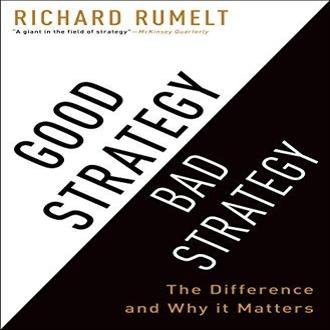
Good Startegy And Bad Startegy by Richard Rumelt

රු1,950.00
3 X Rs. 650.00 or 8% Cashback with


or 3 X රු650.00 with


or up to 4 X රු487.50 with


Good Strategy/Bad Strategy by Richard Rumelt is a highly influential business book that explains what real strategy looks like and why many organizations fail to create it. The book breaks down the difference between effective strategy and vague, ineffective planning.
Through real-world examples and clear explanations, it shows how successful strategies are built on identifying key problems, focusing resources, and taking decisive actions. It is widely considered a must-read for leaders, managers, and entrepreneurs.
4 in stock
A Practical Guide to Understanding Strategy – Good Strategy/Bad Strategy by Richard Rumelt
Good Strategy/Bad Strategy: The Difference and Why It Matters by Richard Rumelt is a powerful business and leadership book that explains what real strategy is—and what it is not. Instead of vague goals and motivational language, the book presents strategy as a clear, focused approach to solving specific problems.
The central idea of Good Strategy/Bad Strategy is that effective strategy is built on understanding challenges, making tough choices, and focusing resources where they matter most. Weak strategy, on the other hand, avoids problems and relies on broad, unclear ambitions.
Rather than confusing strategy with goals, readers learn how to think critically and act decisively.
Strategy Begins With Clear Diagnosis
One of the earliest lessons in the book is that good strategy starts with identifying the real problem. Richard Rumelt explains that many organizations fail because they do not clearly define their challenges.
Without diagnosis, actions become scattered and ineffective. The book teaches that understanding the core issue allows leaders to create focused and meaningful plans.
Instead of guessing, readers learn to analyze situations deeply before acting.
The Three Elements of Good Strategy
The book organizes its guidance into a simple but powerful framework known as the “kernel” of strategy.
Readers learn that good strategy includes:
- A clear diagnosis of the problem
- A guiding policy to address it
- Coherent actions to implement the solution
Because this structure is practical and logical, Good Strategy/Bad Strategy feels actionable rather than theoretical.
The Difference Between Good and Bad Strategy
A major strength of the book is its clear distinction between effective and ineffective strategy.
Bad strategy often includes:
- Vague goals and buzzwords
- Lack of focus
- Ignoring real challenges
- Trying to do everything at once
Good strategy, however, focuses on solving key problems with clarity and discipline.
Readers discover that strategy is not about ambition—it is about direction and choice.
Focus and Decision-Making
No organization has unlimited resources. Good Strategy/Bad Strategy explains that success depends on focusing efforts where they will have the greatest impact.
The book teaches leaders to make tough decisions, prioritize effectively, and avoid spreading resources too thin.
Through this approach, businesses achieve stronger and more sustainable results.
Strategy in the Modern World
Modern businesses operate in complex and competitive environments. Good Strategy/Bad Strategy addresses how organizations can navigate uncertainty by staying focused and adaptable.
The book emphasizes that strategy must respond to real conditions—not ideal scenarios.
Because of this, it remains highly relevant for today’s leaders and entrepreneurs.
Long-Term Success Through Clarity
Beyond short-term planning, the book explores how long-term success is built on clarity and consistency.
Readers learn that:
- Clear thinking leads to better decisions
- Focus creates competitive advantage
- Strategy requires discipline
- Solving problems drives success
This perspective encourages a more practical and realistic approach to leadership.
Who Should Read This Book
This book is ideal for:
- Entrepreneurs and business leaders
- Managers and decision-makers
- Business students
- Anyone interested in strategy and problem-solving
The lessons apply to both organizations and individuals.
Explore More
- Find more business and self-growth books: https://bargain.lk
- Learn more about the author: https://www.strategyland.com/
Lasting Impact
After reading Good Strategy/Bad Strategy, many readers gain a clearer understanding of how to think strategically. Instead of relying on vague ideas, they begin to focus on real problems and practical solutions.
Ultimately, the book teaches that successful strategy comes from clarity, focus, and the ability to make informed decisions.
Be the first to review “Good Startegy And Bad Startegy by Richard Rumelt”
Related products
![Stillness Is the Key [Hardcover] by Ryan Holiday](https://bargainbooks.lk/wp-content/uploads/51SNDe9bAhL._SL1200_-300x450.jpg)
Out of stock
Analysis & Strategy
රු1,750.00
3 X Rs. 583.33 or 8% Cashback with
or 3 X රු583.33 with
or up to 4 X රු437.50 with
-12%
Out of stock
Analysis & Strategy
Original price was: රු1,700.00.රු1,500.00Current price is: රු1,500.00.
3 X Rs. 500.00 or 8% Cashback with
or 3 X රු500.00 with
or up to 4 X රු375.00 with
-19%
Out of stock
Analysis & Strategy
Original price was: රු2,600.00.රු2,100.00Current price is: රු2,100.00.
3 X Rs. 700.00 or 8% Cashback with
or 3 X රු700.00 with
or up to 4 X රු525.00 with
-39%
Out of stock
Analysis & Strategy
Original price was: රු2,800.00.රු1,700.00Current price is: රු1,700.00.
3 X Rs. 566.67 or 8% Cashback with
or 3 X රු566.67 with
or up to 4 X රු425.00 with
Out of stock
Analysis & Strategy
රු1,800.00
3 X Rs. 600.00 or 8% Cashback with
or 3 X රු600.00 with
or up to 4 X රු450.00 with
Analysis & Strategy
රු1,750.00
3 X Rs. 583.33 or 8% Cashback with
or 3 X රු583.33 with
or up to 4 X රු437.50 with
Out of stock
Analysis & Strategy
රු1,950.00
3 X Rs. 650.00 or 8% Cashback with
or 3 X රු650.00 with
or up to 4 X රු487.50 with

Out of stock
Analysis & Strategy
රු1,900.00
3 X Rs. 633.33 or 8% Cashback with
or 3 X රු633.33 with
or up to 4 X රු475.00 with
Reviews
There are no reviews yet.