
No products in the cart.
-25%
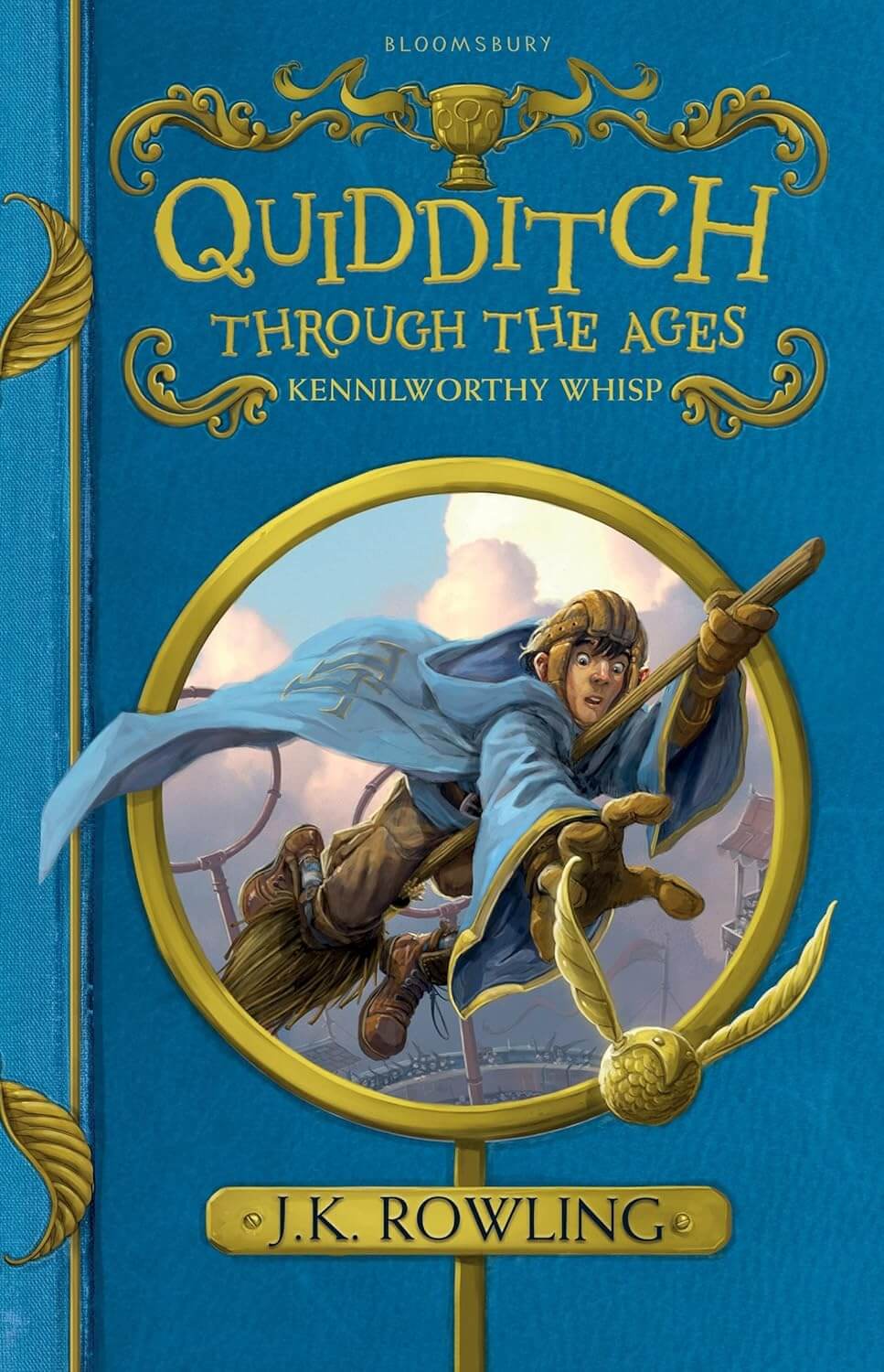
Quidditch Through the Ages by Jk Rowling

Original price was: රු2,000.00.රු1,500.00Current price is: රු1,500.00.
3 X Rs. 500.00 or 8% Cashback with


or 3 X රු500.00 with


or up to 4 X රු375.00 with


Delve into the magical world of wizarding sports with ‘Quidditch Through the Ages’ by J.K. Rowling. This enchanting book, a companion to the Harry Potter series, provides an in-depth exploration of the history, rules, and thrilling moments of the beloved wizarding sport, Quidditch. Rowling’s wit and creativity shine in this delightful addition to the magical universe.
Out of stock
Email when stock available
Quidditch Through the Ages by JK Rowling is a fun and fascinating companion to the Harry Potter series, taking readers inside the history, rules, famous teams, magical equipment and strange traditions of the wizarding world’s most popular sport.
Presented as a famous Hogwarts library book written by fictional Quidditch expert Kennilworthy Whisp, this compact guide explains how a rough game played on broomsticks gradually developed into the organized sport known and loved across the wizarding world.
Readers discover:
Where Quidditch began.
How the rules developed.
Why players use Quaffles, Bludgers and a Golden Snitch.
How broomsticks evolved.
Which famous Quidditch teams built legendary reputations.
Which fouls players somehow managed to invent.
And why Quidditch became such an important part of wizarding culture.
Rather than following Harry, Ron and Hermione through a new adventure, Quidditch Through the Ages by JK Rowling expands the world surrounding them.
It is written like an in-universe reference book—the sort of title students at Hogwarts might genuinely borrow from the school library.
That makes it especially enjoyable for readers who love the smaller details of the Harry Potter universe and want to understand the sport beyond the matches shown in the main novels.
Quidditch Through the Ages by JK Rowling – Book Overview
Quidditch Through the Ages by JK Rowling is not a traditional fantasy novel.
It is a fictional history and reference guide.
The book pretends that Quidditch is a real sport with centuries of:
Rules.
Controversies.
Teams.
Equipment.
Historical records.
Legends.
This format gives the wizarding world extra depth.
Quidditch no longer feels like a game invented only for Harry Potter’s school years.
It feels like a sport with an entire culture behind it.
A Hogwarts Library Book
Within the wizarding world, Quidditch Through the Ages is presented as one of the most popular books in the Hogwarts library.
This framing is part of the fun.
Readers are effectively holding a Muggle edition of a wizarding reference book.
That creates the feeling of discovering an object directly from Hogwarts rather than simply reading another story about Hogwarts.
Kennilworthy Whisp
Inside the fictional world, the author is Kennilworthy Whisp, a respected Quidditch expert.
Of course, the real-world author is J.K. Rowling.
Using an in-universe author allows the book to maintain the illusion that it genuinely belongs to wizarding history.
Whisp writes as though:
Quidditch teams are real.
Historical matches really happened.
Broom manufacturers genuinely competed.
Wizarding sporting controversies were recorded over centuries.
That playful approach makes the guide feel surprisingly convincing.
The Origins of Quidditch
One of the most entertaining parts of Quidditch Through the Ages by JK Rowling is learning that Quidditch did not appear instantly in its modern form.
According to wizarding history, the sport developed gradually.
Early accounts trace games played around Queerditch Marsh.
At first, the sport looked very different from the version played at Hogwarts.
Rules evolved.
Equipment changed.
New positions emerged.
And new traditions appeared.
This gives the game the kind of messy historical development we see in real-world sports.
Queerditch Marsh
The early history of the game begins around Queerditch Marsh.
What starts as a relatively informal broomstick game gradually becomes more structured.
The changing name and rules help show how sports evolve naturally rather than being invented perfectly all at once.
The Development of the Game
Sports change because players discover:
Better equipment.
New tactics.
Unexpected problems.
Safety concerns.
Competitive advantages.
Quidditch develops in a similar way.
The book uses this fictional evolution to make the magical sport feel historically believable.
The Quaffle
The Quaffle is the main scoring ball in Quidditch.
Chasers attempt to throw it through one of the opposing team’s goal hoops.
The game awards points when they succeed.
Modern Quaffles are magically designed to be easier to handle on broomsticks, including enchantments that influence the way they fall.
The history of the Quaffle is one example of how magical technology shaped the sport.
The Bludgers
Bludgers make Quidditch considerably more dangerous.
These enchanted balls fly around the pitch attempting to knock players from their brooms.
Beaters protect teammates by striking Bludgers away and redirecting them toward opponents.
That creates a uniquely magical combination of:
Sport.
Strategy.
Chaos.
And danger.
Beaters
Each team has Beaters whose job is to manage the Bludgers.
A good Beater needs:
Timing.
Strength.
Awareness.
Teamwork.
They must protect teammates while also creating opportunities to disrupt the opposing team.
The Golden Snitch
Perhaps the most famous object in Quidditch is the Golden Snitch.
Small.
Fast.
Extremely difficult to catch.
The Seeker’s job is to locate and catch it.
In traditional Quidditch rules, catching the Snitch awards 150 points and ends the match.
But the Snitch itself has an unusual history.
Before the Golden Snitch
Before the magical Snitch became standard equipment, Quidditch used a living magical bird called the Golden Snidget.
Eventually, concerns about the bird led to the creation of an artificial replacement.
The Golden Snitch was developed to recreate the challenge without continuing to use the endangered creature.
The official Harry Potter site notes that the Snitch’s famous 150-point value reflects the old 150-Galleon reward connected with capturing a Snidget.
The Seeker
The Seeker has one of the most dramatic roles in Quidditch.
While the rest of the team competes around:
Goals.
Bludgers.
Passing.
Defense.
the Seeker spends much of the match searching for one tiny golden object.
Harry Potter famously plays Seeker for Gryffindor.
Understanding the history of the position makes those scenes in the novels even more enjoyable.
Chasers
Chasers focus on scoring with the Quaffle.
They must work together through:
Passing.
Positioning.
Speed.
Tactics.
A great Chaser therefore needs more than flying ability.
Team coordination matters.
The Keeper
The Keeper protects the goal hoops.
Like a goalkeeper in many Muggle sports, the Keeper needs:
Fast reactions.
Positioning.
Confidence.
The ability to read attacking play.
Ron Weasley’s experience as Gryffindor Keeper in the later Harry Potter books gives readers a familiar example of how psychologically demanding the position can be.
Seven Players Per Team
A standard Quidditch team contains seven players:
Three Chasers.
Two Beaters.
One Keeper.
One Seeker.
Each position has a specialized responsibility.
The combination gives the sport its distinctive strategic structure.
Famous Quidditch Teams
Quidditch Through the Ages by JK Rowling also introduces readers to famous professional teams from across the wizarding world.
These teams make Quidditch feel much larger than Hogwarts.
School matches are only one small part of the sport.
Professional clubs have:
Fans.
Traditions.
Rivalries.
History.
Reputations.
The Chudley Cannons
Ron Weasley’s beloved Chudley Cannons are among the teams familiar to readers of the main novels.
The team’s fortunes may not always match Ron’s enthusiasm, but his loyalty reflects the same kind of passion seen among real-world sports fans.
Quidditch Around the World
The game is not limited to Britain.
Different regions develop their own teams and competitive traditions.
This helps expand the Harry Potter universe beyond Hogwarts and the British Ministry of Magic.
Wizarding communities around the world have their own sporting culture.
The Quidditch World Cup
Readers familiar with Harry Potter and the Goblet of Fire already know how important the Quidditch World Cup is.
The World Cup demonstrates that Quidditch operates on an enormous international scale.
Supporters travel.
National teams compete.
Professional players become celebrities.
The sport therefore functions as a major part of wizarding popular culture.
Racing Brooms
A Quidditch player is only as mobile as the broom beneath them.
The evolution of racing brooms is therefore an important part of the book.
Different manufacturers develop faster and more sophisticated designs.
Readers of the main series will recognize names such as:
Nimbus.
Firebolt.
These brooms become more meaningful when understood as part of a longer history of magical transportation technology.
The Firebolt
Harry’s Firebolt is one of the most desirable racing brooms in the series.
The official Harry Potter site notes that Firebolts incorporate goblin-made ironwork, contributing to their exceptional performance.
In the context of Quidditch Through the Ages by JK Rowling, famous broomsticks become part of a larger technological history.
Magical Sports Technology
Quidditch equipment demonstrates that magic does not eliminate technology.
Instead, wizarding technology develops differently.
Broomsticks become:
Faster.
More stable.
More responsive.
Better suited to competition.
This gives the world a believable history of innovation.
Quidditch Rules
A large part of the enjoyment comes from learning the rules that govern the game.
Some are simple.
Others are wonderfully strange.
Because the sport developed over centuries, many rules exist because someone somewhere apparently tried something ridiculous enough to make a new rule necessary.
Quidditch Fouls
The book discusses numerous Quidditch fouls.
This is one of its funniest elements.
The existence of so many possible violations suggests generations of extremely creative rule-breaking.
The humour comes from imagining the circumstances that must have caused officials to ban each particular action.
Dangerous Sport
Quidditch can be genuinely dangerous.
Players fly high above the ground.
Bludgers actively attack them.
Collisions happen.
Broom control matters.
The magical world appears to accept a rather higher level of sporting danger than most modern schools probably would.
Humour
Humour is essential to Quidditch Through the Ages by JK Rowling.
The book is not written like a dry encyclopedia.
Jokes are hidden throughout:
Team histories.
Sporting disasters.
Rules.
Player behaviour.
Broom development.
This makes the book enjoyable even when simply reading it from beginning to end rather than consulting individual sections.
Worldbuilding
The greatest strength of the book is worldbuilding.
Good fantasy worlds feel as though they continue existing beyond the main characters.
People have:
Sports.
Jobs.
Hobbies.
Celebrities.
Arguments.
History.
Quidditch helps make the wizarding world feel lived in.
A World Beyond Harry Potter
Harry is enormously important to the main novels.
But the wizarding world existed long before him.
This companion book reminds readers that magical culture has centuries of its own history.
Quidditch players were competing before Harry was born.
Professional teams already had generations of supporters.
Broom manufacturers already had reputations.
That creates depth.
Is Quidditch Through the Ages a Harry Potter Book?
Yes.
It belongs to the broader Harry Potter / Wizarding World collection.
However, it is not one of the seven main Harry Potter novels.
It is a companion reference book expanding the fictional world.
Do You Need to Read Harry Potter First?
Technically, no.
You can understand much of the guide without reading all seven novels.
However, the experience is much more enjoyable if you already know:
Harry.
Hogwarts.
Gryffindor.
Quidditch.
The Weasley family.
The major broom brands.
Fans recognize many references that would mean less to a complete newcomer.
Is It a Novel?
No.
Quidditch Through the Ages by JK Rowling is not a conventional novel with one continuous plot.
It is written as a fictional sporting history and reference guide.
Customers looking for another Harry Potter adventure should understand this before purchasing.
Is It Part of the Hogwarts Library Collection?
Yes.
The book belongs to the group commonly marketed as the Hogwarts Library companion books, alongside titles such as:
Fantastic Beasts and Where to Find Them
The Tales of Beedle the Bard
These books expand different areas of wizarding culture.
Does Harry Potter Appear?
The book’s purpose is not to follow Harry through a new adventure.
Instead, its value comes from exploring the world around the stories.
Fans will recognize plenty of familiar concepts, but the focus remains on Quidditch itself.
Is It Good for Young Readers?
Yes, particularly for children and teens already familiar with Harry Potter.
The format is approachable because sections are relatively short and focused.
Readers can explore:
Teams.
Rules.
Brooms.
History.
rather than needing to follow a long continuous narrative.
Is It Good for Collectors?
Yes.
Harry Potter collectors often enjoy companion books because they make a collection feel more complete.
A copy of Quidditch Through the Ages by JK Rowling works well beside the seven main novels and other Hogwarts Library titles.
Charity Connection
The book was originally created as part of a charitable publishing initiative, and Bloomsbury continues to note that a contribution from sales of the 2017 edition goes to Comic Relief.
That history gives the book an additional real-world significance beyond its role in Harry Potter fandom.
Illustrated Edition Versus Standard Edition
There are several editions of the book.
An extensively illustrated edition was later created with artwork by Emily Gravett.
The official Harry Potter site explains that this illustrated version builds on Rowling’s original text and visually recreates Quidditch history through many historical art styles.
Your inventory ISBN 9781408883082, however, corresponds to the regular 2017 Bloomsbury paperback with black-and-white line illustrations by Tomislav Tomic, not the large illustrated Emily Gravett edition.
Official Edition Details
For your ISBN:
Title: Quidditch Through the Ages
Real-World Author: J.K. Rowling
Fictional Author: Kennilworthy Whisp
ISBN-13: 9781408883082
Publisher: Bloomsbury Publishing
Imprint: Bloomsbury Children’s Books
Format: Paperback
Pages: 144
Publication Date: 12 January 2017
Illustrations: 30 black-and-white line illustrations
Illustrator: Tomislav Tomic
Your inventory lists the same ISBN, so these edition details match the copy recorded in your stock data.
What Readers Learn
Quidditch Through the Ages by JK Rowling explores topics such as:
- Origins of Quidditch
- Queerditch Marsh
- Development of the sport
- Quaffles
- Bludgers
- Golden Snitches
- Golden Snidgets
- Chasers
- Beaters
- Keepers
- Seekers
- Quidditch rules
- Quidditch fouls
- Famous teams
- Racing brooms
- International Quidditch
- Wizarding sporting culture
- Quidditch history
7 Magical Reasons to Read Quidditch Through the Ages by JK Rowling
- It expands the Harry Potter world beyond Hogwarts adventures. Readers discover that Quidditch has centuries of history, professional teams, equipment manufacturers and international traditions.
- You finally learn how Quidditch developed. The book traces the sport from its early beginnings at Queerditch Marsh to the organized game familiar to Harry Potter readers.
- The Golden Snitch has a fascinating backstory. Readers discover how the Golden Snidget influenced the creation of the Snitch and why catching it became such an important part of the game.
- The Quidditch fouls are hilarious. The rulebook reveals just how inventive witches and wizards became when trying to gain an unfair advantage.
- Famous teams make the wizarding world feel bigger. Professional clubs, international competition and team traditions prove that Quidditch exists far beyond Gryffindor versus Slytherin.
- Broom history adds another layer of magical technology. Readers learn how racing brooms developed and why famous models became so important to competitive players.
- It feels like owning a book from Hogwarts itself. The fictional-author format turns the guide into an immersive Wizarding World collectible rather than an ordinary companion book.
Why Read Quidditch Through the Ages by JK Rowling?
Quidditch Through the Ages by JK Rowling is an excellent choice for readers interested in Harry Potter, Hogwarts, Quidditch, magical sports, wizarding history, fantasy worldbuilding, magical creatures, racing brooms and collectible companion books.
It is especially enjoyable for readers who repeatedly wondered:
Why is the Snitch worth so many points?
Where did Quidditch come from?
Why are there Bludgers?
How did broomsticks become sporting equipment?
What professional teams exist outside Hogwarts?
Why does the wizarding world allow such a dangerous school sport?
The main Harry Potter novels introduce Quidditch.
This guide explains the world behind it.
Who Should Read This Book?
Quidditch Through the Ages by JK Rowling may especially appeal to Harry Potter fans, young fantasy readers, Wizarding World collectors, Quidditch fans, readers interested in magical sports, fans building a Hogwarts Library collection and anyone who enjoys fictional reference books that make fantasy worlds feel more realistic.
It is also a good gift for a Harry Potter reader who already owns the main seven novels and wants something different from another traditional story.
Quidditch Through the Ages by JK Rowling – More Than a Game
Quidditch Through the Ages by JK Rowling transforms one of the most memorable parts of Harry Potter into something that feels as though it has existed for centuries.
In the main novels, Quidditch is exciting because Harry plays it.
Here, readers discover something different.
Quidditch was already enormous before Harry ever climbed onto a broom.
There were legendary teams.
Historic rule changes.
Dangerous fouls.
Technological innovations.
International competitions.
And centuries of players arguing about the game.
That is what makes this companion book so effective.
Great fantasy worldbuilding depends on details that are not strictly necessary for the main plot.
Hogwarts would still be magical without knowing how the Quaffle evolved.
Harry could still fight Voldemort without knowing the origins of the Golden Snitch.
But those details make the world feel real.
They suggest that wizarding life continues even when Harry is not present.
Somebody is debating professional Quidditch.
Someone is buying a new racing broom.
Someone is supporting the Chudley Cannons despite another disappointing season.
Someone is probably committing a foul so ridiculous that the Department of Magical Games and Sports needs another rule.
For fans who love that side of the Wizarding World, Quidditch Through the Ages by JK Rowling is a playful, informative and highly collectible companion book that turns a fictional sport into a surprisingly detailed piece of magical history.
Learn more about Quidditch Through the Ages by J.K. Rowling on the official Bloomsbury website.
Explore more fantasy and Harry Potter books at Bargain Books.
| Author | Jk Rowling |
|---|---|
| Type | Paperback Printed Book |
| ISBN/ISSN | 978-1408883082, 9781408883082 |
| Language | English |
| Pages | 144 |
Be the first to review “Quidditch Through the Ages by Jk Rowling”
Related products
-10%
Out of stock
Children & Young Adult
Lord of the rings triology (Single Book) by J. R. R. Tolkien
Original price was: රු5,000.00.රු4,500.00Current price is: රු4,500.00.
3 X Rs. 1,500.00 or 8% Cashback with
or 3 X රු1,500.00 with
or up to 4 X රු1,125.00 with
-29%

Out of stock
Children & Young Adult
Original price was: රු35,000.00.රු25,000.00Current price is: රු25,000.00.
3 X Rs. 8,333.33 or 8% Cashback with
or 3 X රු8,333.33 with
or up to 4 X රු6,250.00 with
-21%
Children & Young Adult
Original price was: රු2,400.00.රු1,900.00Current price is: රු1,900.00.
3 X Rs. 633.33 or 8% Cashback with
or 3 X රු633.33 with
or up to 4 X රු475.00 with
Out of stock
Children & Young Adult
රු16,900.00
3 X Rs. 5,633.33 or 8% Cashback with
or 3 X රු5,633.33 with
or up to 4 X රු4,225.00 with
-50%

Children & Young Adult
Original price was: රු3,400.00.රු1,700.00Current price is: රු1,700.00.
3 X Rs. 566.67 or 8% Cashback with
or 3 X රු566.67 with
or up to 4 X රු425.00 with
Out of stock
Children & Young Adult
රු1,600.00
3 X Rs. 533.33 or 8% Cashback with
or 3 X රු533.33 with
or up to 4 X රු400.00 with

Damaged & Imperfect Books
රු1,300.00
3 X Rs. 433.33 or 8% Cashback with
or 3 X රු433.33 with
or up to 4 X රු325.00 with

Out of stock
Children & Young Adult
රු2,100.00
3 X Rs. 700.00 or 8% Cashback with
or 3 X රු700.00 with
or up to 4 X රු525.00 with
Reviews
There are no reviews yet.