
No products in the cart.
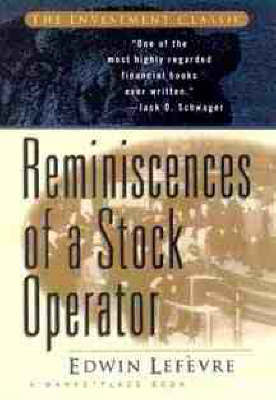
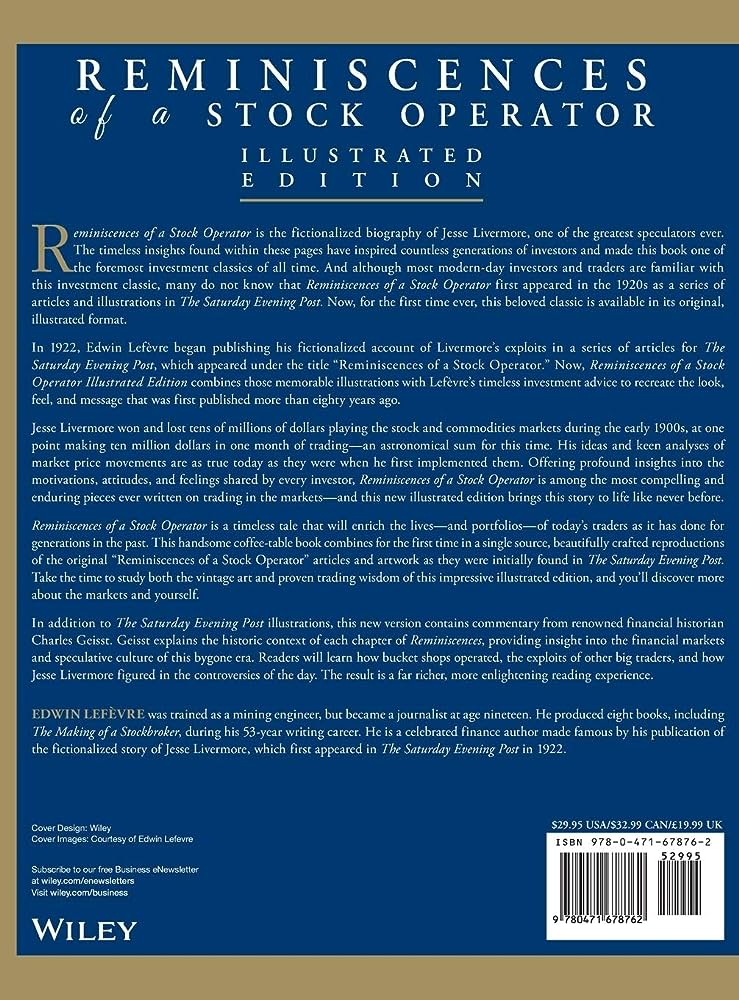

Reminiscences of a Stock Operator by Edwin Lefevre


රු1,800.00
3 X Rs. 600.00 or 8% Cashback with


or 3 X රු600.00 with


or up to 4 X රු450.00 with


Reminiscences of a Stock Operator by Edwin Lefevre is the classic fictionalized account of legendary stock speculator Jesse Livermore, portrayed as trader Larry Livingston. First published in 1923, the book explores market psychology, speculation, risk, losses, patience, fear, greed, discipline and the emotional challenges behind financial decision-making. Ideal for traders, investors, finance students and readers interested in Wall Street history, it remains a compelling study of why mastering your own behavior can be just as important as understanding the market.
Out of stock
Email when stock available
Reminiscences of a Stock Operator by Edwin Lefevre is a classic work of financial literature that explores speculation, market psychology, discipline, risk, greed, fear and the emotional challenges of trading through the fictionalized experiences of legendary stock operator Jesse Livermore.
First published in 1923, the book follows Larry Livingston, a character modeled closely on Livermore.
Livingston begins his career as a young quotation-board boy in a brokerage office.
He becomes fascinated by price movements.
Numbers.
Patterns.
Crowd behavior.
He begins speculating in bucket shops, develops remarkable success, moves into larger markets, suffers major losses, rebuilds fortunes and repeatedly learns that understanding the market is only part of the challenge.
The harder challenge is understanding himself.
Why do traders abandon their plans?
Why do people hold losing positions while quickly selling winners?
Why does greed become strongest near market peaks?
Why does fear become strongest after prices have already fallen?
Why can an intelligent trader understand exactly what should be done and still fail to do it?
These questions are at the heart of Reminiscences of a Stock Operator by Edwin Lefevre.
Although market technology has changed dramatically since the 1920s, the book remains interesting because its central subject is not a particular trading platform or indicator.
It is human behavior.
Reminiscences of a Stock Operator by Edwin Lefevre – Book Overview
Reminiscences of a Stock Operator by Edwin Lefevre is unusual because it sits somewhere between:
Biography.
Novel.
Market memoir.
Trading psychology.
Financial history.
It is not a conventional step-by-step investing manual.
It does not give readers a modern portfolio allocation formula.
Instead, Lefevre tells the story of a trader learning through experience.
Profits.
Losses.
Mistakes.
Success.
Overconfidence.
Patience.
Fear.
Greed.
The result is a book that teaches through narrative rather than through a textbook structure.
Who Is Larry Livingston?
The narrator is Larry Livingston.
He is fictional.
But his career closely reflects that of real-life stock speculator Jesse Livermore.
Modern publishers describe the book as a fictionalized biography or roman à clef based on Livermore’s experiences.
This distinction matters.
You should not market the book as Jesse Livermore’s literal autobiography.
A better description is:
A fictionalized account inspired by the life and trading career of Jesse Livermore.
Jesse Livermore
Jesse Livermore became one of the most famous American stock speculators of the early twentieth century.
His career became legendary partly because of its extremes.
He made large fortunes.
Lost large fortunes.
Returned to the market.
Succeeded again.
Failed again.
Those dramatic reversals make his story a powerful study of both trading skill and psychological vulnerability.
Starting as a Quotation-Board Boy
The book begins with Livingston working in a brokerage office.
His job involves recording price quotations.
He quickly becomes fascinated by patterns in stock prices.
Instead of initially thinking about companies in the way a long-term fundamental investor might, he becomes interested in how prices behave.
He notices:
Movement.
Repetition.
Momentum.
Changes in activity.
The market becomes a puzzle.
Bucket Shops
Livingston’s early trading occurs largely through bucket shops.
These establishments allowed customers to speculate on price movements without necessarily owning the underlying securities in the conventional way.
They became important to his early development because they encouraged extremely short-term speculation.
Livingston becomes exceptionally good at reading price behavior.
So good, in fact, that some establishments no longer want his business.
Early Success Can Be Dangerous
One important lesson from Reminiscences of a Stock Operator by Edwin Lefevre is that early success can create overconfidence.
When someone wins repeatedly, they may begin believing:
My method always works.
I understand the market completely.
Risk is under control.
But changing market conditions can quickly expose weaknesses.
A strategy effective in one environment may fail in another.
Moving Into Larger Markets
Livingston eventually discovers that success in a small speculative environment does not automatically transfer perfectly to larger professional markets.
Execution differs.
Liquidity differs.
Timing differs.
Market structure differs.
His previous edge is not always enough.
This creates an important general lesson:
Skills are often context-dependent.
Adaptability
A trader cannot simply learn one technique and assume it will work forever.
Markets change.
Participants change.
Technology changes.
Regulations change.
Liquidity changes.
A useful market principle is therefore:
Adapt to what the market is doing, not what you wish it were doing.
Trading Psychology
The greatest strength of the book is its exploration of psychology.
Many traders know rules such as:
Cut losses.
Manage risk.
Do not overtrade.
Avoid emotional decisions.
Wait for favorable opportunities.
Knowing these principles intellectually is easy.
Following them when real money is involved is much harder.
Knowledge Versus Behavior
Suppose someone knows:
“I should not increase a losing position simply because I want to recover quickly.”
Then the loss becomes painful.
Emotion enters.
The trader wants revenge.
They abandon the rule.
This gap between knowledge and action is where many financial mistakes occur.
Fear
Fear affects trading in several ways.
People may:
Sell too early.
Avoid valid opportunities.
Panic after prices have already fallen.
Change plans at the worst moment.
Fear is not automatically bad.
Risk awareness matters.
But unmanaged fear can distort judgment.
Greed
Greed can create the opposite problem.
A trader sees profits increasing and begins assuming they will continue indefinitely.
Risk feels smaller.
Confidence grows.
Position size increases.
Discipline disappears.
This combination can be dangerous.
Hope
One of the most destructive emotions in speculation can be hope.
A losing position falls.
Instead of reassessing evidence, the trader says:
“It will come back.”
The decision is no longer based on analysis.
It becomes emotional attachment.
The book repeatedly shows why markets do not care what an individual participant needs to happen.
The Market Does Not Owe You Anything
This is one of the most useful principles that can be drawn from Reminiscences of a Stock Operator by Edwin Lefevre.
You may:
Need the stock to rise.
Want the trade to recover.
Believe the price is unfair.
Have spent hours researching.
None of that forces the market to agree.
Reality remains reality.
Cut Losses
One of the recurring ideas in the book is the importance of accepting when a position is wrong.
Small losses are part of speculation.
The dangerous situation begins when ego turns a manageable loss into a much larger one.
The lesson is not:
Never lose.
That is impossible.
A better principle is:
Do not let one bad decision become catastrophic.
Risk Management
Modern readers should be careful not to interpret the book only as encouragement toward speculation.
Livermore’s life demonstrates both extraordinary success and extreme financial loss.
Risk management therefore matters as much as finding opportunities.
No strategy guarantees profit.
Position Size
Even a good trading idea can become dangerous if the position is too large.
Suppose you are correct 70% of the time.
That does not help if one oversized losing position destroys the account.
Survival matters.
The ability to remain in the game matters.
Patience
A surprisingly large part of successful speculation involves waiting.
Not every day offers an attractive opportunity.
Not every price movement needs to be traded.
Livingston gradually learns that forcing activity can create unnecessary losses.
Sitting Tight
One of the most famous ideas associated with the book is that large profits may come not simply from identifying a move but from staying with a correct position long enough.
This is psychologically difficult.
As profits increase, people become tempted to take them immediately.
Being Right Too Early
Timing matters.
A trader can correctly predict a larger trend but enter at a poor moment.
If the position moves heavily against them before eventually going in the expected direction, the trade may still fail.
Being right about the eventual outcome does not automatically mean the trade itself was well executed.
Timing
This creates a distinction between:
Analysis.
Entry.
Position size.
Exit.
Risk.
All matter.
A market opinion alone is not a complete strategy.
Market Trends
Livingston becomes increasingly interested in major market movements rather than tiny fluctuations.
He begins learning the difference between:
Noise
and
meaningful trend.
This concept remains relevant because financial markets still generate constant short-term information.
Not every move deserves interpretation.
Do Not Fight the Tape
The historical language of the book comes from the ticker-tape era.
But the idea remains understandable today.
If price behavior repeatedly contradicts your theory, do not simply ignore the evidence.
A theory should respond to reality.
Reality should not be forced to fit the theory.
Price Action
Livingston pays intense attention to price behavior.
Modern traders might describe some of his observations using language such as:
Price action.
Momentum.
Breakouts.
Market structure.
Trend confirmation.
But readers should avoid treating the book as a complete modern trading system.
Its greatest value is psychological and historical.
Tips and Rumors
Another recurring danger is acting on tips.
Someone says:
“This stock is going higher.”
Another person claims:
“I know something.”
The temptation is powerful because it appears to remove uncertainty.
But blindly following another person’s opinion means you may not understand:
Why you entered.
When the idea is invalid.
When to exit.
How much risk is appropriate.
Do Your Own Thinking
Reminiscences of a Stock Operator by Edwin Lefevre repeatedly demonstrates the value of independent judgment.
That does not mean ignoring all outside information.
It means understanding the reasoning behind the decision.
Insider Information
Historical markets often involved practices that would be viewed very differently under modern securities regulation.
The book reflects its own era.
Readers should treat descriptions of operators, pools, tips and market manipulation as financial history—not as instructions for modern lawful trading.
Market Manipulation
Large operators historically attempted to influence stock prices.
The book provides a window into a period when markets were structured very differently from today’s regulated electronic exchanges.
This historical context makes the book especially fascinating.
The Market of the 1920s Was Different
There were no:
Smartphone trading apps.
Real-time retail dashboards.
Modern online brokers.
Algorithmic retail platforms.
Instant financial news feeds.
The technological environment has changed enormously.
Human emotion has changed much less.
Technology Changes, Psychology Persists
This explains why the book still feels recognizable.
A trader staring at a ticker tape in the 1920s could experience:
Fear.
Greed.
FOMO.
Hope.
Overconfidence.
The same emotions appear today on digital screens.
FOMO Before Social Media
Fear of missing out is not new.
People have always watched others make money and thought:
“I need to get in.”
When prices rise rapidly, seeing other people profit can become emotionally difficult.
That pressure encourages late entries.
Crowds
Markets are social systems.
People observe:
Prices.
News.
Other investors.
Rumours.
Crowd psychology can amplify movement.
When everyone becomes extremely confident, caution may disappear.
When everyone becomes terrified, rational analysis may disappear.
Contrarian Thinking
However, contrarian investing should not be reduced to:
Always do the opposite of everyone else.
Sometimes the crowd is correct.
The more useful principle is:
Do not substitute crowd excitement for independent reasoning.
Ego
Ego is a major hidden risk.
A trader may refuse to admit a mistake because being wrong feels personally painful.
But the market is not a debate.
There is no prize for defending a losing argument.
Flexibility is more useful than pride.
Being Wrong Is Normal
Every investor and trader will eventually be wrong.
The objective is not avoiding all mistakes.
The objective is managing them.
This is one of the strongest lessons in Reminiscences of a Stock Operator by Edwin Lefevre.
Revenge Trading
After a loss, some traders feel an immediate need to win the money back.
That emotional reaction can lead to:
Larger positions.
Lower-quality trades.
Reduced patience.
Poor risk control.
Although modern terminology may differ, the behavior is clearly recognizable in the psychological patterns described by the book.
Overtrading
Constant activity feels productive.
In markets, it can be expensive.
More trades can mean:
More mistakes.
More costs.
More emotional decisions.
More exposure.
Activity should not be confused with progress.
Waiting for the Right Opportunity
Livingston eventually recognizes that extraordinary opportunities do not appear constantly.
Patience allows capital to remain available until conditions become attractive.
This principle applies beyond finance.
Sometimes waiting is part of strategy.
Conviction
Conviction is useful when grounded in evidence.
It becomes dangerous when grounded only in ego.
The challenge is distinguishing:
“I have analyzed this carefully.”
from
“I desperately want to be right.”
Discipline
Trading discipline involves following predetermined principles even when emotion pushes in another direction.
Examples might include:
Maximum risk.
Entry requirements.
Exit rules.
Position limits.
The exact modern system is not supplied by the book.
The psychological need for discipline is.
Rules Protect You From Yourself
Many people think trading rules exist mainly to protect them from the market.
Often they also protect them from their own behavior.
A rule can interrupt an emotional impulse.
Journaling and Review
The book predates modern digital trading journals, but its lesson-based narrative illustrates why reviewing decisions matters.
After a trade or investment, ask:
Why did I enter?
What did I expect?
What happened?
Was the process sound?
What should change?
The goal is not simply remembering profits.
It is improving decisions.
Process Versus Outcome
A profitable trade can still be a bad decision.
A losing trade can sometimes result from a reasonable process under uncertainty.
This is crucial.
If someone rewards every profitable outcome regardless of process, reckless behavior can eventually become disastrous.
Luck
Financial markets contain uncertainty.
Luck matters.
An individual outcome cannot always prove skill.
Longer-term patterns are more informative.
Speculation Versus Investing
Reminiscences of a Stock Operator by Edwin Lefevre is primarily about speculation and trading, not traditional long-term diversified investing.
Readers should understand this distinction.
Speculation often focuses heavily on:
Price movement.
Timing.
Market psychology.
Trading.
Long-term investing may focus more on:
Business fundamentals.
Cash flows.
Diversification.
Valuation.
Long-term ownership.
They are not identical activities.
Is This a Beginner Investing Guide?
Not exactly.
The book is excellent for understanding market psychology.
But beginners should not treat it as a complete practical guide for building a modern investment portfolio.
It does not teach:
Modern asset allocation.
ETF selection.
Tax planning.
Retirement planning.
Diversification frameworks.
It belongs more naturally under:
Finance / Investing / Trading Psychology / Market History.
Is It a Trading Strategy Book?
Only partly.
The narrative contains many observations about speculation.
But it is not organized as a modern technical-analysis course.
The most valuable lessons concern:
Discipline.
Patience.
Losses.
Market behavior.
Psychology.
Risk.
Is It a True Story?
Partly.
The character Larry Livingston is fictionalized, but the story is based closely on Jesse Livermore’s experiences.
Harriman House describes it as the classic novel based on Livermore’s life, while bibliographic sources identify it as a 1923 roman à clef.
Therefore, the safest product wording is:
A fictionalized biography inspired by Jesse Livermore’s trading career.
Is Edwin Lefevre the Trader?
No.
Edwin Lefevre was the author.
Jesse Livermore was the real-world trader who inspired Larry Livingston.
This distinction is worth making clearly in your website description.
First Published in 1923
The original book was copyrighted in 1923 by George H. Doran Company. The public-domain text also shows the book dedicated to Jesse Lauriston Livermore.
Because the underlying work is over a century old, many different modern editions exist.
Edition and ISBN Note
Your inventory contains conflicting edition information.
One current procurement sheet lists:
Title: Reminiscences of a Stock Operator
Author: Edwin Lefevre
ISBN: 9780471770886
Another combined inventory file lists:
ISBN: 9798243166683.
This is likely because you have encountered different reprints/editions.
Use the ISBN printed on the exact physical copy you are uploading.
Do not automatically replace one with another unless you have confirmed the cover/barcode.
The Wiley Edition
ISBN 9780471770886 is associated with a Wiley edition of Reminiscences of a Stock Operator.
If your physical stock carries that ISBN, it is safe to use it.
If your copy carries another ISBN, use the physical book instead.
Jesse Livermore’s Success and Failure
One reason the story remains compelling is that Livermore was not presented as someone who discovered a perfect formula.
His career contained extreme swings.
That makes the book a warning as much as an inspiration.
Skill does not eliminate risk.
Past success does not guarantee future success.
Confidence can become dangerous.
Wealth Can Disappear
Large profits can create the illusion of permanent mastery.
Markets can reverse that illusion quickly.
A person can make excellent decisions for years and still suffer severe losses later.
This is why capital preservation matters.
Never Confuse a Bull Market With Genius
A rising market can make many strategies look brilliant.
The real test may come when conditions change.
This is one of the broader lessons readers can draw from Livingston’s experiences.
Market Regimes
Markets can behave differently during:
Strong uptrends.
Bear markets.
Sideways periods.
Panic.
Speculative bubbles.
Methods that perform well in one environment may struggle in another.
Flexibility
A successful market participant needs enough conviction to act and enough humility to change.
Those qualities appear contradictory.
They are both necessary.
Emotional Control
The book does not suggest becoming emotionless.
That is unrealistic.
A more practical objective is preventing emotion from making every decision.
Money Intensifies Emotion
A hypothetical trade is easy to analyze calmly.
A real position containing meaningful money feels different.
Loss threatens security.
Profit creates excitement.
Therefore, risk should remain small enough that thinking remains possible.
Protecting Capital
Capital is what allows a trader or investor to continue participating.
Once capital is gone, future opportunities no longer matter.
That is why survival is often more important than maximizing one trade.
No Guaranteed Formula
One lesson worth emphasizing on a modern product page is that Reminiscences of a Stock Operator by Edwin Lefevre does not provide a guaranteed way to make money.
No book can guarantee profitable trading.
Markets involve risk.
Readers should treat the book as:
Financial literature.
Trading psychology.
Historical insight.
Not personalized investment advice.
Modern Relevance
Why read a 1923 market book in the age of AI trading, online brokers and real-time charts?
Because many modern problems remain psychological.
FOMO.
Panic.
Overconfidence.
Chasing losses.
Following tips.
Ignoring risk.
Breaking rules.
Those patterns are older than modern technology.
Lessons for Investors
Even long-term investors who never actively trade may find useful principles.
For example:
Do not chase excitement.
Understand what you own.
Manage risk.
Think independently.
Do not let crowd emotion replace reasoning.
Avoid making financial decisions from fear alone.
Lessons for Entrepreneurs
The book also contains ideas relevant outside finance.
Entrepreneurs experience similar psychological challenges:
Overconfidence after success.
Refusal to abandon failing ideas.
Following trends too late.
Ignoring evidence.
Taking excessive risk.
Trying to recover losses emotionally.
Market psychology often resembles business psychology.
Lessons for Decision-Making
The broader lesson is about making decisions under uncertainty.
You rarely have perfect information.
You need to:
Form a hypothesis.
Act carefully.
Observe the result.
Update your view.
That process is useful in many fields.
Important Themes
Reminiscences of a Stock Operator by Edwin Lefevre explores:
- Stock market speculation
- Jesse Livermore
- Larry Livingston
- Trading psychology
- Market behavior
- Fear
- Greed
- Hope
- Discipline
- Risk management
- Losses
- Patience
- Market trends
- Price action
- Crowd psychology
- Independent thinking
- Overconfidence
- Position sizing
- Speculation
- Financial history
7 Powerful Trading Lessons From Reminiscences of a Stock Operator by Edwin Lefevre
- Protect yourself from large losses. Being wrong is unavoidable; allowing one mistake to destroy your capital is not.
- Patience is part of strategy. Constant activity can create unnecessary mistakes. Sometimes the strongest decision is to wait.
- Do not fight the evidence. If the market behaves differently from your expectation, reassess the idea rather than demanding that reality prove you right.
- Your psychology may be more dangerous than the market. Fear, greed, hope, ego and overconfidence can destroy a sound process if they are not managed.
- Independent thinking matters. Tips and rumours can be seductive, but following someone else’s conviction without understanding it leaves you without a clear plan when conditions change.
- A good idea still needs good timing and risk control. Being correct about a larger trend does not guarantee a profitable trade if the entry, position size or exit is poorly managed.
- Past success does not make you invincible. Some of Livingston’s greatest difficulties come after periods of strong success, demonstrating why humility remains essential even after winning.
Why Read Reminiscences of a Stock Operator by Edwin Lefevre?
Reminiscences of a Stock Operator by Edwin Lefevre is an excellent choice for readers interested in:
- Stock markets
- Trading
- Investing
- Jesse Livermore
- Financial history
- Wall Street
- Trading psychology
- Market psychology
- Speculation
- Risk management
- Trader discipline
- Price behavior
- Market cycles
- Behavioral finance
- Decision-making
- Financial classics
- Investor psychology
- Historical markets
- Business books
- Finance books
The book is particularly valuable for readers who want to understand why market success is not only a matter of intelligence.
You can understand a market principle perfectly and still violate it under emotional pressure.
That gap between:
Knowing
and
doing
is where many of the book’s most enduring lessons appear.
Who Should Read This Book?
Reminiscences of a Stock Operator by Edwin Lefevre may especially appeal to:
- Traders
- Investors
- Finance students
- Business students
- Entrepreneurs
- Market-history readers
- Technical-analysis enthusiasts
- Readers interested in Jesse Livermore
- People studying behavioral finance
- Anyone interested in decision-making under uncertainty
- Readers of classic finance books
- Professionals interested in risk and psychology
It can also be valuable for beginners, provided they understand that it is a historical and psychological market classic rather than a complete modern investing manual.
Reminiscences of a Stock Operator by Edwin Lefevre – The Hardest Market to Master Is Yourself
Reminiscences of a Stock Operator by Edwin Lefevre begins with a young man watching numbers move.
Prices rise.
Prices fall.
Patterns appear.
He realizes he may have a talent for understanding those movements.
At first, that talent seems like everything he needs.
Then the market teaches him otherwise.
Knowing how prices move is one challenge.
Knowing how you behave when money is involved is another.
That second challenge becomes the deeper story.
Livingston makes money.
Then loses money.
He becomes confident.
Then overconfident.
He sees opportunities.
Sometimes he acts correctly.
Sometimes he knows the correct action and still does something else.
That is why the book remains compelling more than a century after publication.
Technology changes.
Human nature changes more slowly.
A modern trader may use:
Real-time charts.
Algorithms.
Mobile apps.
News terminals.
Technical indicators.
AI tools.
But the person pressing the button can still experience the same emotions.
Fear.
Greed.
Hope.
Ego.
Impatience.
The market does not need to defeat a trader if the trader defeats himself.
That is the central power of this classic.
It is not simply:
“How Jesse Livermore traded.”
It is also:
“What happens when intelligence, ambition, uncertainty and emotion collide in the financial markets?”
For readers interested in trading, investing, financial history and market psychology, Reminiscences of a Stock Operator by Edwin Lefevre remains a fascinating study of speculation and the difficult discipline required to survive uncertainty.
Learn more about Reminiscences of a Stock Operator by Edwin Lefèvre on the official Wiley website.
Explore more investing and finance books at Bargain Books.

| Author | Edwin Lefevre |
|---|---|
| Type | Paperback Printed Book |
| ISBN/ISSN | 9386867753, 978-9386867759 |
| Language | English |
| Pages | 400 |
Be the first to review “Reminiscences of a Stock Operator by Edwin Lefevre”
Related products
Autobiography
රු1,950.00
3 X Rs. 650.00 or 8% Cashback with
or 3 X රු650.00 with
or up to 4 X රු487.50 with
-11%

Out of stock
Autobiography
Original price was: රු4,450.00.රු3,950.00Current price is: රු3,950.00.
3 X Rs. 1,316.67 or 8% Cashback with
or 3 X රු1,316.67 with
or up to 4 X රු987.50 with
-24%

Original price was: රු2,100.00.රු1,600.00Current price is: රු1,600.00.
3 X Rs. 533.33 or 8% Cashback with
or 3 X රු533.33 with
or up to 4 X රු400.00 with
-12%

Out of stock
Biography
Original price was: රු2,600.00.රු2,300.00Current price is: රු2,300.00.
3 X Rs. 766.67 or 8% Cashback with
or 3 X රු766.67 with
or up to 4 X රු575.00 with

Out of stock
රු4,000.00
3 X Rs. 1,333.33 or 8% Cashback with
or 3 X රු1,333.33 with
or up to 4 X රු1,000.00 with

Autobiography
රු1,900.00
3 X Rs. 633.33 or 8% Cashback with
or 3 X රු633.33 with
or up to 4 X රු475.00 with
-15%

Out of stock
Biography
Original price was: රු3,300.00.රු2,800.00Current price is: රු2,800.00.
3 X Rs. 933.33 or 8% Cashback with
or 3 X රු933.33 with
or up to 4 X රු700.00 with

Out of stock
රු1,800.00
3 X Rs. 600.00 or 8% Cashback with
or 3 X රු600.00 with
or up to 4 X රු450.00 with
Reviews
There are no reviews yet.