
-
×
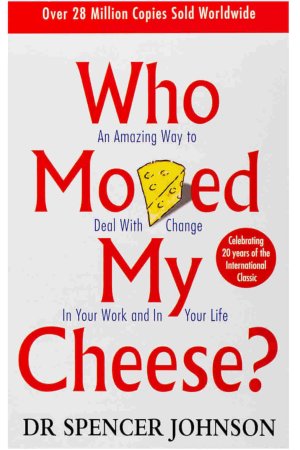
 Who Moved My Cheese? by Dr.Spencer Johnson
1 × රු1,250.00
Who Moved My Cheese? by Dr.Spencer Johnson
1 × රු1,250.00
Subtotal: රු1,250.00
රු1,950.00





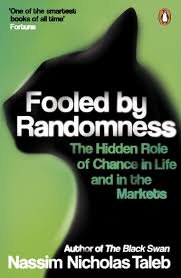
Fooled by Randomness by Nassim Nicholas Taleb explores how luck and chance influence success, challenging common beliefs about skill, risk, and decision-making.
5 in stock
Fooled by Randomness by Nassim Nicholas Taleb is a groundbreaking book that challenges how people perceive success, failure, and chance in life and financial markets. Blending philosophy, probability, psychology, and real-world examples, Taleb explains how randomness plays a far greater role in outcomes than most people are willing to admit. The book reveals how humans often mistake luck for skill, especially in investing, business, and decision-making.
As the first book in Taleb’s influential Incerto series, Fooled by Randomness has become essential reading for traders, investors, entrepreneurs, and thinkers who want to understand uncertainty and risk more clearly.
One of the core ideas in Fooled by Randomness is that many successful outcomes are not purely the result of intelligence or talent, but of chance. Taleb illustrates how people tend to create stories after the fact to explain success, ignoring the powerful role of randomness.
In financial markets especially, individuals who experience short-term success are often praised as experts, even when their results may be due to luck. Taleb warns that this illusion of skill can lead to overconfidence, excessive risk-taking, and eventual failure.
Fooled by Randomness pays special attention to investing and trading. Taleb explains how market fluctuations are often unpredictable and influenced by rare, random events. He criticizes traditional financial models that underestimate uncertainty and overestimate predictability.
The book highlights how traders can experience long winning streaks by chance alone, which can reinforce false beliefs about their abilities. Taleb emphasizes the importance of understanding probability, variance, and statistical bias to avoid being misled by random outcomes.
Taleb explores several cognitive biases that cause people to misinterpret randomness. These include survivorship bias, hindsight bias, and narrative fallacy. Survivorship bias leads people to focus only on winners while ignoring those who failed due to bad luck. Hindsight bias makes past events appear predictable after they have occurred.
By exposing these mental traps, Fooled by Randomness helps readers become more skeptical of success stories and expert predictions. The book encourages critical thinking and intellectual humility when evaluating outcomes.
Beyond finance, Fooled by Randomness offers deep philosophical insights into life, decision-making, and uncertainty. Taleb argues that people should focus more on avoiding large losses than chasing extraordinary gains. This mindset promotes resilience and long-term survival in uncertain environments.
The book also introduces the idea of “alternative histories,” suggesting that many life outcomes could have turned out very differently due to small changes or chance events. This perspective fosters gratitude, humility, and caution when judging success and failure.
Taleb stresses the importance of understanding probability and risk in decision-making. He explains that good decisions can lead to bad outcomes, and bad decisions can sometimes result in good outcomes due to luck. Therefore, outcomes alone should not be used to evaluate the quality of decisions.
Fooled by Randomness teaches readers to focus on processes rather than results. By evaluating decisions based on logic, risk assessment, and probability, individuals can improve their judgment even in unpredictable environments.
Taleb’s writing style in Fooled by Randomness is bold, witty, and intellectually challenging. He blends storytelling with mathematical intuition, philosophy, and personal experience. While the book demands attention, it rewards readers with profound insights that reshape how they view success and uncertainty.
The book appeals to analytical thinkers as well as readers interested in philosophy, economics, and behavioral science. Taleb’s sharp critiques and unconventional ideas make the reading experience engaging and thought-provoking.
This edition of Fooled by Randomness by Nassim Nicholas Taleb is an Indian locally published copy, offering affordability while preserving the complete original content. It is ideal for investors, traders, entrepreneurs, students, and anyone interested in risk, probability, and critical thinking.
Self-Help
Non-fiction
Non-fiction

Non-fiction
Non-fiction
Non-fiction

Self-Help

Reviews
There are no reviews yet.