
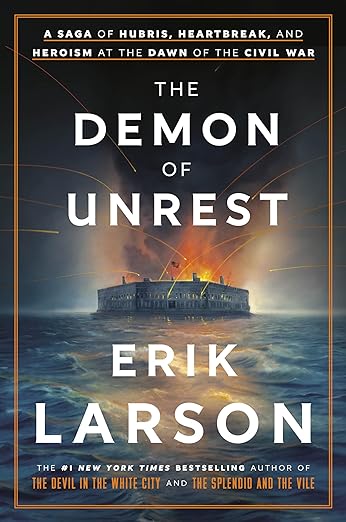
Demon of Unrest: A Saga of Hubris, Heartbreak, and Heroism at the Dawn of the Civil War by Erik Larson

රු2,750.00






Short Description:
Demon of Unrest by Erik Larson is a compelling historical narrative that explores the tense and emotional months leading up to the American Civil War. Through vivid storytelling and real-life perspectives, the book reveals how political tension, personal pride, and miscommunication pushed a divided nation toward war. Blending drama with history, it offers a powerful insight into how human decisions shaped one of America’s most defining moments.
2 in stock
Demon of Unrest: A Saga of Hubris, Heartbreak, and Heroism at the Dawn of the Civil War – by Erik Larson
Demon of Unrest by Erik Larson is a gripping historical narrative that explores the tense months leading up to the American Civil War. Known for his cinematic storytelling, Larson brings history to life by focusing on the human emotions, political tensions, and personal ambitions that pushed the United States toward one of its most defining conflicts.
Rather than presenting history as distant facts, the book reveals how fear, pride, miscommunication, and strong personalities shaped events. At its core, Demon of Unrest shows that large-scale conflicts often begin with deeply human decisions and misunderstandings.
History Begins With Human Emotion
One of the central ideas in Demon of Unrest is that history is not just about events—it is about people. Larson dives into the thoughts, fears, and motivations of key figures involved in the crisis.
Many leaders believed they were acting rationally, yet their personal pride and assumptions fueled tension. Misjudgments and emotional reactions escalated situations that might otherwise have been resolved peacefully. The book shows how even small decisions, driven by ego or fear, can lead to massive consequences.
The Build-Up to Conflict
The book carefully traces the fragile period just before war officially began. Instead of jumping directly into battle, Larson focuses on the slow unraveling of unity.
Readers learn how:
- Political divisions deepened over time
- Communication failures increased mistrust
- Leaders underestimated the consequences of their actions
- Compromise became increasingly impossible
Because of this step-by-step storytelling, Demon of Unrest feels tense and suspenseful, even though the outcome is already known.
The Power of Perspective
A major strength of Demon of Unrest is its multi-perspective narrative. Larson presents viewpoints from different sides, allowing readers to understand the complexity of the situation.
Rather than portraying history as “good vs. bad,” the book reveals:
- Conflicting beliefs and values
- Regional loyalties and identities
- Personal struggles within larger political decisions
This approach helps readers see how both sides believed they were justified, making the conflict more tragic and human.
Leadership, Pride, and Miscalculation
The book highlights how leadership decisions played a critical role in shaping events. Many individuals in power acted with confidence, but not always with clarity.
Larson illustrates that:
- Pride often prevented compromise
- Leaders misread intentions of others
- Delays and hesitation created further instability
These leadership flaws contributed significantly to the outbreak of war, showing that poor decision-making at the top can affect entire nations.
Tension, Atmosphere, and Storytelling
Like Larson’s previous works, Demon of Unrest reads almost like a novel. The author builds atmosphere through detailed descriptions of locations, conversations, and emotional states.
The growing tension is especially evident as the situation moves toward conflict at places like Charleston Harbor. Readers experience the anxiety, uncertainty, and inevitability that surrounded the early days of war.
This storytelling style makes history feel immediate and engaging rather than distant and academic.
Conflict as an Inevitable Outcome
One of the deeper messages of the book is that conflict often becomes inevitable when tension is ignored for too long.
The book shows how:
- Small disagreements evolved into major divisions
- Opportunities for peace were missed
- Emotional reactions replaced rational dialogue
By the time action was taken, it was too late to reverse course. This gradual escalation is one of the most powerful themes in Demon of Unrest.
Lessons for the Modern World
Although the book is set in the 19th century, its lessons remain highly relevant today. Modern societies still face polarization, miscommunication, and leadership challenges.
Demon of Unrest reminds readers that:
- Listening is more powerful than reacting
- Understanding different perspectives prevents conflict
- Pride and assumptions can lead to irreversible consequences
Because of this, the book feels not just historical, but deeply contemporary.
Long-Term Impact and Reflection
After reading Demon of Unrest, many readers gain a deeper appreciation for how fragile stability can be. The book encourages reflection on how easily societies can shift from peace to conflict.
Instead of viewing history as inevitable, readers begin to see it as a series of choices—choices that could have been made differently.
Ultimately, Demon of Unrest teaches that awareness, humility, and communication are essential to preventing conflict, both in nations and in everyday life.
Bargain Books (Buy Now)
Buy Demon of Unrest from Bargain Books
(You can also check availability on your own store: https://bargainbooks.lk)
Wikipedia Link
Be the first to review “Demon of Unrest: A Saga of Hubris, Heartbreak, and Heroism at the Dawn of the Civil War by Erik Larson”
Related products

Non-fiction

Non-fiction

Non-fiction

Self-Help

Non-fiction


Non-fiction

Reviews
There are no reviews yet.