
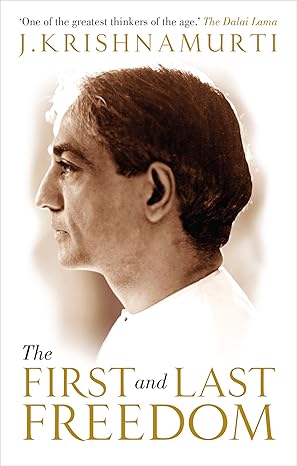
First And Last Freedom by J Krishnamurti

රු1,600.00






Short Description:
The First and Last Freedom by J. Krishnamurti is a thought-provoking philosophical book that explores self-awareness, freedom, and the human mind. It encourages readers to understand their thoughts and emotions deeply, showing that true freedom comes from inner clarity rather than external guidance.
6 in stock
The First and Last Freedom – by J. Krishnamurti
The First and Last Freedom by J. Krishnamurti is a deeply philosophical and introspective work that explores the nature of the human mind, freedom, and self-understanding. Rather than offering fixed beliefs or methods, the book encourages readers to observe their own thoughts and emotions to discover truth for themselves.
The central idea of The First and Last Freedom is that true freedom comes from understanding oneself—free from fear, conditioning, and external influence.
Freedom Begins Within
One of the earliest lessons in the book is that freedom is not something given by society, religion, or authority—it must be discovered internally.
Krishnamurti explains that:
- True freedom comes from self-awareness
- External rules cannot bring inner peace
- Understanding the mind leads to liberation
This shifts the focus from external solutions to inner observation.
Understanding the Mind
A major theme in The First and Last Freedom is the importance of understanding how the mind works.
The book explores:
- Thoughts, emotions, and conditioning
- Fear, desire, and conflict
- The patterns that shape human behavior
By observing these processes, readers begin to understand themselves more clearly.
Breaking Free from Conditioning
Krishnamurti emphasizes that people are shaped by society, culture, and past experiences. This conditioning limits true freedom.
The book teaches readers to:
- Question beliefs and assumptions
- Recognize social and psychological conditioning
- Think independently
This approach encourages deep personal insight.
The Role of Fear and Desire
Fear and desire are central forces that influence human behavior. The book explores how these emotions create conflict and limit freedom.
It explains:
- How fear controls decisions
- The endless cycle of desire and dissatisfaction
- The need to observe emotions without judgment
Understanding these emotions is key to inner peace.
Truth Without Authority
Unlike many philosophical or spiritual books, Krishnamurti rejects the idea of following a teacher or system blindly.
He suggests:
- Truth cannot be taught—it must be discovered
- Authority can limit independent thinking
- Each person must find their own understanding
This makes the book unique and thought-provoking.
Living in the Present
The book emphasizes the importance of living fully in the present moment rather than being trapped in the past or future.
It highlights:
- Awareness of the present
- Letting go of past conditioning
- Experiencing life directly
This creates a sense of clarity and peace.
A Guide to Inner Transformation
Rather than offering techniques, The First and Last Freedom invites readers to explore themselves deeply.
It encourages:
- Self-inquiry and reflection
- Awareness without judgment
- Continuous learning about oneself
This makes the book more experiential than instructional.
Who Should Read This Book
This book is ideal for:
- Readers interested in philosophy and spirituality
- Anyone seeking self-understanding and inner peace
- Readers exploring mindfulness and awareness
- Those questioning traditional beliefs
Explore More
- Explore more books: https://bargainbooks.lk
- Learn more about the author: https://en.wikipedia.org/wiki/Jiddu_Krishnamurti
Lasting Impact
After reading The First and Last Freedom, many readers begin to see their thoughts and behaviors more clearly. The book does not provide answers—it encourages deeper questioning.
Ultimately, it teaches that true freedom is not external—it is discovered within through awareness, understanding, and self-knowledge.
Be the first to review “First And Last Freedom by J Krishnamurti”
Related products
Non-fiction
Non-fiction
Non-fiction
Non-fiction
Non-fiction

Biography
Reviews
There are no reviews yet.